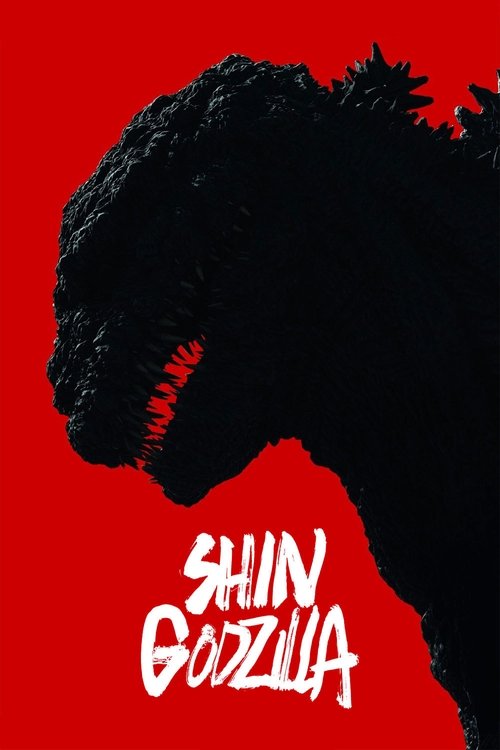
Shin Godzilla
2016 · Shinji Higuchi
For when you want a smart blockbuster to argue about afterward — spectacle with teeth, satire with stakes. More bracing than comforting; the monster will genuinely unsettle you.
What it's about
A massive creature rises from Tokyo Bay and starts tearing through the city — and the film's real subject is what happens next in the conference rooms: a government paralyzed by protocol, jurisdiction, and its own org chart. A rag-tag task force of misfits and pencil-pushers races to cut through the red tape and find the monster's weakness before it evolves into something worse, while foreign powers circle with their own solutions.
The experience
Relentless and strange — a disaster movie that plays like a caffeinated political procedural, all rapid-fire meetings and on-screen job titles, punctuated by moments of genuinely nightmarish monster horror. It's darkly funny about bureaucracy and dead serious about catastrophe, often in the same scene.
The craft
Hideaki Anno (creator of Neon Genesis Evangelion) and effects veteran Shinji Higuchi edit government meetings with the strobe-cut rhythm of an anime, captions naming every official and ministry as they blur past. The creature itself is a mutating, dead-eyed horror that evolves through grotesque intermediate forms — big-screen, loud-speakers material, with a score that hits like a siren.
Why it matters
It revived Godzilla for Japan after a twelve-year absence by restoring him to what he was in 1954 — a national trauma given a body, here deliberately echoing the 2011 earthquake, tsunami, and Fukushima disaster — and became a huge domestic hit and awards magnet.
Toho's first domestic Godzilla in twelve years handed the franchise to Hideaki Anno — creator of Neon Genesis Evangelion — and Anno turned the monster movie inside out: the creature is onscreen for minutes; the real spectacle is the Japanese state trying to respond. Co-directed with effects veteran Shinji Higuchi, the film plays as a procedural satire, all emergency meetings, jurisdictional turf wars, and captions naming every official and ministry in rapid-fire strobe — bureaucracy rendered with the editing rhythm of an anime. Its terror is precise: the imagery deliberately echoes the 2011 Tōhoku earthquake, tsunami, and Fukushima meltdown, restoring Godzilla to what he was in 1954 — a national trauma given a body. And what a body: a mutating, dead-eyed horror that evolves through grotesque intermediate forms, animated in part by motion capture of butoh-trained actor Mansai Nomura. Shiro Sagisu's score smuggles in Evangelion cues alongside Akira Ifukube's classic themes, fusing two generations of Japanese apocalypse. It swept the Japan Academy Prizes, including Best Picture — a kaiju film taken, at last, as seriously as its subject deserves.
A Deleuzian reading
The thing comes ashore with its eyes wrong.
The full Deleuzian reading of Shin Godzilla →
Reception
A blockbuster and Japan Academy Prize Picture of the Year winner at home, it initially baffled some Western kaiju fans expecting wall-to-wall monster action — but its reputation has only climbed, and it's now routinely called the best Godzilla film since 1954.
How Shin Godzilla was received, from release to now →
Influences: the films it descends from and the films it influenced
- Godzilla (1954) — Shin Godzilla literally re-orchestrates Akira Ifukube's original brass motifs and inherits the tragic nuclear-trauma creature-as-allegory framework, down to reusing archival cues rather than pure pastiche.
- The End of Evangelion (1997) — Anno self-quotes his own method: staccato anime-derived cutting, kanji intertitle cards captioning every person/place/hardware, and Sagisu chorale swelling over catastrophe while committees (SEELE/NERV) sit paralyzed in meeting rooms.
- Patlabor 2: The Movie (1993) — Established the dialogue-heavy JSDF/police procedural about constitutional limits on Japanese military force during a Tokyo crisis, turning quiet ministerial meetings and legal hair-splitting into the suspense engine.
- Dr. Strangelove (1964) — The war-room-as-stage bureaucratic satire where an escalating extinction threat is 'managed' through absurd deadpan committee protocol and procedural etiquette.
- Fail-Safe (1964) — Real-time institutional crisis procedural in which chains of command, telephone relays, and protocol adherence — not spectacle — generate the dread and momentum.
- Gamera: Guardian of the Universe (1995) — Higuchi's own SFX method here: kaiju treated as a logistical/military problem with grounded, physically-plausible miniature destruction and realistic evacuation staging, the template he later scales up.
- The Return of Godzilla (1984) — Reintroduced the political-cabinet response subplot — PM crisis meetings, superpower diplomacy over nuclear use — as core narrative rather than filler between monster attacks.
- Sinking of Japan (2006) — Higuchi's earlier disaster-as-government-crisis feature rehearses the cabinet-room emergency-management dramaturgy and large-scale VFX destruction he brings to Shin Godzilla.
- All the President's Men (1976) — Procedural dramaturgy that mines tension from paperwork, corridors, and information relay, proving an institutional-detail film can be a thriller without action set-pieces.
- Godzilla vs. Destoroyah (1995) — Reuses Ifukube's original cues and reframes Godzilla as a live meltdown, with phased biological evolution and thermal/coolant imagery echoing Destoroyah's mutation-and-meltdown craft.
- Ritual (2000) — Anno's mature industrial geometry and obsessive frames-within-frames documentary compositing, the visual grammar first field-tested in Ritual's port-city compositions.
- Godzilla vs. Biollante (1989) — Works the territory Biollante opened — the kaiju as an evolving biological specimen and a bureaucratic scheduling problem, resolved by a coagulant chemistry plan across converging committee plotlines rather than a fight; affinity of method rather than documented debt.
- Shin Ultraman (2022) — Direct continuation of the method: handheld meeting-room tokusatsu revival, kanji title cards, Sagisu scoring, and bureaucratic-response framing applied to another Showa kaiju property.
- Shin Kamen Rider (2023) — Extends Anno's 'Shin' reconstruction template — anime-rhythm editing and institutional-conspiracy framing — onto classic tokusatsu IP within the same authored revival project.
- The Host (2006) — Keeps the creature largely off-screen while aiming its satire at governmental quarantine incompetence and bureaucratic obstruction, the same monster-minimal / institution-maximal balance.
- Contagion (2011) — Ensemble institutional procedural using clinical location/name supertitles to track a multi-agency emergency response, dramatizing crisis as coordination logistics.
- Cloverfield (2008) — Builds monster dread from restricted, on-the-ground POV and deliberate minimal reveal, withholding full creature exposure as a suspense strategy.
- Don't Look Up (2021) — Stages an extinction-level threat as a farce of political/media/institutional dithering, the same procedural-satire target aimed at governance under existential deadline.
- Godzilla Minus One (2023) — The other modern Japanese-authored Godzilla that re-centers postwar national trauma and an improvised civilian/quasi-governmental response, sharing the VFX-driven realism and allegorical weight.
- Godzilla (2014) — Toho's own revival restoring Godzilla to terrifying natural-force/nuclear-allegory status within the same 2010s reclamation Edwards validated, via withheld escalation and atmospheric dread.
- Godzilla: King of the Monsters (2019) — Contemporaneous kaiju sibling that took the opposite formal path — procedural austerity over mythic spectacle — clarifying by contrast this film's commitment to operatic eco-mysticism and heritage scoring.
- Evangelion: 3.0+1.0 Thrice Upon a Time (2021) — Same Khara-era Anno toolkit: an unmoored digital handheld camera roams impossibly through CG geometry with hyper-rapid cutting and docudrama framing, the identical 'unmoored-CG-camera' language of Thrice Upon a Time's action.
- Suzume (2022) — The other major post-3/11 disaster allegory of the era — shares the earthquake-quake-alert sound design, evacuation-procedure texture, and treatment of catastrophe as recurring national wound, arrived at from the live-action/tokusatsu side.
Similar films
- Godzilla (1954) — influence & lineage
- Godzilla Minus One (2023) — influence & lineage
- Cloverfield (2008) — influence & lineage
- The Host (2006) — influence & lineage
- Godzilla (2014) — shared sensibility
- Godzilla: King of the Monsters (2019) — shared sensibility
- Godzilla vs. Biollante (1989) — shared sensibility
- Godzilla (1998) — shared sensibility