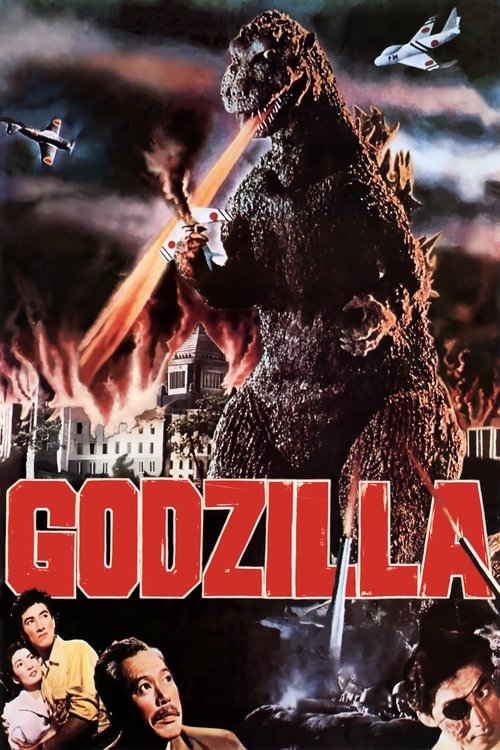
Godzilla
1954 · Ishirō Honda
For when you want the genuine article: the somber, serious original behind decades of monster movies. Expect to be moved as much as thrilled — this is the version that leaves a mark.
What it's about
Ships begin sinking in flames off a Japanese island, and an expedition traces the disaster to something the islanders call Gojira — a fifty-meter creature woken and warped by nuclear testing. As scientists argue over whether to study it or destroy it, the monster comes ashore in Tokyo, and a tormented young scientist holds a secret that could stop it at a terrible cost.
The experience
Far bleaker and sadder than its pop-culture descendants — the rampage plays like war footage, all evacuation trains, hospital wards, and a city burning in black and white. It's a monster movie that feels like national mourning, and the dread is real.
Performances
Takashi Shimura brings a grave, sorrowful authority to Dr. Yamane, the scientist who can't celebrate the destruction of the thing he understands.
The craft
Eiji Tsuburaya's effects team, lacking time for stop-motion, invented a whole working method — a performer in a heavy suit, a meticulously built miniature Tokyo, cameras overcranked so debris falls with terrible weight — and Ishirō Honda shoots the aftermath with a newsreel maker's sobriety. Akira Ifukube's grinding, mournful score, including the monster's famous roar and theme, does as much as the images; it deserves good speakers and full attention in its original Japanese cut.
Why it matters
Made barely two years after occupation censorship lifted, it turned Japan's atomic trauma into a screen myth, founded the entire kaiju genre, launched cinema's longest-running film franchise, and made its creature a global icon.
Snapshot
Gojira is the film in which the atomic bomb returns to Japanese screens as a body. Released by Toho on 3 November 1954 — barely two years after the Allied occupation, and its censorship regime, ended — it converts a national trauma that had been legally unspeakable into a creature that walks out of Tokyo Bay and burns the city down again. Ishirō Honda, a career studio director with a documentarian's temperament and a soldier's memory of the ruins, shoots the impossible in the grammar of newsreel: evacuation trains, triage wards, Geiger counters ticking over a child's hair. Eiji Tsuburaya's special-effects unit, denied the time and money for stop-motion, invented a working method out of necessity — a man in a latex suit, a quarter-scale Tokyo, cameras overcranked so that plywood falls with the weight of concrete. Akira Ifukube supplied a funeral march and a roar made from a leather glove dragged across a contrabass string. The result is a monster picture whose deepest structure is elegiac rather than sensational, and whose final act turns not on killing the creature but on a scientist choosing to die alongside his own invention so it can never be weaponized. Everything the kaiju film became — and much of what global blockbuster cinema learned about civic destruction — begins here.
Industry & production
The project originated in a failure. Producer Tomoyuki Tanaka had a Japanese–Indonesian co-production collapse when visas and political friction killed it, leaving Toho with an unfilled slot on its release calendar and a producer under pressure to fill it. Tanaka's substitute idea drew on two live currents: the commercial success in Japan of Hollywood's The Beast from 20,000 Fathoms (1953) and the 1952 reissue of King Kong (1933), and the domestic outrage over the Daigo Fukuryū Maru (Lucky Dragon No. 5) incident of 1 March 1954, when a Japanese tuna boat was showered with fallout from the American Castle Bravo hydrogen-bomb test at Bikini Atoll. The crew's radiation sickness, contaminated tuna pulled from Tokyo markets, and the death of radio operator Aikichi Kuboyama that September made fallout a daily newspaper subject during the film's development. Gojira's opening scene — a freighter's crew consumed by a blinding flash at sea — is a direct transposition.
Toho developed the film under a working title referring to it simply as a giant-monster project, from a treatment by the popular adventure and mystery writer Shigeru Kayama, adapted into a shooting script by Takeo Murata with Honda. The studio committed unusual resources: contemporary accounts and later studio histories agree it was among Toho's most expensive productions to that date, absorbing a long effects schedule and a large miniature build, though the specific budget figures circulated in later literature vary and should be treated as approximate. Toho's postwar recovery from the bitter labor strikes of the late 1940s had left it with a disciplined studio system — contract stars, a permanent effects department under Tsuburaya, and a double-bill program structure that could absorb an expensive gamble.
The gamble paid. Gojira was a substantial hit; the admission figure most often cited in Japanese sources is roughly nine and a half million, which would place it among the year's biggest domestic draws. Toho immediately ordered a sequel — Godzilla Raids Again (1955) — establishing the serial logic that would define the studio's next two decades.
The film's international life took a peculiar detour. American rights were acquired and the picture substantially reconstructed in 1956 as Godzilla, King of the Monsters!, directed for the new material by Terry O. Morse, with Raymond Burr inserted as an American correspondent named Steve Martin, dubbed dialogue, a shortened running time, and much of the political and anti-nuclear content trimmed or blunted. It was this hybrid that circulated worldwide for nearly fifty years and shaped the Anglophone reputation of Godzilla as camp. Honda's original received a proper American theatrical release only in 2004, for the fiftieth anniversary, and the critical reassessment that followed is largely a reassessment of a film most Western viewers had never actually seen.
Technology
The technological question at the center of Gojira was how to put a fifty-meter animal into a photographed city. Tsuburaya's preferred answer was stop-motion in the Willis O'Brien and Ray Harryhausen line, but the schedule made frame-by-frame animation impossible. The solution — later given the retroactive name suitmation — was a full-body latex costume built over a bamboo and wire armature by the sculptor Teizo Toshimitsu with the modelers Kanju and Yasuei Yagi. The first suit was punishingly heavy and nearly airless; a lighter second suit and separate partial pieces (a lower-body section for walking inserts, hand puppets and articulated head models for close work) were built to cover what the full costume could not.
The city was constructed as a miniature set at roughly quarter-inch-to-the-foot scale, detailed to the level of individual shopfronts and rendered in materials chosen for how they break — plaster, thin wood, wax-impregnated elements that would collapse rather than splinter like models. Around it Tsuburaya's unit deployed the full optical toolkit of mid-century effects work: overcranked (high-speed) photography so that falling debris descends at a slowed, massive rate; wire rigs; rear projection; matte paintings; split-screen and traveling matte composites to place actors and crowds in the same frame as the creature. Godzilla's atomic breath was hand-drawn cel animation optically composited over the live plates — an animation department solution inside a live-action effects film.
The economic significance of this toolkit is easy to underrate. Stop-motion is slow and non-repeatable; suit-and-miniature work is fast, schedulable, and reusable. Tsuburaya effectively engineered a production system, not a one-off effect, and that is why the kaiju film could become an annual industrial product rather than a decade-spanning artisanal event.
Technique
Cinematography
Masao Tamai shot the live-action material in black-and-white with a deep, sooty low-key palette, and the film's most famous decision is a restrictive one: Godzilla is largely withheld, and largely nocturnal. Early appearances are partial — a head cresting a ridge on Odo Island, a silhouette against burning oil tanks. The Tokyo raid is staged at night, backlit by fire, with the creature frequently reduced to a black shape against orange-white flame rendered as blazing grays. This is not only atmosphere; it is the concealment strategy that makes a rubber suit read as mass. Sadamasa Arikawa headed the effects-unit camera work, and the seam between the two units is managed by matching Tamai's contrast and haze — smoke is used constantly, as diffusion as much as spectacle.
The human-scale material is shot with a reportorial flatness that deliberately refuses expressionism: eye-level medium shots, functional coverage of meetings and laboratories, handheld or quasi-newsreel framing for crowd and evacuation scenes. The gap between that plainness and the monstrous content is the film's central formal effect.
Editing
Kazuji Taira cuts the film in a mode closer to disaster reportage than to adventure serial. The first act is a chain of dispatches — ship lost, ship lost again, survivors, island testimony, expedition — accumulating like wire copy. The Tokyo sequence is built by intercutting three registers: the creature in the miniature city, the defense response (tanks, aircraft, the electrical barrier), and civilian ground-level vignettes. Crucially, Taira gives the civilian inserts real duration. A mother crouching with her children in a doorway, telling them they will soon be with their father, is held long enough to function as a scene rather than a beat; a radio announcer keeps broadcasting from a tower until the tower goes over. These are the cuts that convert spectacle into aftermath, and they are precisely the material most compressed in the 1956 American recut.
Mise-en-scène / staging
Honda stages the film as a series of institutional rooms — a shipping office, a Diet committee chamber, a research institute, a hospital gymnasium converted to a ward — punctuated by two zones of the uncanny: Odo Island, with its ritual kagura performance and folk memory of an appeased sea-god, and Serizawa's basement laboratory, a private space of forbidden knowledge. The Diet scene, in which legislators argue over whether the truth about Godzilla should be made public and a woman member insists that it must, is unusually explicit political staging for a monster film, and it sets the film's argument in the register of civic deliberation rather than heroics.
The destruction sequence is composed with a geography a Tokyo audience would recognize: the Ginza clock tower, the Diet Building, the bridges and rail lines. Ruining named, locatable places is a rhetorical act, and one that carried unmistakable memory of the 1945 firebombing for the film's first viewers.
Sound
Akira Ifukube's contribution is arguably the film's most durable authorial signature, and it is as much sound design as score. The roar was produced by drawing a resin-coated leather glove along a loosened contrabass string and manipulating the recording in playback — an acoustic, instrumental origin for what reads as animal. The footfalls were generated percussively in the studio; accounts of the exact method differ, and the film's technical record here is thinner than the retelling suggests. Ifukube's music proper works in heavy ostinato: the marching main theme built on repeated low figures, and the somber "Prayer for Peace" chorus sung by schoolgirls over the ruins, which functions as the film's requiem and its moral summary. Silence is used with equal deliberation — the underwater climax plays with an emptiness that makes Serizawa's last transmission unbearably close.
Performance
The casting carries prestige weight. Takashi Shimura — that same year the lead of Kurosawa's Seven Samurai, and two years earlier of Ikiru — plays the paleontologist Kyohei Yamane with a stubborn, grieving gravity; his conviction that Godzilla should be studied rather than destroyed gives the film its most uncomfortable ethical thread. Akihiko Hirata's Serizawa, eyepatched and withdrawn, is legible to a 1954 audience as war-damaged, and his performance is built on suppression: the horror is in what he will not say about his discovery. Momoko Kōchi's Emiko carries the film's disclosure — she is the one who sees the Oxygen Destroyer demonstrated and must decide whether to break her promise — and Akira Takarada's Ogata supplies the ordinary decency against which the two scientists' positions are measured. Haruo Nakajima's work inside the suit, with Katsumi Tezuka covering some shots, is a performance in its own right, built on studied animal locomotion and a heavy, uninterested gait that reads less as malice than as force.
Narrative & dramatic mode
The film's dramatic mode is procedural tragedy. It advances by investigation — testimony, hearings, expedition, laboratory analysis — and its climax is a moral decision, not a battle. The romantic triangle (Emiko is bound by family expectation to Serizawa and loves Ogata) is not decorative; it is the mechanism that forces Serizawa's secret into the open, and it registers the postwar reorganization of Japanese family authority.
Godzilla itself is doubly figured: as weapon and as victim. Woken and irradiated by hydrogen-bomb testing, the creature is both the bomb's effect and its avatar. Yamane's insistence that it be preserved for study is the film's refusal of easy catharsis — the monster is evidence. And the resolution is deliberately anti-heroic: Serizawa uses the Oxygen Destroyer, burns his notes, and severs his own air line on the sea floor so that the knowledge of the weapon dies with him. The closing warning, that continued testing may raise another Godzilla, denies the audience the reassurance the genre normally supplies.
Genre & cycle
Gojira is the origin point of kaiju eiga as an industrial category and, more broadly, of tokusatsu (special-effects) filmmaking as a Japanese studio speciality. Its immediate ancestors are the American giant-creature cycle of the early 1950s — irradiated-monster pictures of which The Beast from 20,000 Fathoms is the closest template — grafted onto the Japanese tradition of the transformed avenging spirit and onto war-memory cinema.
What Toho built from it was a repeatable cycle: Godzilla Raids Again (1955), Rodan (1956), Mothra (1961), and the long Shōwa series that progressively domesticated the creature into a protector and then a children's-matinee hero. The reflexive arc of the franchise — terror, then spectacle, then camp, then periodic returns to horror — is one of the clearest cases in film history of a genre metabolizing its own founding trauma. Later reinventions have repeatedly gone back to 1954 for authority: the 1984 Japanese relaunch that ignored the intervening sequels, the Heisei and Millennium cycles, Shin Godzilla (2016), and Godzilla Minus One (2023).
Authorship & method
Honda is the film's controlling intelligence and its least flamboyant presence. A contemporary and close friend of Akira Kurosawa from their days as assistants at P.C.L./Toho, he served in the Imperial Japanese Army, spent time as a prisoner of war, and — by his own repeated account — passed through the ruins of Hiroshima on his return to Japan. That biography is the acknowledged root of the film's method: he directed the fantastic as though covering an event, and he insisted the human consequences be shown at ground level. Late in life he returned to Kurosawa's side as a collaborator and directorial assistant on the final films, including Kagemusha, Ran, Dreams, and Madadayo.
Authorship here is genuinely divided. Tsuburaya ran the effects unit as a parallel production with its own cameras, art department, and shooting schedule, and the film's images are as much his as Honda's — a co-directorial arrangement that became standard Toho practice. Tanaka's producorial role in originating and protecting the project was decisive. Murata and Honda's script gave the material its hearings-and-laboratories spine over Kayama's more pulp-inflected treatment. Tamai's photography and Taira's cutting supply the documentary register. And Ifukube — a self-taught composer from Hokkaidō whose concert work drew on Ainu and folk sources, and who would score, among much else, Kon Ichikawa's The Burmese Harp (1956) — gave the film a sonic identity so strong that it, rather than any single image, became the franchise's continuous thread across seven decades.
Movement / national cinema
Gojira belongs to the extraordinary Japanese studio year of 1954, alongside Seven Samurai, Sansho the Bailiff, and Twenty-Four Eyes — a moment when the Big Five studios were at peak production capacity and the international festival circuit had just discovered Japanese cinema via Rashomon. But Gojira was never festival cinema; it is a program picture made with prestige resources, and its significance to national cinema lies in genre rather than art-house prestige.
Its specific national work is the recovery of forbidden imagery. Under Occupation censorship, depiction of the atomic bombings was suppressed; the lifting of that regime in 1952 opened a brief, intense period of atomic-themed filmmaking, including Kaneto Shindō's Children of Hiroshima (1952) and Hideo Sekigawa's Hiroshima (1953). Gojira arrives two years into that opening and does something those documentaries and dramas could not: it displaces the trauma into fantasy and thereby makes it mass-audience material, including for children. The often-repeated claim that Godzilla's fissured skin texture was modeled on the keloid scarring of bomb survivors circulates widely in the literature; it should be flagged as attributed rather than firmly documented.
Era / period
The film sits precisely at the hinge of 1954: the end of occupation, the beginning of the "reverse course" in US–Japan relations, the Lucky Dragon incident and the subsequent nationwide anti-nuclear petition movement, and the start of the economic expansion that would remake Tokyo. Its anxieties are legible on both sides of that hinge — behind it, firebombing and defeat, evacuation and rubble; ahead of it, dependence on an ally that was still detonating hydrogen bombs in the Pacific. The Diet scene's argument about official secrecy and public disclosure is a period document as much as a plot device, and the deliberately unresolved question of whether Japan can defend itself — the film's military response is thoroughly, visibly futile — speaks directly to a nation constitutionally restricted from possessing offensive forces.
Themes
Nuclear consequence as inheritance. The bomb in Gojira is not an event but a condition: it produced a thing that keeps returning. Yamane's closing warning makes the film cyclical rather than resolved.
Scientific responsibility. The film's true moral subject is Serizawa, who has discovered something worse than the bomb and refuses to let it exist — a position it takes seriously enough to cost him his life and his work. Against him stands Yamane's scientific curiosity, which the film treats with sympathy and does not vindicate.
Knowledge and disclosure. Who is told what — the Diet debate, Emiko's broken promise, the newspaper reporter — is the film's recurring structural problem.
Ritual, memory, modernity. Odo Island's kagura and its legend of an appeased sea-god frame Godzilla as something older than the bomb that woke it, giving the science-fiction premise a mythic underlayer.
Mourning. The hospital ward, the orphaned child, the schoolgirls' chorus: the film ends in a funeral register, and the monster's death is filmed as a death rather than a victory.
Reception, canon & influence
Contemporary Japanese critical reception was mixed. The film was a decisive commercial success and its effects work was recognized within the industry, but a portion of the critical establishment treated it as exploitation of the Lucky Dragon tragedy or as juvenile spectacle unworthy of a studio's serious resources — a reception pattern that would harden as the sequels grew lighter. In the English-speaking world the situation was worse: for half a century the available text was the 1956 Raymond Burr reconstruction, and the film's reputation abroad was formed on a version with much of its politics and mourning removed.
The scholarly recovery began in earnest in the late 1980s — Chon Noriega's work on Godzilla as a Japanese-American nuclear text is a frequently cited turning point — and accelerated with the 2004 fiftieth-anniversary release of the original Japanese cut in American theaters and its subsequent home-video canonization, including a Criterion edition presenting both versions. The film now sits securely in the canon of postwar Japanese cinema and of political science fiction.
Backward influences. Hollywood's irradiated-creature cycle, above all The Beast from 20,000 Fathoms; the 1952 reissue of King Kong and the O'Brien tradition of monster spectacle; Japanese war-memory and atomic cinema of 1952–53; the folkloric and jidaigeki traditions Toho already commanded; and the specific documentary vocabulary of newsreel coverage of the bombings and of the Lucky Dragon.
Forward influence. Directly: the entire Toho kaiju cycle and the tokusatsu television tradition Tsuburaya founded, of which Ultraman (1966) is the keystone — a lineage that shaped Japanese sentai and superhero television, and through it a global children's-media industry. Godzilla itself became one of cinema's longest continuously produced franchises, running from Honda's original through the Shōwa, Heisei and Millennium cycles to Shin Godzilla and Godzilla Minus One, plus American productions in 1998 and from 2014 onward.
Less directly but more pervasively, Gojira established the modern grammar of the destroyed metropolis: recognizable landmarks, ground-level civilian witness, institutional response as narrative spine, and destruction filmed as bereavement. That grammar runs through Akira and Japanese apocalyptic animation, through Cloverfield, Pacific Rim, Monsters, and Colossal, and through the disaster-scale climax that has become the default third act of the global blockbuster. What most of those descendants inherited was the spectacle. What Honda's film actually offers — a monster you cannot defeat without committing another atrocity, and a scientist who chooses to take the atrocity with him — remains comparatively rare.
A Deleuzian reading
A mother crouches in a doorway with her children while the block behind her burns.
The full Deleuzian reading of Godzilla →
Reception
A box-office smash in 1954 Japan, though some Japanese critics initially bristled at a monster movie trading on such fresh nuclear wounds — and the West knew it for decades only as the recut, Raymond Burr–inserted 'King of the Monsters!' The uncut Japanese version's 2004 US theatrical release triggered a full reappraisal: not camp, but one of cinema's great grief-stricken atomic allegories.
How Godzilla was received, from release to now →
How to watch Godzilla: what to notice on a first viewing
- Count how often you see only part of Godzilla. Tamai shoots black and white in a sooty low key and the creature is mostly nocturnal. A head cresting a ridge. A black shape against burning oil tanks. Smoke is used constantly as diffusion. Concealment is what makes a rubber suit read as mass. You supply the rest of the body out of what the frame withholds.
- Time how long the camera stays with people who can do nothing. Taira cuts the Tokyo raid across three registers: the creature, the defense response, and civilians at street level. He gives the third real duration. A mother in a doorway. An announcer who keeps broadcasting. Those holds convert spectacle into aftermath. They advance nothing, and they are the reason the film reads as mourning.
- Listen to the roar and the low repeated march under it. The roar came from a resin-coated glove dragged down a loosened contrabass string. Ifukube writes in heavy ostinato, the same low figures repeating, and a schoolgirls' chorus arrives over the ruins. The score is built like a funeral march rather than an adventure cue. It tells you early what kind of film this is.
- Watch the meetings: a shipping office, a committee chamber, a ward. Honda shoots hearings, laboratories, and triage at eye level with functional coverage and newsreel framing. Legislators argue over whether the public should be told. The fantastic is handled as an event being covered. The plainness is the method. A monster film that runs on testimony and debate makes the destruction feel reported rather than staged.
- Look for the Ginza clock tower and the Diet Building. Tokyo was rebuilt in miniature from plaster, thin wood, and wax chosen for how it breaks. Cameras were overcranked so debris falls slow and heavy. The places being ruined are ones the audience could name. Wrecking locatable places is the rhetoric. For a 1954 audience this city had already burned once, nine years earlier.
The whole guide to watching Godzilla, with the keys for a rewatch →
Influences: the films it descends from and the films it influenced
- King Kong (1933) — Its 1952 Japanese reissue is the commercial proof-of-concept Tanaka cited, and its third act supplies the template Honda rebuilds shot-for-function — a giant animal moving through a miniature of a real, named metropolis, cut against ground-level crowds fleeing toward camera and rear-projected composites that place actors and creature in one frame.
- The Lost World (1925) — Willis O'Brien's miniature London rampage established the rule Tsuburaya's Ginza set obeys — the monster must break something the audience can name — and its matte-and-glass compositing of live crowds beneath an animated creature is the optical problem Tsuburaya solved differently with a man in a suit.
- The War at Sea from Hawaii to Malaya (1942) — Tsuburaya's miniature Pearl Harbor — shot overcranked, from low angles, with smoke and water scaled to the model rather than to the lens — was mistaken for actual newsreel by Occupation censors; it is the direct technical parent of the overcranked Tokyo destruction, and the same forced-perspective water tanks return for Godzilla's landfall.
- Children of Hiroshima (1952) — Establishes the postwar atomic-aftermath vocabulary Honda quotes without dramatizing: the crowded triage ward shot in flat available light, the Geiger counter passed over a child's body, and the extended hold on a survivor who has no dialogue and no plot function.
- Hiroshima (1953) — Its mass-casualty processions through a ruined city — thousands of extras staged in slow lateral drifts rather than panic — are the staging model for Honda's post-rampage sequences, where the camera tracks past mourners at walking pace and the score gives way to a schoolgirls' chorus.
- Eagle of the Pacific (1953) — The immediate rehearsal for the film's divided authorship: Honda directing conference rooms and command decisions on the main unit while Tsuburaya shot miniature naval action as a parallel production with its own crew and schedule — the arrangement that becomes standard Toho practice a year later.
- The Beast from 20,000 Fathoms (1953) — Supplies the plot engine Honda inverts — an atomic test wakes a prehistoric animal — plus the procedural spine of specialists reading physical evidence toward identification, and the 'defeat it with a novel weapon' climax that Honda turns into an ethical catastrophe rather than a technical fix.
- Ikiru (1952) — Takashi Shimura's stooped, quiet moral authority is carried directly into Dr. Yamane, and Kurosawa's bureaucratic set-pieces — long-table committee rooms, deflected questions, officials shot in flat frontal groupings — are the staging grammar of the Diet hearing sequence.
- Rodan (1956) — Ports the whole apparatus into color: suitmation and wire-flown miniatures under overcranked cameras, the mine-shaft investigation as first-act procedural, and the Sasebo destruction shot as civil-defense reportage — with the same closing device of characters watching their own weapon's cost.
- Mothra (1961) — Extends the miniature-city method to a creature whose scale is proven by architecture rather than by comparison shots — the larva shot through collapsing scale models of Tokyo Tower — and keeps Honda's institutional rooms while replacing the scientist's sacrifice with a colonial-guilt reversal.
- Jaws (1975) — The two most transferable devices: the creature withheld for an hour and represented by sound plus its effects on bodies, and the municipal-authority procedural — the council meeting where officials suppress the threat for economic reasons — which is Honda's hearing sequence relocated to a town hall.
- Akira (1988) — Animates Honda's destroyed-metropolis grammar frame by frame: the opening blast rendered as a clean expanding dome over a named city, then civilian-level streets, ministry offices and a military containment apparatus, with the destruction's duration held past the point of spectacle into aftermath.
- The Host (2006) — The sharpest inheritance of the Oxygen Destroyer's logic — 'Agent Yellow,' a cure that is itself an atrocity — combined with Honda's ground-level civilian witness and quarantine-bureaucracy staging, keeping the monster's origin in a specific documented act of contamination rather than in metaphor.
- Cloverfield (2008) — Absolutizes the newsreel-realism strand: the monster is glimpsed only in fragments through a civilian camera, scale is conveyed by falling debris and recognizable Manhattan landmarks, and the film consists almost entirely of the civilian vignettes Honda cut between.
- Godzilla (2014) — Deliberately restores the withheld-monster discipline — reveals staged through TV feeds, dust and the HALO-jump obscurity — and keeps camera height at human eye level so that the creature is always framed by people looking up, reversing three decades of unmotivated aerial coverage.
- Shin Godzilla (2016) — Returns the franchise to the hearings-and-laboratories spine and pushes it further: nearly the whole film is institutional rooms, chyron-labeled officials and interagency deadlock, with Ifukube's 1954 ostinato cues reused verbatim over the destruction rather than rescored.
- Godzilla Minus One (2023) — Recovers the two elements the spectacle-descendants dropped — the extended civilian vignette given real duration, and a plan whose cost falls on the man who devises it — while rebuilding the atomic-breath blast as a mushroom cloud over a named district and quoting the contrabass roar's low-register attack.
- Pacific Rim: Uprising (2018) — The Toho kaiju grammar of city-scale destruction set against a sub-bass roar — Uprising's low-frequency sound-impact design and the very notion of monsters as seismic events descend from Honda's suitmation spectacle.
- Godzilla vs. Destoroyah (1995) — Supplies the entire closure engine — Destoroyah is spawned from the original's Oxygen Destroyer and Momoko Kochi returns as Emiko Yamane, so the finale is literally built out of the weapon and character that ended the first film.
- Millennium Actress: Tracks (2001) — Its Toho tokusatsu spectacle is literally re-staged inside Millennium Actress as a genre Chiyoko acts in; the making-of shows how storyboards recreate the suitmation/burning-city iconography as animated homage.
- Them! (1954) — Arrived at the same solution independently five months earlier: monochrome atomic-mutation horror told as institutional procedure — briefing rooms, wire-service maps, scientists lecturing officers — with the creature withheld behind sound and aftermath for the first act.
- Godzilla Raids Again (1955) — A frame-rate error on the Osaka bout played the suits back at speed, inverting Honda's overcranked weight-bearing tempo, and its monster-versus-monster structure displaced the procedural-tragedy spine — the exact fork that sets the franchise's later direction.
- Pacific Rim (2013) — The suitmation/tokusatsu method of conveying immense scale through a human-sized performer in a city-block miniature shot at high frame rates — del Toro dedicates the film to Honda and replicates the scale-reference staging (figures, ships, buildings dwarfed in frame) that sells kaiju mass.
- The Burmese Harp (1956) — Shares composer Akira Ifukube from the same season, whose weighty brass-and-choral orchestral idiom scores the film's grief and processional passages in the same monumental postwar register.
Similar films
- Godzilla Minus One (2023) — influence & lineage
- Godzilla (2014) — influence & lineage
- Shin Godzilla (2016) — influence & lineage
- King Kong (1933) — influence & lineage
- Cloverfield (2008) — influence & lineage
- Akira (1988) — influence & lineage
- Ikiru (1952) — influence & lineage
- Godzilla vs. Destoroyah (1995) — shared sensibility