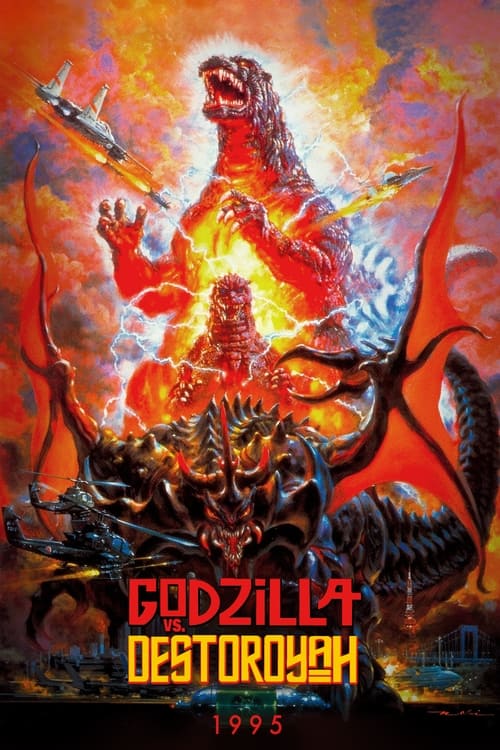
Godzilla vs. Destoroyah
1995 · Takao Okawara
For when you want kaiju destruction with real emotional stakes — a monster movie you can actually feel something at. Comfort-food genre on the surface, but bring more heart than you'd expect to need.
What it's about
Godzilla is dying. His body has become a runaway nuclear reactor, his dorsal fins glowing like coals, and a meltdown looms that could take the planet with him. Meanwhile, crustacean-like organisms spawned by the Oxygen Destroyer — the weapon that killed the original Godzilla in 1954 — begin evolving into something far worse, and Japan finds itself caught between a burning god and the nightmare his first death left behind.
The experience
Heavier and more mournful than a monster brawl has any right to be — the spectacle is huge, but there's a funeral running underneath it. Destoroyah is genuinely scary, closer to a horror creature than a wrestling opponent, and the whole film carries a sense of an era ending.
The craft
The burning Godzilla suit, lit from within, is one of the great images in the series, and Destoroyah's escalating forms give the effects team a full horror-movie arc to play with. Miniature city destruction, oxygen-drained battlefields, and a thunderous score make this one worth the biggest screen and loudest speakers you can find.
Why it matters
The finale of Toho's Heisei cycle and a deliberate closing of the circle with the 1954 original — even bringing back actress Momoko Kōchi from the first film. Toho marketed it as the end of an era, and fans still treat it as one of the emotional peaks of the entire franchise.
The Heisei Godzilla cycle — Toho's continuity-driven run begun in 1984 — needed a finale worthy of forty years of the character, and Takao Okawara delivered a funeral. Godzilla arrives already dying, his dorsal fins glowing like coals, his body a runaway reactor threatening a meltdown that could crack the planet; his adversary is spawned from the Oxygen Destroyer, the weapon that killed the original creature in 1954. That closing of the circle is literal: Momoko Kōchi returns as Emiko Yamane, her first appearance in the series since Ishirō Honda's film, and the script treats the 1954 tragedy as an open wound rather than backstory. Destoroyah itself is among the most genuinely horrific of Toho's monsters, a crustacean nightmare that evolves through escalating forms like a slasher villain. Toho publicized Godzilla's death in advance — a national news event in Japan — to clear the stage for the American remake. Akira Ifukube, the composer who had given the monster its voice since the beginning, scored the end as a requiem, and it plays like one.
Reception
Sold in Japan as a national event — Toho openly advertised it as Godzilla's swan song, and it was a big domestic hit in 1995. Kaiju fans have since canonized it as the emotional peak of the Heisei series, the entry even lukewarm-on-Godzilla people get told to watch.
How Godzilla vs. Destoroyah was received, from release to now →
Influences: the films it descends from and the films it influenced
- Godzilla (1954) — Supplies the entire closure engine — Destoroyah is spawned from the original's Oxygen Destroyer and Momoko Kochi returns as Emiko Yamane, so the finale is literally built out of the weapon and character that ended the first film.
- Rodan (1956) — Establishes Ifukube's mournful brass requiem for a dying monster, the exact tonal and scoring template reprised over Godzilla's meltdown death.
- The Return of Godzilla (1984) — Rebooted Godzilla as a lone, serious atomic menace that ignores the intervening films, founding the self-contained Heisei continuity this movie caps.
- Godzilla vs. Biollante (1989) — Introduced G-cells and genetic-mutation monster design — the bioengineering premise that lets Destoroyah evolve from microbe to hordelings to giant.
- Godzilla vs. King Ghidorah (1991) — Cemented the Heisei habit of continuity callbacks and Godzilla's escalating power output, feeding the 'Burning Godzilla' overload that drives the meltdown plot.
- Aliens (1986) — Destoroyah's swarming juvenile creatures overwhelming Maser-armed soldiers restages the Colonial-Marines-vs-xenomorph siege, from biomechanical design to pulse-weapon standoffs.
- Alien (1979) — Giger's exoskeletal, biomechanical horror aesthetic underlies Destoroyah's crustacean-demon form, breaking from Toho's traditional reptilian suit design.
- The Thing (1982) — Destoroyah's aggregation of many small organisms into one shifting giant borrows the body-horror logic of a colonial creature reassembling itself.
- Godzilla 2000: Millennium (1999) — Okawara relaunched the franchise right after this finale, carrying over the standalone-continuity approach and the orange meltdown-energy palette.
- Godzilla, Mothra and King Ghidorah: GMK (2001) — Extends the legacy-callback method of binding a new film back to the 1954 dead and framing nuclear guilt as the monster's core meaning.
- Godzilla: King of the Monsters (2019) — Lifts 'Burning Godzilla' — the thermally overloading, glowing Godzilla of this finale — wholesale, and quotes Ifukube's themes as requiem.
- Shin Godzilla (2016) — Reuses Ifukube's original cues and reframes Godzilla as a live meltdown, with phased biological evolution and thermal/coolant imagery echoing Destoroyah's mutation-and-meltdown craft.
- Godzilla Minus One (2023) — Builds its climax on a 1954-style scientific super-weapon and a mortality/sacrifice frame, repeating the circular-closure-to-the-original move.
- Godzilla vs. Mechagodzilla II (1993) — Okawara's own prior Heisei entry sharing the same suitmation staging, production team, and Ifukube-scored gravitas, directly upstream in method.
- Pacific Rim (2013) — Translates kaiju suitmation grammar into CG while homaging Ifukube-style orchestral bombast and the swarm-plus-titan military siege staging.
Similar films
- Godzilla (1954) — influence & lineage
- Godzilla vs. Biollante (1989) — influence & lineage
- Godzilla: King of the Monsters (2019) — influence & lineage
- Godzilla Minus One (2023) — influence & lineage
- Shin Godzilla (2016) — influence & lineage
- Pacific Rim (2013) — influence & lineage
- Godzilla (2014) — shared sensibility
- Godzilla (1998) — shared sensibility