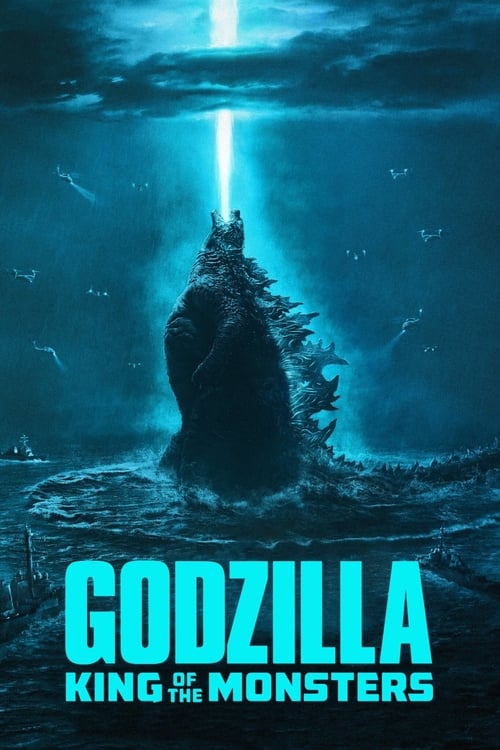
Godzilla: King of the Monsters
2019 · Michael Dougherty
When you're in the mood to turn the volume up and watch titans level cities — pure popcorn spectacle, zero homework required. The monster-movie equivalent of a stadium rock show.
What it's about
Ancient god-sized creatures called Titans are waking up all over the planet, and the secretive agency that tracks them is torn apart from within over whether these monsters should be stopped — or unleashed. As Godzilla squares off against a three-headed rival from the depths of myth, a fractured family caught inside the agency has to pick a side. It's a global-scale monster war with humanity scrambling in the margins.
The experience
Maximalist is the word: this one goes for wall-to-wall monster spectacle — lightning-wreathed showdowns, glowing wings unfurling out of volcanoes, whole cities as battlegrounds. It's loud, operatic, and unashamedly excessive, made for viewers who want the creatures front and center.
The craft
The film treats its creatures with genuine reverence — framed like living gods in storm light and bioluminescent glow, backed by a thunderous score that works in classic monster themes. The imagery leans painterly and apocalyptic rather than merely destructive. Absolutely a big-screen, big-speakers film.
Why it matters
It brought Mothra, Rodan, and King Ghidorah into the American MonsterVerse for the first time, embracing the full mythology of the classic Japanese monster films and pushing the franchise from restraint toward all-out creature opera.
Snapshot
Godzilla: King of the Monsters is the third installment in Legendary Pictures' "MonsterVerse," a shared-universe franchise that began with Gareth Edwards' Godzilla (2014) and continued through Jordan Vogt-Roberts' Kong: Skull Island (2017). Directed and co-written by Michael Dougherty, the film abandons the restrained, slow-reveal aesthetic of the 2014 picture in favor of a maximalist monster spectacle that brings three additional classic Toho creatures — Mothra, Rodan, and the three-headed King Ghidorah — into the American MonsterVerse for the first time. Its narrative follows the crypto-zoological agency Monarch as a faction seeks to awaken the dormant "Titans" to reset the planet's ecological balance, with Godzilla positioned as a kind of apex guardian against the extraterrestrial Ghidorah. The film functions simultaneously as a tribute to Toho's Shōwa-era kaiju cycle and as a tentpole designed to escalate the franchise toward the eventual Godzilla vs. Kong (2021). Critically divisive and a commercial disappointment relative to expectations, it remains a significant text for understanding how Hollywood adapted a Japanese genre tradition for global blockbuster scale.
Industry & production
The film was produced by Legendary Pictures, with Warner Bros. handling domestic distribution and Toho retaining its character licenses — a co-development arrangement that had governed the MonsterVerse since 2014. Legendary's strategy mirrored the broader 2010s industry move toward "cinematic universes" modeled on Marvel, and King of the Monsters was conceived as a connective bridge: it expanded the roster of monetizable monster IP while seeding the crossover with Kong. Reportedly mounted on a large production budget in the $170–200 million range (figures vary across trade reporting, so the exact number should be treated as approximate), the film carried the financial expectations of a summer 2019 tentpole.
Principal photography took place largely in and around Atlanta, Georgia, using EUE/Screen Gems and other Georgia facilities — a choice driven substantially by the state's aggressive film tax incentives, which by the late 2010s had made Atlanta a major hub for studio production. The film opened in late May 2019 into a crowded summer marketplace. Its commercial performance is generally characterized as underwhelming relative to its budget and to the 2014 film, with a domestic gross widely reported as below that predecessor; I will not cite precise box-office totals here, as the franchise accounting and source figures vary. The reception of King of the Monsters directly shaped the more economical, Kong-forward calibration of Godzilla vs. Kong.
Technology
The production was built around large-scale digital visual effects, with companies including MPC and others contributing the creature animation and environmental destruction. The four headline Titans were realized entirely as CG creatures, animated to convey enormous mass and weight; King Ghidorah in particular posed a distinctive technical problem, as its three independently expressive necks and heads required an animation approach that gave each head a separable "personality" while maintaining a single coordinated body — the production described the heads almost as three characters sharing one organism.
The film leaned heavily on atmospheric obscurants — rain, snow, ash, storm cloud, and volcanic haze — both as a dramatic motif and as a rendering strategy that integrated the creatures into degraded, weather-heavy environments. This is a meaningful technological choice: rather than presenting monsters in clean daylight, the film embeds them in particulate-dense atmospheres that soften CG edges and lend scale through diffusion and silhouette. The picture was finished as a digital intermediate and released in premium large-format and 3D presentations, formats toward which its scale-driven imagery was explicitly oriented.
Technique
Cinematography
Cinematography is by Lawrence Sher, a DP whose prior credits were concentrated in comedy (the Hangover trilogy) and who would shortly afterward shoot Todd Phillips' Joker (2019). Sher's work here favors heavily atmospheric, often desaturated and storm-lit imagery, with the monsters frequently revealed in backlit silhouette against fire, lightning, and cloud. The film repeatedly stages its creatures as quasi-religious apparitions — Ghidorah descending in an electrical storm, Mothra unfurling against a waterfall, Godzilla framed in low-angle reverence — using volumetric light and scale-cueing foreground figures to communicate immensity. The visual approach drew commentary, both admiring and critical, for its painterly, almost iconographic tableaux; detractors argued the persistent murk obscured the action, while admirers read it as a deliberate sublime-romantic register.
Editing
The film is credited to multiple editors (including Roger Barton, Bob Ducsay, and Richard Pearson across various credits), a configuration typical of effects-heavy tentpoles where parallel cutting tracks and extensive VFX coordination demand more than one editorial hand. The editing alternates between rapid, kinetic human-scale sequences and the longer-held monster confrontations, and the picture has been criticized in some quarters for a busy, propulsive cutting rhythm in its human scenes that contrasts with the grandeur it seeks in the kaiju material. The structural challenge — intercutting a large human ensemble across multiple global locations with the monster set pieces — is one the editing only partly resolves, a point recurrent in the critical record.
Mise-en-scène / staging
Dougherty's staging is consciously votive. Human characters are repeatedly positioned as small witnesses at the feet of the Titans, and the monster designs themselves are treated with iconographic care: Mothra is coded as benevolent and luminous, Rodan as volcanic and volatile, Ghidorah as a golden, gravity-defying false king. The film's Monarch facilities, ancient underwater temples, and storm-wracked landscapes are dressed to evoke myth and deep time rather than contemporary realism. This staging strategy aligns with the film's thematic ambition to treat the monsters as gods and natural forces.
Sound
The sound design is a central pleasure of the film, reconstructing and updating the iconic vocalizations of the Toho creatures — Godzilla's roar, Mothra's cry, Rodan's screech, and Ghidorah's distinctive cackling call. The mix uses subsonic weight and reverberant scale to register the creatures' mass. Sound functions as one of the film's clearest acts of franchise homage, treating the original Toho audio signatures as heritage to be honored.
Performance
The film carries a large ensemble: Kyle Chandler and Vera Farmiga as estranged Monarch scientists, Millie Bobby Brown (in a prominent early film role following Stranger Things) as their daughter, Ken Watanabe reprising Dr. Ishirō Serizawa from the 2014 film, Sally Hawkins returning as Dr. Vivienne Graham, with Bradley Whitford, Charles Dance, Thomas Middleditch, Zhang Ziyi, O'Shea Jackson Jr., Aisha Hinds, and David Strathairn. The performances are pitched in the earnest-melodramatic register typical of disaster cinema. Watanabe's Serizawa is the emotional and thematic anchor, his reverence for Godzilla giving the film its most quoted line of sentiment; critical consensus generally singled out the human drama, rather than the cast's commitment, as the film's weak link.
Narrative & dramatic mode
The screenplay, by Dougherty and Zach Shields (from a story developed with Max Borenstein, who wrote the 2014 film), operates in the disaster-melodrama mode: a fractured family — grief over a child lost in the 2014 San Francisco event — is mapped onto a planetary crisis, so that personal reconciliation and global survival resolve in tandem. This is a structural inheritance from Spielbergian disaster cinema and from the Toho tradition itself, where domestic and familial frames repeatedly humanize the kaiju spectacle. The film layers an eco-radical conspiracy plot (a faction deliberately awakening the Titans) atop the family story, generating a moral argument about humanity's relationship to nature. The dramatic mode is sincere and mythic rather than ironic; the film asks to be taken as modern mythology, a tonal choice that some viewers found earnestly affecting and others found ponderous.
Genre & cycle
King of the Monsters sits at the intersection of the American disaster film and the Japanese kaiju eiga (giant-monster film). It belongs most immediately to the 2010s "monsterverse" cycle of shared-universe blockbusters, but its deeper lineage is the Toho Godzilla series, specifically the Shōwa-era films of the 1960s–70s in which Godzilla, Mothra, Rodan, and Ghidorah repeatedly shared the screen (notably Ghidorah, the Three-Headed Monster, 1964, and Destroy All Monsters, 1968). Where Edwards' 2014 film drew on the somber, apocalyptic register of the original Gojira (1954), Dougherty's film deliberately revives the maximalist monster-mash spirit of the later Shōwa entries, in which Godzilla functions as a heroic defender against invading threats. The film thus represents a tonal pivot within the MonsterVerse from disaster-realism toward kaiju-fantasy.
Authorship & method
Michael Dougherty came to the film as a self-identified Godzilla devotee, with a prior directorial career in horror (the cult anthology Trick 'r Treat, 2007, and the holiday creature film Krampus, 2015) and a screenwriting background that included X2 (2003) and Superman Returns (2006). His approach to the franchise was fan-forward: an emphasis on honoring Toho iconography, restoring the classic monster roster, and treating the creatures with reverence. His regular collaborator Zach Shields co-wrote both Krampus and King of the Monsters.
The film's most distinctive authorial signature is arguably its score, by composer Bear McCreary (known for Battlestar Galactica and The Walking Dead). McCreary made a point of incorporating and reorchestrating the heritage themes of the Toho series — Akira Ifukube's classic Godzilla march and Yūji Koseki's Mothra theme — weaving these motifs into a large symphonic-and-choral score. This act of musical citation is one of the film's clearest authorial gestures, binding the Hollywood production to its Japanese source tradition. The contributions of cinematographer Lawrence Sher (atmospheric, iconographic imagery) and the multi-editor team complete a production whose method foregrounded homage and scale over the austerity of the prior film.
Movement / national cinema
The film is an American studio production but is unintelligible without its Japanese genealogy. Godzilla originated with Toho's Gojira (1954), directed by Ishirō Honda with special effects by Eiji Tsuburaya, as a nuclear-age allegory shaped by the atomic bombings and the Lucky Dragon 5 incident. King of the Monsters is therefore a transnational artifact: a Hollywood film operating under license from Toho, deploying characters and audiovisual signatures developed across decades of Japanese cinema, and reframing them for a global multiplex audience. The casting of Watanabe, Zhang Ziyi, and the gesture of placing Monarch within an international scientific framework reflect both the franchise's transnational ambitions and the practical pursuit of global (and particularly East Asian) markets.
Era / period
The film is a product of the late-2010s peak of the shared-universe blockbuster, a period when studios sought to convert legacy IP into expandable, cross-pollinating franchises. It also reflects a moment of growing climate anxiety: the film's central conceit — that the Titans might be agents of planetary self-correction against human ecological damage — channels late-2010s discourse about environmental catastrophe and the Anthropocene. Technologically it represents the mature state of large-scale digital creature work, and industrially it embodies the Georgia-centered, incentive-driven model of American studio production. Its underperformance was also read, in trade commentary, as a sign of the strain on the cinematic-universe model by decade's end.
Themes
The film's governing theme is ecological: humanity as a destabilizing infection upon the planet, and the Titans as a restorative natural order. The antagonists' radical-environmentalist logic — awaken the monsters to cull and reset humanity — externalizes a genuine moral question the film only partly endorses, ultimately recuperating Godzilla as a protective force that restores balance rather than annihilates. Secondary themes include grief and familial repair (the fractured family as microcosm of a fractured species), the tension between scientific stewardship and military force (Monarch versus the armed response), and myth versus modernity (the recurrent framing of the monsters as gods, with ancient civilizations having worshipped them). The film's eco-mysticism — nature as sacred, the monsters as deities — is its most sincere and most debated thematic commitment.
Reception, canon & influence
Critical reception was mixed-to-negative. Reviewers widely praised the monster design, the audacious creature confrontations, McCreary's heritage-laden score, and the film's commitment to kaiju spectacle, while criticizing thin and overcrowded human characters, a convoluted plot, and visually murky action staging. The aggregate critical posture was notably more divided than for the 2014 film, though some critics defended King of the Monsters precisely as a purer, more fan-serving kaiju picture. Commercially it is generally regarded as a disappointment relative to its budget and to its predecessor; I avoid citing exact grosses given variation in the reported figures.
Looking backward, the film's influences are overwhelmingly the Toho tradition: Honda and Tsuburaya's original Gojira; the Shōwa-era monster ensembles that first paired Godzilla with Mothra, Rodan, and Ghidorah; and the broader American disaster-film and Spielbergian spectacle lineage that shaped its human-scaled melodrama. Its musical citation of Ifukube and Koseki makes the debt explicit.
Looking forward, the film's chief legacy is structural: it established the expanded Titan roster and the eco-mythic framing that carried into Godzilla vs. Kong (2021) and the subsequent MonsterVerse expansions, including the streaming series Monarch: Legacy of Monsters (2023) and later films. Its relative commercial shortfall is generally credited with prompting the franchise to recalibrate toward the more streamlined, action-forward Kong crossover. Within fan culture it has accrued a partial critical reappraisal as an unabashed celebration of the kaiju form, even as the broader critical record remains ambivalent. Its lasting significance lies less in its own reception than in its role as the hinge on which the American MonsterVerse turned from disaster-realism toward full-blown monster mythology.
A Deleuzian reading
Start with a face.
The full Deleuzian reading of Godzilla: King of the Monsters →
Reception
Panned by critics on release as murky and overstuffed even as monster fans embraced it, it has steadily grown into a kaiju-community favorite — the MonsterVerse entry its defenders insist was misjudged for being exactly the Toho-style monster brawl it set out to be.
How Godzilla: King of the Monsters was received, from release to now →
Influences: the films it descends from and the films it influenced
- Godzilla (2014) — Direct MonsterVerse predecessor whose murk-and-withholding cinematography — monsters glimpsed through dust, rain, and low human POV — sets the atmospheric-obscurant house style this film extends (and is faulted for over-applying).
- Godzilla vs. Destoroyah (1995) — Lifts 'Burning Godzilla' — the thermally overloading, glowing Godzilla of this finale — wholesale, and quotes Ifukube's themes as requiem.
- Gojira (1954) — The source the film explicitly cites — Ifukube's reorchestrated Godzilla march and Tsuburaya's low-angle, human-eye framing of the monster as towering votive presence are imported wholesale by McCreary and Sher.
- Mothra (1961) — Supplies Koseki's Mothra theme (quoted directly in McCreary's score) and the templates of twin-fairy votive iconography and the larval/imago divine-insect staging that the film treats with religious reverence.
- Ghidorah, the Three-Headed Monster (1964) — Originates the monster-mash structure — multiple Toho kaiju (Godzilla, Mothra, Rodan, Ghidorah) sharing one diegesis — that this film's expanded Titan roster reconstitutes as its core architecture.
- Rodan (1956) — Establishes the airborne kaiju shrouded in cloud and volcanic smoke — the atmospheric-obscurant, backlit aerial reveal that Sher restages for Rodan's eruption from the volcano.
- Destroy All Monsters (1968) — The all-roster gathering film — the ensemble-of-Titans convergence and the gimmick of staging the full bestiary in confrontation is the direct precedent for this film's design.
- Close Encounters of the Third Kind (1977) — Bequeaths the backlit-silhouette grammar of awe — vast forms emerging from haze and shafts of light, with upturned human faces lit by the spectacle, central to the film's reverent monster reveals.
- Jaws (1975) — Model for the human-scaled disaster melodrama bolted onto a monster picture — the fractured-family and besieged-experts subplot structure the franchise inherits as its 'ground-level' counterweight.
- Pacific Rim (2013) — Sibling Hollywood kaiju revival that codified rain-soaked, neon-and-debris atmospheric staging of city-scale creature combat for American audiences just before the MonsterVerse.
- Trick 'r Treat (2007) — Dougherty's own authorial root — its votive seasonal iconography and reverent, ritualized treatment of a monster-figure carry into his framing of the Titans as objects of worship.
- Krampus (2015) — Same Dougherty–Zach Shields writing team and creature-reverence method — a folkloric monster treated as awe-inspiring deity rather than mere threat — directly precedes their Godzilla collaboration.
- Kong: Skull Island (2017) — MonsterVerse sibling that pioneered the low-angle, sun-flared iconographic 'splash' framing of the titan as monumental silhouette, a compositional vocabulary this film adopts.
- Shin Godzilla (2016) — Contemporaneous kaiju sibling that took the opposite formal path — procedural austerity over mythic spectacle — clarifying by contrast this film's commitment to operatic eco-mysticism and heritage scoring.
Similar films
- Godzilla (2014) — influence & lineage
- Pacific Rim (2013) — influence & lineage
- Shin Godzilla (2016) — influence & lineage
- Godzilla Minus One (2023) — influence & lineage
- Godzilla (1998) — shared sensibility
- Godzilla (1954) — shared sensibility
- Godzilla vs. Destoroyah (1995) — shared sensibility
- Godzilla vs. Biollante (1989) — shared sensibility