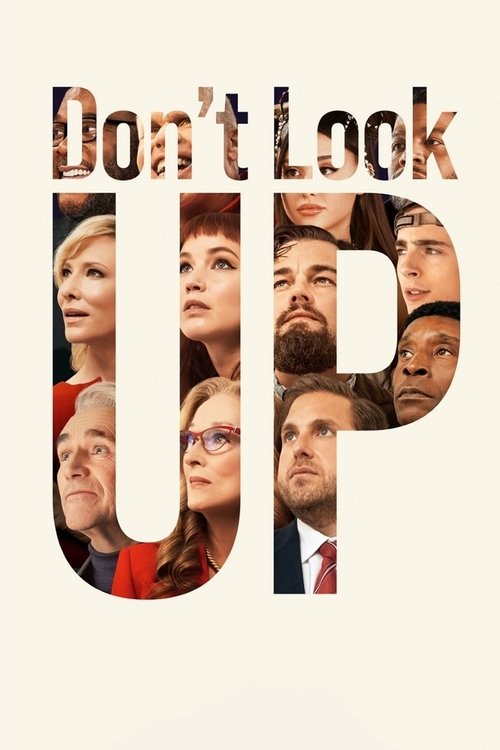
Don't Look Up
2021 · Adam McKay
When you want to yell at the screen in agreement — a satire for a night when you're feeling cynical about the news and want company in it. Comfort food for the frustrated, though the ending note is anything but cozy.
What it's about
A grad student and her professor discover a comet big enough to end civilization, arriving in six months, with the math beyond dispute. They take the news to the White House, then to morning television, then to anyone who will listen — and collide with a political and media machine that treats extinction as a messaging problem, a ratings segment, and eventually a business opportunity.
The experience
Fast, loud, and furious under the jokes — a comedy powered by genuine rage that keeps tipping into despair. It's funny in the way that makes you wince, because none of the absurdity feels invented.
Performances
Leonardo DiCaprio and Jennifer Lawrence anchor it as scientists coming apart in different ways, Meryl Streep has a ball as a venal president, and Mark Rylance is quietly the scariest thing in the film as a whispery tech billionaire who's mistaken himself for a savior.
The craft
McKay directs in his signature caffeinated register — whip-pan cutaways, channel-surfing montage, jokes buried in chyrons and background screens — with a murderer's row cast playing broad on purpose. It's built like a broadcast you can't turn off, which is exactly the point.
Why it matters
One of Netflix's most-watched films ever and a four-time Oscar nominee including Best Picture, it became an instant cultural flashpoint — embraced as a climate-crisis allegory, attacked as smug, and impossible to ignore either way.
Snapshot
A sophomore astronomer and her doctoral supervisor discover a comet on a nine-month collision course with Earth, then watch in mounting horror as the political class, media apparatus, and tech-billionaire complex conspire — through vanity, greed, and willful distraction — to render the apocalypse negotiable. Operatically cast, Netflix-distributed, and arriving at the peak of COVID-era social-media frenzy, Don't Look Up is Adam McKay's most schematic and most ambitious film: a broadside political satire in the tradition of Kubrick and Chayefsky that polarized critics even as it accumulated one of the platform's highest viewership totals of the 2021–22 season. It received four Academy Award nominations, including Best Picture and Best Original Screenplay, and entered cultural discourse immediately as a flashpoint for debates about allegorical filmmaking, climate communication, and what satire is permitted to do.
Industry & production
McKay developed the screenplay with progressive political journalist David Sirota, who had been publicly writing about the structural failures of media and politics to confront the climate crisis. The collaboration brought a reportorial, op-ed sensibility to the script — a quality that critics would either celebrate as moral clarity or condemn as didacticism, depending on their priors. Production was handled through McKay's Hyperobject Industries banner alongside Kevin Messick's producing partnership, with Netflix acquiring and financing the project at a reported budget in the mid-to-upper-eight-figure range. The streamer's willingness to fund an ensemble of this scale — Leonardo DiCaprio, Jennifer Lawrence, Meryl Streep, Cate Blanchett, Mark Rylance, Jonah Hill, Rob Morgan, Timothée Chalamet, Tyler Perry, Ron Perlman, Ariana Grande, and Scott Mescudi — reflects the post-Roma period in which Netflix aggressively positioned itself as a prestige destination for auteur-adjacent projects it could not have attracted in an earlier era. Principal photography took place during the COVID-19 pandemic, imposing production protocols that the film's own themes of collective denial made darkly ironic on set.
The Netflix release model — a brief theatrical window opening December 10, 2021, followed by the platform debut on December 24 — was itself a kind of argument about how contemporary audiences consume information: in fragments, on personal devices, interrupted. The film reached an enormous global audience quickly, though its Netflix viewership metrics, as with all platform data, remain difficult to verify with precision.
Technology
Don't Look Up deploys its visual-effects work — primarily the comet's approach, fragmenting impact, and aftermath sequences — in the service of emotional devastation rather than spectacle for its own sake. The comet is rendered convincingly, but McKay refuses to linger on disaster-film grandeur; the film cuts away from destruction at its most operatic moments, a deliberate negation of the genre pleasures it has spent two hours cannibalising. The production used large-format digital acquisition, which Linus Sandgren put to characteristically controlled use. The film's integration of broadcast and social-media screen aesthetics — news chyrons, tweet-scroll inserts, cable-panel graphics — draws on digital compositing to stage its satirical argument directly within the frame.
Technique
Cinematography
Linus Sandgren, the Swedish cinematographer who won an Academy Award for La La Land (2016) and shot First Man (2018) for Damien Chazelle, brings a restless, hand-held intimacy to the film's early scenes that gradually gives way to more architecturally composed framings as the institutional machinery closes around the protagonists. Sandgren calibrates his palette between the warm, chaotic close-quarters of the scientists' world and the cooler, more manicured aesthetic of television studios and the White House. The camera pushes into faces with uncomfortable proximity during moments of frustration and disbelief — a technique that amplifies the performers' reactions against the impeccably produced blandness of the media environments surrounding them. Sandgren's background in both intimate drama and large-scale production allows Don't Look Up to feel simultaneously claustrophobic and panoramic: the Earth it depicts is enormous and doomed, yet most of its citizens are shown only in tight, distracted close-up.
Editing
Hank Corwin's editing is the film's most formally distinctive contribution. Corwin built his career in the cutting rooms of Oliver Stone (Natural Born Killers, JFK) and subsequently became Terrence Malick's primary collaborator (The New World, The Tree of Life, Knight of Cups, Song to Song), a pairing that produced some of the most intellectually ambitious editing in American cinema of the past two decades. His work for McKay — a relationship that began with The Big Short (2015) — translates those associative, rhyming rhythms into satirical mode. In Don't Look Up, Corwin intercepts narrative momentum with news-ticker inserts, social-media reaction montages, and sudden intrusions of natural footage — animals, weather, sky — that function as elegiac counterpoint to the film's human comedy. The editing received an Academy Award nomination and was the subject of substantial critical discussion, with some praising its mimicry of distracted-attention culture and others finding the technique exhausting. The Malick influence is visible in the film's ending, which expands into something approaching lyric cinema before the satirical register reasserts itself in a post-credits coda.
Mise-en-scène / staging
McKay stages his ensemble in shallow, crowd-dense configurations that recall Robert Altman's overlapping-dialogue compositions, though where Altman's controlled chaos served humanist observation, McKay's serves diagnosis. The Oval Office scenes in particular deploy deep-focus staging to keep President Orlean (Meryl Streep) and her son/chief-of-staff Jason (Jonah Hill) in a consistent visual relationship — a double act literally and figuratively in the frame — while the scientists recede toward its margins. Television studio sets are designed with the aggressive cheerfulness of actual morning-show infrastructure, and McKay positions his characters within these spaces as people subtly dwarfed by the aesthetic machinery that surrounds them. Peter Isherwell's (Mark Rylance) environments — gleaming, affectless, palatial — are staged to suggest a consciousness genuinely alien to the film's other registers.
Sound
Nicholas Britell, whose scores for Moonlight (2016), If Beale Street Could Talk (2018), and the television series Succession established him as one of the most versatile composers working in American prestige production, provides music that refuses to let satire collapse into comedy. His score moves between orchestral grandeur, intimate piano, and — in the comet-approach sequences — passages of genuine desolation that the film does not undercut. The Academy Award nomination for Best Original Score reflected recognition that Britell's work holds the film's emotional register in a coherent key even when McKay's direction is pulling in several directions simultaneously. Sound design throughout emphasizes the cacophony of competing media streams, the intrusion of notification pings and broadcast noise, as environmental texture.
Performance
The casting strategy positions established performers in relationships that exploit their public personae. DiCaprio's Dr. Randall Mindy begins as a nervous, self-doubting academic and is gradually corrupted by media attention into a cable-news regular; the performance charts this arc with an unusual willingness to make the character complicit rather than sympathetic. Jennifer Lawrence's Kate Dibiasky is angrier and less accommodated to the film's institutions — her trajectory is deliberately more marginalized, a structural argument McKay makes through the casting as much as the screenplay. Streep's President Orlean is a broadly drawn satirical construction, and Streep plays the caricature with precise comic calibration, avoiding the trap of simply impersonating a recognizable politician. Rylance's Isherwell is the film's most formally strange performance: studied, soft-voiced, and slightly dissociated in ways that read as either comic genius or mannered depending on the viewer's tolerance. Rob Morgan's Dr. Teddy Oglethorpe functions as the film's moral baseline — a performance of quietly accumulated frustration that grounds the more expansive work around it.
Narrative & dramatic mode
The film is structured as a countdown thriller inverted: we know the comet is real and will arrive, making every institutional delay a form of dramatic irony elevated to allegory. McKay works in the tradition of the jeremiad — the prophetic form that addresses a people already lost to its own error — and the narrative mode is accordingly more accusatory than suspenseful in the conventional sense. Act breaks correspond to the stages of public denial and co-option: discovery and dismissal; media capture and celebrity distraction; corporate appropriation of the crisis; and final resignation. The screenplay's most formally audacious move is to not allow a last-minute reversal. The comet hits. The film insists on this not as nihilism but as structural sincerity: a satire of denial that itself refuses denial.
Genre & cycle
Don't Look Up positions itself explicitly within the American tradition of political satire-disaster film hybridity, invoking and deflating the conventions of films like Armageddon (1998) and Deep Impact (1998). Its most important ancestors are Dr. Strangelove or: How I Learned to Stop Worrying and Love the Bomb (1964), Kubrick's nuclear-age satire in which institutional irrationality guarantees catastrophe, and Network (1976), Paddy Chayefsky and Sidney Lumet's media jeremiad that remains the genre's formal and rhetorical benchmark. Mike Judge's Idiocracy (2006) is a visible precursor in its depiction of a future audience too distracted by entertainment to address systemic crises. Wag the Dog (1997) informs the film's treatment of media management. Don't Look Up arrived at a moment of considerable genre self-consciousness: the 2010s and 2020s produced a cluster of films and prestige television grappling with political dysfunction and epistemic crisis, from Vice (McKay's own, 2018) to The Death of Stalin (2017) to Veep (2012–2019), and McKay's film both participates in and amplifies this cycle.
Authorship & method
Adam McKay's career divides cleanly into two phases. The first — Anchorman (2004), Talladega Nights (2006), Step Brothers (2008), The Other Guys (2010) — established him as a director of improvisationally inflected studio comedy with Will Ferrell as his primary collaborator. The Big Short (2015) initiated the second phase: a formally aggressive, didactically inclined mode of political filmmaking that uses comedy as a Trojan horse for structural critique. The Big Short's innovations — celebrity cameos explaining financial instruments directly to camera, the erasure of the fiction/documentary boundary, the deployment of archival material within dramatized narrative — became McKay's toolkit, one he developed further in Vice (2018) and carried into Don't Look Up. His method involves close collaboration with Corwin on editing structure and a willingness to use post-production to reshape a film's rhetorical argument; the cutting room functions for McKay less as a place to refine a pre-existing vision than to discover the final form of the argument.
Sandgren's cinematographic contribution added visual seriousness to a project that might otherwise have felt like illustrated op-ed. Britell's score gave it emotional range. Corwin's editing supplied its most formally ambitious passages. Sirota's political journalism background anchored the screenplay's structural argument against techno-solutionism and institutional capture. The film is in all meaningful senses a collaborative essay film wearing the clothes of a disaster-comedy.
Movement / national cinema
Don't Look Up is a product of a particular strain of American independent-minded Hollywood — the prestige-studio or, in this case, prestige-streamer project that retains auteur ambition within a large-scale production framework. It belongs to no coherent movement in the national-cinema sense, but it exemplifies a distinct moment in American political filmmaking: the post-2016 cycle of work made by filmmakers who came to regard commercial entertainment as insufficient and sought to reactivate the rhetorical traditions of 1970s American political cinema. This impulse connects McKay to, among others, the documentary work of Adam Curtis (referenced as an aesthetic influence in critical writing on The Big Short) and the broader tradition of essay cinema, though McKay's methods remain firmly within commercial narrative conventions even at their most formally disruptive.
Era / period
The film is wholly of its historical moment: late-pandemic 2021, the period of Zoom-mediated governance, algorithmically sorted reality, and the mainstreaming of climate-communication anxiety. Its release coincided with the COP26 climate summit in Glasgow, and critics and commentators almost universally processed the film through that context. The comet is climate change and also, as McKay and Sirota acknowledged in interviews, a more generalized metaphor for any crisis rendered politically negotiable by media distraction and institutional self-interest — a category that had, by 2021, expanded considerably in the public imagination.
Themes
The film's central argument concerns what might be called epistemic infrastructure: the systems through which a society decides what is real and what is actionable. Against this backdrop, McKay examines the capture of scientific communication by entertainment frameworks (scientists become celebrities and then memes), the appropriation of crisis by capital (the comet's minerals become a resource to be extracted), the gendering of credibility (Dibiasky's anger is pathologised while Mindy's is aestheticized), and the failure of democratic institutions to respond to information that is politically inconvenient. Beneath the satire runs a more mournful register concerned with the beauty of the world being lost, given expression in Britell's score and Corwin's lyric interludes. The film is not purely nihilistic: the final dinner scene, in which a small community of people who loved each other gathers in the face of extinction, carries genuine emotional weight as a kind of counter-argument to everything that preceded it.
Reception, canon & influence
Critical reception was genuinely polarized in ways that were themselves diagnostic of the cultural moment the film addressed. Positive responses emphasized its ambition, its formal energy, its willingness to refuse consolation, and the quality of several performances. Negative responses — some of them sharp and substantive — argued that the film preached to its own choir, that its targets were too obvious, and that satire requiring this much explanatory scaffolding had already failed. The specific charge that the film was condescending to the audiences it needed to persuade was raised frequently. This debate was productive rather than merely polemical; it generated some of the more substantive film-critical writing of the year about what political satire is for and whom it addresses.
The backward influences are clear and acknowledged: Dr. Strangelove as formal and tonal ancestor; Network as the benchmark for media-system critique; the disaster genre as the structural host being ironised. The forward influence of Don't Look Up is more difficult to assess at this early remove. Its Netflix success and awards profile ensured visibility. Its willingness to end without consolation, and its deployment of lyric-essay passages within commercial satire, represent genuine formal contributions that subsequent filmmakers may or may not elect to develop. Its reception debate has itself become part of the critical record of how American culture processed the political and epistemic crises of the early 2020s — a status that secures its place in the historical account regardless of how its cinematic reputation ultimately settles.
A Deleuzian reading
The astronomer has the math.
The full Deleuzian reading of Don't Look Up →
Reception
Landed in December 2021 as an instant discourse bomb — critics split hard (smug vs. essential) while it became one of Netflix's most-watched films ever and picked up a Best Picture nomination. Years on, the split hasn't healed so much as hardened: every new climate or crisis headline restarts the 'it was right, actually' vs. 'being right isn't the same as being good' cycle.
How Don't Look Up was received, from release to now →
Influences: the films it descends from and the films it influenced
- Dr. Strangelove or: How I Learned to Stop Worrying and Love the Bomb (1964) — Kubrick's invention of the genre-hosted extinction-comedy — the military procedural as satirical container, with the countdown-to-annihilation played as farce and institutional failure as the mechanism of self-destruction — is the structural template McKay directly inherits and updates for climate-era epistemic collapse.
- Network (1976) — Chayefsky's screenplay establishes the precise jeremiad structure McKay adopts: the prophet-figure whose correct diagnosis of media-system collapse is absorbed and neutralized by the system itself, with TV news simultaneously the medium of critique and the engine of the catastrophe it reports.
- Nashville (1975) — Altman's overlapping-ensemble method — simultaneous storylines managed through acoustic layering of competing dialogue, converging on a media-spectacle climax in which the political and entertainment industries become indistinguishable — is the direct source of McKay's Altman-ensemble staging and multi-track sonic design.
- A Face in the Crowd (1957) — Kazan deploys Andy Griffith's 'aw shucks' TV persona as the instrument of political corruption, establishing the persona-exploitation technique McKay uses when casting DiCaprio and Hill against star-type: the gap between screen persona and character becomes the film's political argument rather than its dramatic premise.
- The Tree of Life (2011) — Malick's formal device of interrupting dramatic narrative with lyric-essay passages of natural and cosmic imagery — a counter-temporal meditation on geological scale erupting into human story — is precisely what McKay appropriates for Don't Look Up's final-act elegiac montage of wildlife, ocean, and starlight.
- On the Beach (1959) — Kramer's studio-mainstream refusal of narrative consolation — a commercial film in which humanity is simply extinct at the end, no rescue mechanism, no survivor — is the formal precedent for Don't Look Up's ending, which explicitly quotes this mode of denying the disaster genre's built-in salvation convention.
- Wag the Dog (1997) — Levinson and Mamet structure their political satire around a specialist ensemble manufacturing crisis-as-spectacle, each professional contributing a distinct technique of reality-fabrication — the ensemble-of-institutional-cynics model McKay populates with his scientist-versus-political-apparatus framework and media-cacophony sound design.
- Broadcast News (1987) — Brooks structures the TV news production environment as the site where institutional intelligence is systematically defeated by entertainment logic — the ensemble of media professionals staging their own institutional failure in real time — providing McKay the specific milieu and the 'competent-person-trapped-in-dumb-system' character dynamic anchoring the film's scientist protagonists.
- Idiocracy (2006) — Judge's formal strategy of making satirical argument through near-future genre world-building — the satirical premise literalized as diegetic reality rather than metaphor — establishes the genre-as-satirical-container approach McKay inherits, though McKay replaces Judge's classical narrative closure with essay-film ruptures that directly address the audience.
- The Big Short (2015) — McKay and Hank Corwin's first essay-film establishes the formal toolkit Don't Look Up directly extends: associative editing rupturing drama with essayistic address, celebrity-cameo explanatory inserts that break the fictional frame, and the deployment of financial-crisis material as satirical content within a mainstream commercial structure — the same editor, the same rhetorical architecture.
- Vice (2018) — McKay extends The Big Short's toolkit with more aggressive temporal fragmentation — false endings, meta-commentary epilogue, direct-to-camera political monologue — and this intensified essay-film-within-commercial-narrative is the formal baseline Don't Look Up inherits wholesale, again with Corwin's associative editing as its structural spine.
- The Menu (2022) — Mylod extends the satire-within-genre-host formula Don't Look Up helped institutionalize on streaming: ensemble cast managed through overlapping staging, the institution (restaurant) as political allegory for elite capture and aesthetic narcissism, and dark comedy deployed to refuse genre rescue — the post-2021 streaming-era satire-in-genre-clothes format made portable.
- The Death of Stalin (2017) — Iannucci's ensemble political dark comedy operates through comedy-of-manners staging in which figures of institutional power negotiate catastrophe via comic misunderstanding, achieving simultaneously the absurdity and genuine horror of institutional failure that is Don't Look Up's central tonal problem — and its shared solution.
- Sorry to Bother You (2018) — Riley's formal strategy of inserting surrealist image-ruptures and associative-montage passages into a genre narrative as tools of political argumentation — rather than story-illustration — shares Don't Look Up's approach to using editing rhythm as rhetorical instrument, treating the cut itself as a unit of political meaning.
- Triangle of Sadness (2022) — Östlund deploys the luxury vessel as satirical container for class critique through multi-strand ensemble staging with formal asymmetry between dramatic register and comic incident — the same genre-host-as-political-allegory structure Don't Look Up uses with the disaster film, and with the same programmatic refusal of consolation at the close.
- Eddington (2025) — Contemporary star-ensemble satire dramatizing pandemic-era American derangement and online polarization directly, sharing the no-moral-center, everyone-is-wrong stance.
- Shin Godzilla (2016) — Stages an extinction-level threat as a farce of political/media/institutional dithering, the same procedural-satire target aimed at governance under existential deadline.
Similar films
- The Big Short (2015) — influence & lineage
- Network (1976) — influence & lineage
- The Martian (2015) — shared sensibility
- 2012 (2009) — shared sensibility
- A House of Dynamite (2025) — shared sensibility
- Interstellar (2014) — shared sensibility
- Asteroid City (2023) — shared sensibility
- The Mitchells vs. the Machines (2021) — shared sensibility
All the films related to Don't Look Up →