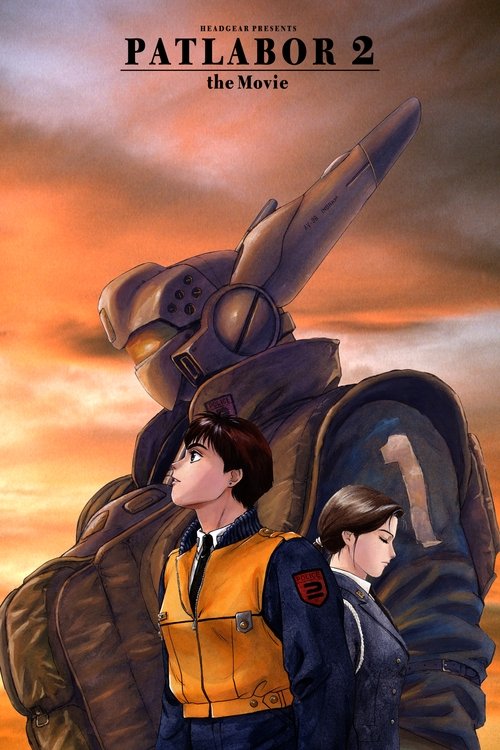
Patlabor 2: The Movie
1993 · Mamoru Oshii
For when you want anime that treats you like an adult — a cold, cerebral evening watch to chew on for days, closer to a paranoid political thriller than a robot show. Challenge, not comfort.
What it's about
A missile strikes a Tokyo bridge, and the blame lands on a military jet — but the evidence doesn't add up. As the standoff between civilian government and armed forces tips the city toward martial law, a police unit that operates giant industrial robots is pulled into the search for the terrorist orchestrating it all. The robots, though, mostly stay in the hangar; this is a conspiracy thriller about a peaceful nation discovering how thin its peace really is.
The experience
Slow-burning, wintry, and hypnotic — long wordless stretches of Tokyo under gray light, tanks idling beneath cherry trees, all scored to mournful electronics. It's a thriller that works by mood and implication, and it leaves you unsettled in a way action rarely does.
The craft
Mamoru Oshii and his team developed a rigorous layout system that treated animation drawings like a cinematographer's setups, and it shows: the film's vision of Tokyo under creeping military occupation is composed with a realism that reset the standard for the medium. Kenji Kawai's melancholy electronic score is inseparable from the film's spell — this one rewards good speakers and your full attention.
Why it matters
The hinge between mecha anime and the philosophical science fiction Oshii would pursue in Ghost in the Shell, and a touchstone for anyone arguing animation can carry serious political cinema. Its portrait of a nation insulated from the wars fought in its name has only grown more discussed with time.
Mamoru Oshii's masterpiece, and the quiet hinge between mecha anime and the philosophical cinema he would pursue in Ghost in the Shell. What begins as a procedural — a mysterious missile strike on a Tokyo bridge, a police unit dragged into the fallout — deepens into a meditation on postwar Japan itself: a nation living inside an 'unjust peace,' insulated from the wars fought elsewhere in its name. The genre hardware stays mostly in its hangar; Oshii is more interested in wordless passages of Tokyo under winter light and creeping martial law — tanks idling beneath cherry trees, birds wheeling over canals — scored to Kenji Kawai's mournful electronics. The film's rigorous 'layout system,' developed with Toshihiko Nishikubo and artists who treated animation drawings like cinematographer's setups, reset the standard for realism in Japanese animation and directly shaped everything from Evangelion onward. Dense with argument, patient beyond commercial reason, it is routinely cited by animators and critics as one of the medium's supreme achievements — a political thriller in which the most devastating weapon deployed is a single long conversation in a car.
A Deleuzian reading
Tanks idle under cherry trees.
The full Deleuzian reading of Patlabor 2: The Movie →
Reception
In 1993 it wrongfooted Patlabor fans expecting the franchise's usual comedy-with-robots and instead delivered a slow, wintry political thriller — respected but hardly a crowd-pleaser. Three decades on it's routinely called Oshii's true masterpiece, the film where 'anime for adults' stopped being a marketing line and became a fact.
How Patlabor 2: The Movie was received, from release to now →
Influences: the films it descends from and the films it influenced
- La Jetée (1962) — Oshii's essayistic wordless passages and voiceover-over-still-imagery meditation on war and memory descend directly from Marker's photo-roman method of building a film from held images and reflective narration.
- Stalker (1979) — The patient duration, water-and-reflection imagery, and philosophy delivered through atmosphere rather than plot in Patlabor 2's dead-time Tokyo sequences are lifted from Tarkovsky's long contemplative takes.
- The Battle of Algiers (1966) — The cold documentary-grained procedural of a state security apparatus responding to insurgency — checkpoints, chain-of-command, martial law — models Patlabor 2's clinical staging of a Tokyo coup crackdown.
- Mobile Suit Gundam (1979) — Tomino's 'real robot' reframing of mecha as military hardware with logistics, politics, and fallible operators is the genre foundation Patlabor extends into police-procedural realism.
- Akira (1988) — Otomo's dense photographic layouts, detailed urban environments, and realistic light established the animation-as-cinematography precision Oshii's Headgear team pushed toward telephoto-camera realism.
- Patlabor: The Movie (1989) — The direct predecessor: same team and layout system, and the template of an absent ideologue antagonist whose worldview structures a procedural investigation rather than a physical confrontation.
- Angel's Egg (1985) — Oshii's near-wordless, image-driven method of storytelling through silence, water, and falling light — later distilled into Patlabor 2's mute city montages — is prototyped here.
- The Man Who Stole the Sun (1979) — Reprises the lone catastrophist holding a paralyzed capital, staged in long-lens compositions of emptied infrastructure and committee rooms, with tension generated by procedural inaction rather than by confrontation.
- Ghost in the Shell (1995) — The direct heir: a wordless city-drift montage set to Kenji Kawai's choral-electronic score, layout-driven photographic backgrounds, and a philosophical procedural — all techniques first fused in Patlabor 2.
- Neon Genesis Evangelion (1995) — Anno absorbed Patlabor 2's JSDF-and-bureaucracy procedural detail, its use of held silence and dead-air pauses, and its on-screen military readouts and text cards as dramatic devices.
- Jin-Roh: The Wolf Brigade (1999) — Scripted by Oshii, it extends the Kerberos political thriller of an armed state unit with the same layout realism and 'peace resting on concealed violence' thesis.
- Innocence: Ghost in the Shell 2 (2004) — Extends animation-as-cinematography into extended dialogue-as-philosophy exchanges and a Kawai-scored festival-procession set-piece that is the direct descendant of Patlabor 2's wordless passages.
- Metal Gear Solid (1998) — Kojima explicitly modeled its political-military procedural, JSDF-coup scenario, and dialogue-heavy expository confrontations on Patlabor 2's structure of talk as combat.
- Serial Experiments Lain (1998) — Inherits the Oshii mood of urban dread built through ambient sound design, desaturated stillness, and philosophical inaction rather than event-driven plotting.
- Avalon (2001) — Oshii's live-action extension of the same desaturated, contemplative war-and-simulation meditation, again scored by Kenji Kawai with sustained wordless procedural stretches.
- Shin Godzilla (2016) — Established the dialogue-heavy JSDF/police procedural about constitutional limits on Japanese military force during a Tokyo crisis, turning quiet ministerial meetings and legal hair-splitting into the suspense engine.
- Ghost in the Shell 2: Innocence (2004) — Its extended still-life city montage — empty streets, bridges and canals held in long takes scored to Kawai — is the exact template for Innocence's contemplative interstitial passages.
- The Red Spectacles (1987) — Oshii's live-action Kerberos film supplies the dialogue-as-weapon register: long theatrical monologues that migrate into Arakawa's philosophical interrogations of just war and unjust peace.
- Mobile Suit Gundam 0080: War in the Pocket (1989) — Contemporaneous real-robot realism sharing Patlabor 2's anti-heroic register — war observed cold and from the margins, quiet military mood over spectacle.
Similar films
- Ghost in the Shell (1995) — influence & lineage
- Jin-Roh: The Wolf Brigade (1999) — influence & lineage
- Akira (1988) — influence & lineage
- Angel's Egg (1985) — influence & lineage
- Ghost in the Shell 2: Innocence (2004) — shared sensibility
- Sonatine (1993) — shared sensibility
- The Boy and the Heron (2023) — shared sensibility
- Tora! Tora! Tora! (1970) — shared sensibility