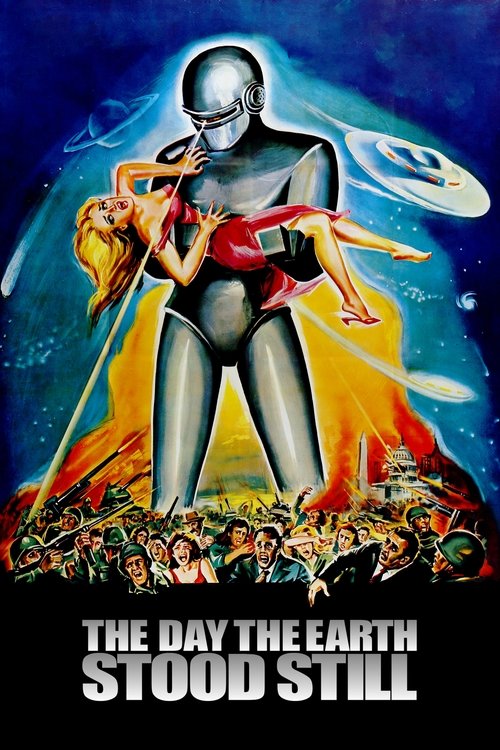
The Day the Earth Stood Still
1951 · Robert Wise
For a classic-movie night when you want science fiction with ideas — something to discuss afterward rather than jump at. Comfortable to watch, but it takes humanity's worst habits seriously enough to sting.
What it's about
A flying saucer lands in the middle of Washington, D.C., and out steps Klaatu, a calm, humanlike emissary with a towering robot at his side and a message for all of humanity: make peace, or be destroyed. When governments prove incapable of listening, he slips into the city to live among ordinary people and take our measure. The threat in this alien-visitor story, pointedly, isn't the alien.
The experience
Cool, elegant, and quietly gripping — more moral suspense than monster-movie thrills, with an eerie hum of Cold War dread underneath its civilized surface. It's talky in the best way, and its big moments still land.
Performances
Michael Rennie's Klaatu is the film's ace: dignified, dryly amused, and faintly sorrowful, he makes an alien visitor the most humane figure on screen.
The craft
Robert Wise directs with documentary crispness, and Bernard Herrmann's score — built around the wailing electronic voice of the theremin — practically invented the sound of screen sci-fi. The saucer, the robot Gort, and the black-and-white images of a halted world remain iconic in their simplicity.
Why it matters
The film that lifted science fiction from matinee serials into serious moral fable, it inverted the alien-invasion formula at the height of atomic anxiety and was inducted into the National Film Registry in 1995.
Snapshot
Released by 20th Century-Fox in 1951, The Day the Earth Stood Still is the film that lifted science fiction out of the serial matinee and into the register of moral fable. A humanoid emissary named Klaatu (Michael Rennie) descends on Washington, D.C., in a gleaming saucer, accompanied by an implacable robot, Gort, to deliver an ultimatum: humanity may keep its atomic weapons or keep its place among the civilizations of space, but not both. What distinguishes the picture from the alien-menace cycle that surrounded it is its inversion of fear — the visitor is not an invader but a warning, and the danger in the frame is us. Directed by Robert Wise, scored by Bernard Herrmann, and written by Edmund H. North, it remains one of the touchstones of serious postwar SF, admitted to the National Film Registry in 1995.
Industry & production
The project originated not with a studio franchise but with a producer's convictions. Julian Blaustein, working at Fox, set out to make a message picture about international cooperation and the atomic peril, and searched science-fiction magazines for a vehicle that could carry that argument without preaching. He found it in Harry Bates's 1940 novelette "Farewell to the Master," published in Astounding Science-Fiction, and commissioned Edmund H. North to adapt it. Studio head Darryl F. Zanuck and Fox backed the film as a prestige-inflected genre entry, budgeted with restraint rather than spectacle in mind.
The production leaned on Fox's institutional strengths: its effects department, its contract craftsmen, and location access to the capital. Second-unit and establishing photography was taken in Washington, D.C., grounding the fantasy in recognizable civic geography — the Mall, the monuments, the ordinary streets — while interiors were built and shot on the Fox lot. The casting of Michael Rennie, a British actor largely unknown to American audiences, was a deliberate production choice: an unfamiliar face let audiences accept Klaatu as a genuine stranger, unencumbered by star associations. The film was a critical and commercial success in its day; precise box-office figures are not something I can reliably cite, so I won't attach numbers to it, but its reputation and industry standing were secured quickly and have only grown.
Technology
The picture's technological ambitions were modest in budget and disciplined in execution, which is precisely why they still convince. The flying saucer — smooth, seamless, without visible rivets or panels — was designed to look manufactured by an intelligence beyond ours; its ramp and hatch open without evident seams, an effect achieved through careful set construction and matte work by Fox's effects unit under supervisors including Fred Sersen and Ray Kellogg. Gort, the robot, was a costume worn by Lock Martin, a very tall doorman from Grauman's Chinese Theatre, chosen for his height; contemporary accounts note that Martin's physical limitations meant he could only sustain short takes and that the heavy suit required careful staging. Gort's visor lifts to emit a disintegrating beam, an optical effect that dissolves rifles and tanks — economical, clean, and memorably sinister.
The single most consequential piece of "technology" in the film is sonic rather than visual: Bernard Herrmann's use of electronic instruments, above all the theremin. Herrmann built an orchestra without a conventional string section, emphasizing brass, percussion, pianos, harps, electronic organ, and two theremins — the instrument's wavering, disembodied glissando became, through this score, the sound of the alien itself. The theremin work is associated with Samuel Hoffman, the era's best-known player of the instrument. The exact instrument roster is sometimes reported with slight variation, so I'll describe the ensemble's character rather than fix a precise count, but the innovation is not in doubt: Herrmann treated electronic timbre as a structural voice, not a gimmick.
Technique
Cinematography
Leo Tover photographed the film in crisp black and white with a restrained, near-documentary clarity, especially in the Washington sequences, where the newsreel flatness lends the fantastic premise a reportorial weight. The visual grammar is unshowy and legible — clean compositions, controlled contrast — reserving stylization for the moments that require awe: the saucer's landing, Gort's looming stillness, the wash of light when power fails across the world. The camera treats Klaatu with dignity and Gort with dread, and much of the film's tension comes from how plainly the extraordinary is filmed against the ordinary.
Editing
Robert Wise had come up as an editor — famously cutting Citizen Kane and The Magnificent Ambersons at RKO — and that discipline shows. The film, cut by William Reynolds (later an editor of The Sound of Music, The Sting, and The Godfather), is tightly paced and economical, withholding spectacle and doling it out. The global demonstration — Klaatu neutralizing electrical power for thirty minutes, the sequence that gives the film its title — is edited as a montage of stalled ordinary life, its power derived from accumulation rather than any single effect.
Mise-en-scène / staging
The film's spatial logic sets the cosmic against the domestic. Much of the story unfolds in a Washington boarding house, a microcosm of everyday America where Klaatu, under the alias "Mr. Carpenter," lives incognito among ordinary citizens. Art direction by Lyle Wheeler and Addison Hehr keeps these interiors homely and specific, so that the saucer resting on the Mall and Gort standing sentinel read as intrusions of another order of being. The staging repeatedly frames Klaatu as a calm, contained figure amid anxious crowds, and Gort as a monolith — stillness weaponized.
Sound
Beyond Herrmann's score, the sound design does quiet, deliberate work: the hum and whir of the ship, the eerie tone of Gort's beam, the ambient hush when the world's machinery stops. The absence of sound in the power-off sequence is as expressive as any cue. Herrmann's music, however, dominates the aural identity of the film — the theremin's cry is inseparable from the image of the alien, and the score's spare, brass-heavy solemnity gives the whole picture its funereal grandeur.
Performance
Michael Rennie's Klaatu is the film's center of gravity: measured, courteous, faintly sorrowful, an intelligence that regards humanity with more patience than we deserve. His unfamiliarity to American audiences was an asset, and his restraint keeps the messianic role from tipping into sanctimony. Patricia Neal grounds the film emotionally as Helen Benson, the widow who comes to trust Klaatu; her calm delivery of the phrase "Klaatu barada nikto," entrusted to her as a fail-safe, is one of cinema's most quoted moments. Billy Gray plays her son Bobby with an unforced naturalism, and Sam Jaffe lends the scientist Professor Barnhardt an Einstein-like humane authority. Hugh Marlowe supplies the petty, self-interested human foil.
Narrative & dramatic mode
The film operates as parable and thriller at once. Its dramatic mode is fundamentally allegorical: Klaatu is a stranger who arrives with a gospel of peace, is met with fear and violence, moves among ordinary people under a common name, is betrayed and killed by earthly authority, and is restored to life to deliver a final warning before departing. Edmund North built these Christian parallels deliberately — the alias "Carpenter," the death and resurrection, the ascension — though he kept them understated. Around this spiritual spine, the film runs a manhunt thriller: Klaatu hidden in plain sight, the city on alert, the clock ticking toward his demonstration and his ultimatum. The structure is patient and dialectical, arguing its case through encounter rather than action.
Genre & cycle
The Day the Earth Stood Still belongs to the great early-1950s wave of American science fiction, born of atomic anxiety and Cold War dread — but it stands against the grain of that cycle. Where The Thing from Another World (also 1951), War of the Worlds (1953), and Invasion of the Body Snatchers (1956) figured the alien as invader, contaminant, or predator, Wise's film makes the alien the voice of reason and locates the threat in human belligerence. It is the founding text of the "benevolent visitor" strain of SF, the counter-tradition to the monster movie. It also helped legitimize the genre as a vehicle for adult political argument, establishing that a saucer film could be about disarmament and coexistence rather than merely about spectacle and survival.
Authorship & method
Robert Wise directed with the craftsman's tact that defined his eclectic career. Trained as an editor and seasoned by his work on Val Lewton's atmospheric RKO horror films (The Curse of the Cat People, The Body Snatcher), Wise brought economy, restraint, and a feel for suggestion over display; he would go on to genres as varied as the musical (West Side Story, The Sound of Music) and later SF (The Andromeda Strain, Star Trek: The Motion Picture). His method here was to keep the fantastic legible and the human scale intimate.
His collaborators shaped the film as decisively. Producer Julian Blaustein supplied the animating purpose. Screenwriter Edmund H. North transformed Bates's story — discarding its famous twist, in which the robot rather than the man proves to be the master — into a moral fable with a religious undertext. Cinematographer Leo Tover gave it documentary clarity; editor William Reynolds gave it pace. And Bernard Herrmann, in his first score for a science-fiction film, produced perhaps the single most influential element of all — a body of electronic and orchestral music that permanently coded the sound of "outer space" for popular culture.
Movement / national cinema
The film is a product of the classical Hollywood studio system at its late maturity, made inside 20th Century-Fox's vertically integrated apparatus with its stable of contract craftsmen and its effects department. It is not the work of a movement in the avant-garde sense, but it participates in a distinctly American postwar current: the socially conscious "message picture" fused, here, with genre. Its semidocumentary use of Washington locations connects it to a late-1940s Hollywood taste for location realism, and its liberal internationalism reflects a strain of Cold War-era American filmmaking willing, cautiously, to critique militarism and nationalism.
Era / period
The film is inseparable from its moment: 1951, six years after Hiroshima and Nagasaki, at the height of early Cold War tension, with the hydrogen bomb on the horizon and anticommunist anxiety saturating public life. Klaatu's warning — that a species with atomic weapons and interplanetary ambitions is a danger the galaxy will not tolerate — is a direct address to the nuclear standoff. The film's pacifist internationalism was, in that climate, a pointed position. One trace of the period's pressures survives in the text itself: the censorship regime governing religious content led to a modification of the resurrection, so that Klaatu's restored life is framed as temporary and the ultimate power over life and death is reserved to "the Almighty Spirit" — a line inserted to satisfy the Production Code's guardians rather than the writer's original design.
Themes
At its core the film is a meditation on peace and its price. It argues that survival for a violent species may require surrendering some sovereignty to a higher order — Klaatu describes an interstellar authority that keeps the peace through the incorruptible force of robots like Gort, trading a measure of freedom for the guarantee of security, a bargain the film presents as sobering rather than utopian. Braided through this political argument is the Christian allegory of a savior rejected and killed by the world he came to redeem. Further themes recur: the failure of nationalism and the fragmentation of human authority (Klaatu cannot find a single leader to address); the moral seriousness of science against the shortsightedness of politics and the military, embodied in Barnhardt; and the openness of the child and the widow, who accept the stranger the crowd fears.
Reception, canon & influence
The film was well received on release and has been steadily elevated since; it won a Golden Globe recognizing a film that promoted international understanding, an honor squarely aligned with Blaustein's original intent. Critical estimation has only risen, and in 1995 the Library of Congress selected it for the National Film Registry as a work of cultural, historical, and aesthetic significance.
Its influences run backward to Harry Bates's pulp novelette and, more diffusely, to the long literary tradition of the messianic stranger and the moral fable — North's screenplay openly grafts the Gospels onto Bates's plot. Its forward legacy is enormous. It established the benevolent-alien archetype that runs through Spielberg's Close Encounters of the Third Kind and E.T., and its hopeful, cooperative vision of contact prefigures the ethos of Star Trek. Bernard Herrmann's theremin-inflected score became a template for the sound of the uncanny and the extraterrestrial for decades. The phrase "Klaatu barada nikto" entered the popular lexicon and has been quoted and paid homage across later cinema, from the character names Klaatu, Barada, and Nikto in Return of the Jedi to its comic deployment in Army of Darkness. Gort's sleek, faceless design shaped the iconography of the movie robot. A 2008 studio remake, with Keanu Reeves as Klaatu, testified to the original's durability even as it underscored how completely Wise's 1951 film had defined the material. Few genre pictures of its era have proved so foundational; its argument, and its images, remain load-bearing for science fiction as a whole.
Reception
A prestige hit in 1951 — it even won a Golden Globe for promoting 'international understanding' — at a moment when most alien-invasion pictures were drive-in cheapies. Its stature has only compounded since: National Film Registry, AFI lists, and near-universal agreement that it's the crown jewel of Golden Age sci-fi.
How The Day the Earth Stood Still was received, from release to now →
Influences: the films it descends from and the films it influenced
- Metropolis (1927) — Established the towering, humanoid metal automaton as screen icon — Gort's sleek faceless design descends directly from Lang's Maschinenmensch as the robot-as-object-of-awe.
- Things to Come (1936) — Modeled the didactic SF fable that stages a message-bearing visitor lecturing humanity toward pacifist internationalism, the same sermon-in-spectacle structure North's screenplay adopts.
- The Curse of the Cat People (1944) — Wise's own Val Lewton apprenticeship in suggestion-over-display — dread built from shadow and offscreen implication — is the restraint he carries into Klaatu's understated menace.
- The Body Snatcher (1945) — Wise's Lewton-trained economy of staging and editor's instinct for withholding the reveal directly informs his refusal to over-show the saucer and Gort.
- Spellbound (1945) — Miklós Rózsa's theremin scoring of psychological otherness set the precedent Herrmann extends, coding the instrument's wavering tone as the sound of the uncanny.
- Citizen Kane (1941) — Wise cut this film as editor and Herrmann scored it; the montage economy and leitmotif discipline of that collaboration are the craft toolkit both men bring to Klaatu.
- Forbidden Planet (1956) — Extends the intelligent-robot-as-servant iconography (Robby) and the fully electronic 'tonalities' score, pushing Herrmann's electronic coding of space into pure synthesized soundscape.
- The Andromeda Strain (1971) — Wise reprises his own method — clinical documentary realism and procedural restraint applied to an extraterrestrial threat — refining the legible-fantastic approach he pioneered here.
- Close Encounters of the Third Kind (1977) — Directly inherits the benevolent-alien archetype and the cooperative-contact ethos, transposing Klaatu's peaceful arrival into a communion staged through light and tone.
- Star Wars (1977) — Pays explicit homage by naming characters Klaatu, Barada, and Nikto in Return of the Jedi, carrying the film's coined phrase into franchise iconography.
- Star Trek: The Motion Picture (1979) — Wise directs the feature born from a series whose cooperative-contact ethos this film prefigured, closing the loop between his 1951 template and its televisual heir.
- E.T. the Extra-Terrestrial (1982) — Completes the benevolent-alien lineage by fusing the messianic-visitor Christian allegory (the death-and-resurrection arc) with the intimate human scale Wise insisted on.
- Starman (1984) — Reprises the humanoid-emissary-among-us premise, an alien in human form observing humanity's capacity for violence and grace, the direct dramatic descendant of Klaatu's incognito walk.
- Contact (1997) — Extends the hopeful-first-contact ethos rendered in documentary-realist register, staging cosmic encounter against grounded institutional and domestic scale.
- Arrival (2016) — Inherits the pacifist-internationalist thesis — contact as a test of whether humanity chooses cooperation over militarized fear — staged with restrained, legible-fantastic control.
- Independence Day (1996) — Staged the saucer's arrival as a Washington-centered national-emergency media event — the reverent iconography ID4 deliberately inverts into hostility.
- The Iron Giant (1999) — Provides the Cold War arrival-from-the-sky robot (Gort) as a moral mirror of humanity's atomic militarism — the arms-race parable Bird relocates to 1957.
- The Rocky Horror Picture Show (1975) — Named in the opening song ('Michael Rennie was ill…'); its benevolent-then-menacing alien visitor arriving among ordinary Americans is reworked into Frank's Transylvanian 'visitation' of Brad and Janet.
- The Lost Weekend (1945) — Rózsa's theremin-as-derangement here, contemporaneous with Spellbound, cemented the electronic timbre Herrmann would repurpose from inner disturbance to cosmic otherness.
- The Thing from Another World (1951) — Released the same year, it answers the benevolent-alien thesis with the hostile-alien antithesis while sharing the theremin-scored, documentary-flat military-procedural staging of first contact.
- Invasion of the Body Snatchers (1956) — Shares the Cold War allegory delivered through documentary-realist small-town staging, treating the fantastic as an intrusion into ordinary domestic space rather than spectacle.
Similar films
- Forbidden Planet (1956) — influence & lineage
- Close Encounters of the Third Kind (1977) — influence & lineage
- The Andromeda Strain (1971) — influence & lineage
- Metropolis (1927) — influence & lineage
- Contact (1997) — influence & lineage
- Arrival (2016) — influence & lineage
- Invasion of the Body Snatchers (1956) — influence & lineage
- E.T. the Extra-Terrestrial (1982) — influence & lineage