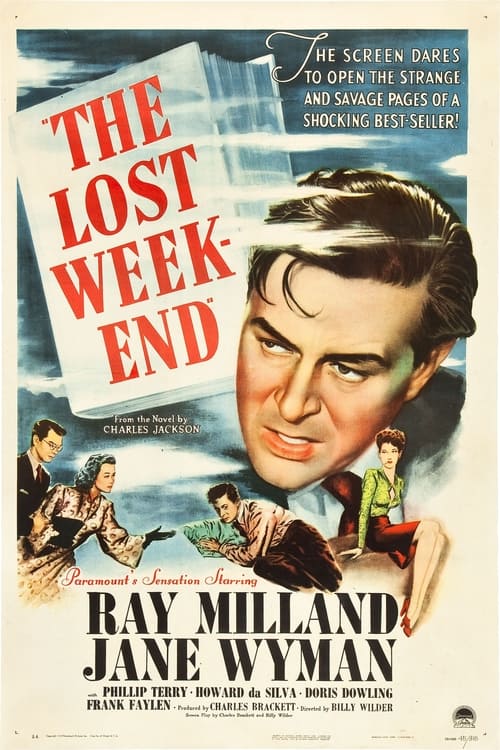
The Lost Weekend
1945 · Billy Wilder
For when you want a serious, gripping drama that stares at something hard without blinking — a film to reach for when you're ready to be shaken rather than soothed. This is a challenge, not a comfort watch.
What it's about
Don Birnam is a New York writer who hasn't written anything in years, and drinking is the reason. Ten days sober and supposedly on the mend, he dodges a quiet country weekend arranged by his brother and his girlfriend and slips instead into a four-day bender through Manhattan's bars and pawnshops — one that spirals from evasion and small lies toward genuine danger. It's a portrait of addiction from the inside: the scheming, the shame, the terrifying pull of the next drink.
The experience
Tense and claustrophobic in a way that sneaks up on you — you watch a charming, articulate man lie to everyone including himself, and the dread ratchets with each hour of the weekend. It's unsparing without being lurid, and by the hospital-ward stretch it edges into outright horror.
Performances
Ray Milland, in the role that won him the Oscar, plays Don with unnerving completeness — the charm, the eloquent self-justification, the panic and the shakes — making a man in freefall sympathetic without ever letting him off the hook.
The craft
Billy Wilder and Charles Brackett strip the story to a lean arc of craving and collapse, and Wilder shoots it with a realism rare for 1945 — real New York streets, a real hospital alcoholic ward — laced with noir shadows and paranoid flourishes. The black-and-white photography turns bars and pawnshop-lined avenues into a landscape of temptation, and the famous score wires the craving directly into the soundtrack.
Why it matters
It swept the top Academy Awards for 1945 — Picture, Director, Actor, and Screenplay — and broke a taboo: Hollywood had treated drunks as comic relief or moral failures, and this film insisted addiction was a disease. Nearly every serious screen treatment of alcoholism since stands in its shadow.
Snapshot
The Lost Weekend is Billy Wilder's unsparing chronicle of four days in the drinking life of Don Birnam, a blocked New York writer whose alcoholism has hollowed out his talent, his relationships, and his sense of self. Adapted from Charles R. Jackson's 1944 novel of the same name, the film was, for its moment, a startling act of frankness: it treated addiction not as moral weakness played for melodrama or comedy but as a compulsive, physiological, self-perpetuating disease. Wilder and his writing partner Charles Brackett stripped the material to a taut arc of craving, evasion, humiliation, and near-collapse, and Wilder shot much of it on real New York streets and in a hospital alcoholic ward. The result swept the major Academy Awards for 1945 — Picture, Director, Actor (Ray Milland), and Adapted Screenplay — and shortly after took the Grand Prix at the inaugural Cannes Film Festival in 1946, an unusual dual endorsement from Hollywood and the emerging European festival culture. It remains the foundational addiction drama in American cinema and a key transitional work between the social-problem picture and the shadow world of film noir.
Industry & production
The film was produced by Charles Brackett for Paramount Pictures, the studio to which the Brackett–Wilder partnership was then attached and where they had just completed the landmark Double Indemnity (1944). By Wilder's own often-repeated account, part of his motivation for the project grew out of that earlier collaboration: he had worked with Raymond Chandler on the Double Indemnity screenplay and observed Chandler's struggle with drinking, which sharpened his interest in Jackson's novel. That origin story is well attested in Wilder's interviews, though like much of his self-narration it should be read as the director's own framing rather than documented cause.
Adapting the novel was itself a commercial gamble. Alcoholism had appeared in American films mostly as comic business or as a symptom in a larger melodrama; a picture that made a drunk its protagonist and refused to soften him was considered risky under the Production Code and with exhibitors. The most durable production legend surrounding the film is that liquor-industry interests, alarmed by its portrait of drinking, reportedly attempted to buy and suppress the negative, while temperance organizations pressed for the opposite emphasis. This anecdote is repeated in many accounts and traces largely to Wilder himself and to studio publicity; the specifics are not firmly documented, and it is best treated as industry lore rather than established fact.
Equally part of the film's legend is a troubled preview. The picture is widely said to have played badly at an early sneak screening — audiences reportedly laughed in the wrong places — and Paramount is said to have considered shelving it, with the addition of Miklós Rózsa's score credited by many accounts with helping the film cohere on reshown previews. The broad outline is consistent across sources, but the precise chronology varies in the retellings.
Technology
The Lost Weekend was made with the standard black-and-white, Academy-ratio (1.37:1), optical-sound apparatus of mid-1940s Hollywood, but it deployed two technological choices with real expressive consequence. The first was extensive location shooting in New York — most famously the sequence in which Birnam trudges up Third Avenue trying to pawn his typewriter, only to find every pawnshop shuttered for Yom Kippur. Cinematographer John F. Seitz worked with concealed and long-lensed setups to capture the actual city, an approach that anticipated the semi-documentary location style that would spread through late-1940s American filmmaking.
The second was musical-technological: Rózsa's prominent use of the theremin, the early electronic instrument, to voice Birnam's craving and his descent into delirium. Rózsa used the instrument in the same period for Hitchcock's Spellbound (1945), and these two scores are commonly cited as the works that established the theremin's Hollywood association with psychological derangement and altered states — a convention that would echo for years.
Technique
Cinematography
John F. Seitz — who also shot Double Indemnity and later Sunset Boulevard for Wilder — gives the film a hard, urban chiaroscuro that sits close to contemporaneous film noir. Interiors of Nat's bar, Birnam's apartment, and the hospital ward are handled with pooled light and deep shadow; exteriors exploit the grimy authenticity of the location work. Seitz is also credited with the film's most discussed optical effects, produced to render Birnam's delirium tremens: the notorious hallucination in which a bat attacks a mouse emerging from the wall, and the subjective distortions of the ward sequence. These special-effect passages are motivated entirely by the protagonist's disintegrating perception, an early sustained use of subjective imagery in a mainstream American drama.
Editing
The credited editor is Doane Harrison, Wilder's essential and long-standing editorial collaborator, whose partnership with the director began in this Paramount period and continued for years. Harrison's influence on Wilder is generally understood to have been unusually large — Wilder repeatedly acknowledged learning cutting logic from him and increasingly shot economically, capturing only what he intended to use. The film's construction reflects that discipline: a tight present-tense spine of the bender, punctuated by a flashback that fills in Birnam's history with Helen and the origins of his drinking, so that exposition is delivered without slackening the forward pull of the four-day crisis.
Mise-en-scène / staging
Wilder stages the film around the geography of a compulsion: the apartment where a bottle is hidden in the ceiling light fixture and on a string outside the window; the neighborhood bar presided over by Nat; the liquor store, the pawnshop, and finally the hospital ward. Objects carry the drama — the concealed bottle, the pawned typewriter, the borrowed money — and Wilder repeatedly returns to them so that the audience tracks Birnam's cunning as an addict. One of the film's celebrated small touches is the ring of moisture a glass leaves behind, used as a visual motif of the drink's omnipresence. The staging is functional rather than baroque, keeping attention on behavior.
Sound
Beyond Rózsa's theremin-inflected score, the film uses sound expressionistically at its extremes — the amplified, warped sonic texture of the DT sequence — while holding to naturalistic dialogue elsewhere. The contrast between the muted realism of the bar and street scenes and the heightened audiovisual assault of the hallucinations marks the boundary between Birnam's functioning self and his collapse.
Performance
Ray Milland's performance as Don Birnam is the film's center and its greatest achievement. Milland, previously known largely for light leading-man roles, plays the full range of the addict: the charming rationalizer, the self-pitying romantic, the frightened man in the ward, and the physically wrecked figure of the delirium sequence. The performance won him the Academy Award for Best Actor and the acting prize at the first Cannes Festival, and it is generally regarded as the model for the serious screen depiction of addiction. Around him, Jane Wyman brings unsentimental steadiness to Helen St. James; Howard Da Silva's bartender Nat functions as a wary moral witness; Frank Faylen is chilling as Bim, the sardonic male nurse in the alcoholic ward; and Doris Dowling and Phillip Terry fill out the world of the bar and the family.
Narrative & dramatic mode
The film operates in a compressed realist mode organized around a single, escalating crisis. Its principal structural device is the flashback: from the present-tense weekend, the narrative reaches back to explain how Birnam and Helen met and how his drinking corroded their life, then returns to the deepening emergency. The dramatic engine is not external conflict but the addict's relationship to his own compulsion — the lies, the hidden bottles, the missed weekend in the country, the failed attempt to write, the theft of a purse, the pawnshop odyssey, the fall down the stairs, the ward, and the final temptation. Wilder maintains sympathy for Birnam without excusing him, and the film's contested ending — which pivots on the reclaimed typewriter and Helen's insistence on hope — has long been debated as either an earned turn or a studio-inflected concession to redemption. The novel's bleaker openness is generally acknowledged to have been resolved more hopefully on screen.
Genre & cycle
The Lost Weekend belongs most directly to the "social problem" or message picture, the Hollywood cycle that dramatized public issues — and it is arguably the strongest of the addiction-themed entries in that tradition. But its visual language, urban setting, doomed-feeling protagonist, and shadowed cinematography place it adjacent to film noir, which was crystallizing in exactly these years and partly through the same personnel (Wilder and Seitz on Double Indemnity). It is best understood as a hybrid: a problem picture shot with noir's tools, which lends its ostensibly reformist subject an existential darkness beyond the genre's usual didacticism.
Authorship & method
The film is a product of the Brackett–Wilder partnership at its height. Charles Brackett produced and co-wrote; Billy Wilder co-wrote and directed. Their working method — Brackett the more restrained, literary sensibility and Wilder the sharper, more cynical one — produced a screenplay that is both compassionate and unsparing, and the Academy recognized the writing alongside the direction. Wilder's direction here is notably restrained by his own later standards: fewer of the verbal fireworks of his comedies, more sustained attention to a single deteriorating consciousness.
The key collaborators form a recognizable Wilder unit of the period. John F. Seitz (cinematographer) supplied the noir-inflected image that Wilder would draw on again for Sunset Boulevard. Doane Harrison (editor) was the editorial conscience Wilder credited throughout his career. Miklós Rózsa (composer), a Hungarian émigré then doing some of the most inventive scoring in Hollywood, gave the film its aural signature; his theremin work here and in Spellbound the same year is central to his historical reputation. Together they translated Jackson's interior novel into a rigorously external, behavior-driven film.
Movement / national cinema
The film is a Hollywood studio production, but it stands at a crossroads of currents. Its location realism looks forward to the semi-documentary strain of late-1940s American cinema and shares sensibility with the era's turn toward social realism. Its expressionist flourishes and shadow work descend from the German and Central European visual tradition carried into Hollywood by émigré artists — Wilder and Rózsa among them — and align it with the noir movement those figures helped shape. It is, in short, an American film deeply marked by émigré European craft.
Era / period
Released in 1945, at the very close of World War II, the film reflects a Hollywood beginning to test the boundaries of the Production Code and audience appetite for darker, more adult subject matter. It belongs to the same immediate postwar moment that produced the maturing of film noir and a wave of problem pictures confronting subjects — addiction, prejudice, mental illness — that the industry had previously avoided or trivialized. Its awards success signaled that such seriousness could be commercially and critically viable.
Themes
At its core the film is about compulsion and the self-deception that sustains it. Birnam is a writer who cannot write, and the film ties his addiction to a specific artistic and personal failure: alcohol is both his escape from the terror of the blank page and the agent of his ruin. Related themes cluster around it — the corrosion of love and family loyalty (Helen and brother Wick as enablers and rescuers), shame and public humiliation (the restaurant, the pawnshop, the ward), and the addict's isolating grandiosity and self-pity. The alcoholic ward sequence enlarges the personal story into a social one, presenting addiction as a mass condition handled by an indifferent institution. Underlying all of it is a question the film keeps open: whether the will and the love of others can actually break the cycle, or only interrupt it.
Reception, canon & influence
Critically and institutionally, The Lost Weekend was received as a breakthrough. Its four Academy Awards — Best Picture, Best Director, Best Actor, and Best Adapted Screenplay — marked it as one of the most honored films of its year, and its Grand Prix at the first Cannes Festival in 1946 (where Milland also took the acting prize) gave it a rare standing on both sides of the Atlantic; it is frequently noted as the first film to win both the top Oscar and the top Cannes award. It has since been recognized as a canonical American film, including selection to the National Film Registry by the Library of Congress for cultural and historical significance.
Influences on the film (backward): most directly, Charles R. Jackson's 1944 novel, whose interiority Wilder and Brackett externalized. Stylistically, the film draws on the émigré-carried expressionist tradition and on Wilder and Seitz's own immediately preceding work in Double Indemnity, which supplied the noir visual grammar. Rózsa's theremin experiment connects to the broader mid-1940s vogue, shared with Spellbound, for using new sonorities to signify disordered minds.
Legacy (forward): the film effectively created the template for the serious American addiction drama, and its DNA is visible in later works such as Days of Wine and Roses (1962) and, decades on, Leaving Las Vegas (1995), among many films that treat dependency as disease rather than vice. Its subjective rendering of hallucination and its willingness to inhabit a self-destructive protagonist fed into both the maturing problem picture and the darker character studies of subsequent decades. More diffusely, Rózsa's theremin cemented an audiovisual convention for madness and craving that persisted through the era's genre filmmaking. Within Wilder's own career, the film confirmed him as a director of dramatic weight as well as wit and consolidated the Seitz–Harrison–Brackett collaboration that would soon yield Sunset Boulevard (1950).
A Deleuzian reading
A glass leaves a wet ring on the bar.
The full Deleuzian reading of The Lost Weekend →
Reception
A sensation in 1945 — it swept the Oscars (Picture, Director, Actor, Screenplay) and shared the Grand Prix at the very first Cannes Festival — for its then-shocking, unglamorous portrait of alcoholism. Today it's respected as a landmark but often ranks as the 'homework' entry in Wilder's run, overshadowed by Double Indemnity and Sunset Blvd.
How The Lost Weekend was received, from release to now →
How to watch The Lost Weekend: what to notice on a first viewing
- Watch where Birnam hides his bottles around the apartment. Wilder keeps returning to the ceiling fixture and the string outside the window, so you learn his hiding places like an accomplice. The film builds you into an expert on his cunning instead of narrating his psychology.
- Notice the wet ring a glass leaves on the bar. Nat wipes it away and another appears in its place all through the film, a small recurring mark of the drink's presence. The ring shows what Wilder trusts: an object can carry the drama better than a line of dialogue.
- Listen for the theremin entering under Birnam's craving. Rózsa's theremin surfaces whenever the pull toward drink sharpens, then recedes when Birnam is functioning, marking his two states without a word. A sound with no visible source becomes the audible shape of an urge before he admits it.
- Watch Milland's face in the quiet moments before he drinks. Milland plays the charming rationalizer, the self-pitying romantic, and the frightened man in the ward, often shifting between them without a line of dialogue. The performance carries the addiction's whole range on one face, which is why it still anchors the film.
The whole guide to watching The Lost Weekend, with the keys for a rewatch →
Influences: the films it descends from and the films it influenced
- Double Indemnity (1944) — Wilder and Seitz's immediately preceding collaboration supplied the low-key noir lighting, venetian-blind shadow grammar, and confessional-voiceover framing that Lost Weekend redeploys around a single deteriorating psyche.
- The Cabinet of Dr. Caligari (1920) — Foundational text of the émigré expressionism Wilder inherited — externalizing a deranged consciousness through distorted mise-en-scène rather than dialogue exposition.
- Sunrise (1927) — Murnau's subjective moving camera and studio-built city-as-psychological-landscape model the film's fusion of expressionist interiority with textured location realism.
- M (1931) — Lang's expressionist deployment of offscreen sound and leitmotif to render a compulsive, craving mind seeds the 'expressionist audio' strategy for sonifying addiction.
- Vampyr (1932) — Dreyer's hallucinatory subjective camera (the coffin-lid POV) prefigures the first-person delirium tremens hallucination effects — the bat-and-mouse attack seen from inside the sufferer's perception.
- The Informer (1935) — Ford and Max Steiner externalize a guilt-ridden, self-destructive man's psychological collapse through fog-shrouded subjective imagery and leitmotif scoring — a social-problem melodrama built entirely on one crumbling psyche.
- I Am a Fugitive from a Chain Gang (1932) — Establishes the Warner Bros. social-problem-picture template of location realism and an unflinching institutional/personal affliction treated as diagnosis rather than moral fable.
- Sunset Boulevard (1950) — Reunites the Seitz–Harrison–Brackett unit to apply the same noir image and doomed-narrator structure to another study of self-delusion and interior rot.
- The Snake Pit (1948) — Extends the subjective-affliction problem picture into mental illness, using institutional location realism and POV distortion to inhabit a disordered mind from the inside.
- The Man with the Golden Arm (1955) — Transposes the addiction template to heroin, with Elmer Bernstein's jazz replacing Rózsa's theremin as the sonic signature of craving and a subjective cold-turkey withdrawal sequence.
- Days of Wine and Roses (1962) — Direct heir to the serious-alcoholism-as-disease template, tracking a couple's mutual deterioration with clinical compassion rather than temperance moralizing.
- Barfly (1987) — Behavior-driven character study that fully inhabits a functioning alcoholic without redemption arc, extending the disease-portrait lineage.
- Leaving Las Vegas (1995) — Inhabits a self-destructive alcoholic without moralizing or cure, extending the dependency-as-disease framing that Lost Weekend pioneered.
- Trainspotting (1996) — Makes subjective hallucination the primary formal device (the sinking-into-carpet and dead-baby sequences) — the delirium-from-inside technique radicalized for heroin.
- Requiem for a Dream (2000) — Escalates the subjective rendering of craving and withdrawal into total formal externalization — hip-hop montage, distorted sound design, and split-screen — descending directly from the film's first-person hallucination effects.
- Under the Volcano (1984) — The founding alcoholism drama structured as a single ruinous bender, establishing the compressed downward-day architecture that Gallo's screenplay adapts to Firmin.
- Wake in Fright (1971) — Codifies the alcoholic bender as an accelerating montage of dissolves and elliptical time-collapse rather than dramatized scenes — the same editing logic Anthony Buckley pushes to delirium in Grant's two-up and drinking loops.
- Spellbound (1945) — Rózsa's theremin scoring the same year for a disordered mind — the shared mid-1940s vogue for novel sonorities as an audiovisual signifier of psychological derangement.
- Murder, My Sweet (1944) — Extends the subjective-derangement montage — Wilder's delirium-tremens hallucination sequence is the same first-person collapse of perception dramatized in Marlowe's drugged 'black pool' passage.
- The Day the Earth Stood Still (1951) — Rózsa's theremin-as-derangement here, contemporaneous with Spellbound, cemented the electronic timbre Herrmann would repurpose from inner disturbance to cosmic otherness.
Similar films
- Leaving Las Vegas (1995) — influence & lineage
- Sunset Boulevard (1950) — influence & lineage
- Double Indemnity (1944) — influence & lineage
- The Man with the Golden Arm (1955) — influence & lineage
- Requiem for a Dream (2000) — influence & lineage
- The Hustler (1961) — shared sensibility
- The Best Years of Our Lives (1946) — shared sensibility
- Wild Strawberries (1957) — shared sensibility