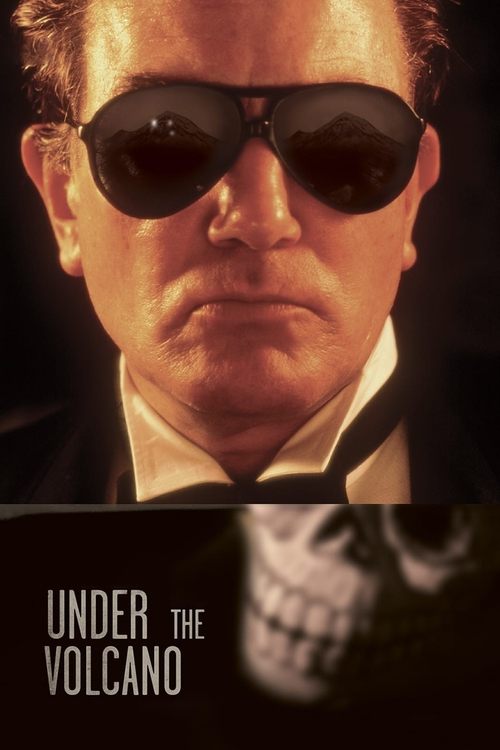
Under the Volcano
1984 · John Huston
For when you're ready to sit with a great, dark character study — a film about addiction and love that offers no easy consolation. This is a challenge watch, best met head-on rather than half-attended.
What it's about
Mexico, the Day of the Dead, 1938, with war gathering in Europe: Geoffrey Firmin, a cashiered British consul, is drinking himself to death in a small town beneath two volcanoes. Over a single day, his estranged wife Yvonne returns and, with his idealistic half-brother Hugh, tries to pull him back from the edge — while Geoffrey, brilliant and bitterly funny even in ruin, keeps choosing the abyss.
The experience
Harrowing and hypnotic — the film has the lucid, doomed momentum of its hero, moving through fiesta color and skull imagery toward something you dread. It's a portrait of self-destruction that's grimly witty on the surface and devastating underneath.
Performances
Albert Finney gives one of the towering screen performances of the 1980s: his consul is drunk in a dozen distinct registers — courtly, savage, self-mocking, lost — without a single false or showy note. Jacqueline Bisset brings aching restraint to Yvonne, the woman who came back too late or maybe just in time.
The craft
John Huston, late in his career, took a novel long called unfilmable and made the shrewd choice to strip away its stream-of-consciousness apparatus and build everything on behavior — one man, one day, one performance. The Day of the Dead setting does the symbolic work the prose once did: skulls, fireworks, and fiesta light framing a private apocalypse.
Why it matters
It stands as one of the crowning achievements of Huston's remarkable final decade and the definitive proof that Lowry's novel could reach the screen — anchored by a Finney performance that remains a reference point for portrayals of alcoholism.
Snapshot
Under the Volcano is John Huston's late-career adaptation of Malcolm Lowry's 1947 novel, long reputed to be among the most "unfilmable" works of twentieth-century literature. Compressing Lowry's dense, allusive, stream-of-consciousness modernism into a single day — the Mexican Day of the Dead, November 1938 — the film follows Geoffrey Firmin, a cashiered British consul drinking himself to death in the shadow of the volcanoes Popocatépetl and Ixtaccíhuatl, as his estranged wife Yvonne and idealistic half-brother Hugh try and fail to save him. Where the novel externalizes Geoffrey's disintegration through interior monologue and a thicket of literary and occult reference, Huston and screenwriter Guy Gallo made the pragmatic decision to strip the apparatus away and build the film around behavior — and around a single, towering performance by Albert Finney. The result is less an "adaptation" in the fidelity sense than a chamber tragedy of alcoholism and the failure of love, set against a civilization sliding toward war. It earned Finney an Academy Award nomination and stands as one of the more austere and personal works of Huston's prolific final decade.
Industry & production
The film was an independent production assembled outside the major studios and released through Universal Pictures. It was produced by Wieland Schulz-Keil and Moritz Borman, with the project's long gestation reflecting both the novel's difficulty and the perennial trouble of financing literary material with no commercial hook. Lowry's book had attracted filmmakers for decades — the rights and the ambition had circulated among various directors and writers over the years — and a great many screenplays were reportedly attempted before Gallo's spare draft cracked the problem by abandoning the attempt to reproduce the novel's interiority. Huston, then in his late seventies and physically frail (he worked with an oxygen supply on hand because of emphysema), shot the picture on location in Cuernavaca and around the state of Morelos, Mexico, the landscape that had partly inspired Lowry. The production drew heavily on Mexican craft and talent, most consequentially in hiring the veteran cinematographer Gabriel Figueroa. The film premiered in competition at the Cannes Film Festival in 1984. Precise budget and box-office figures are not something I can state with confidence, but the picture was understood as a prestige, awards-oriented release rather than a commercial one, and its theatrical reach was modest.
Technology
Under the Volcano was made with conventional mid-1980s 35mm photochemical technology, and it is in no sense a technically experimental film; its ambitions lie in performance and atmosphere rather than apparatus. It was shot on color negative and finished for standard theatrical projection. The most significant "technological" choices are really aesthetic ones rooted in older craft: location shooting in available Mexican light and within real interiors and streets, and the use of Figueroa's classical command of black-and-white-trained deep-focus and chiaroscuro technique translated into color. The film makes no notable use of optical trickery, and its handful of subjective or hallucinatory passages — Geoffrey's drink-blurred perceptions, the encroaching sense of doom — are achieved through staging, sound, and editing rather than through visual effects. The score was recorded acoustically in the orchestral tradition (see Authorship). In short, the technology is unremarkable by design; the film deliberately reaches back toward an older, handcrafted cinema.
Technique
Cinematography
The cinematography is by Gabriel Figueroa, the legendary Mexican director of photography whose work with Emilio Fernández (María Candelaria) and Luis Buñuel (Los Olvidados, Nazarín) helped define the visual identity of Mexican cinema's Golden Age. His participation is the film's signal coup. Figueroa renders the Mexican town, its cantinas, gardens, and dusty streets, with a painterly attentiveness to light and to the looming presence of the volcanoes and gathering clouds. The camera tends to observe rather than editorialize, holding on Finney to let the performance breathe, and the palette runs to sun-bleached daylight giving way to the deepening shadow and torchlit reds of the Day of the Dead as the film moves toward its violent night. The pictorial weight Figueroa brings — landscape as fate, sky as portent — supplies much of the cosmic dimension that Lowry achieved through language and that the screenplay otherwise renounces.
Editing
The film was edited by Roberto Silvi, a regular Huston collaborator of the period. The cutting is classical and unhurried, organized around the unity-of-a-single-day structure and built to sustain long stretches of Finney in real time. Rather than fragmenting Geoffrey's consciousness in a modernist montage that would have mimicked the novel, the editing keeps the viewer anchored in continuous, observed scenes, allowing tension to accumulate through duration and through the slow drift of the three principals toward catastrophe. The rhythm tightens as the day darkens, the fiesta presses in, and the final movement carries Geoffrey to the cantina-brothel El Farolito.
Mise-en-scène / staging
Huston stages the film as a procession through a single day and a single descent. The Day of the Dead — skulls, marigolds, processions, fireworks, masked revelers — is not decorative but structural: a culture's ritualized communion with mortality framing one man's literal courtship of death. Public spectacle (the fiesta, a roadside encounter with a dying Indian, the climactic dance hall) is set against intimate domestic spaces (the consul's overgrown garden, the marital bedroom heavy with what cannot be repaired). The staging continually places Geoffrey amid life and ceremony from which he is fatally estranged, and uses the encroaching crowd and dusk to externalize his trajectory.
Sound
Sound design leans on the ambient texture of the fiesta — church bells, firecrackers, mariachi and ranchera music, the murmur of crowds — to build an environment at once festive and menacing, and to register the world as Geoffrey's deteriorating senses receive it. Alex North's orchestral score (discussed below) threads through this diegetic Mexican soundscape. The film's aural strategy substitutes for the novel's interiority: the swelling noise of celebration around a man bent on annihilation does the work that Lowry's prose did on the page.
Performance
Performance is the film's reason for being. Albert Finney's Geoffrey Firmin is a feat of sustained, physically exact acting — the precise gait, slurred lucidity, and terrible dignity of the functioning alcoholic, capable of erudition and cruelty in the same breath, lurching between charm, self-pity, and despair without ever sentimentalizing the disease. It is widely regarded as one of the great screen portraits of addiction, and it earned Finney an Academy Award nomination for Best Actor. Jacqueline Bisset plays Yvonne, the returning wife whose hope curdles against Geoffrey's refusal to be saved, and Anthony Andrews plays Hugh, the half-brother carrying youthful political idealism (he is bound for the Spanish Civil War) and a guilty history with Yvonne. The drama is essentially a triangle of love offered and declined, and its power depends on the supporting performances giving Finney something human to push away.
Narrative & dramatic mode
The film operates in the mode of literary tragedy compressed into classical dramatic unity — a single day, a single town, an inexorable downward arc. Its closest structural kin is the well-made stage tragedy, with the fiesta functioning as chorus and the volcanoes as a fatalistic backdrop. The decisive adaptive choice was to externalize: where Lowry's novel lives almost entirely inside Geoffrey's mind, braided with allusion (Faust, the Cabbala, Dante, the Elizabethans) and shifting points of view across its principals, Gallo's screenplay narrows focus to Geoffrey and proceeds through observable action and dialogue. This sacrifices the novel's polyphony and metaphysical density but gains dramatic clarity and a clean tragic line. The story withholds conventional catharsis: there is no redemption, only the spectacle of a man who has chosen his ruin and the helplessness of those who love him.
Genre & cycle
Under the Volcano sits at the intersection of the prestige literary adaptation and the addiction drama, two durable forms. As a portrait of alcoholic self-destruction it belongs to a lineage running from The Lost Weekend (1945) and Days of Wine and Roses (1962) through to later entries like Leaving Las Vegas (1995), and Finney's performance is frequently cited within that tradition. As a literary adaptation of a "difficult," modernist source it belongs to a riskier and smaller category — films that take on canonically interior novels — and shares the era's appetite (in the 1980s) for ambitious, often European-flavored arthouse literary cinema. It is not a genre film in the commercial sense; it is a character tragedy whose "genre" is finally that of the doomed-protagonist drama.
Authorship & method
The film is unmistakably a John Huston work and a product of his remarkable late period. In his seventies and gravely ill, Huston in these years directed a string of films — Wise Blood (1979), Annie (1982), Under the Volcano (1984), Prizzi's Honor (1985), and his valedictory The Dead (1987) — several of them, like this one, adaptations of revered prose. Huston had a lifelong affinity for stories of obsession, failure, and men destroyed by their own quests (The Treasure of the Sierra Madre, The Man Who Would Be King, Fat City), and Geoffrey Firmin's self-willed annihilation belongs squarely to that thematic family; Fat City's compassion for life's losers is a clear forebear. His method here is one of restraint and trust — trust in his source's spirit rather than its letter, in his location, and above all in his lead actor. Huston also had a deep personal connection to Mexico, where he had set and shot earlier work (The Treasure of the Sierra Madre, The Night of the Iguana), which lends the film a sense of an artist returning to familiar ground near the end.
The key collaborators are central to the film's character. Screenwriter Guy Gallo found the workable structure — radical compression and externalization — after years in which the novel had defeated other adapters. Cinematographer Gabriel Figueroa brought the authority of Mexican Golden Age image-making, grounding the film in an authentically Mexican light and landscape. Composer Alex North — one of Hollywood's most distinguished film composers, a pioneer of the jazz-inflected dramatic score in the 1950s — wrote a score that earned an Academy Award nomination for Best Original Score, weaving orchestral writing through the diegetic Mexican music. Editor Roberto Silvi shaped the film's patient, accumulating rhythm. Together they realized Huston's strategy of conveying Lowry's cosmic despair through surface and atmosphere rather than through interior monologue.
Movement / national cinema
The film is a hybrid object: an English-language, American-financed production made on Mexican soil with major Mexican creative participation. In the Anglo-American frame it belongs to no movement so much as to the auteurist tail of the New Hollywood generation's elders and to the 1980s vogue for serious literary adaptation. But its most interesting affiliation is with Mexican cinema, through Figueroa, through its setting, and through Huston's recurring engagement with the country. The film absorbs the iconography of Mexican popular culture — above all the Day of the Dead — not as exotic backdrop but as the very frame through which its meditation on mortality is expressed. It thus reads partly as an outsider's homage to a Mexican visual and ritual tradition, mediated by one of that tradition's own master cinematographers.
Era / period
The film is doubly periodized. Diegetically it is set in late 1938, on the eve of the Second World War and amid the Spanish Civil War (Hugh's destination), so that Geoffrey's private collapse is shadowed by a civilization's — the synopsis's "menaced civilization" reading is the film's own. Produced in 1984, it belongs to a moment when independent and arthouse-adjacent prestige cinema could still find studio distribution for difficult literary material, and when several of the great classical-era directors were making late, reflective work. Coming from Huston, it carries the additional charge of a late style: spare, unsentimental, preoccupied with death, made by a dying master.
Themes
The governing theme is self-destruction as a kind of vocation — Geoffrey's drinking is not merely illness but a willed metaphysical choice, a refusal of the salvation that love offers. Around this cluster the film's other concerns: the failure and impossibility of redemption; alcoholism rendered with unusual honesty as both a moral and physiological catastrophe; the impotence of love and idealism against another person's death drive (Yvonne's hope, Hugh's politics, both futile). Mortality saturates the film through the Day of the Dead, which frames individual death within communal ritual. And there is the broad allegorical reading, present in Lowry and preserved here: the consul as a figure for a Western civilization drinking itself toward the abyss of 1939. The film also touches on colonial belatedness and exile — the broken Englishman adrift in a culture he cannot join, presiding consul-like over nothing.
Reception, canon & influence
Critical reception centered, almost unanimously, on Albert Finney. His performance was widely praised as one of the finest of its kind and earned him an Academy Award nomination for Best Actor; Alex North's score was likewise nominated. Critical opinion on the film as a whole was more divided, and that division has persisted: admirers regard it as a brave, dignified realization of an impossible book and a high point of Huston's late period, while skeptics argue that in jettisoning Lowry's interior architecture the film necessarily forfeits much of what makes the novel great, leaving a powerful performance somewhat stranded within a respectful but externalized drama. Both positions concede the central achievement of Finney's work.
In terms of influences on the film, the determining source is Lowry's novel, refracted through Huston's own lifelong preoccupations with obsession and failure and through his earlier Mexican films; Figueroa carries the inheritance of Mexican Golden Age cinema. As for its legacy forward, the film's most lasting cultural function may be twofold: it stands as a touchstone in the screen tradition of alcoholism dramas, and it serves as a kind of cautionary case study in the limits of literary adaptation — the standard reference point for what is gained and lost when an interior modernist novel is reconceived as observed drama. Its broader influence on subsequent filmmaking is modest and diffuse rather than easily traced; the honest summary is that it endures less as a stylistic model than as a revered performance, a late testament from Huston, and a perennial subject in debates about adaptation. Where firm claims about its commercial performance or its direct imitators would be required, the record is genuinely thin, and it is better to say so than to manufacture a lineage the film did not have.
A Deleuzian reading
A man wakes at dawn with a glass already in his hand.
The full Deleuzian reading of Under the Volcano →
Reception
In 1984 it landed as a respectable near-miss — Cannes competition slot, huge praise for Albert Finney, shrugs for the film around him. Decades on it's been quietly reclaimed as essential late Huston, with Finney's consul now routinely called one of the greatest portraits of alcoholism ever put on screen.
How Under the Volcano was received, from release to now →
Influences: the films it descends from and the films it influenced
- The Treasure of the Sierra Madre (1948) — Establishes Huston's own template — men annihilated by their own obsession, shot on authentic Mexican locations — that Geoffrey Firmin's self-willed destruction directly extends.
- The Night of the Iguana (1964) — The prior Huston–Figueroa collaboration: Figueroa's deep-focus Mexican light dramatizing a dissolute, drink-ruined protagonist in the tropics, the exact image-method reused here.
- Fat City (1972) — Huston's patient, compassionate naturalism toward life's losers — observed surface over interiority — the dossier-named forebear for conveying despair through atmosphere rather than monologue.
- María Candelaria (1944) — Source of Figueroa's signature Mexican Golden Age grammar — low-angle compositions against towering chiaroscuro skies — that grounds the volcano landscape's monumental fatalism.
- Los Olvidados (1950) — Figueroa's harsh, hallucinatory Mexican light photographing mortality and squalor, the photochemical register he brings to Firmin's drunken descent through the barrancas.
- The Lost Weekend (1945) — The founding alcoholism drama structured as a single ruinous bender, establishing the compressed downward-day architecture that Gallo's screenplay adapts to Firmin.
- A Streetcar Named Desire (1951) — Alex North's pioneering jazz-inflected dramatic scoring debuted here; the same composer's method of weaving orchestral writing through atmosphere shapes the volcano score.
- Viva Zapata! (1952) — North's earlier Mexican-set orchestral idiom — folk-inflected motifs braided into dramatic underscore — anticipates his blending of orchestra with diegetic Mexican music here.
- The Dead (1987) — Huston's valedictory literary adaptation perfects the late method seen here — compressing an interior prose masterwork into observed, atmospheric drama near the end of his life.
- Ironweed (1987) — Adapts a revered literary novel of alcoholic ruin into externalized, mortality-haunted drama leaning on a virtuoso lead, the same prestige-adaptation-of-a-drunkard mode.
- The Sheltering Sky (1990) — Reconceives a supposedly unfilmable interior modernist novel of Westerners disintegrating abroad as observed landscape drama — the identical gain/loss problem of adaptation.
- Naked Lunch (1991) — Belongs to the impossible-adaptation tradition this film anchors, solving an un-dramatizable interior text by inventing external equivalents rather than transcribing it.
- Leaving Las Vegas (1995) — The clearest heir to the addiction drama as deliberate suicide — a protagonist who drinks himself to death by choice, treated with the same elegiac dignity Huston grants Firmin.
- Mississippi Masala (1991) — Editor Roberto Silvi's Huston-honed handling of a memory-haunted, temporally layered narrative feeds directly into the braided time-scheme he cuts for Nair, folding the Ugandan expulsion into the Mississippi present.
- Wise Blood (1979) — Opens Huston's late-period run of adapting revered prose by trusting the source's spirit over its letter, the same externalizing strategy applied to a modernist interior.
- Prizzi's Honor (1985) — Late-style Huston direction built on restraint and total trust in a bravura lead performance to carry the film, the working method that strands and elevates Finney here.
- Barfly (1987) — Extends the dignified-dissolution alcoholism drama, building the film around a romanticized self-destroyer rendered through behavior and milieu rather than psychology.
Similar films
- The Dead (1987) — influence & lineage
- The Treasure of the Sierra Madre (1948) — influence & lineage
- The Night of the Iguana (1964) — influence & lineage
- Leaving Las Vegas (1995) — influence & lineage
- The Lost Weekend (1945) — influence & lineage
- Long Day's Journey Into Night (1962) — shared sensibility
- The Maltese Falcon (1941) — shared sensibility
- Day for Night (1973) — shared sensibility