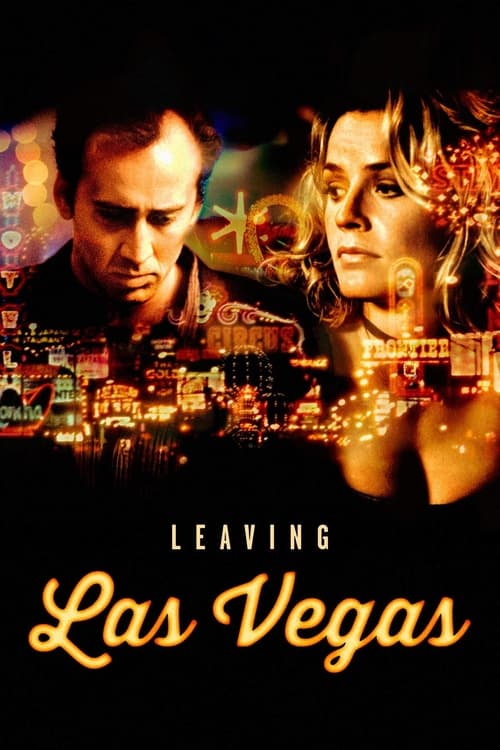
Leaving Las Vegas
1995 · Mike Figgis
For when you need a good cry and want a film that takes love and grief seriously — this is challenge viewing, the kind you choose deliberately, not the kind you stumble into. Save it for a night when you can sit with heavy feelings afterward.
What it's about
Ben, a Hollywood screenwriter who has drunk away his career and family, arrives in Las Vegas with one clear-eyed intention: to drink himself to death. There he meets Sera, a prostitute who agrees to love him on his one condition — that she never ask him to stop. It's a romance built on a pact of non-interference, two damaged people offering each other acceptance instead of rescue.
The experience
Devastating and strangely tender at once — the film never flinches from where it's headed, but the connection between its two leads keeps it from being merely bleak. It moves like a sad late-night song: woozy, intimate, neon-lit, and it will wreck you.
Performances
Nicolas Cage won the Best Actor Oscar for a portrait of alcoholism that is charming, ruinous, and never sentimental, and Elisabeth Shue earned a nomination matching him with fierce, wounded dignity — two performances in total freefall together.
The craft
Mike Figgis shot fast and cheap on Super 16mm, giving Vegas a smeared, feverish glow far from the postcard version, and composed the lounge-jazz score himself. The result sits somewhere between raw street-level realism and boozy reverie — grain, neon, and saxophone doing as much storytelling as the script.
Why it matters
One of the defining independent-film successes of the 1990s, it proved a tiny, uncompromising drama could win major Oscars and gave Cage the dramatic credibility that reshaped his career.
Snapshot
Leaving Las Vegas is a love story stripped of the thing love stories normally promise: rescue. Ben, a Hollywood screenwriter who has incinerated his career and family in drink, comes to Las Vegas with a single, lucidly stated intention — to drink himself to death — and there meets Sera, a prostitute who agrees to love him on the condition that she never ask him to stop. From this premise Mike Figgis fashioned a film at once intimate and operatic, shot fast and cheap on Super 16mm, scored by the director himself, and pitched somewhere between gutter naturalism and lounge-jazz reverie. Released in 1995 by United Artists, it became one of the decade's signal independent successes, winning Nicolas Cage an Academy Award for Best Actor and earning nominations for Figgis (direction and adapted screenplay) and Elisabeth Shue. Its lasting reputation rests on its refusal of recovery: where the canonical addiction film moves toward redemption, Leaving Las Vegas honors a death wish without endorsing it, treating self-destruction as a fact to be witnessed rather than a problem to be solved.
Industry & production
The film belongs to the mid-1990s American independent surge, when specialty production and a maturing arthouse market let small, uncompromising pictures reach wide audiences. It was adapted from the semi-autobiographical novel by John O'Brien, a writer whose own alcoholism shadowed the material to a degree few films can claim: O'Brien died by suicide in 1994, during the project's early life, and is often described as the film's "raw material" by those who worked on it. That biographical weight hangs over every account of the production.
Figgis worked on a deliberately modest budget — figures commonly cited fall in the low-single-millions range, though I would treat any precise number with caution — and the economy was a creative choice as much as a constraint. Shooting in Las Vegas with a small crew on the lighter, more mobile Super 16mm format let Figgis steal images on location, sometimes without the full apparatus of permits and lighting trucks that a studio drama would demand. The production was backed through United Artists with Lumière among the financing entities; the lean structure gave Figgis, who had come up in British independent and television work, an unusual degree of authorial control for a film that would compete at the Oscars. That control extended to roles a director normally delegates: Figgis wrote the screenplay and composed the score, concentrating authorship in a way that recalls the European auteur model more than the American studio division of labor.
Technology
The defining technological decision was format. Figgis and cinematographer Declan Quinn shot on Super 16mm rather than 35mm, a gauge that delivers visible grain, faster setups, smaller crews, and the freedom to shoot in cramped, low-light interiors — bars, motel rooms, casino margins — without elaborate rigging. Blown up for theatrical projection, Super 16 carries a texture: a slight coarseness and a tolerance for available and practical light that reads as immediacy. The choice married budget to aesthetic. It let the camera move quickly and intimately, and it gave the Las Vegas neon a smeared, halated quality when pushed.
The film also sits at a hinge moment before digital tools reshaped low-budget production; its means are essentially photochemical and analog, and its handmade quality — grain, location sound textures, a score recorded by the director — is part of its argument. Figgis's background as a trained musician meant the soundtrack was generated in-house rather than licensed wholesale, another way the production folded craft costs into the director's own labor.
Technique
Cinematography
Declan Quinn's photography is the film's sensory signature, and it earned wide critical admiration. Working handheld and close, Quinn renders Las Vegas not as spectacle but as a feverish, dissolving environment — neon bleeding across the frame, reflections multiplying faces in glass and chrome, light sources left to flare. The Super 16 grain keeps the image from ever looking glossy; even the most beautiful compositions carry a residue of cheapness appropriate to the milieu. Quinn favors warm, saturated color — reds, ambers, the sodium glow of the Strip — that can tip toward the hallucinatory, mirroring Ben's intoxication, then pull back to the flat fluorescent ugliness of motel bathrooms and pawn-shop interiors. The camera stays intimate with the actors' faces, often in tight, slightly unstable framings that privilege emotional proximity over geographic clarity. It is a style that treats the city as a state of consciousness.
Editing
The cutting, by John Smith, serves mood and performance more than plot mechanics. The film is loosely structured, built from encounters and durations rather than tight cause-and-effect sequencing; scenes are allowed to breathe, and the editing tolerates the longueurs of drunkenness and the dead time of two lonely people circling each other. Against these slower passages, montage-like impressions of the Strip and of Ben's deterioration compress time and convey the blur of a sustained binge. The rhythm is musical — unsurprising given Figgis's compositional instincts — letting scenes resolve on feeling and on the score's cadence.
Mise-en-scène / staging
Figgis stages the film in the interstitial spaces of Las Vegas: motel rooms, bars, the backseats of cars, the edges of casinos rather than their glittering centers. The production design foregrounds transience and disrepair — the threadbare, the rented, the neon-lit. Sera's apartment and Ben's motel become the film's emotional theaters, small rooms where two people enact a relationship with no future. The staging keeps the lovers physically close and the world peripheral; Las Vegas is omnipresent as texture but rarely as touristic image. This is a city of service workers and the desperate, glimpsed from the underside.
Sound
Sound is unusually authored here because Figgis composed the score himself, drawing on his jazz background. The music — moody, saxophone-inflected, lounge-adjacent — functions almost as a second narrator, lending Ben's suicide a romantic, elegiac register that the events themselves would deny. The film also leans on standards and vocal performances that give it the ambiance of a smoky after-hours bar. The interplay of diegetic Vegas sound — slot machines, traffic, barroom murmur — and the composed score blurs the line between the world and Ben's anesthetized perception of it. The result is a soundscape that beautifies decline without quite excusing it, a tension central to the film's effect.
Performance
Performance is where the film stakes its claim to greatness. Nicolas Cage's Ben is a study in articulate ruin — charming, self-aware, by turns funny and frightening — and Cage famously committed to it with notorious intensity, including research into the physical and behavioral reality of heavy drinking. His Ben is never merely pitiable; he retains wit and tenderness even as his body fails, which makes the death he has chosen harder to dismiss. Elisabeth Shue's Sera is the film's moral center and arguably its harder role: she must convey both professional armor and a capacity for unguarded love, and she resists sentimentalizing either the sex work or the devotion. The two performances are built on listening; their scenes together generate the film's uneasy, tender chemistry. Cage won the Academy Award for Best Actor; Shue was nominated and won significant critical recognition, and many regard her work as the equal of his.
Narrative & dramatic mode
The film operates in a tragic-romantic mode that deliberately withholds the structural promises of mainstream drama. There is no arc of recovery, no intervention that takes, no last-minute reversal. Ben announces his intention early and pursues it; the dramatic question is not will he stop but can he be loved as he is. The central device is the non-interference pact — Sera's vow never to ask Ben to quit drinking, his acceptance of her work — which converts the relationship into a study of unconditional acceptance pushed to a moral extreme. Narratively the film is episodic and associative, more a series of encounters and a deepening intimacy than a plotted machine. This loose construction, paired with the lush score, gives the descent an elegiac inevitability; the form mirrors the surrender at the story's heart.
Genre & cycle
Leaving Las Vegas sits within the long cinematic tradition of the alcoholism drama while defining itself against that tradition's dominant shape. The canonical entries — Billy Wilder's The Lost Weekend (1945), Days of Wine and Roses (1962) — move, however darkly, toward the possibility of sobriety; addiction is a sickness with, at least theoretically, a cure. Figgis's film severs that link. It is also a doomed-romance and a city-of-night film, kin to stories of prostitutes and outcasts and to the noir-tinged tradition of Las Vegas as a place where people go to lose themselves. By fusing the addiction drama with the tragic love story and refusing redemption, it occupies a distinct position: an anti-recovery film that treats a chosen death as the premise rather than the catastrophe. Within the 1990s independent cycle, it stands alongside other unflinching dramas of marginal life that found mainstream traction.
Authorship & method
The film is strongly authored, concentrated in Figgis to an unusual degree: he adapted the screenplay, directed, and composed the score, making it close to a total work in the European auteur sense. Figgis came from a musical and theatrical background in Britain and brought to the project a willingness to let mood, music, and performance govern over plot. His method on this film prized speed, intimacy, and improvisatory freedom — small crew, light camera, location shooting — and a trust in his actors to carry long, exposed scenes.
His key collaborators shaped the result decisively. Cinematographer Declan Quinn translated the budgetary constraint of Super 16 into the film's hallucinatory visual identity and emerged from the project with a substantially raised profile. Editor John Smith gave the loose material its musical, durational rhythm. The score, by Figgis himself, supplied the romantic, jazz-inflected register that distinguishes the film's tone from its grim subject. And the source author, John O'Brien, whose novel and whose death haunt the production, is the originating authorial presence whose autobiography the film cannot be separated from. The two lead performances should be counted as authorship as well: Cage and Shue's choices define the film as much as Figgis's.
Movement / national cinema
The film is a transatlantic object. Its director is British, formed in the UK independent and television scene of the 1980s, and his sensibility — the auteurist concentration of roles, the musicality, the comfort with downbeat European-style tragedy — marks the film even though its subject and setting are emphatically American. It belongs simultaneously to the American independent movement of the 1990s, which gave it its financing route and its audience, and to a lineage of British directors working in and on America. That hybridity is part of why it feels tonally distinct from a homegrown Hollywood addiction drama: it brings an outsider's eye and an art-cinema license to a quintessentially American landscape of neon and excess.
Era / period
Made and set in the mid-1990s, the film captures a particular Las Vegas — the city in transition, still trading on its tawdry, pre-corporate-spectacle mystique even as redevelopment loomed. More broadly it is a document of 1990s independent cinema's appetite for unsentimental adult drama and of a moment when a small film with a death wish at its center could win Oscars. Its analog, photochemical means place it at the tail end of a filmmaking era soon to be reorganized by digital tools. The period sensibility — its frankness about sex and addiction, its rejection of uplift — reflects a decade in American film willing to follow despair to its end without redemptive consolation.
Themes
The film's central theme is unconditional love and its limits: Sera loves Ben without trying to change him, and the film asks whether such acceptance is the highest form of love or a complicity in death — refusing to resolve the question. Closely bound to this is self-destruction as agency: Ben's drinking is a chosen, articulate project, not merely a disease that happens to him, which forces the audience to sit with a suicide it can neither cheer nor fully condemn. The film treats addiction without the consolation of recovery, breaking from the genre's redemptive default. It explores dignity among the marginal — the screenwriter and the sex worker as fully realized interior lives rather than cautionary types — and the related theme of loneliness and the human need to be witnessed: what Ben and Sera give each other is, finally, company in extremity. Las Vegas itself becomes thematic: a city of fantasy and ruin, beautiful and squalid, the perfect stage for a romance that mistakes, or perhaps perfects, the line between love and surrender.
Reception, canon & influence
Critically, Leaving Las Vegas was among the most acclaimed films of 1995, praised for its performances, Quinn's cinematography, and Figgis's refusal of easy uplift, even as some critics debated whether its romanticism aestheticized self-destruction. It performed strongly for an independent drama of its scale and severity, and its awards run cemented its standing: Cage's Best Actor Oscar was the decade's emphatic recognition of his range, and the nominations for Figgis and Shue marked the film as a genuine awards-season force despite its bleakness.
Its influences ON the film run backward to the addiction-drama canon it defines itself against — The Lost Weekend, Days of Wine and Roses — and to the doomed-romance and city-of-night traditions; most directly, it is bound to John O'Brien's autobiographical novel and the European auteur model that let Figgis compose, write, and direct as a single authorial act. Its legacy forward is several-fold. It confirmed the late-century reputation of Nicolas Cage as an actor capable of total commitment, a touchstone often invoked in discussions of his career. It demonstrated, for the independent sector, that a small, formally adventurous, commercially unfriendly subject could reach prestige and audiences alike. It advanced the careers of its collaborators, Quinn especially, whose work here became a calling card for grainy, intimate, color-saturated naturalism. And it remains the reference point for the "anti-recovery" addiction film — the work cited whenever a story declines to redeem its self-destructive protagonist. Where the record of its frame-by-frame production process is thin, the film's broad significance is not: it stands as one of the 1990s' defining American independent tragedies, a love story that found its beauty precisely by refusing to save anyone.
A Deleuzian reading
Start with a face.
The full Deleuzian reading of Leaving Las Vegas →
Reception
An awards juggernaut on arrival — Nicolas Cage swept virtually every Best Actor prize going — and today it's the permanent exhibit A whenever anyone argues Cage is one of the great screen actors, not just a meme. If anything its stock has risen as his wilderness years made people nostalgic for it.
How Leaving Las Vegas was received, from release to now →
Influences: the films it descends from and the films it influenced
- The Lost Weekend (1945) — Founded the subjective alcoholic-POV addiction drama whose redemptive cure Figgis deliberately withholds, defining his 'anti-recovery' film against its arc.
- Days of Wine and Roses (1962) — Established the two-hander codependent-decline structure in which the love story and the drinking are formally inseparable, the spine Figgis inverts by removing any sobriety endpoint.
- Barfly (1987) — Bukowski's romanticized skid-row barfly courtship aestheticizes dissolution rather than moralizing it — the precedent for LLV being accused of beautifying self-destruction.
- A Woman Under the Influence (1974) — Handheld, long exposed actor-governed scenes where performance overrides plot — the 'trust the leads to carry it' method Figgis ran with a small crew and light camera.
- Last Tango in Paris (1972) — Built a doomed affair between two strangers inside borrowed, interstitial spaces through improvisatory intimacy, the staging logic of LLV's motels and bars.
- Stormy Monday (1988) — Figgis's own neon-saturated, jazz-scored noir where he composed the music himself — the prototype of the total-auteur (write/direct/score) act he completes here.
- Bad Lieutenant (1992) — An actor's total-immersion descent with no redemptive architecture, self-destruction staged as agency rather than affliction.
- Under the Volcano (1984) — The clearest heir to the addiction drama as deliberate suicide — a protagonist who drinks himself to death by choice, treated with the same elegiac dignity Huston grants Firmin.
- Requiem for a Dream (2000) — The definitive post-LLV anti-recovery film, declining to redeem any of its four addicts and citing LLV's refusal of uplift as license.
- Shame (2011) — Compulsion drama built on long, exposed, near-real-time scenes and a flat refusal of redemption, extending the actor-carries-it austerity.
- The Wrestler (2008) — Self-destruction-as-agency carried by a performer's total-immersion role, where the protagonist actively chooses the decline rather than being saved from it.
- In America (2002) — Declan Quinn's grainy, color-saturated Super-16 intimacy became his signature here, the handheld naturalism LLV first made his calling card.
- Rachel Getting Married (2008) — Declan Quinn's available-light handheld coverage in long actor-driven takes extends the intimate, documentary-grain method he developed on LLV.
- Timecode (2000) — Figgis pushes the total-auteur control further — again composing his own score and letting a musical, durational structure govern a real-time form.
- The Cooler (2003) — Models the doomed Vegas romance scored to jazz-lounge melancholy — the same Isham-adjacent sensibility of saxophone-soaked fatalism wrapping two damaged people in a neon city.
- Another Round (2020) — Nicolas Cage's physiologically precise, graded portrayal of a man across stages of intoxication is the direct performance ancestor of Mikkelsen's 'graded-intoxication' calibration.
- Sid and Nancy (1986) — Doomed romance as a mutual non-interference pact, lovers who agree not to halt each other's decline — the same compact Ben and Sera strike.
- Drugstore Cowboy (1989) — Non-judgmental American-indie addiction portrait that refuses recovery moralism and treats the habit as chosen identity rather than disease to be cured.
- Trainspotting (1996) — Addiction film that lets musical-rhythm editing structure the scenes and pointedly declines to moralize, emerging from the same mid-90s indie moment.
Similar films
- Shame (2011) — influence & lineage · same viewing thread
- A Woman Under the Influence (1974) — influence & lineage · often watched together
- The Lost Weekend (1945) — influence & lineage
- Casino (1995) — often watched together
- Before Sunset (2004) — often watched together
- Before Sunrise (1995) — often watched together
- Dallas Buyers Club (2013) — often watched together
- The Big Lebowski (1998) — often watched together
All the films related to Leaving Las Vegas →
Watch it with: curated runs of related films
- Adrift and Coming Apart — A run of solitary souls drifting through motels, deserts, and empty apartments and quietly dissolving — they rhyme on stillness, loneliness, and dread.