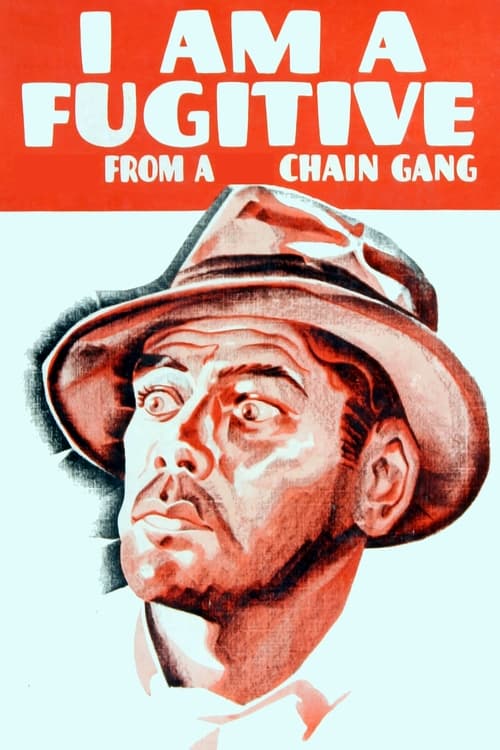
I Am a Fugitive from a Chain Gang
1932 · Mervyn LeRoy
For when you want a film with fire in its belly — a tight, true-story injustice drama that leaves you shaken rather than soothed. Great for a night when righteous anger sounds better than escapism.
What it's about
A decorated World War I veteran comes home dreaming of building things, but the economy has other plans, and a botched robbery he never intended lands him on a Southern chain gang. He escapes, builds a respectable new life under a new name, and discovers that the system that brutalized him is not done with him yet.
The experience
Lean, fast, and furious — it moves like a thriller but hits like an exposé, and its anger at what the state does to one decent man builds scene by scene. The final moments are famously chilling and will stay with you.
Performances
Paul Muni's James Allen is one of the defining performances of the early sound era — desperate, dignified, and increasingly hollowed out as the system grinds him down.
The craft
Warner Bros. at its punchiest: drawn from a real fugitive's published exposé, told with docudrama bluntness and pre-Code frankness about violence and injustice, and capped by one of the most quoted endings in American cinema. Not a wasted minute in it.
Why it matters
It stirred genuine public outrage over chain gang conditions and helped push real reform — one of the rare Hollywood films with measurable social consequences — while setting the template for the studio social-problem picture.
Snapshot
I Am a Fugitive from a Chain Gang is the hardest and most enduring of Warner Bros.' early-1930s social-problem pictures: a lean, angry docudrama about a decorated World War I veteran who drifts into a botched robbery, is sentenced to a Southern chain gang, escapes, rebuilds a respectable life, and is finally destroyed by the state that claims to have reformed him. Adapted from Robert Elliott Burns's autobiographical exposé, it fuses the momentum of the gangster cycle with the muckraking conscience of the Depression. Paul Muni's James Allen is one of the defining performances of the pre-Code era, and the film's celebrated closing exchange — Allen retreating into literal darkness with the whispered admission "I steal" — is among the most quoted endings in American sound cinema. More than most message pictures, it retained its charge because its indictment was concrete, journalistic, and unresolved.
Industry & production
The film was produced by Warner Bros. at the height of the studio's identification with topical, working-class subject matter — a brand cultivated under production chief Darryl F. Zanuck, who steered the studio toward stories "ripped from the headlines." Its source was Robert Elliott Burns's memoir I Am a Fugitive from a Georgia Chain Gang!, an account of Burns's own conviction, forced labor, and two escapes that had appeared in serial form and then as a book in 1931–32. Because Burns was still a wanted fugitive and the penal system he described was identifiably Georgia's, Warner Bros. handled the material gingerly: the film pointedly never names the state, a legal and commercial hedge against the defamation and extradition controversies swirling around the book. Burns himself is generally reported to have consulted on the production, though because of his legal status the exact terms of his involvement are murky, and I would not overstate them.
Warner Bros.' house style — fast schedules, tight budgets, contract talent, and a preference for social friction over glamour — shaped every level of the picture. The studio's willingness to point a finger at an existing American institution, rather than a fictionalized abstraction, is what distinguishes the film from softer "prison pictures" of the period. The precise internal production credits (associate producer, supervising roles) are recorded inconsistently across sources, and I will flag that rather than assign them with false confidence.
Technology
The film was made in the fully sound era, roughly four years after The Jazz Singer, using the Vitaphone-descended optical sound-on-film systems standard at Warner Bros. by 1932. It is black-and-white, shot on orthochromatic/panchromatic stock of the day with the relatively immobile early-sound camera still a practical constraint, though by 1932 studios had regained considerable camera mobility after the paralysis of 1928–29. There are no exotic technologies at work here; the film's power comes from the disciplined deployment of mature tools — hard directional lighting, location-suggestive set construction, and a sound recording capable of registering the percussive, rhythmic noise of the labor gang. Its most famous "effect," the final plunge into blackness, was achieved photographically and reportedly in part by chance rather than by any special process (see Technique/Cinematography).
Technique
Cinematography
Sol Polito's photography is the film's aesthetic backbone. He renders the chain gang with a documentary flatness — sweating bodies, sledgehammers, striped uniforms in harsh sun — that reads as reportage rather than melodrama, then shifts to expressionistic shadow for the escape and fugitive passages. The picture's imagery of bondage is relentless and physical: shackles, sweatboxes, the swing of hammers timed to labor. The ending is the most discussed image in the film. As Allen backs away from his former sweetheart into the dark, the light drains from him until only his face and then nothing remains. A durable production anecdote holds that this fade into total blackness was at least partly serendipitous — a lighting failure that LeRoy and Polito recognized as perfect and kept. The anecdote is widely repeated but hard to verify definitively, so it should be treated as a well-attested story rather than settled fact.
Editing
The cutting, credited to William Holmes, is brisk and propulsive in the Warner manner, compressing years of Allen's life — imprisonment, escape, professional rise in the construction trade, re-arrest, second escape — into a forward-driving arc with almost no fat. Montage sequences carry Allen's northern success and the passage of time economically, a technique the studio used repeatedly to cover large spans cheaply and vividly. The film's momentum is inseparable from its meaning: the sense that the machinery of law and labor grinds forward inexorably is enacted by the pace of the cutting itself.
Mise-en-scène / staging
The film alternates two visual worlds: the open, sun-blasted, over-exposed spaces of the chain gang, where bodies are exposed and controlled, and the shadowed interiors of Allen's fugitive existence, where he is nominally free but perpetually hunted. The staging emphasizes labor as spectacle and punishment — the rhythmic collective swing of hammers, the roll-call of shackled men — and later the claustrophobia of a respectable life built on a secret. Props and costume do heavy thematic work: the striped uniform, the chains, and the veteran's medal that opens the film as an emblem of a promise the nation will not keep.
Sound
Sound is used with unusual force for 1932. The clang of hammers on stone, the scrape and rattle of chains, and the barked commands of guards form a near-musical rhythm that defines the gang sequences; the film leans on diegetic, environmental sound rather than a continuous score. In keeping with early-sound Warner practice, non-diegetic underscoring is sparse — Leo F. Forbstein headed the studio's music department during this period — and the film's most powerful "musical" passages are the industrial rhythms of forced labor. The final line, delivered nearly in a whisper out of the dark, depends entirely on the sound era's capacity for intimacy.
Performance
Paul Muni's James Allen is the film's center of gravity and one of the era's landmark performances. Muni charts a full arc from hopeful, slightly naïve returning veteran to hardened escapee to hollowed-out fugitive, without sentimentalizing any stage. He earned an Academy Award nomination for Best Actor for the role. The supporting playing is in the sturdy Warner mode — including the predatory landlady-turned-wife who traps Allen in a second imprisonment of blackmail and domesticity — but the picture is unmistakably built as a vehicle for Muni's controlled intensity, culminating in the final scene, which he plays almost entirely in retreat and shadow.
Narrative & dramatic mode
The film's dramatic mode is tragic social realism structured as an indictment. Its narrative logic is that of a trap that keeps re-closing: every time Allen earns a legitimate second chance, an institution — the penal system, the state, a coercive marriage, a broken official promise of pardon — hauls him back. The screenplay by Howard J. Green and Brown Holmes refuses the redemptive arc that Hollywood convention would demand; instead it delivers one of the bleakest endings in studio cinema, in which the protagonist is neither saved nor punished by law but simply erased into criminality and darkness. The famous exchange — asked how he lives, Allen answers "I steal" before vanishing — converts a personal tragedy into a systemic accusation: the state, not the man, has manufactured the fugitive.
Genre & cycle
The picture sits at the intersection of the crime film and the "social problem" film, the two genres most associated with Warner Bros. in the early Depression. It belongs to the studio's cycle of pre-Code exposés that dramatized institutional failure — poverty, unemployment, corrupt penal and political systems — and it is often grouped with the era's prison pictures. But it is more pointed than most prison dramas because its target is a specific, real, still-operating practice: the Southern convict-labor chain gang. It shares DNA with the gangster cycle (Little Caesar, which LeRoy had also directed, and The Public Enemy) in its fatalism and its interest in a man ground down by circumstance, but it inverts the gangster formula: Allen is not a criminal who is punished but an innocent whom the system makes into a criminal.
Authorship & method
Mervyn LeRoy was among Warner Bros.' most reliable and versatile contract directors, and Fugitive is frequently cited as his finest achievement. Having already directed Little Caesar (1931), LeRoy brought to the material a taste for velocity, unvarnished environments, and social anger, directing in the efficient, unfussy studio idiom while allowing the subject's brutality to speak plainly. His key collaborators define the film as much as he does: cinematographer Sol Polito, whose hard, near-documentary lighting gives the gang sequences their authority; editor William Holmes, whose compression sustains the film's momentum; and screenwriters Howard J. Green and Brown Holmes, who adapted Burns's memoir with unusual fidelity to its outrage. Music was overseen by the Warner music department under Leo F. Forbstein, though the film is notably score-light by design. The animating "author" behind the project is arguably Robert Elliott Burns himself, whose lived testimony supplied not only the plot but the film's moral urgency. As with much studio-system work, authorship here is genuinely collective — a producer-driven Warner property realized by a skilled director and a strong craft team rather than the expression of a single sensibility.
Movement / national cinema
The film is a quintessential product of American studio cinema and, more specifically, of the pre-Code moment (1930–34) before the Production Code was rigorously enforced from mid-1934. That window permitted the film's frank brutality, its refusal of a consoling ending, and its direct assault on an American institution — content that would have been far harder to make just two years later. Its expressionistic shadow-work reflects the general absorption of German Expressionist lighting into Hollywood by the early 1930s, but its sensibility is thoroughly American: Depression-era, journalistic, and reformist. It stands as a canonical example of the Warner Bros. "social conscience" tendency within classical Hollywood.
Era / period
Released in 1932, at roughly the deepest point of the Great Depression, the film speaks directly to a nation of unemployed and displaced men. Allen is introduced as a returning Great War veteran — a figure loaded with topical resonance in a year that also saw the Bonus Army march on Washington — whose service earns him neither work nor justice. The film's vision of a man unable to find honest employment, criminalized by circumstance and then by the state, mapped precisely onto contemporary anxieties about economic collapse and institutional betrayal. Its period specificity is a large part of why it landed with such force.
Themes
The dominant theme is the manufacture of criminality by unjust institutions: the system does not correct James Allen, it creates the fugitive it claims to punish. Adjacent themes include the betrayal of the veteran and the hollowness of the postwar promise; the dehumanization of forced labor; the impossibility of a clean second chance under a punitive state; and the corrosion of identity, as Allen is progressively stripped of name, freedom, and finally selfhood, dissolving into the dark. The film also indicts the machinery of respectability — the blackmailing marriage, the reneged official pardon — as another cage. Underlying all of it is a bleak thesis about American justice: that its promises are conditional, and that it will consume the very men it professes to rehabilitate.
Reception, canon & influence
The film was a critical success and an award contender, receiving Academy Award nominations including Outstanding Production (Best Picture), Best Actor for Paul Muni, and Best Sound, though it did not win in those categories. Beyond reviews, its most consequential reception was political and social: as a high-profile dramatization of Burns's exposé, it intensified public scrutiny of the chain-gang system and is widely credited with contributing to the reform movement against convict labor in the American South, even as Georgia officials disputed the account and continued efforts to return Burns to custody. That real-world impact is central to the film's historical standing.
Looking backward, the film draws on the Warner gangster cycle's fatalism (LeRoy's own Little Caesar), the muckraking tradition of American social reportage, and the expressionist lighting vocabulary that Hollywood had absorbed by the early sound era — all in service of Burns's first-person testimony. Looking forward, it became the template for the Hollywood social-problem film and the socially conscious prison picture, establishing that a studio could turn journalism into a commercially viable moral indictment. Its unresolved, despairing ending has been repeatedly cited as a high-water mark of pre-Code candor and a model for later films willing to let a protagonist be destroyed by the system rather than redeemed. It is routinely included in surveys of the essential American films of the 1930s and preserved as a landmark of the studio era's social conscience. The line "I steal," spoken from the dark, remains its enduring signature — a two-word verdict on the machinery that produced it.
A Deleuzian reading
A man backs away from a woman on a dark street.
The full Deleuzian reading of I Am a Fugitive from a Chain Gang →
Reception
A sensation in 1932 — it shocked audiences, earned Oscar nominations, and actually helped spur real chain-gang reform in the South. Today it's held up as the peak of Warner Bros' ripped-from-the-headlines social-problem pictures, one of the few pre-Code dramas whose anger still lands.
How I Am a Fugitive from a Chain Gang was received, from release to now →
How to watch I Am a Fugitive from a Chain Gang: what to notice on a first viewing
- Listen to hammers and chains keep rhythm instead of music. The clang of sledgehammers, the scrape of chains, and barked guard commands are cut to a steady beat, with almost no score standing between you and the sound of the labor itself. The prison camp becomes audible as a machine, not just visible as a setting.
- Notice the flat, harsh sunlight on the chain gang scenes. Sol Polito shoots the labor scenes in an unglamorous, overexposed glare that reads like reportage rather than melodrama, with sweat, shackles, and hammers photographed as plain fact. Shot this flatly, the cruelty looks like something simply true, which is harder to dismiss than an obvious performance of outrage.
- Watch the shackled men swing their hammers on the same beat. LeRoy stages the gang as one coordinated body of forced labor, hammers rising and falling together, the roll call lining up shackled men as a single unit rather than individuals. The staging turns punishment into something choreographed, which makes its ordinariness to the guards feel worse.
- Notice the war medal Allen wears before anything else happens. The medal that opens the film sits against the striped uniform and chains that follow, two costumes for the same man, one a promise and one what the promise turned into. An object the film shows you in the first minutes quietly measures the distance the story is about to travel.
- Watch how quickly the film jumps across years of his life. William Holmes compresses years of his life into a brisk, forward-driving montage, so time itself feels like it is grinding forward without pause. The speed of the cutting is doing the film's argument for it: the machinery never slows down to let him catch his breath.
The whole guide to watching I Am a Fugitive from a Chain Gang, with the keys for a rewatch →
Influences: the films it descends from and the films it influenced
- Little Caesar (1931) — LeRoy carries over his own Warner gangster idiom — momentum-driven, unfussy cutting tracing a rise-and-fall that ends in the protagonist's total destruction rather than redemption.
- The Big House (1930) — Supplies the prison-picture grammar Fugitive inherits — regimented mass movement of convicts, the lockstep rhythm of forced labor, and the sonic oppression of clanging cellblock and yard as environmental sound.
- The Public Enemy (1931) — Establishes Warner's unromanticized social realism where the slum environment manufactures the criminal, delivered through curt, offhand brutality rather than melodramatic staging.
- The Crowd (1928) — Models the anonymous everyman ground down by an impersonal social machine, closing on an unresolved, un-triumphant note that refuses the uplift ending.
- Greed (1924) — Naturalist determinism — fate dictated by economics and environment, with a hard refusal of moral redemption that Fugitive's unredemptive arc extends.
- Sunrise (1927) — The imported German chiaroscuro that Sol Polito adapts for the gang sequences and, above all, the shadow-swallowed final frame where Muni retreats into darkness.
- The Cabinet of Dr. Caligari (1920) — Source of the expressionist vocabulary of menacing, entrapping shadow that Hollywood absorbed and Fugitive deploys as darkness-as-fate in its whispered 'I steal' ending.
- They Won't Forget (1937) — LeRoy returns to his own template — a journalistic indictment of Southern justice built from compressed montage and documentary-flat lighting, again letting the system, not virtue, decide the outcome.
- Fury (1936) — Extends the social-problem indictment of American justice — an innocent man ground up by the machinery of law and mob, staged with expressionist menace inherited via the same 1930s lighting lineage.
- You Only Live Once (1937) — Directly inherits the ex-convict-hounded-by-the-system fatalism — a man branded by his record can never escape it, driven to a despairing, unredemptive end.
- Dead End (1937) — Dramatizes Fugitive's 'manufactured criminality' thesis as social argument — the slum environment demonstrably producing the criminal, in the fully-formed studio social-problem mode Fugitive templated.
- The Grapes of Wrath (1940) — Turns first-person social testimony into commercially viable moral indictment via documentary-hard lighting (Toland) — the poor destroyed by an economic system, the studio social-conscience picture at its apex.
- Brute Force (1947) — Reworks the prison picture as an indictment of the carceral system itself — brutal forced labor as spectacle, expressionist noir shadow, and inmates doomed by an authority beyond appeal.
- Cool Hand Luke (1967) — The chain-gang film reborn — roadside forced labor staged as spectacle, a defiant individual crushed by carceral authority, closing on the same refusal to let the system be redeemed.
- The Shawshank Redemption (1994) — Foundational American prison-injustice melodrama that codifies the wrongfully-punished-man escape narrative and the formal indictment of the penal institution itself.
- Mr. Smith Goes to Washington (1939) — LeRoy's pre-Code indictment legitimized the Hollywood strategy of mixing documentary-texture location footage with studio reconstruction to make institutional critique feel like authentic reportage; Capra adopted this mixed-register approach — Washington exteriors against the studio-built Senate interior — directly from LeRoy's model.
- O Brother, Where Art Thou? (2000) — Founding 1930s chain-gang-on-the-run narrative whose period iconography (shackles, swamp pursuit, fugitive picaresque) the film cites as part of its braided Depression-cinema vernacular.
- Midnight Express (1978) — Founds the true-crime prison-exposé mode Midnight Express works in — a wronged innocent indicting a brutal penal system through escalating punishment, ending on a despairing fade rather than redemption.
- They Shoot Horses, Don't They? (1969) — Establishes the Warner social-problem template of unsparing institutional naturalism ending in unredeemed despair rather than uplift — the studio-realist bleakness Pollack inherits and refuses to soften.
- Heroes for Sale (1933) — Companion in the Warner Depression social-problem cycle — a decent veteran destroyed by an indifferent economic system, journalistic in texture and pointedly unredemptive.
- Wild Boys of the Road (1933) — Extends the Warner social-conscience method of turning current reportage (transient Depression youth) into semi-documentary studio drama with hard location-like realism.
- The Hurricane (1999) — Founding social-protest wrongful-conviction biopic built to indict the carceral system through one wronged man — the genre Hurricane updates.
Similar films
- Cool Hand Luke (1967) — influence & lineage
- Fury (1936) — influence & lineage
- The Shawshank Redemption (1994) — shared sensibility
- All Quiet on the Western Front (1930) — shared sensibility
- Reservoir Dogs (1992) — shared sensibility
- The General (1926) — shared sensibility
- The Maltese Falcon (1941) — shared sensibility
- The Fugitive (1993) — shared sensibility
All the films related to I Am a Fugitive from a Chain Gang →