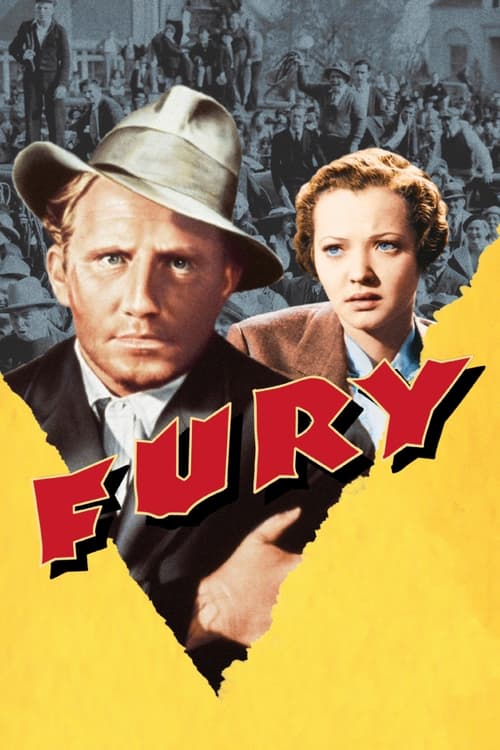
Fury
1936 · Fritz Lang
For when you want an old movie with real teeth — something angry and gripping rather than cozy. It's a challenge, not comfort, and it pairs a fast thriller pace with questions you'll argue about after.
What it's about
Joe Wilson is an ordinary working man — a gas station owner saving up to marry his fiancée Katherine — who drives through a small town at exactly the wrong moment. Mistaken for a wanted kidnapper on flimsy evidence, he's thrown in jail, and as rumor races through the town, ordinary citizens curdle into a mob. What follows is a hard look at collective hysteria, and at what the hunger for revenge does to everyone it touches.
The experience
Lean, furious, and shockingly bleak for a 1930s studio picture. The mob scenes still raise the hair on your neck, and the back half turns cold and morally queasy in a way that lingers.
Performances
Spencer Tracy is remarkable, transforming from genial everyman to something hard and frightening, and Sylvia Sidney brings real anguish to a role that could have been merely decorative.
The craft
Fritz Lang's first American film imports his German expressionist precision — faces in crowds shot like a wave of malice, and a jailhouse fire sequence staged with terrifying scale. The courtroom stretch pulls off a then-novel trick, using newsreel footage as evidence in a way that feels startlingly modern.
Why it matters
One of Hollywood's earliest and fiercest indictments of lynch-mob violence, it launched Lang's American career and set the template for the socially conscious crime drama that fed into film noir.
Snapshot
Fury is Fritz Lang's first American film, a lean and furious social-problem melodrama about mob violence and its aftermath. Joe Wilson (Spencer Tracy), an ordinary working man saving to marry Katherine Grant (Sylvia Sidney), is arrested on flimsy circumstantial evidence while passing through a small town, wrongly taken for a kidnapping suspect. Rumor metastasizes into a lynch mob that storms the jail and burns it down. Joe survives — unbeknownst to the town and to Katherine — and, consumed by a cold desire for revenge, allows the mob's ringleaders to stand trial for his "murder." The film thus splits cleanly in two: a study of collective hysteria, and a study of what vengeance does to the man it was meant to satisfy. Made at MGM, the least likely of the major studios to court so grim a subject, Fury remains one of the most unflinching Hollywood statements on lynching and mob justice of the decade, and the film with which a great European director announced himself in America.
Industry & production
Fury was produced by Metro-Goldwyn-Mayer, the most prestigious and most conservative of the Hollywood majors, and it is one of the studio's genuine anomalies — a socially pointed picture from a lot better known for glossy star vehicles and prestige literary adaptations. The producer was Joseph L. Mankiewicz, then a young MGM staff producer years before his own directorial career; the association of a subject this bleak with the studio of Louis B. Mayer owes much to the internal latitude a producer of standing could still command. The screenplay, by Lang and Bartlett Cormack, was based on a story by Norman Krasna (widely cited under the working title "Mob Rule"), and Krasna's original story earned an Academy Award nomination — the film's principal awards recognition.
The production was, by well-documented accounts, difficult. Lang arrived at MGM under contract but had spent roughly a year without a greenlit project, and his exacting, autocratic European working methods sat uneasily with the studio's factory efficiency and with a crew unaccustomed to his perfectionism. The most consequential industrial fact about Fury concerns its handling of race: lynching in 1930s America was overwhelmingly a crime against Black Americans, yet the film's victim is a white man, and the mob's target is defined by rumor rather than race. This displacement — whether read as commercial caution, as the limits of what MGM and the Production Code would permit, or as Lang's strategic universalizing of mob psychology — is the central interpretive crux of the film's production history, and it should be stated plainly rather than explained away.
Technology
Technologically Fury is a conventional mid-1930s studio product: 35mm black-and-white photography, standard-ratio Academy frame, and Western Electric–standard optical sound recording of the kind universal on the major lots by 1936. It breaks no new ground in equipment or process. Its one genuinely notable technological gesture is diegetic rather than mechanical — the use of newsreel-style motion-picture footage as courtroom evidence. In the trial sequence, film shot of the mob at the jail is projected as proof, so that the camera's documentary authority becomes a plot instrument: the medium indicts the very faces caught committing the crime. For a director to make the recording apparatus itself the agent of justice within the story is a self-aware use of cinema's evidentiary power, and it is the film's most forward-looking idea about what the technology could do.
Technique
Cinematography
The cinematography is by Joseph Ruttenberg, one of MGM's leading camera artists. Ruttenberg's work here fuses the studio's polished house style with the graphic, high-contrast lighting Lang had carried from German cinema. The film's most celebrated passage — the burning of the jail — is a study in mounting chiaroscuro: firelight, smoke, and the surging silhouettes of the crowd rendered as an almost abstract spectacle of mass frenzy. Lang and Ruttenberg photograph the mob less as individuals than as a single writhing organism, cutting to faces lit with a horrible exhilaration. The framing throughout favors Lang's characteristic geometric precision and his instinct for entrapment: bars, windows, and doorways compose the mise-en-scène into cages long before Joe is literally behind them.
Editing
Edited by Frank Sullivan, Fury is built on montage as an argument. The most quoted example is Lang's intercutting of gossiping townswomen with clucking hens — a montage that likens the spread of rumor to mindless barnyard noise, and a piece of editorial editorializing worthy of the Soviet montage tradition Lang knew well. The assault on the jail is assembled as an accelerating rhythmic crescendo, individual gestures of violence stacked into collective momentum. The second half slows deliberately, the cutting turning patient and clinical to match Joe's calculated, corrosive scheme of revenge — the editing itself enacting the shift from hot mob frenzy to cold private vengeance.
Mise-en-scène / staging
Lang's staging translates his Expressionist heritage into an American key. The small town is drawn in a few economical strokes — the barbershop, the saloon, the storefront gossip — as a social ecology in which rumor circulates like current. The jail sequence is staged with an architect's command of mass movement (Lang had trained as an architect), the crowd choreographed as a force with its own dreadful logic. Recurrent motifs of confinement and observation — bars, reflections, watching faces — knit the visual field together, so that the theme of judgment is present in the composition before it is present in the dialogue.
Sound
The sound design leans on the contrast between clamor and silence: the roar of the mob against the hush of Joe's later scenes of brooding isolation. Franz Waxman's score (see below) supplies much of the emotional architecture, but Lang, a filmmaker acutely attentive to sound since M (1931) and its famous use of a whistled leitmotif, also exploits pointed silences and the ordinary noise of the town. The trial's use of projected newsreel footage further foregrounds the relationship between image and testimony, sound and proof.
Performance
Spencer Tracy's Joe Wilson is the film's spine and its most disquieting achievement. In the first half he is an unremarkable, likable everyman; in the second he becomes a gaunt, embittered figure whose grief has hardened into something close to sadism, and Tracy plays the transformation without softening it — one of the performances that established his reputation for unforced naturalism. Sylvia Sidney, an emblematic actress of Depression-era suffering and a Lang favorite (she would work with him again), gives Katherine a grounded moral clarity that becomes the film's conscience. Among the supporting players, Bruce Cabot as a swaggering mob ringleader and Walter Abel as the district attorney anchor the second half's courtroom machinery.
Narrative & dramatic mode
Fury operates in the mode of social melodrama sharpened toward tragedy. Its structure is a diptych: the first movement is a suspense narrative of wrongful accusation building to catastrophe; the second is a moral drama of revenge in which the audience's sympathies are deliberately unsettled. The dramatic engine of the second half is a savage irony — Joe, the wronged innocent, engineers a judicial murder of his own, allowing people to be tried for a death that did not occur. This structural gamble makes the film unusual for its period: it refuses to let the victim remain uncomplicatedly sympathetic and implicates vengeance itself in the cycle of violence. The resolution, in which Joe is drawn back from the brink, has long been read as a partial softening — whether imposed by studio expectation or dramatic necessity, the record supports genuine tension between Lang's darker instincts and the demands of an MGM release, and the exact authorship of the ending's tempering is not something to state with false precision.
Genre & cycle
The film belongs to the 1930s cycle of American social-problem pictures — films that dramatized institutional injustice, most prominently associated with Warner Bros. and titles like I Am a Fugitive from a Chain Gang (1932). Fury's specific subject, mob violence and lynching, places it at the head of a short run of Hollywood lynching dramas; Mervyn LeRoy's They Won't Forget followed in 1937, and the theme would recur through the 1940s. Generically the film is a hybrid — part crime thriller, part courtroom drama, part melodrama of vengeance — and its refusal to resolve neatly into one register is part of what gives it lasting force. Lang would go on to explore related terrain of guilt, fate, and false accusation across his American career, making Fury the opening statement of a coherent thematic project.
Authorship & method
Fury is unmistakably a Fritz Lang film, bearing the signatures of the director of Metropolis (1927) and M: architectural staging, a deterministic vision of individuals caught in social and psychological machinery, and a moral seriousness about crime and punishment. Lang, who had fled Nazi Germany, brought to American subject matter the perspective of an exile alert to how ordinary communities can be swept into collective cruelty — a reading strongly supported by the film's preoccupations, and one Lang himself encouraged in later interviews.
His collaborators shaped the result decisively. Cinematographer Joseph Ruttenberg gave Lang's compositions their tonal richness. Composer Franz Waxman, another émigré from Germany and one of the foundational figures of Hollywood scoring, supplied a score that underlines the film's tension without sentimentalizing it. Editor Frank Sullivan executed the montage passages on which the film's argument depends. Writers Bartlett Cormack and Lang adapted Norman Krasna's story into the two-part structure that defines the picture. The producing sensibility of Joseph L. Mankiewicz helped shepherd an atypical project through MGM. The friction between Lang's method and the studio system is itself part of the authorship story: Fury is the sound of a European auteur negotiating, not always comfortably, with the American industrial machine.
Movement / national cinema
Fury sits at the hinge between two national cinemas. Lang was a leading figure of Weimar German cinema and its Expressionist and Neue Sachlichkeit currents; his American debut carries that inheritance — graphic lighting, fatalism, a sociological eye — into the idiom of the Hollywood studio picture. It is thus a key document of the great émigré migration that reshaped American film in the 1930s, as directors, cinematographers, and composers fleeing Europe (Lang and Waxman among them) transplanted Continental technique into Hollywood genre filmmaking. The film is best understood not as pure Hollywood nor pure Weimar but as a product of that transatlantic graft.
Era / period
Released in 1936, Fury is a Depression-era film and a Production Code–era film, and both contexts mark it. Its everyman hero, its anxiety about social breakdown, and its distrust of crowds speak to the economic and civic strains of the mid-1930s. The Production Code, rigorously enforced from 1934, constrained how directly the film could treat violence, sexuality, and — crucially — the racial reality of American lynching, which helps frame (without fully excusing) the film's decision to make its victim a white man. It arrived at a moment when Hollywood was cautiously testing how much social criticism a mainstream feature could carry, and Fury stands as one of the boldest results of that test.
Themes
The film's governing theme is the psychology of the mob — how rumor, boredom, self-righteousness, and latent cruelty converge into collective violence, and how easily a community persuades itself that its lawlessness is justice. Its second, darker theme is the corruption of the victim: vengeance, the film insists, does not restore the wronged man but deforms him, threatening to make him the moral equal of his persecutors. Around these run subsidiary concerns — the fragility of due process, the gap between law and justice, the complicity of "decent" people who do nothing, and the question of whether a person or a community can be redeemed after such a rupture. That the redemption offered at the film's close feels provisional rather than triumphant is consistent with its refusal of easy consolation.
Reception, canon & influence
Fury was received on release as a serious and impressive work, widely regarded among the notable American films of its year and singled out for the power of its mob sequences and the audacity of its subject; Norman Krasna's story nomination at the Academy Awards is the concrete marker of that esteem. The influential contemporary criticism of the period treated it as evidence that Lang's transatlantic move had succeeded artistically, even as commentators noted its evasion of race.
Backward — influences on the film: Fury draws on Lang's own Weimar cinema, above all M with its study of a community turning on an accused man and its ambivalence about crowd justice; on the Soviet montage tradition audible in its editorial set pieces; and on the Warner Bros. social-problem cycle that had already made institutional injustice a viable Hollywood subject.
Forward — its legacy: The film established the template for Hollywood's lynching dramas and fed directly into the cycle that produced They Won't Forget (1937) and later mob-justice pictures such as The Ox-Bow Incident (1943). Within Lang's own filmography it inaugurates a long American engagement with guilt, false accusation, and the machinery of fate that runs through You Only Live Once (1937) and beyond. More broadly, Fury endures in the critical canon as a foundational text on cinematic representations of mob violence and as a case study in émigré authorship — the moment a Weimar master proved his vision could survive translation into the American studio system, scars and compromises included.
A Deleuzian reading
A woman leans across a store counter to pass along something she heard.
The full Deleuzian reading of Fury →
Reception
Critics loved it on release — Graham Greene famously called it the only film he'd ever wanted to label 'great' — but MGM was nervous about its lynching subject and never quite got behind it; today it's ranked among the finest American films of the 1930s and the proof Lang's genius survived the move to Hollywood.
How Fury was received, from release to now →
Influences: the films it descends from and the films it influenced
- M (1931) — Lang's own prototype for the crowd-as-tribunal — the underworld kangaroo court massing geometrically around an accused man — which Fury re-stages as a small-town jail siege, the same ambivalence about mob justice ported into English.
- I Am a Fugitive from a Chain Gang (1932) — The Warner social-problem template Fury inherits — an innocent man ground through an American institution, indicted in a documentary-realist register that treats systemic injustice as a fit studio subject.
- The Ox-Bow Incident (1943) — Carries forward Fury's diptych moral structure, making the crowd itself the protagonist of guilt and staging the reckoning as a sober tract on collective culpability rather than melodrama.
- Anatomy of a Murder (1959) — Lang's trial sequences introduce the courtroom as a machine for parsing physical evidence piece by piece — newsreel footage entered as exhibit, lawyers as technicians of proof — establishing the procedural grammar Preminger scales into a full two-hour narrative architecture.
- Bad Day at Black Rock (1955) — Prototype of the social-problem drama that indicts an entire town's collective guilt in mob violence, supplying Black Rock's structural engine of a whole community sharing complicity in a buried crime.
- Hangmen Also Die! (1943) — Lang's American proof-of-concept for anatomizing mob complicity and staging dramatic irony around an accused man caught in impersonal justice machinery.
- Body and Soul (1947) — Popular Front social-realist indictment smuggled inside genre entertainment — the same craft of making a mass melodrama carry a systemic critique.
- The Woman in the Window (1944) — Lang's first transplant of Weimar fatalism into American material — a decent citizen ground down by circumstance and the apparatus of justice — the 'ordinary man ensnared' engine this film runs on.
- Le Corbeau (1943) — Anatomizes how ordinary townspeople curdle into a denouncing mob, the social-anatomy-of-collective-guilt structure Le Corbeau applies to a poison-pen town.
- Metropolis (1927) — Establishes Lang's architectural staging of human masses as deterministic machinery, individuals dwarfed and swept by geometric compositional forces — the visual grammar Fury applies to a townsfolk mob surging toward the jail.
- Strike (1925) — Model for Fury's associative intellectual montage — Eisenstein's shock cuts between people and animals directly license Lang's cut from gossiping townswomen to a row of clucking, cackling hens.
- Battleship Potemkin (1925) — Source of the rhythmic-crescendo editing of collective violence (the Odessa Steps) that Frank Sullivan's montage of the mob forming and torching the jail deliberately echoes to build its accelerating argument.
- The Cabinet of Dr. Caligari (1920) — Anchors the Weimar-expressionist chiaroscuro Ruttenberg tempers into Fury — pooled shadow and hard side-light used to morally distort ordinary faces at the moment they turn cruel.
- Intolerance (1916) — Griffith's crosscutting between the machinery of a courtroom and a gathering mob, racing toward a last-minute reprieve, is the narrative-editing ancestor of Fury's courtroom-versus-lynch-mob construction.
- They Won't Forget (1937) — The most direct descendant — a Southern lynching drama drawing the same equation of rumor, press, and mob that Fury codified, extending its template to the Leo Frank case a year later.
- You Only Live Once (1937) — Lang's immediate American follow-up, extending Fury's machinery-of-fate — a wrongly-condemned man crushed by circumstantial evidence and public presumption — into full noir fatalism.
- Try and Get Me! (The Sound of Fury) (1950) — Extends Fury's newsreel-as-evidence motif into full media critique, showing an inflammatory press deliberately manufacturing the frenzy that drives an actual jail-storming lynch mob.
- Ace in the Hole (1951) — Inherits Fury's suspicion of spectacle-as-truth, turning the gathered crowd into a media circus and the camera/press into the manufacturer of collective appetite — the mob remade for the age of broadcast.
- The Wrong Man (1956) — Extends Fury's procedural determinism — the pitiless, near-documentary accumulation of circumstantial evidence closing around an innocent man — treating the justice apparatus itself as the antagonist.
- Beyond a Reasonable Doubt (1956) — Lang's late American bookend to Fury, again built on manipulated circumstantial proof and a fatalist courtroom, closing the arc of guilt and false accusation his 1936 debut opened.
- A Face in the Crowd (1957) — Advances Fury's newsreel-as-evidence anxiety into television, dramatizing how mass media can whip an ordinary public into a manipulable collective — the mob abstracted into an audience.
Similar films
- M (1931) — influence & lineage · same viewing thread
- 12 Angry Men (1957) — influence & lineage
- The Wrong Man (1956) — influence & lineage
- The Ox-Bow Incident (1943) — influence & lineage
- I Am a Fugitive from a Chain Gang (1932) — influence & lineage
- The Big Heat (1953) — same viewing thread
- Kiss Me Deadly (1955) — same viewing thread
- The Prowler (1951) — same viewing thread
All the films related to Fury →
Watch it with: curated runs of related films
- The Long Shadow of M — A run from Lang's Weimar crime films through their noir and neo-noir children — killers, con men, masterminds, and manhunts — where you can watch expressionist menace mutate step by step into the modern thriller.