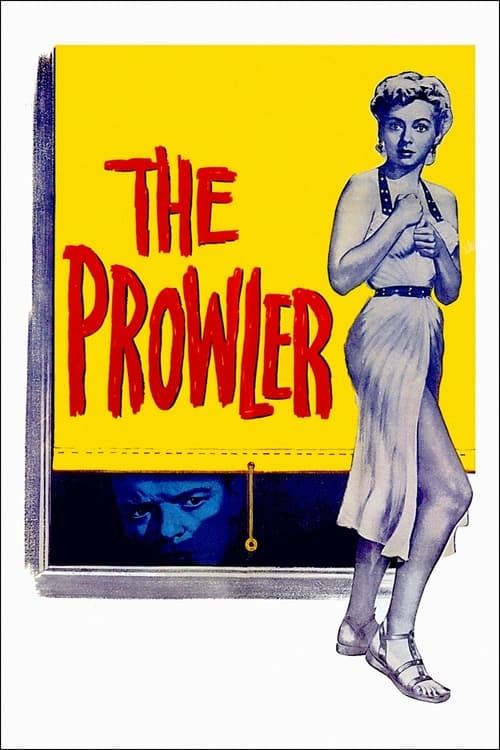
The Prowler
1951 · Joseph Losey
For when you want noir with real teeth — a dark, adult crime story to watch alone with the lights low, more unsettling than comforting. Reach for it when you're in the mood to watch a bad man work and feel the walls close in.
What it's about
A Los Angeles patrolman answers a late-night prowler call at the home of a lonely married woman and doesn't really leave. He's a resentful ex-athlete who believes life shorted him, and in her fear — and her comfortable house, and her absent radio-host husband — he sees an opening. What starts as a stalking investigation curdles into seduction and a scheme, with the man sworn to protect the home becoming the danger inside it.
The experience
Lean, tense, and quietly nasty — a thriller that keeps tightening while making you complicit with a man you'd cross the street to avoid. It's less about shocks than a slow moral suffocation that leaves you uneasy long after.
Performances
Van Heflin is remarkable as the cop, playing charm and grievance as the same muscle — you can see the self-pity under every smile. Evelyn Keyes matches him with a lonely, credulous warmth that makes the manipulation sting.
The craft
Joseph Losey directs with ruthless economy: cramped domestic spaces, a predator framed in doorways, no fat on the story. The screenplay — largely the uncredited work of blacklisted Dalton Trumbo — gives the pulp plot a corrosive class-resentment engine, and the final stretch trades cozy interiors for stark, desolate landscape to striking effect.
Why it matters
Made independently on the eve of Losey's blacklisting, it's become a touchstone of noir at its most politically pointed — a genre film that indicts postwar getting-ahead culture — and a key document of the blacklist era's underground screenwriting.
Horror · Suspense & terror · Home invasion. Lean, nasty 1951 noir: a resentful cop answers a lonely wife's prowler call and becomes the threat inside her home.
Snapshot
The Prowler is a lean, corrosive American film noir about a Los Angeles patrolman who converts a routine prowler call into an opportunity for murder, sex, and social climbing. Van Heflin plays Webb Garwood, a beat cop rotting with resentment—an ex-athlete who believes the good life was stolen from him—and Evelyn Keyes plays Susan Gilvray, the lonely wife whose late-night fear brings him to her door. What begins as a stalking case inverts itself: the man sworn to protect the home becomes the predator inside it. Produced independently by Sam Spiegel for Horizon Pictures and directed by Joseph Losey on the eve of his blacklisting, the film is at once a tight genre thriller and a bleak indictment of postwar acquisitiveness. Its scandalous open secret—that its screenplay was substantially the work of the blacklisted Dalton Trumbo, who also supplies the disembodied voice of the husband Webb murders—gives the picture a second life as a political artifact. Long difficult to see, it has been reclaimed by later critics and archivists as one of the sharpest noirs of its moment.
Industry & production
The Prowler was made outside the major-studio system as an independent production of Horizon Pictures, the company Sam Spiegel had formed with John Huston. Spiegel, still using the screen credit "S. P. Eagle," produced; distribution was handled by United Artists, the traditional home for independents. This independent footing matters: it gave Losey more latitude than a contract director would have had at MGM or Warners, and it allowed the assembling of blacklisted or soon-to-be-blacklisted talent that a cautious studio would have avoided.
The film's authorship is inseparable from the politics of the Hollywood blacklist. The onscreen screenplay credit reads Hugo Butler (from a story by Robert Thoeren and Hans Wilhelm), but it is well established in the historical record that Dalton Trumbo—one of the Hollywood Ten, then unemployable under his own name—did substantial work on the script. Both Butler and Trumbo were on a collision course with the industry's anti-Communist machinery, and Losey himself would be named and forced into European exile within roughly a year of the film's release. The Prowler thus belongs to a small, poignant category of films made in the last window before HUAC's second wave scattered its makers. Trumbo's participation is memorialized inside the film itself: the voice of Susan's husband, the radio announcer John Gilvray, heard signing off with "I'll be seeing you, Susan," is Trumbo's own—an uncredited ghost haunting a film about a man who is himself never seen alive on screen.
Production drew on a distinguished, somewhat old-guard craft team, which lent this modestly budgeted picture an unexpected polish—most notably the veteran cinematographer Arthur C. Miller. The precise budget and box-office figures are not something I can state with confidence, and I will not invent them; the film was a commercial modest performer rather than a hit, and its subsequent scarcity suggests it never achieved wide penetration.
Technology
Technologically, The Prowler is a conventional 1950 Hollywood production: 35mm black-and-white photography in the standard Academy ratio, monaural optical sound, studio-standard lighting and camera equipment. There is no technical novelty to claim, and it would be false to suggest otherwise. What distinguishes the film is not apparatus but the assured handling of ordinary tools. It combines studio-built interiors—principally the Gilvray house, whose geography the film exploits relentlessly—with location work in and around Los Angeles and, crucially, in the Mojave. The climactic passages were staged in a genuine desert ghost town (Calico, in the historical record of the production), and the film's move from claustrophobic domestic interiors to blistering open desert is achieved through location shooting rather than any process or optical trickery. The film's power comes from the intelligent deployment of standard mid-century technology, not from innovation in it.
Technique
Cinematography
The photography is by Arthur C. Miller, one of the most honored cameramen of the studio era (his reputation rested on prestige work at Fox, including his collaborations with John Ford). His presence on a hard-boiled independent noir is itself notable, and he brings a controlled, classical elegance rather than the jagged expressionism of the more baroque noirs. Miller's compositions emphasize the trap-like architecture of the Gilvray home—doorways, staircases, and the swimming pool that becomes a recurring visual motif of leisure the cop covets. Interior scenes use deep, sculpted shadow economically, reserving high-contrast effects for moments of moral crisis. The great tonal reversal of the film is visual as much as narrative: the shift from the enclosed, shadowed house to the flat, over-lit cruelty of the sunbaked ghost town, where there is nowhere to hide and the light itself becomes accusatory.
Editing
Cut by Paul Weatherwax, the film is notably economical, running a tight feature length without narrative fat. The editing serves suspense architecture cleanly—particularly in the extended sequence of the staged killing and the coroner's inquest, where the rhythm must sustain dramatic irony (the audience knows what the inquest does not). The desert childbirth climax is built through accelerating cross-cutting between the labor, Webb's errand to fetch a doctor, and his dawning realization that the doctor's arrival will expose him. The cutting is functional and disciplined rather than showy; it is the work of a craftsman serving the screenplay's mechanism.
Mise-en-scène / staging
This is the film's richest technical dimension, and the one where Losey's authorship is most legible. Losey stages the drama around objects and spaces of aspiration: the coveted house, the pool, the radio, and above all Webb's fantasy of owning a motor court in Las Vegas—a materialist dream he recites like a catechism. Property is the film's true subject, and Losey blocks his actors so that the environment is always pressing on them. The Gilvray house is filmed as a covetable object, and Webb's movement through it charts his colonization of another man's life. Losey would carry this preoccupation with interiors, thresholds, and the psychology of class into his celebrated European work with Harold Pinter; The Prowler is an early, American articulation of that sensibility.
Sound
Sound is used with unusual pointedness. The most striking device is aural: the murdered husband exists for the audience only as a voice on the radio (Trumbo's), so that a disembodied broadcast presides over the household it can no longer protect. The recurring radio sign-off, returning after the killing, becomes an instrument of guilt. The score is by Lyn Murray, deployed conventionally but effectively to underscore suspense and the doomed romance; I would not overstate its distinctiveness, but it supports the film's tightening dread competently.
Performance
Van Heflin gives what is arguably the film's defining asset: a portrait of ressentiment made physically ordinary. His Webb Garwood is not a flamboyant villain but a plausible, self-pitying American man—handsome, aggrieved, convinced the world owes him—whose evil is an outgrowth of everyday envy. Evelyn Keyes matches him with a performance of loneliness curdling into complicity and, finally, horror; her Susan is neither femme fatale nor pure victim but a woman gradually made to understand what she has married. The two-hander intimacy of much of the film places enormous weight on these performances, and both carry it.
Narrative & dramatic mode
The dramatic mode is tragic irony executed as a suspense mechanism. The audience is made complicit early—we understand Webb's intentions before Susan does—so that tension arises not from whodunit but from watching a moral catastrophe assemble itself in plain sight. The structure is a downward spiral: opportunity, seduction, premeditated murder disguised as an accident, official exculpation at the inquest, marriage, and then the slow closing of the trap by the one thing the killer cannot control—a pregnancy whose timing indicts him. The desert finale strips the story to primal terms: a birth, a killing, and the impossibility of escape. It is a fatalist structure of the purest noir kind, in which the protagonist's own scheming furnishes the instrument of his destruction.
Genre & cycle
The Prowler is a late-classical film noir, and more specifically an early and unusually pure example of the "rogue cop" or corrupt-policeman noir—the strain in which the figure of authority is the source of criminality. It anticipates and sits alongside a cluster of early-to-mid-1950s films preoccupied with police corruption and predatory lawmen (the cycle that would include pictures like Rogue Cop, Shield for Murder, and, at its apex, Welles's Touch of Evil). It also participates in the "obsessive desire" strain of noir, where sexual fixation and greed are indistinguishable. What sharpens it beyond the cycle's norms is the political edge supplied by its writers: the corruption is not merely individual but presented as a symptom of a national appetite.
Authorship & method
The film is a convergence of several strong authors. Joseph Losey, directing his last American features before exile, brings the spatial intelligence and class consciousness that would define his career; The Prowler is a Rosetta Stone for his later English work, already fixated on property, servitude, and the psychology of ambition. Dalton Trumbo, working uncredited behind the front of Hugo Butler, supplies the script's ideological spine—its vision of a cop as the logical product of a get-rich-quick society—and lends his literal voice to the victim. Arthur C. Miller, the eminent cinematographer, gives the picture its classical visual composure. Paul Weatherwax edits with disciplined economy, and Lyn Murray scores it. Producer Sam Spiegel provided the independent framework that made this particular gathering of talent possible. The method, in sum, was a collaboration of major craftsmen operating on a modest independent scale, several of them working under the shadow or the fact of the blacklist.
Movement / national cinema
The film belongs to the American film noir movement at its mature midpoint, but it is also a document of a specific national-political moment: Hollywood under HUAC. It sits at the hinge between Losey's American and European careers, and can be read retrospectively as a bridge into the tradition of politically inflected European art cinema he would join. Within American cinema, it exemplifies the independent, socially critical filmmaking that the blacklist was in the process of extinguishing—a nearly last gasp of overt left-wing critique smuggled inside genre entertainment.
Era / period
Made in 1950 and released in 1951, the film is saturated in the anxieties of the early Cold War and the postwar consumer boom. Its Las Vegas motor-court fantasy, its fetish for the single-family house and pool, and its portrait of a man measuring his worth in property all belong precisely to this moment of suburban aspiration. The blacklist context is not incidental background but the very condition of the film's making, and the picture reads now as both a product of its era and a coded protest against it.
Themes
The governing theme is the corruption of the American Dream into pure acquisitiveness—the idea that a society organized around getting and having produces men like Webb Garwood as naturally as it produces motor courts. Adjacent themes braid through it: class envy and resentment; the collapse of the boundary between protector and predator; sexual obsession as an engine of destruction; guilt as a force that returns through the very channels (radio, biology, the law) the guilty try to master. The recurring image of property—house, pool, business—functions as the film's central metaphor: the dream of ownership as a spiritual dead end. There is a persistent irony that the machinery of legitimacy (the police, the inquest, marriage) is precisely what enables and launders the crime.
Reception, canon & influence
The Prowler was not a landmark commercial event on release, and for decades it was genuinely hard to see—a factor that suppressed its reputation more than any critical verdict did. Its rehabilitation has been substantial and comparatively recent. Championed by noir advocates and archivists—the Film Noir Foundation and the writer-programmer Eddie Muller prominent among them—it underwent restoration and rerelease that returned it to circulation, with the novelist James Ellroy publicly extolling it as an exemplary film noir. That reclamation has secured its standing as one of the finest and most morally serious noirs of the early 1950s, and as an essential text for understanding Losey's development.
Influences on the film run backward to the hardboiled crime tradition and the established noir grammar of fatalism, doomed romance, and the murder-for-gain plot; its DNA includes the Double Indemnity template of adultery-and-insurance murder, refracted through the specific figure of the corrupt cop. Its forward legacy is twofold. Within genre, it stands as a seminal entry in the rogue-cop cycle that would culminate in Touch of Evil. Within authorship, it is the crucial American prologue to Joseph Losey's European career, prefiguring the concern with class, property, and psychological entrapment that flowered in his collaborations with Harold Pinter. As a blacklist artifact—Trumbo's voice literally embedded in a film he could not sign—it has also become a touchstone for the history of the Hollywood Ten and the human cost of that period. Where the documentary record is thin (exact budget, grosses, the precise division of writing labor between Butler and Trumbo), the honest position is that these remain partially obscured; what is not in doubt is the film's belated ascension to the noir canon.
A Deleuzian reading
The pool keeps coming back.
The full Deleuzian reading of The Prowler →
Reception
A modest, little-noticed B-noir in 1951 that then nearly vanished — its blacklisted makers scattered and prints decayed — until a 2000s restoration championed by the Film Noir Foundation turned it into one of noir's great rediscoveries, now routinely called one of the darkest films of the classic cycle.
How The Prowler was received, from release to now →
How to watch The Prowler: what to notice on a first viewing
- Notice how often the pool appears in the same shot as Webb. Miller's camera finds the swimming pool through doorways and past staircases again and again, with Webb usually somewhere in the same frame, in uniform, not swimming. The pool is doing more work in this film than most of the dialogue.
- Watch how often Webb is framed inside a doorway or hall. Miller composes the Gilvray house as trap-like architecture, doorways and staircases that Losey uses to chart Webb's slow colonization of another man's life. The house itself keeps measuring how much of it Webb is taking over.
- Watch how ordinary and plausible Heflin plays Webb's self-pity. Van Heflin plays Webb as a handsome, aggrieved, entirely plausible man convinced the world owes him, not a flamboyant villain twirling a mustache. His evil looks exactly like everyday envy, which is what makes him unsettling.
- Notice the shadow stays restrained until a moment of crisis. Miller uses deep, sculpted shadow economically in the interiors, reserving high-contrast lighting for the moments when the film wants you to feel moral danger. When the shadows finally deepen, you know something has crossed a line.
- Listen for the husband's voice, heard through the radio. John Gilvray exists as a radio announcer's voice signing off to his wife each night. A voice on a radio presides over this household.
The whole guide to watching The Prowler, with the keys for a rewatch →
Influences: the films it descends from and the films it influenced
- Double Indemnity (1944) — Supplies the load-bearing template The Prowler refracts—murder of a spouse engineered to collect on insurance and start clean—plus the confessional, retrospective structure in which the scheme's mechanics are laid out as a fatal chain the audience watches tighten.
- The Postman Always Rings Twice (1946) — Cain's blueprint of a striving outsider and a discontented wife plotting the husband's death, then being destroyed by the ironic legal-fatal aftermath, models The Prowler's working-class adultery-murder and its downward spiral toward accidental self-incrimination.
- Scarlet Street (1945) — Lang's study of an ordinary man driven to murder by acquisitive longing—for money and a woman above his station—prefigures the 'objects of aspiration' staging by which The Prowler makes covetousness (the house, the pregnancy, the payoff) the engine of ruin.
- Force of Evil (1948) — The blacklist-era noir as Marxist parable—patterned dialogue that indicts American money-lust as a system, not a vice—furnishes exactly the ideological spine Trumbo grafts onto The Prowler's cop-as-logical-product-of-a-get-rich-quick-society.
- Detour (1945) — Establishes the poverty-row fatalist grammar The Prowler works in—a single protagonist narrating himself into a trap where each 'solution' deepens the doom—achieving tragic inevitability through economy rather than spectacle.
- Pushover (1954) — Effectively transplants the Double Indemnity/Prowler scheme onto a detective—a cop seduced by money and a woman into homicide and cover-up—making explicit the corrupt-cop-for-gain plot The Prowler pioneered.
- Shield for Murder (1954) — A plainclothes cop murders for a hidden payoff dreaming of a suburban house and a fresh start—an almost direct inheritance of Van Heflin's aspirational-cop-killer and The Prowler's 'objects of aspiration' motive.
- Touch of Evil (1958) — The acknowledged culmination of the rogue-cop cycle The Prowler seeds—the lawman as tragic, self-justifying predator planting and manipulating evidence—rendered in baroque deep-shadow staging.
- Eve (1962) — Losey's European work extends The Prowler's psychology of class-humiliated ambition, tracing a man consumed by desire for status and a woman who exposes his ressentiment—the American 'prologue' fully continentalized.
- The Servant (1963) — With Pinter, Losey matures The Prowler's architecture-of-entrapment into its purest form—the house itself as a trap of property, servitude, and shifting power—flowering the class-and-space obsession the noir first announced.
- Accident (1967) — The Losey-Pinter elliptical staging of covetousness and slow psychological entrapment among the English class-bound develops the interior fatalism and ambition-poisoned desire seeded in The Prowler.
- L.A. Confidential (1997) — Sustains the protector-as-predator architecture into neo-noir—cops whose ambition and greed make them the crime—reanimating The Prowler's vision of the corrupted-American-dream lawman inside a period-accurate genre frame.
- Where the Sidewalk Ends (1950) — A policeman who kills and then abuses his badge to steer the investigation away from himself—the protector-as-predator manipulating official procedure—runs the same corrupt-cop mechanism a year before The Prowler.
- M (1951) — Losey's own concurrent American feature deploys the deep-shadow, architecture-of-entrapment staging—figures caged and hunted through urban space—that is the spatial signature he brings to The Prowler.
- On Dangerous Ground (1951) — Ray's portrait of a cop whose violence exceeds and corrupts his authority extends the same interrogation of the badge-holder as unstable aggressor, the lawman's ressentiment curdling into predation.
- The Big Heat (1953) — Builds the procedural of a lawman entangled with the corruption he polices, sustaining the early-Cold-War genre premise that the institution of policing itself breeds the criminality it claims to contain.
Similar films
- Where the Sidewalk Ends (1950) — influence & lineage · same viewing thread
- Touch of Evil (1958) — influence & lineage · same viewing thread
- The Postman Always Rings Twice (1946) — influence & lineage
- Double Indemnity (1944) — influence & lineage
- L.A. Confidential (1997) — influence & lineage
- The Big Heat (1953) — influence & lineage · same viewing thread
- Kiss Me Deadly (1955) — same viewing thread
- M (1931) — same viewing thread
All the films related to The Prowler →
Watch it with: curated runs of related films
- The Long Shadow of M — A run from Lang's Weimar crime films through their noir and neo-noir children — killers, con men, masterminds, and manhunts — where you can watch expressionist menace mutate step by step into the modern thriller.
- Uninvited: The Home Under Siege — A run of films where the threat gets inside the house, whether it knocks politely, cons its way in, rings from upstairs or was already living in the basement. Watched together, they show how one premise moves from 1950s noir and the 60s thriller through slashers and French extremity to class satire.