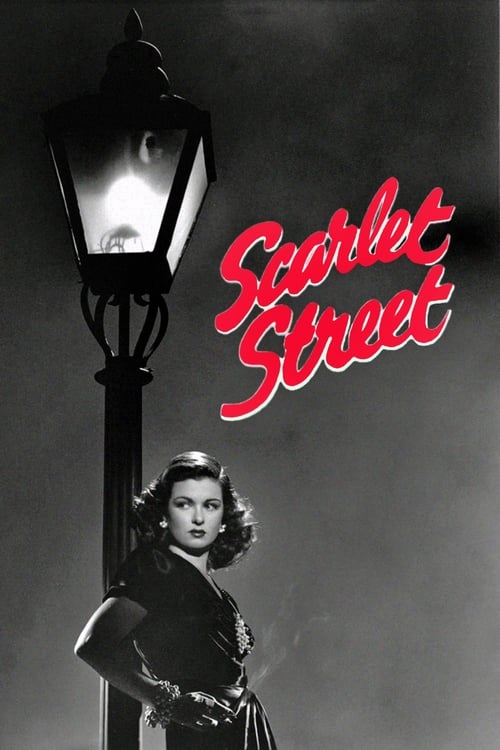
Scarlet Street
1945 · Fritz Lang
For when you want darkness with a spine — a rainy-night noir to watch alone and think about for days. This is the opposite of comfort viewing, and that's the point.
What it's about
A meek, middle-aged cashier who paints on Sundays falls helplessly for a beautiful young woman he meets on a New York street — never suspecting she and her small-time crook boyfriend see him only as a mark. When art dealers take an interest in his paintings, the pair con him into letting her claim the work as her own, and he lets it happen because he's in love. It's a slow-motion fleecing of a man whose one talent and one hope are being stripped from him at once.
The experience
Cold, gripping, and quietly devastating — you watch the trap close with total clarity while its victim refuses to see it. Lang keeps it hypnotic rather than punishing, and the final stretch lands with a moral chill few films of any era match.
Performances
Edward G. Robinson, cast against every gangster he ever played, shrinks into a stooped, apologetic nobody — heartbreaking work. Joan Bennett's lazily cruel Kitty and Dan Duryea's preening, whiny hustler Johnny complete one of noir's nastiest triangles.
The craft
Fritz Lang directs with surgical precision, reuniting the star trio of The Woman in the Window and pushing them somewhere far bleaker; Dudley Nichols' script, adapted from the French novel La Chienne, builds its ironies like clockwork. The shadowed apartments and gloomy city streets are studio-era noir photography at its most expressive.
Why it matters
One of the darkest films Hollywood released under the Production Code, famous for an ending that outmaneuvered the censors, and a cornerstone of Lang's American career and of film noir itself.
Snapshot
Scarlet Street is Fritz Lang's coldest American masterwork: a chamber tragedy of self-delusion in which a meek, middle-aged cashier and amateur painter is bled dry — financially, artistically, and finally spiritually — by a woman he cannot stop loving and the small-time hustler who runs her. Edward G. Robinson plays Christopher Cross against every gangster type he had built his career on, shrinking into a stooped, apologetic nobody; Joan Bennett is Kitty March, indolent and cruel; Dan Duryea is Johnny, her preening pimp. Adapted by Dudley Nichols from the French novel and play La Chienne (previously filmed by Jean Renoir in 1931), the picture reassembles the star quartet of Lang's The Woman in the Window (1944) and pushes their material into far darker territory. It is best known today for a triple ending that outmaneuvered the Production Code — a murder whose legal punishment falls on the wrong man while the true killer walks free into a living hell — and for the censorship bans that briefly kept it off screens in New York, Milwaukee, and Atlanta. It stands as one of the defining films of American noir and among the purest expressions of Lang's deterministic vision of a trap closing on an ordinary man.
Industry & production
The film was the first production of Diana Productions, an independent company formed by Lang together with actress Joan Bennett and her husband, the producer Walter Wanger, with distribution handled through Universal. The venture reflected the mid-1940s drift toward star- and director-owned independents operating inside the studio system, and it gave Lang an unusual degree of control over a modestly budgeted, tightly contained picture. Diana's formation grew directly out of the commercial and creative success of The Woman in the Window, and Scarlet Street was conceived in part to keep that winning combination — Lang, Robinson, Bennett, Duryea, cinematographer Milton Krasner, screenwriter Dudley Nichols — working together.
The property itself carried a European pedigree: Georges de la Fouchardière's novel La Chienne ("The Bitch"), which Jean Renoir had turned into an early sound film in 1931 with Michel Simon. Nichols, one of Hollywood's most respected screenwriters (an Oscar winner for The Informer), transposed the story to New York while preserving its bleak arithmetic of exploitation. The chief production challenge was less logistical than institutional: the story required a protagonist who commits murder and is never brought to legal justice, a direct affront to the Production Code's insistence that crime be seen to be punished. Getting the film approved, and then defending it against state and municipal censor boards after release, was the central industrial drama surrounding it. The precise budget and grosses are not something I can state reliably, so I won't assign numbers.
Technology
Technologically, Scarlet Street is a conventional 1945 studio production and makes no claim to innovation: black-and-white 35mm, standard Academy ratio, optical monaural sound, largely soundstage-bound with the era's back-projection for exteriors. Its interest lies not in new apparatus but in the expressive deployment of mature tools. The picture belongs to the post–Citizen Kane moment when deep-focus compositions, high-contrast low-key lighting, and heavy practical-source shadows had become the working grammar of dramatic cinematography, and Krasner exploits the sensitivity of contemporary panchromatic stock and the studio's lighting instruments to sculpt darkness rather than merely fill light. Any claim beyond this general context — specific lenses, stocks, or lab processes — would be speculation, and the surviving technical record on the production is thin.
Technique
Cinematography
Milton Krasner's photography is the film's most celebrated craft element. Working in a restricted set of interiors — Chris's cramped domestic apartment, the Greenwich Village studio, Kitty's rooms, the office — Krasner uses pooled lamplight and deep, engulfing shadow to externalize a psychology of entrapment. Figures are repeatedly boxed by doorframes, mirrors, and windows; the visual field narrows as Chris's options do. The lighting refuses glamour: Robinson is often shot flatly or from angles that emphasize his softness and age, while Kitty is lit to be desirable without ever being warm. Rain-streaked night exteriors and the reflective surfaces of the city give the film its characteristic noir sheen. Crucially, the camera tends toward stillness and precise framing rather than flamboyant movement — a discipline that suits Lang's architectural sense of fate.
Editing
Cut by Arthur Hilton, the film is edited for tightening inevitability rather than kinetic excitement. Scenes are held; the rhythm is deliberate, even oppressive, matching a narrative in which the audience often sees the trap before the character does. The famous murder sequence and its aftermath are structured for dramatic irony — the cross-cutting of guilt, accusation, and misplaced legal consequence — while the film's coda, tracing Chris's disintegration, is elongated to force the viewer to sit inside his punishment. The editing serves Lang's fatalism: nothing is rushed past, because the point is that there is no escape from what has been set in motion.
Mise-en-scène / staging
This is where Lang's authorship is most legible. The film is built on recurring visual motifs — the confining apartment where Chris's shrewish wife dominates, the paintings that migrate from private compulsion to public commodity, and above all the act of signing. Kitty's forged signature on Chris's canvases is staged as the story's moral hinge, dramatized in objects and gestures rather than dialogue. Mirrors and self-portraiture recur; the paintings themselves (executed for the production by the artist John Decker) function as characters, expressing what Chris cannot say. Lang stages emasculation spatially, framing Robinson small within domestic and social architectures that dwarf him, so that the design of every room becomes an argument about power.
Sound
Hans J. Salter's score works largely in a restrained, foreboding register, swelling at moments of obsession and violence but often withholding, letting silence and the ambient sound of the city carry dread. The film exploits sound bridges and off-screen noise — most memorably in the way guilt and public accusation are made to intrude aurally on Chris's isolation. Diegetic music and street sound anchor the New York setting, while Salter's cues underline the tragic-ironic distance between what Chris feels and what is being done to him.
Performance
The performances are the film's engine and its great act of casting-against-type. Edward G. Robinson, the archetypal screen tough, plays Christopher Cross as a stooped, blinking, chronically apologetic man whose tenderness curdles into horror — a performance of near-total physical de-glamorization that ranks among his finest. Joan Bennett's Kitty is languid and contemptuous, her allure inseparable from her indifference; the character's cruelty is played casually, which makes it worse. Dan Duryea's Johnny is a definitive noir heel — sneering, cowardly, feline — and his rapport with Bennett gives the exploitation its sadistic texture. Rosalind Ivan as Chris's browbeating wife and Charles Kemper as her presumed-dead first husband supply the grotesque domestic comedy that darkens into plot mechanism.
Narrative & dramatic mode
Scarlet Street operates in the tragic-ironic mode characteristic of Lang: a deterministic machine in which each of Chris's attempts at love, art, and finally self-assertion only tightens the noose. The dramaturgy turns on dramatic irony — the audience understands the con on Chris long before he does, and understands the true guilt long after the law has misassigned it. Its structure is a slow-build seduction and swindle that culminates in a sudden eruption of violence, followed by an extended, almost purgatorial denouement. The masterstroke is the layered ending: Chris murders Kitty; Johnny is tried, convicted, and executed for a crime Chris committed; and Chris, legally untouched, is destroyed by conscience, sinking into homeless, hallucinatory ruin, haunted by the voices of the lovers he can never confess to. It is one of the most ruthless conclusions in classical Hollywood — a punishment more total than any the courts could impose.
Genre & cycle
The picture is a cornerstone of 1940s American film noir, and specifically of its subgenre of the ordinary man ensnared by a femme fatale and his own desire — the terrain of Double Indemnity, The Woman in the Window, and Detour. It shares noir's fatalism, its urban nocturnal iconography, its morally compromised protagonist, and its structural sense of a trap. Yet it complicates the cycle: Chris is neither a hardboiled schemer nor an innocent, but a passive dreamer whose weakness is his tragedy. As a companion piece to The Woman in the Window — same director, same central trio — it forms an informal diptych, though where the earlier film retreats into a dream-frame, Scarlet Street refuses any such consolation.
Authorship & method
The film is unmistakably Lang's, bearing his signature obsessions: guilt, fate, the entrapment of an individual by circumstance and his own compulsions, and the recurring image of a man who commits a crime and must live inside its consequences. Lang's method here is one of rigorous control and cold observation — precise geometric framing, a refusal of sentimentality, and a fascination with the mechanisms (legal, social, psychological) that grind the protagonist down. His key collaborators were essential to realizing this vision: screenwriter Dudley Nichols, who furnished the tight, ironic adaptation of La Chienne; cinematographer Milton Krasner, whose shadow-work gave the film its visual soul; composer Hans J. Salter, whose score sustained its dread; and editor Arthur Hilton, whose measured cutting enforced its sense of inevitability. The producing partnership with Joan Bennett and Walter Wanger through Diana Productions gave Lang the independence to pursue so uncompromising an ending. The picture is often discussed alongside Renoir's La Chienne as a study in how two great directors treated the same material — Renoir with earthy irony, Lang with metaphysical severity.
Movement / national cinema
Scarlet Street sits at the confluence of two currents in American cinema. It is a product of Hollywood's studio-era independent production, but its sensibility is deeply European: Lang was among the most eminent of the Weimar émigrés — the director of Metropolis and M — who carried German Expressionism's chiaroscuro, its fatalism, and its psychological architecture into American genre filmmaking, becoming a foundational influence on noir itself. The film's very source is French, and its story of an artist ruined by love descends from a European literary-theatrical tradition. It thus exemplifies the transatlantic hybridization that made 1940s noir: American crime material and studio resources fused with the visual language and worldview of Central European cinema in exile.
Era / period
Released in 1945, at the very close of the Second World War, the film belongs to the moment when noir was crystallizing into a recognizable body of work and when the Production Code's grip was still firm but increasingly contested. Its production and reception are inseparable from that censorship regime: the Code's demand that criminality be punished shaped the film's ingenious ending, and the postwar mood — disillusioned, shadowed, skeptical of American optimism — is legible throughout. The bans imposed by several state and municipal censor boards, later overturned, mark the period's ongoing struggle over what mainstream cinema could depict about crime, sex, and unpunished guilt.
Themes
The film's governing theme is self-delusion — Chris's willful blindness to a woman he needs to be other than she is. Around it cluster several of Lang's deepest preoccupations. Authorship and identity: the paintings Chris creates in secret become valuable only when signed with Kitty's name, so that his truest self-expression is literally stolen and attributed to another — a bitter parable about art, ownership, and erasure. Emasculation and power: Chris is dominated first by his wife, then by Kitty and Johnny, his tenderness endlessly exploited. Guilt and justice: the film draws a merciless line between legal punishment and moral punishment, letting the guilty man go free precisely so that conscience can annihilate him more thoroughly than the state ever could. Money and worth: value — of paintings, of people, of love — is shown to be manipulable, forged, and finally hollow. Beneath all of it runs Lang's fatalism, the sense that character is destiny and that the trap was always already sprung.
Reception, canon & influence
On release the film provoked as much controversy as praise. Its notoriety was fueled by the censorship battles — bans in New York State, Milwaukee, and Atlanta over its treatment of unpunished murder, adultery, and its unsavory milieu — which were subsequently lifted, giving the film an outlaw reputation. Contemporary critical response was mixed, some reviewers unsettled by its bleakness and its degradation of a beloved star; but its stature grew steadily in the decades that followed. Looking backward, the film draws on German Expressionism and Lang's own Weimar cinema, on Renoir's 1931 La Chienne and its French literary source, and on the immediate template of The Woman in the Window. Looking forward, it became a canonical text of film noir, routinely cited in histories of the cycle and celebrated by later critics and filmmakers as one of Lang's supreme American achievements; its lapse into the public domain has kept it unusually accessible and widely seen. Its central conceit — the ordinary man destroyed by desire, and the killer punished only by his own conscience — echoes through subsequent crime cinema, and its unflinching final act remains a benchmark for how far classical Hollywood could go in denying its audience any comfort.
A Deleuzian reading
Kitty March signs her name in the corner of a canvas she didn't paint.
The full Deleuzian reading of Scarlet Street →
Reception
A box-office hit in 1945 but scandalous enough to be banned outright by censors in New York, Atlanta, and Milwaukee; today it's routinely ranked among the greatest films noir and often called Lang's American masterpiece.
How Scarlet Street was received, from release to now →
How to watch Scarlet Street: what to notice on a first viewing
- Notice how often characters are boxed by doorframes or windows. Krasner repeatedly frames people inside doorframes, mirrors, and window shapes, so the visual field narrows as the story's options do. The compositions are quietly closing in around Chris long before the plot does.
- Notice the pools of light against the deep black around them. Krasner lights interiors with hard, restricted pools of lamplight and engulfing shadow, refusing any glamorous fill even on the film's most desirable character. The lighting refuses to flatter anyone, which is part of how the film keeps its distance from romance.
- Watch Robinson play stooped, blinking, and apologetic throughout. The actor built his career on tough-guy roles, and here he shrinks into a soft, hesitant nobody, a performance of near-total physical de-glamorization. Casting against type makes Chris a timid man you read by his posture, not his reputation.
- Notice the paintings Chris makes in his rented studio. The canvases recur throughout as physical objects, expressing feelings the dialogue never states directly, a private compulsion staged in paint rather than speech. The paintings say what the man who made them cannot bring himself to say out loud.
The whole guide to watching Scarlet Street, with the keys for a rewatch →
Influences: the films it descends from and the films it influenced
- La Chienne (1931) — The direct source: Lang and Dudley Nichols reworked Renoir's amateur-painter-and-prostitute plot beat for beat, but replaced Renoir's earthy street-life realism with rigid geometric framing, converting the same narrative machine into a study of fate rather than irony.
- The Woman in the Window (1944) — The immediate template — Lang reunited the exact Robinson–Bennett–Duryea triangle and Milton Krasner's shadow-work one year earlier, so Scarlet Street reads as its ruthless correction, stripping away the dream-frame escape hatch to strand the meek man inside his crime.
- M (1931) — Established Lang's signature of a man ground down by overlapping legal, social and psychological machineries, and the motif of guilt punished by conscience rather than the state — the exact 'killer sentenced only by himself' structure of Scarlet Street's ending.
- Dr. Mabuse, der Spieler (1922) — Lang's Weimar expressionism — clawing shadows, entrapment compositions and figures boxed by architecture — is the visual grammar Krasner's low-key lighting imports wholesale into the American noir frame.
- The Blue Angel (1930) — The prototype of the respectable man annihilated by sexual infatuation, with Emil Jannings cast against his dignified image exactly as Edward G. Robinson's gangster persona is inverted into a timid cashier.
- Pandora's Box (1929) — Codified the amoral, guileless femme fatale who destroys men without malice — the template for Joan Bennett's Kitty, whose casual cruelty (not scheming villainy) is what makes the entrapment lethal.
- You Only Live Once (1937) — Lang's first full American fusion of deterministic fate with expressionist shadow, rehearsing the closing-net editing rhythm — the deliberate, inevitable cutting cadence — that enforces doom in Scarlet Street.
- Daybreak (1939) — Transposes the ordinary man destroyed by love and crime into expressionist American melodrama, extending the crime-melodrama-of-the-doomed-everyman that Gabin embodied.
- The Postman Always Rings Twice (1946) — Extends the working-man-plus-faithless-woman-plus-murder triangle, retaining the Production-Code compromise Lang fought — punishment arrives, but the film mimics his study of desire dismantling an unremarkable man.
- Criss Cross (1949) — Another émigré's expressionist noir built on the same entrapment framing and a passive man destroyed by obsessive desire, carrying forward the German shadow-craft Lang naturalized into Hollywood.
- Nightmare Alley (1947) — Advances Scarlet Street's benchmark for how far Hollywood could push audience discomfort, tracking a man's total moral and social disintegration without offering the comfort of clean justice.
- Human Desire (1954) — Lang returns to adapting the same French naturalist lineage (Zola/Renoir's La Bête Humaine) with Krasner-style shadow and a triangle of desire and murder, a late-career mirror of the La Chienne project.
- The Big Heat (1953) — Lang refines the deterministic machinery and cold-observational framing of Scarlet Street, again dramatizing how institutional and personal violence grind down individuals with clinical, sentiment-free precision.
- Ace in the Hole (1951) — Inherits Scarlet Street's willingness to deny the audience any sympathetic figure or comforting resolution, weaponizing noir's bleakness into an unflinching moral indictment with no redemptive off-ramp.
- Nightmare Alley (2021) — Lang maps power geometry onto studio interiors — bodies positioned as a diagram of dominance, the manipulator always spatially elevated above the deceived — and builds a manipulation-and-hubris narrative in which the man's arrogant self-belief makes him the precise instrument of the femme fatale's destruction, the architecture del Toro inherits wholesale.
- Night and the City (1950) — Lang's portrait of a weak, deluded striver destroyed by his own scheming supplies the 'ambition-without-substance' character archetype that Widmark's Fabian inherits.
- The Prowler (1951) — Lang's study of an ordinary man driven to murder by acquisitive longing—for money and a woman above his station—prefigures the 'objects of aspiration' staging by which The Prowler makes covetousness (the house, the pregnancy, the payoff) the engine of ruin.
- Double Indemnity (1944) — The parallel 1944 noir that fixed the same craft vocabulary — venetian-blind low-key lighting and a doomed ordinary man lured by a femme fatale — but resolved through confession, throwing Lang's uniquely unpunished murder into relief.
- Detour (1945) — The same-year Poverty Row companion in fatalism, where an ordinary man is dragged to ruin by a hard woman and a self-justifying narration, sharing Scarlet Street's refusal of any redemptive exit.
- The Reckless Moment (1949) — Produced by the same Bennett–Wanger partnership and starring Joan Bennett, it applies the identical craft of respectable-domestic-life-invaded-by-crime and blackmail, sustaining the Diana Productions house style of chilly moral entrapment.
- Laura (1944) — Lang pursues Preminger's examination of male artistic projection: the painter protagonist constructs an ideal of a woman onto whom he projects fantasies she actively exploits, the same dynamic of male gaze manufacturing the erotic object that Laura anatomizes through McPherson's obsessive archaeology of Laura's apartment and portrait.
Similar films
- The Woman in the Window (1944) — influence & lineage
- The Postman Always Rings Twice (1946) — influence & lineage
- Double Indemnity (1944) — influence & lineage
- Criss Cross (1949) — influence & lineage
- Nightmare Alley (1947) — influence & lineage
- Detour (1945) — influence & lineage
- The Postman Always Rings Twice (1981) — shared sensibility
- They Live by Night (1949) — shared sensibility