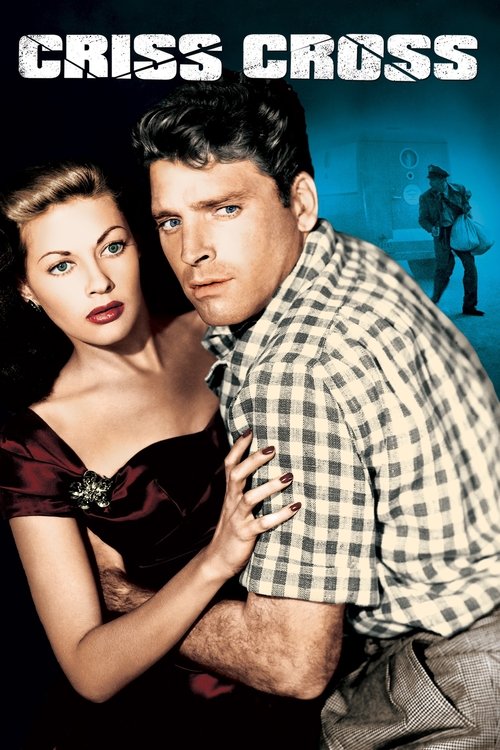
Criss Cross
1949 · Robert Siodmak
For when you want to sink into something dark and fatalistic — a late-night watch to savor for its doomed atmosphere, not a pick-me-up. Comfort viewing only if your comfort is shadows.
What it's about
Steve Thompson drifts back to his old Los Angeles neighborhood and straight back into the orbit of Anna, the ex-wife he never got over — who is now married to a dangerous gangster named Slim Dundee. Caught alone with her, Steve improvises a cover story: he was only there to propose a heist, an inside job on the armored car he guards. The lie becomes a plan, and the plan pulls everyone into it.
The experience
Coldly gripping — a slow-motion trap narrated by the man building it around himself, thick with desire, dread, and the sense that every exit closed a long time ago. It tightens steadily until it's hard to breathe.
Performances
Burt Lancaster plays Steve's obsession as something almost physical, a man visibly arguing with a decision he's already made, while Yvonne De Carlo gives Anna real ambiguity — you're never sure what she wants, which is the point.
The craft
Robert Siodmak directs with a fatalist's precision: sun-bleached Los Angeles locations shading into deep noir shadow, a heist staged in choking smoke, and a voice-over that lets you hear a man rationalize his own destruction in real time. It's one of the most formally controlled American crime films of its era.
Why it matters
A high-water mark of classic film noir's fatalistic strain, frequently cited among the darkest studio films of its period, and a touchstone for later crime films built on desire as a form of doom.
Snapshot
Criss Cross is the second and darker of Robert Siodmak's two collaborations with Burt Lancaster at Universal-International, following The Killers (1946), and it stands as one of the most fatalistic American films of the classical period. Steve Thompson, an armored-car guard returned to his old Los Angeles neighborhood after aimless drifting, cannot let go of his ex-wife Anna; when her new husband, the gangster Slim Dundee, finds them together, Steve improvises a lie that becomes a plan — an inside job on his own truck — and the lie devours everyone who touches it. The film's premise is a trap that its protagonist builds himself and then walks into with his eyes open, narrating his own descent in voice-over while insisting he had no choice.
What distinguishes the film is not the heist, which occupies only a few minutes of screen time, but the architecture of self-deception around it. Siodmak and screenwriter Daniel Fuchs, adapting Don Tracy's 1934 novel, restructure the story so that it opens near its end — a nocturnal embrace in a parking lot, seen from a helicopter-like high angle — then doubles back through flashback to explain how these people arrived there. The effect is to make the entire film a completed circuit. Nothing that Steve does can alter an outcome the audience has already glimpsed. Franz Planer's photography, Miklós Rózsa's score, and Lancaster's performance as a man rationalizing his way toward annihilation combine into what many critics have regarded as the purest expression of noir's deterministic strain: not a mystery, but a mechanism.
The film was a modest performer in its day and was overshadowed by The Killers, which had made Lancaster a star. Its critical standing rose substantially in the decades that followed, particularly after French and Anglo-American critics began treating film noir as a coherent object of study in the 1950s and 1970s, and it has since been widely anthologized in noir criticism and remade, in altered form, by Steven Soderbergh as The Underneath (1995).
Industry & production
Criss Cross was produced at Universal-International, the studio formed by the 1946 merger of Universal Pictures with William Goetz and Leo Spitz's International Pictures. The new management's stated ambition was to move Universal upmarket — away from the serials, horror cycles, and Abbott and Costello vehicles that had sustained it — toward prestige productions and adult drama. In practice, this meant a period of expensive experimentation followed by retrenchment, and noir-inflected crime pictures were attractive precisely because they could carry adult subject matter at moderate cost.
Siodmak was, by 1949, Universal's most reliable director of this material. A German émigré who had directed in Weimar Berlin and then in France before arriving in Hollywood, he had worked his way up through the studio's B unit and had a run of successes — Phantom Lady (1944), Christmas Holiday (1944), The Suspect (1944), The Spiral Staircase (1946), The Killers (1946), Cry of the City (1948, on loan to Fox) — that made him the studio's specialist in atmospheric crime. Lancaster, whose screen debut in The Killers had been engineered by producer Mark Hellinger, was by this point both a Universal contract asset and, through his partnership with Harold Hecht, an early example of the star-as-independent-producer. That dual status shaped his availability and his choices; Criss Cross was a studio assignment rather than a Hecht-Lancaster production.
The source was Don Tracy's hard-boiled novel Criss-Cross, published in 1934 and set on the Atlantic coast. Daniel Fuchs — a Brooklyn novelist (Summer in Williamsburg, Homage to Blenholt, Low Company) who had come to Hollywood in the late 1930s and would later win an Academy Award for the story of Love Me or Leave Me — relocated the action to Los Angeles and reworked the narration and structure substantially. Fuchs's screenplay is the film's crucial intervention: the flashback frame, the specificity of the Bunker Hill milieu, and the tone of aggrieved working-class fatalism are his contribution as much as Tracy's.
Production drew on Universal's standing resources — Rózsa was under contract, Planer was among the studio's senior cinematographers, and art director Bernard Herzbrun oversaw the studio's design department — while making unusually heavy use of Los Angeles locations. The film was shot in 1948 and released in early 1949. Documentation of its budget and returns is thin in the widely available record; it is generally described as a moderate commercial performer rather than a hit, and it did not repeat The Killers' success. Reports have long circulated that Siodmak was unhappy with aspects of the production, including the ending, but the specifics vary between accounts and should be treated with caution.
Technology
The film is a black-and-white production shot on nitrate-era orthochromatic-successor panchromatic stock, in the Academy ratio, with optical monaural sound — the standard technical package for a 1949 American studio picture. What is notable is less the equipment than how it was deployed.
The postwar years saw a marked increase in location shooting by Hollywood crews, enabled partly by faster film stocks, more portable lighting, and the practical experience many technicians had acquired in wartime documentary and newsreel units. Criss Cross participates fully in this shift. Its Los Angeles is a real one: the Angels Flight funicular and the decaying Victorian rooming houses of Bunker Hill, streets and storefronts around downtown, and — for the robbery — an actual industrial exterior staged with smoke and moving vehicles. The armored-car holdup sequence is built around a tear-gas or smoke effect that fills the frame with drifting white, an in-camera atmospheric solution rather than an optical one, and it converts a technical constraint into the film's most memorable visual passage: figures firing at one another through a fog they cannot see through.
Siodmak also exploits the crane and the elevated camera position. The opening shot descends from a high vantage over a nightclub parking lot onto the two lovers, an aerial-to-intimate move that establishes the film's governing perspective — fate looking down — before a word is spoken. Such moves required substantial rigging and were expensive; their presence indicates a production willing to spend on visual signature.
Technique
Cinematography
Franz Planer — Franz F. Planer in his American credits — was, like Siodmak, a Central European émigré with a career in German-language cinema behind him, and his work here belongs to the tradition of expressive low-key lighting that émigré cinematographers helped naturalize in Hollywood. The film's visual scheme is organized around a contrast between two registers. The Los Angeles daylight scenes are relatively open and hard-edged, sunlit in a way that feels indifferent rather than warm: the ordinary world in which Steve claims he wants to live. The night scenes, by contrast, are built from pooled light and deep shadow, with faces half-obscured, shafts thrown across walls, and the characteristic noir vocabulary of venetian-blind and stair-rail patterning.
Planer favors deep, sharply defined compositions in interiors and makes recurring use of foreground obstruction — bodies, furniture, doorframes cutting into the frame — so that the viewer is repeatedly placed as an observer of something partially concealed. The nightclub sequences use moving camera and crowded frames to suggest a world in which Steve is never alone with Anna even when he believes he is. The smoke-filled robbery is the extreme case of the film's general strategy: visibility withdrawn at the moment of maximum consequence.
Editing
Ted J. Kent, a Universal veteran whose career stretched back to the silent era and included Bride of Frankenstein (1935), cuts the film with a marked asymmetry of rhythm. The flashback body of the film unfolds in long, patient scenes — conversations in bars, kitchens, and hospital rooms that are allowed to accumulate discomfort — while the robbery is cut fast and disorientingly, in short bursts of movement and gunfire through smoke. The contrast is structural: the film spends its running time on the slow construction of a trap and dispatches its ostensible climax in minutes.
The flashback architecture itself is an editorial and structural achievement. The film opens in the present, moves back to Steve's return to Los Angeles, and proceeds forward until it rejoins and passes the opening scene, so that the audience experiences the second half knowing where it leads. Siodmak had used elaborate multiple-flashback construction in The Killers; here the design is simpler but arguably more punishing, because there is no investigator standing between the audience and the doomed man.
Mise-en-scène / staging
The film's settings are among its most precise elements. Steve's mother's house — with its kitchen table, its family dinners, its brother-in-law the cop, its ordinary domestic clutter — is rendered with a specificity unusual in noir, which more often abstracts its milieux. Fuchs's Brooklyn-novelist attention to working-class interiors survives the transposition to Los Angeles. Against this stands the Round-Up bar, the nightclub, Slim's orbit of hotel rooms and back offices, and finally the beach house where the film ends: spaces of increasing enclosure.
Bunker Hill functions as more than a location. Its steep streets, funicular, and subdividing mansions gave the film an image of a neighborhood in decline that mirrors Steve's own trajectory, and the district's subsequent demolition has made the film, incidentally, a document of a vanished Los Angeles. Staging within scenes tends toward triangulation — Steve, Anna, and a third presence (Slim, the detective Ramirez, the mother, the bartender) — so that intimacy is continually policed.
Sound
Miklós Rózsa's score is central to the film's effect. Rózsa, a Hungarian émigré composer who had already shaped the sound of American psychological crime drama with Double Indemnity (1944), The Lost Weekend (1945), and The Killers (1946), writes here in his characteristic idiom: brass-heavy, chromatic, insistent, with a driving rhythmic figure that functions less as accompaniment than as pressure. The score does not comment ironically on the action; it presses forward with the same inevitability the plot describes.
Against this sits Steve's first-person voice-over, delivered by Lancaster in a flat, rationalizing register — a man explaining to himself why what he is about to do is not his fault. The film also makes pointed use of source music, most famously the Latin dance-band material in the nightclub sequence (an early screen appearance by Tony Curtis, then billed as Anthony Curtis, as Anna's dance partner). The juxtaposition of diegetic dance music with Steve's jealous watching is one of the film's sharpest sound-image ideas.
Performance
Lancaster's Steve Thompson is a study in physical strength rendered useless. Lancaster, a former circus acrobat whose screen presence depended on athletic authority, plays a man whose body is repeatedly immobilized — in a hospital bed, in a wheelchair, finally seated and unable to run — and whose intelligence is entirely deployed in the service of self-deception. It is a performance of restraint and inwardness quite unlike his more expansive later work.
Yvonne De Carlo, cast against her Universal image as an exotic-adventure leading lady, plays Anna as neither straightforward femme fatale nor victim; the film's most contested critical question concerns how much agency and how much desperation to read into her. Her final scene, in which the character's calculations become explicit, is played without melodramatic pitch, which makes it colder. Dan Duryea's Slim Dundee is a variation on the whining, dangerous weakling Duryea had refined in Scarlet Street (1945) and elsewhere — charming, petulant, and lethal. Stephen McNally as detective Pete Ramirez supplies the film's moralizing counter-voice, and Percy Helton, Alan Napier, and Griff Barnett fill out the neighborhood with character work that anchors the film's social texture.
Narrative & dramatic mode
Criss Cross is a tragedy of rationalization rather than a crime puzzle. There is no investigation to follow and no concealed truth for the audience to discover; the interest lies entirely in watching a man construct justifications for a course he has already chosen. The voice-over is the mechanism: it grants access to Steve's reasoning while making plain that the reasoning is false. He tells us he is being forced. The images tell us he is choosing.
The flashback structure converts the film from suspense into dread. Because the opening scene has already shown us Steve and Anna in a compromised embrace on the night of the robbery, the film's forward motion is toward a point we have seen. Classical Hollywood used flashback frames frequently in this period, often for exculpatory purposes — a confession, a courtroom, an explanation. Here the frame offers no exculpation. It simply confirms the closure of the circuit.
The title names the film's dramatic principle. Every alliance in the story is a double cross nested inside another: Steve deceives Slim, Anna deceives Steve, Slim deceives everyone, and the plan Steve devises to protect Anna is the instrument of her destruction and his own. The final movement — Steve immobilized, Anna preparing to abandon him, Slim arriving — resolves nothing morally. It executes an arithmetic.
Genre & cycle
The film sits at the intersection of two noir subtypes. The first is the doomed-romance strand descending from The Postman Always Rings Twice (novel 1934; Hollywood film 1946) and Double Indemnity (1944): a man, a woman he cannot relinquish, and a scheme that destroys them. The second is the heist film, which was in the process of consolidating into a recognizable form and would reach its canonical American statement the following year in John Huston's The Asphalt Jungle (1950) and then in Kubrick's The Killing (1956) and Dassin's French-made Rififi (1955).
Criss Cross is unusual in the heist lineage for how little it cares about procedure. Where The Asphalt Jungle and The Killing dwell on planning, expertise, and the mechanics of failure, Siodmak's robbery is almost an afterthought — a violent spasm in the middle of a love story. What the film shares with those pictures is the underlying proposition that the caper is a machine for revealing character, and that the plan's collapse follows from who these people are rather than from bad luck.
The film also belongs to the postwar cycle of returning-and-displaced-men pictures. Steve's drifting, his inability to resume ordinary life, his family's incomprehension, and his sense that the world has moved without him are recognizable postwar anxieties, even though the script does not make him a veteran in the manner of The Blue Dahlia (1946) or Crossfire (1947).
Authorship & method
Siodmak's authorship rests on a consistent method rather than a signature theme: the construction of psychological entrapment through spatial and lighting design. Trained in the German industry — he directed Menschen am Sonntag (1930) with Edgar G. Ulmer, from a script involving Billy Wilder — and having worked in French exile before emigrating, he brought to Hollywood a vocabulary of shadow, camera movement, and off-screen menace that meshed with what American crime pictures were becoming. His best films share an interest in characters who cannot see their own situations: Phantom Lady, The Spiral Staircase, The Killers, Cry of the City, and Criss Cross all place the audience at an angle of knowledge the protagonist lacks.
The collaborators matter individually. Daniel Fuchs supplied the social specificity and the fatalistic voice; his literary background in the naturalist tradition of Depression-era urban fiction gives the film a grain that pure genre writing rarely achieves. Franz Planer supplied the two-register lighting scheme and the willingness to withhold visual information. Miklós Rózsa supplied a score that behaves like a physical force. Ted J. Kent supplied the rhythmic asymmetry between deliberation and catastrophe. This is studio filmmaking in the fullest sense — a set of specialists, most of them under long-term contract, converging on a coherent object under a director with a strong point of view but limited final control.
The question of how much control Siodmak had over the ending is genuinely unresolved in the accessible record, and claims about studio interference should be treated as reported rather than established.
Movement / national cinema
Criss Cross is a central instance of the German-émigré contribution to American film noir. Siodmak, Planer, and Rózsa were all Europeans who arrived in Hollywood in the 1930s; the lighting practice, the use of architecture as psychological pressure, and the sense of characters caught in systems larger than themselves all descend, in part, from Weimar cinema and its street-film and Kammerspiel traditions. That descent has sometimes been overstated in criticism — noir also drew heavily on American hard-boiled fiction, on Warner Bros. gangster pictures, on wartime documentary realism, and on the specific economics of postwar Hollywood — but Siodmak's case is among the strongest available for the émigré thesis.
The film is simultaneously a very American picture. Its Los Angeles is not a stylized European city but a documented one, and Fuchs's dialogue is thoroughly idiomatic. The synthesis of European visual method and American social material is exactly what noir, as a body of work, consisted of.
Era / period
The film belongs to the late 1940s, the densest stretch of the noir cycle and a period of considerable turbulence in the American industry. The 1948 Paramount consent decrees had begun the dismantling of studio ownership of theaters; television was emerging; audiences were beginning their long postwar decline; and the House Un-American Activities Committee hearings of 1947 had already begun to constrain what American films could say about social conditions. Crime pictures offered a form in which pessimism could be expressed as genre convention rather than as social critique.
The Production Code remained in force, and Criss Cross observes it in the standard way: transgression is depicted with considerable sympathy, and punishment arrives comprehensively at the end. The film's fatalism is thus partly a formal accommodation — the Code required that crime not pay — and partly a genuine worldview that the accommodation happened to suit. It is also worth noting the film's relationship to postwar Los Angeles as a subject: the city's rapid growth, its automobile geography, and its socially stratified neighborhoods appear here as lived environment rather than backdrop.
Themes
Compulsion and the alibi of fate. The film's controlling idea is that Steve's insistence on being trapped is itself the trap. He returns to Los Angeles claiming he has no particular reason; he seeks out Anna claiming he only wants to see her; he proposes the robbery claiming it was the only story available. The voice-over performs necessity while the images document choice.
Obsessive desire. Steve's attachment to Anna is presented without romantic idealization. It is a fixation that overrides self-interest, family, and survival, and the film is unsentimental about how little either party can articulate it.
Class and the closed neighborhood. The Bunker Hill setting, the family kitchen, the armored-car job, and the small ambitions of everyone around Steve establish a world in which the robbery is legible as a shortcut out — and in which no shortcut exists. Fuchs's naturalist background is visible here.
Domesticity as reproach. The mother, the sister, and the brother-in-law cop offer an alternative life that the film treats as genuinely available and genuinely insufficient. Steve's rejection of it is not presented as glamorous.
Bodies and immobility. Lancaster's physical power is systematically neutralized — the hospital, the wheelchair, the final helplessness. Strength is shown to be irrelevant to the kind of trap the film describes.
Reception, canon & influence
Contemporary American reception was respectful but not exceptional; the film was received as a competent, atmospheric crime picture from a director known for them, and it did not command the attention The Killers had. Reviews of the period generally praised the atmosphere, Rózsa's score, and Lancaster's performance while treating the material as familiar. Detailed contemporaneous critical documentation is more scattered than for the era's prestige releases.
The film's reputation grew through the long process by which noir was constituted as a critical category — beginning with French critics in the immediate postwar years, notably Raymond Borde and Étienne Chaumeton's Panorama du film noir américain (1955), and expanding in Anglo-American criticism from the 1970s onward, when noir became a standard object of academic study and repertory programming. In that literature Siodmak is consistently identified as one of the cycle's essential directors, and Criss Cross is frequently placed alongside The Killers and Phantom Lady at the center of his American work. Some critics have argued it is the better of the two Lancaster films precisely because it lacks The Killers' investigative scaffolding.
Influences on the film (backward). Don Tracy's 1934 novel supplies the plot skeleton. The James M. Cain lineage — The Postman Always Rings Twice, Double Indemnity — supplies the doomed-triangle template and the confessional narration. Weimar and émigré visual practice supplies the lighting and spatial method. Siodmak's own The Killers supplies the flashback architecture, the Lancaster persona, the Rózsa idiom, and the general proposition that a man's past is a sentence already passed. Depression-era urban naturalism, via Fuchs, supplies the social texture.
Legacy (forward). The film is a significant node in the heist lineage that runs through The Asphalt Jungle (1950), Rififi (1955), and The Killing (1956), and it contributed to the model of the caper as character revelation rather than procedural showcase. Its structural device — open near the end, then circle back — became a durable convention of crime cinema and was taken up, with acknowledgment, by later filmmakers working in the noir tradition. Steven Soderbergh remade it as The Underneath (1995), relocating the story to Austin and reworking its time scheme into a more overtly fragmented structure; the remake's mixed reception has, if anything, strengthened the original's standing. Quentin Tarantino, Rian Johnson, and other post-1990s American crime filmmakers work within conventions the film helped establish, though direct-line claims of specific influence should be made carefully.
The film's afterlife has also been archival and geographic: as one of the most extensive surviving records of Bunker Hill before its redevelopment, it has been cited in urban and architectural histories of Los Angeles as well as in film criticism. Restored and reissued on home video and in repertory over the past several decades, Criss Cross now occupies a secure position in the noir canon — less as a discovery than as a film whose severity became more legible as the cycle it belonged to came into focus.
A Deleuzian reading
A camera comes down out of the night over a parking lot in Los Angeles.
The full Deleuzian reading of Criss Cross →
Reception
A solid programmer in 1949 that spent decades in the shadow of Siodmak and Lancaster's earlier hit The Killers; noir devotees have since flipped the ranking, and it's now routinely placed among the very greatest films noirs.
How Criss Cross was received, from release to now →
How to watch Criss Cross: what to notice on a first viewing
- Watch the opening shot descend from high above onto two people. The film opens with a crane move down from a nighttime vantage no character could ever occupy, arriving on Steve and Anna already mid-embrace before anything has been explained. You are shown where this is heading before you know a single fact about how it got there.
- Notice a shoulder or doorframe blocking part of the shot. Planer keeps cutting bodies, furniture, and doorframes across the lens, so you are constantly watching a scene that is partly hidden from you. You are never given a clean, complete view, which is exactly how much this world lets Steve see.
- Listen for the score pushing forward instead of just underlining scenes. Rozsa's brass-heavy, insistent music does not comment ironically on the action, it presses ahead with the same inevitability the story itself is building toward. The music is not telling you how to feel about the plot. It is behaving like the plot.
- Listen to Steve's voice explain why he had no choice. Lancaster narrates in a flat, rationalizing tone that insists he is being forced into everything, while the images keep showing him actually choosing each step himself. The voice and the picture are telling you two different stories, and only one of them is true.
- Notice a third person almost always present in a scene. Steve and Anna are rarely alone together on screen. Someone else, Slim, a detective, his mother, is nearly always staged somewhere in the frame with them. Even in scenes he thinks are private, Steve is always actually being watched by somebody.
The whole guide to watching Criss Cross, with the keys for a rewatch →
Influences: the films it descends from and the films it influenced
- Menschen am Sonntag (1930) — Siodmak's own silent debut established his practice of shooting nonprofessional faces in unmodified real locations with available light — the documentary habit he returns to on Bunker Hill's stairs, funiculars and stucco tenements, filmed as found space rather than dressed backlot.
- M (1931) — Supplies the Weimar grammar Siodmak carries to Universal: menace located off-screen and in obstructed foregrounds, criminal business staged as a bureaucratic convocation, and low-key pools that isolate a figure inside an otherwise unreadable frame.
- Pépé le Moko (1937) — The French poetic-realist template Siodmak absorbed during his Paris exile: a man whose geography is his cage, and a closing tableau in which the lovers are separated by a physical barrier shot through obstructing foreground — the exact figure of the final beach-house two-shot.
- Le Jour se lève (1939) — Establishes the flashback frame whose function is not mystery but sentence: the film opens at the terminal moment and circles back, so every remembered scene is watched with its outcome already known — the determinist architecture Daniel Fuchs adopts wholesale.
- Double Indemnity (1944) — Cain's doomed-triangle skeleton plus the confessional voice-over delivered by a mortally compromised narrator, scored by Miklós Rózsa with the same low brass ostinato and minor-second dread figure he re-tools for Steve Thompson.
- Phantom Lady (1944) — Siodmak's proof that a diegetic band number can carry the erotic charge the Code forbids elsewhere — the basement jam session's intercut of drumming and arousal is the direct method behind the Esy Morales rumba that reintroduces Anna.
- The Killers (1946) — The immediate parent: the same flashback-from-the-body architecture, the same Lancaster introduced supine and passive, Rózsa's identical scoring idiom, and the payroll robbery rendered in one uninterrupted crane descent — the single-take heist Siodmak restages here with smoke.
- The Postman Always Rings Twice (1946) — Fixes the Cain triangle's casting logic — drifter, restless wife, brutish possessor — and the practice of staging the adulterous conspiracy in blunt daylight interiors so that the fatalism reads as social fact rather than expressionist mood.
- Cry of the City (1948) — Siodmak's immediately preceding picture worked out the method of cutting studio-lit interiors against genuine street exteriors so the seams read as continuity — the technique that lets the Union Station and Bunker Hill material sit inside a soundstage film without rupture.
- Scarlet Street (1945) — Another émigré's expressionist noir built on the same entrapment framing and a passive man destroyed by obsessive desire, carrying forward the German shadow-craft Lang naturalized into Hollywood.
- The Woman in the Window (1944) — Consolidates Dan Duryea's oily blackmailer/heavy — the sneering predatory type this film crystallized — inside another chance-driven noir spiral.
- The Asphalt Jungle (1950) — Takes up the caper as character revelation rather than procedural showcase — the robbery is a device for exposing what each man wants and cannot have, with the crew assembled in low-key interiors and the plan narrated before it is executed.
- Kiss Me Deadly (1955) — Continues the Bunker Hill location practice as moral topography, shooting the same funicular, retaining walls and rooming houses in high-contrast night exteriors, and inherits the tilted, obstructed framing of figures pressed against real stairwells.
- Rififi (1955) — Extends the heist-in-flashback into a sustained sensory set piece — Siodmak's tear-gas sequence, where sound and obscured vision replace exposition, is the direct precedent for the wordless silent robbery and its equally deterministic aftermath.
- The Killing (1956) — Rebuilds the double-cross structure as overt temporal fragmentation with an omniscient narrator, and restages the masked, in-camera-obscured armored-car robbery whose payoff is not the money but the betrayal already embedded in the crew.
- Point Blank (1967) — Modernizes the determinist flashback frame — an armored-car-style score, a partner's betrayal, a wounded man who may already be dead — into elliptical fragments cut against hard Los Angeles architecture, with the triangulated blocking of husband, wife and lover preserved intact.
- Reservoir Dogs (1992) — Inherits the convention Siodmak helped fix: open at or near the disaster, then circle back, and treat the robbery itself as elided — the crime's interest displaced entirely onto who crossed whom and the bleeding aftermath in a single holding space.
- The Underneath (1995) — Direct remake that re-cuts the source's single flashback into interleaved time strands marked by color filtration, retaining the armored-car job, the ex-wife's remarriage to a heavy, and the beach-house triangulation as its terminal image.
- Out of the Past (1947) — The parallel case of a first-person retrospection in which the narrator's account is trustworthy about events and blind about himself — voice-over used to expose the speaker's self-deception rather than to clarify plot.
- Letter from an Unknown Woman (1948) — Franz Planer's other 1948 assignment: the same fluid crane that enters a scene by descending through obstructing foreground architecture, and the same conceit of a narration written from a deathbed that makes every earlier scene retroactively irreversible.
Similar films
- The Killers (1946) — influence & lineage
- Double Indemnity (1944) — influence & lineage
- Out of the Past (1947) — influence & lineage
- Point Blank (1967) — influence & lineage
- Kiss Me Deadly (1955) — influence & lineage
- The Postman Always Rings Twice (1946) — influence & lineage
- Where the Sidewalk Ends (1950) — shared sensibility
- Strangers on a Train (1951) — shared sensibility