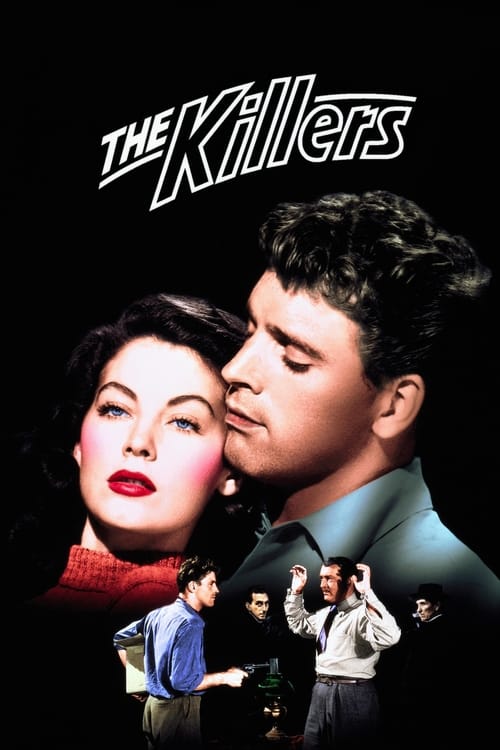
The Killers
1946 · Robert Siodmak
For a late-night noir fix — when you want cigarette smoke, double-crosses, and a story that tightens like a knot. An absolute comfort watch if shadows and fatalism are your comfort.
What it's about
Two hired guns walk into a small-town diner looking for a washed-up boxer called the Swede — who, when they find him, doesn't even try to run. An insurance investigator can't let that go, and pieces together the dead man's story through the people who knew him: a beautiful woman, a criminal crew, and a payroll heist that went wrong.
The experience
Cool, fatalistic, and grippingly told — a mystery that opens with the ending and makes the why more suspenseful than the what. The mood is all rain-slick streets and doomed romance, with a heist sequence that still quickens the pulse.
Performances
Burt Lancaster, in his screen debut, is magnetic as a man resigned to his fate, and Ava Gardner's breakout turn defined the femme fatale for a generation — you understand instantly why men wreck their lives over her.
The craft
Robert Siodmak builds the story as a mosaic of flashbacks from different witnesses, decades before that structure became fashionable, and the shadow-carved black-and-white photography is textbook noir at its most gorgeous. The brooding score drives it like a heartbeat.
Why it matters
One of the defining films of the noir cycle — it launched two major stars, cemented Siodmak's reputation, and its investigative-flashback structure echoed through crime cinema for decades.
Snapshot
One of the defining texts of American film noir, The Killers opens with an act of deliberate homicide and spends the rest of its running time explaining why the dead man let it happen. Robert Siodmak's adaptation of Ernest Hemingway's 1927 short story extends the original's grim, truncated action into a full-dress retrospective mystery: an insurance investigator reconstructs a boxer's fatal entanglement with a beautiful woman, a gang, and a betrayed heist through a mosaic of flashbacks assembled from the testimony of survivors. The film introduced Burt Lancaster to cinema, gave Ava Gardner her breakout role, and secured Siodmak's place among the foremost architects of the noir cycle. Seventy years on, its visual authority — shadow-drenched interiors, the Swede's body folded on a boarding-house bed waiting without complaint for death — remains undimmed.
Industry & production
The Killers was produced by Mark Hellinger for Universal-International and released in August 1946. Hellinger, a former newspaper columnist turned producer, was drawn to material with journalistic specificity and a sense of street-level American fatalism. He purchased the screen rights to Hemingway's brief story — just over 2,700 words, published first in Scribner's Magazine in 1927 and collected in Men Without Women that same year — recognizing that the tale's compressed intensity could anchor a feature if the backstory were invented wholesale. The challenge was considerable: Hemingway's story ends where the film's central mystery begins, leaving Ole Anderson's past entirely unwritten.
The production's casting of the lead proved unexpectedly consequential. Hellinger saw Burt Lancaster on Broadway in A Sound of Hunting (which opened in late 1945), a production in which Lancaster had a relatively small role, but the producer was struck by his physical command. Lancaster, then 32, had been a circus acrobat before the stage; his large frame, athlete's coordination, and quality of barely-contained force were precisely what the role of Ole "the Swede" Anderson demanded. The Killers became Lancaster's film debut, and he immediately commanded attention sufficient to launch one of the defining careers of postwar Hollywood.
Ava Gardner, who had been under contract at MGM since 1941 but had found only minor assignments, was borrowed for the role of Kitty Collins. The film established her as a major presence — poised, dangerous, her beauty weaponized in a way that made clear she had found material equal to her image.
Technology
The Killers was shot at Universal City using standard studio equipment of the period. What distinguished the film's visual texture was not proprietary hardware but the cinematographer's mastery of light control. Elwood Bredell, who had collaborated with Siodmak on Phantom Lady two years earlier, worked with high-contrast arc lighting, extensive use of flags and cutters, and carefully managed practical sources to build the extreme chiaroscuro the film demanded. The technology was conventional; the application was extreme.
The heist sequence at a factory on the outskirts of town was accomplished in a largely unbroken, sustained take with camera movement choreographed to track the robbery as a continuous spatial event — an approach that required rigorous pre-production rehearsal given the absence of editing to correct errors. This commitment to sustained real time in what would become one of the film's most cited sequences anticipates the long-take bravado that subsequent filmmakers would make a signature of heist cinema.
Technique
Cinematography
Bredell's lighting design for The Killers represents one of the high-water marks of noir cinematography. His key strategy is the aggressive restriction of light: in the film's opening diner sequence, hard light angles down onto the counter while the killers (played by Charles McGraw and William Conrad with chilling professional ease) are often partially swallowed in shadow, their faces cut mid-sentence, the compositional instability reinforcing the threat they carry. The diner — a mundane, recognizable American space — is rendered sinister not through set alteration but through illumination alone.
In the boarding-house room where Anderson lies awaiting death, Bredell uses a high key light whose shadows fall with almost religious severity. Lancaster's body — large, still, folded on the bed — is lit so that spatial depth compresses; the room becomes a tomb. This image, placed near the film's opening, establishes the fatalistic key in which all subsequent revelations will be read.
The film makes extensive use of the quintessential noir motif of Venetian blind shadow — light raked across faces, fragmenting identity — and extends it to the insurance investigator's interviews, where each witness is framed in partial darkness as though the past itself remains opaque, approachable only obliquely.
Editing
Arthur Hilton's editing architecture is the film's structural engine. The flashback system — accumulating through a series of retrospective sequences accessed via Jim Reardon's interviews — is interlocked carefully enough to prevent disorientation while maintaining genuine revelation. Each flashback adds a piece without disclosing the whole; the audience undergoes something analogous to Reardon's own incremental comprehension.
Crucially, the flashbacks do not contradict each other: each witness is reliable within their limited perspective, and the gaps between testimonies mark spaces of manipulation and concealment. This is not a Rashomon structure of rival subjectivities but a mosaic of partial truths. Hilton's cuts frequently use sound bridges — dialogue or music carrying across the temporal jump — to smooth transitions without erasing discontinuity, preserving the viewer's orientation across a complex temporal architecture.
Mise-en-scène / staging
Siodmak is a director of precise physical intelligence who uses the architecture of sets to externalize psychological states. The heist is staged in geometry that emphasizes the Swede's entrapment; planning sequences take place in cramped rooms where conspirators are wedged close, the mise-en-scène literalizing mutual dependency and mutual suspicion.
The recurring motif of the Swede being watched — from within rooms, through windows, from the edges of frames — positions him as already hunted before any crime is committed. When Kitty Collins first appears, she is lit and staged with extraordinary care: entering a space with studied unavoidability, her costume and placement in the frame announcing her as both prize and trap. The staging does not need to declare her dangerous; it embeds that knowledge spatially.
Sound
Miklós Rózsa's score is essential to the film's tonal register. Rózsa, who had scored Spellbound for Hitchcock the previous year and was consolidating his identity as the pre-eminent composer for psychological tension in Hollywood, wrote a main theme that has become one of the most recognized in classic noir. The leitmotif associated with Kitty Collins — chromatic, looping, slightly wrong in its insistence — invests her appearances with a sense of inevitability rather than desire. Music functions not to underline emotion but to introduce a note of fatalism that precedes dramatic confirmation.
The film's sound design deploys silence and ambient noise with equal care: the diner opening carries the flat quiet of a place where nothing good is about to happen; the sound of the Swede's breathing in his dark room before the killers arrive is among the film's most unsettling passages. Rózsa received Academy Award recognition for the score, which helped consolidate the jazz-inflected orchestral idiom as definitively noir.
Performance
Lancaster's performance as Ole Anderson is remarkable for a debut. He plays a man who has already effectively died — his will extinguished, his body still functioning from inertia — and achieves this through a physical stillness that coexists with the barely-suppressed power his body radiates. When flashbacks reveal the Swede at his peak — as a boxer, as an active participant in the heist scheme — Lancaster brings kinetic force; the contrast sharpens the tragedy.
Gardner's Kitty Collins is played with a controlled ambiguity that elevates the role beyond standard femme fatale. She does not signal duplicity; she performs seductiveness straight, which is precisely what makes Kitty terrifying. We cannot fully disbelieve the Swede's belief in her because Gardner does not betray the performance from within. Edmond O'Brien as Reardon is appropriately stolid — the investigation demands a figure who absorbs revelation rather than generates it — and the supporting ensemble (McGraw and Conrad as the killers; Albert Dekker as the criminal mastermind Big Jim Colfax; Sam Levene) maintains the film's collective authority.
Narrative & dramatic mode
The film operates in two interlocked registers: the procedural present, in which Reardon pursues his investigation, and the reconstructed past, assembled through interviews. This double temporality — we know the outcome, we seek the cause — creates dramatic irony as the dominant mode. Every piece of evidence about the Swede's life is colored by what we learned at the film's opening: that he accepted death without resistance.
The Hemingway opening — faithfully rendered, dialogue lifted almost verbatim — establishes a temporal anchor point that the rest of the film approaches from behind, asymptotically. By the time we understand exactly what brought the Swede to that boarding-house bed, the film's emotional weight lies entirely in the accumulation of small, ordinary decisions that built the trap. There is no single catastrophic turn; there is a slow erosion of options, accelerated by a woman who may or may not have loved him, and a crime whose logic seemed tight enough to promise freedom but proved, as it always does in noir, to have been a closing circle.
Genre & cycle
The Killers is one of the canonical texts of film noir, arriving in the middle of a concentrated cycle that included Double Indemnity (1944), Laura (1944), Mildred Pierce (1945), The Big Sleep and Gilda (both 1946), and would continue through Out of the Past (1947) and Sunset Boulevard (1950). It participates fully in the cycle's core preoccupations: male vulnerability to female desire, the entrapment narrative, the retrospective structure that establishes loss before it dramatizes cause, and the moral landscape of a postwar America in which the promised stability of homecoming proved hollow or unavailable.
As a genre specimen, The Killers is also notable for its heist-film dimension. The factory robbery is among the earliest fully developed heist sequences in American cinema — planned, executed, and dissected with procedural rigor — and the film's anatomy of a criminal enterprise undermined from within anticipates the subgenre that would crystallize in The Asphalt Jungle (1950) and The Killing (1956).
Authorship & method
Robert Siodmak arrived in Hollywood via a path common to the émigré directors who would shape noir's visual identity. Born in Dresden in 1900, he worked in Germany — where in 1930 he co-directed Menschen am Sonntag (People on Sunday), a proto-neorealist documentary feature made with Edgar Ulmer, Billy Wilder, and Fred Zinnemann — and subsequently in France before the war. His German formation gave him direct access to Expressionist lighting and staging; his French years acquainted him with Poetic Realism's fatalistic atmosphere and location-inflected naturalism. Both streams fed directly into the Siodmak noir cycle of the mid-1940s: Phantom Lady (1944), The Suspect (1944), The Spiral Staircase (1946), The Killers, and subsequently Cry of the City (1948) and Criss Cross (1949, again with Lancaster).
The screenplay's official credit belongs to Anthony Veiller, but John Huston's uncredited contribution is well-documented in subsequent accounts; the exact partition of labor remains unclear, though the structural ingenuity and laconic dialogue reflect a sensibility consistent with Huston's concurrent work in hardboiled genre material. Bredell (cinematographer), Rózsa (composer), and Hilton (editor) were each operating at the height of their studio-era competence, and Hellinger's producorial sensibility — his comfort with material that combined commercial genre mechanics with genuine moral darkness — created conditions under which these contributors could push toward the extreme end of their craft.
Movement / national cinema
The Killers belongs to Hollywood's classical period and to the noir cycle specifically, but it bears significant marks of its makers' European formation. Siodmak's staging and lighting choices are inflected by Weimar-era Expressionism — the geometric shadow work, the emphasis on spatial confinement, the fatalistic visual rhetoric — in ways distinguishable from noirs directed by American-born filmmakers.
This émigré dimension has been a persistent subject of film-historical attention: the darkened, anxiety-saturated vision of American life produced by directors like Siodmak, Fritz Lang, Otto Preminger, and Billy Wilder is partly explicable as an outsider's reading of American genre material through a European cinematographic and literary tradition. The Killers is in this sense a hybrid object: a Hemingway adaptation made within the Hollywood studio system by a German-trained director using techniques derived from a different national cinema to tell a story about American violence and desire.
Era / period
The film was released in August 1946, in the first full calendar year after the end of World War II. The postwar moment in American culture was one of surface optimism and subterranean anxiety: returning veterans encountered a changed domestic landscape, women's wartime labor had altered gender economics, and the national mood oscillated between relief and a disquiet that defied easy articulation. Noir gave that disquiet a form.
The Swede's passivity — a man who, having been betrayed and stripped of his imagined future, simply waits for the end — resonated in a cultural moment when the narrative of individual masculine agency was under pressure. The postwar context is not incidental to the film's power; it is the medium through which its themes of impotence, betrayal, and the collapse of promised reward spoke most directly to its first audiences.
Themes
Fate and acceptance are the film's central concerns. The Swede's willing submission to death is not cowardice but exhaustion — the logical endpoint of a man who placed everything on a love that was instrumental, a crime that was betrayed, and a future that was never available. The film studies how ordinary men are destroyed not by exceptional wickedness but by ordinary desire magnified into catastrophic vulnerability.
The femme fatale figure is handled with unusual complexity. Kitty Collins is genuinely destructive, but Gardner's performance, as noted above, does not perform villainy from within: the audience is positioned alongside the Swede in believing her, which means the film's judgment of his belief does not come easily. We understand how he could love her. The film does not celebrate that understanding, but it takes it seriously.
The heist and its betrayal engage the postwar anxiety about cooperative enterprise and its fragility: the gang is a social unit of mutual dependency, structurally analogous to the fraternal bonds the war had demonstrated were survivable. Their failure — Colfax's manipulation of the enterprise from the beginning — stages the noir version of that collapse: trust as another trap.
Reception, canon & influence
Critical reception. The film was a commercial and critical success on release. It confirmed Siodmak's standing as one of the cycle's leading directors and made Lancaster a star immediately. The cultural prestige of the Hemingway source — and the faithfulness of the adaptation's opening — elevated the film's standing in a period when literary adaptation carried significant critical weight. Subsequent decades reinforced rather than diminished its reputation: The Killers appears consistently in scholarly and critical surveys of film noir as one of the cycle's defining exemplars, and it is frequently cited in accounts of Lancaster's career as the performance that established his particular quality of dangerous, self-destructive intensity.
Influences on the film. Hemingway's short story is the material foundation, the opening sequence reproduced almost intact. The broader influence of James M. Cain — whose Double Indemnity (1935 novella, 1944 film) had established the retrospective flashback structure and moral atmosphere as noir idioms — is legible throughout, though the parallel here reflects shared genre formation rather than direct derivation. Orson Welles's Citizen Kane (1941) provides the most apparent cinematic precursor for the mosaic-flashback approach, with multiple witnesses reconstructing a life, though Siodmak's version operates with more conventional epistemological certainty than Welles's unresolved portrait. German Expressionism and French Poetic Realism — the work of Carné, Duvivier, and late Renoir — inform the visual and atmospheric language throughout.
Legacy. Don Siegel's 1964 remake — starring Lee Marvin, Angie Dickinson, and Ronald Reagan in his final screen role — is the most direct descendant, transposing the structure into a cold, modernist key appropriate to the more cynical atmosphere of the Kennedy era. Stanley Kubrick's The Killing (1956) extends the heist-film dimension The Killers inaugurated, with a similar documentary-procedural quality and comparable structural complexity in its temporal arrangement. The retrospective investigation framework — an outsider reconstructing a dead or ruined life through testimony — became a standard noir and neo-noir device, visible in films from Out of the Past (1947) through the neo-noir revival of the 1970s and beyond. Lancaster's pairing with Siodmak continued in Criss Cross (1949), in which many of the same structural and thematic elements recur with still more rigorous fatalism.
The film's visual vocabulary — the shadows, the light raked across faces, the body folded waiting for its end — has become so thoroughly embedded in the grammar of noir that it is now difficult to see it as choice rather than convention. That normalization is, in its way, the clearest measure of its influence.
A Deleuzian reading
A man lies on a boarding-house bed with his face to the wall.
The full Deleuzian reading of The Killers →
Reception
No rediscovery needed — it was a hit in 1946 (four Oscar nominations, including Siodmak's only Best Director nod) and has only hardened into a cornerstone of the noir canon since, now sitting comfortably in the Criterion Collection.
How The Killers was received, from release to now →
Influences: the films it descends from and the films it influenced
- Citizen Kane (1941) — The mosaic-flashback architecture — multiple witnesses sequentially reconstructing a dead man's life through testimony — is the direct structural template Siodmak adapts for the insurance investigator's episodic interrogations.
- Double Indemnity (1944) — Establishes the retrospective doom-narration form — a fated male protagonist recounting his own destruction through a female accomplice — that Siodmak inherits wholesale, including the femme fatale whose culpability is dramatized through structural revelation rather than explicit accusation.
- M (1931) — Lang's German Expressionist arc-lighting — harsh single-source overhead illumination that carves faces into moral relief — and the city-as-surveillance-apparatus, in which a quarry is tracked through a grid of watchers, supply the visual grammar Siodmak carried from Berlin into Hollywood.
- Quai des brumes (1938) — French Poetic Realism's studio-constructed fatalistic environment — fog-world interiors, trapped male protagonist awaiting inevitable destruction by forces already set in motion — directly informs Siodmak's tonal register and the passivity with which the Swede accepts his killers.
- The Maltese Falcon (1941) — Huston's uncredited co-authorship of The Killers screenplay brought his hard-boiled visual instincts — low-angle setups, deep-focus confinement staging, laconic dialogue stripped of psychological explanation — directly into the film's construction.
- Laura (1944) — The posthumous-investigation framework — a detective reconstructing a dead woman through sequential witness testimony — shares the exact narrative architecture of The Killers, while David Raksin's leitmotif score for the dead woman parallels Rózsa's use of a recurring theme to signify Kitty's hold over the Swede.
- Daybreak (1939) — Reconstructs a dead man's fate through interlocking flashbacks lit in émigré chiaroscuro, the dissolve-to-memory structure and German shadow-play inherited into American noir.
- The Mask of Dimitrios (1944) — Carries the Kane-derived testimonial structure into full noir: an investigator reconstructs a dead criminal's life through the multiple, contradictory flashbacks of those who knew him.
- Out of the Past (1947) — Adopts and extends Siodmak's double-temporality structure — a male protagonist narrating through flashback the chain of decisions that has already sealed his fate — with Nicholas Musuraca's chiaroscuro matching Woody Bredell's precision, and Mitchum's affectless fatalism amplifying Lancaster's precedent.
- Criss Cross (1949) — The direct Siodmak-Lancaster sequel in all but name, repeating the heist-as-fatal-trap structure with still more rigorous fatalism: the same confinement geometry narrows the protagonist's options to zero, and Yvonne De Carlo's Slim extends the femme-fatale-ambiguity model Ava Gardner established as Kitty.
- Rififi (1955) — The landmark 32-minute silent long-take heist sequence — built entirely on silence-as-design, with no score and no dialogue — extends the proto-heist formal experiment The Killers inaugurated, making the absence of sound the primary mechanism of sustained tension.
- The Killing (1956) — Extends the mosaic-flashback heist structure with a more radical temporal fragmentation — the same robbery shown from multiple simultaneous timeframes — building directly on the double-temporality device while applying documentary-procedural narration that literalizes the insurance-investigator's report form.
- Touch of Evil (1958) — Synthesizes Siodmak's venetian-blind shadow patterning and spatial-compression staging into a baroque extreme — Welles's long-take choreography through architecturally constricted spaces amplifies the surveillance-framing device to the point of stylistic dissolution.
- The Killers (1964) — Direct structural remake transposing the mosaic-flashback investigation and heist-failure narrative into a cold modernist register: Lee Marvin's affectless hitman substitutes hard procedural geometry for Expressionist shadow, testing how much of the original's architecture survives when its visual language is stripped away.
- Point Blank (1967) — Radicalizes the mosaic-flashback double-temporality structure into modernist discontinuity: a male protagonist piecing together his own betrayal through fragmented spatial and temporal dislocation, extending Siodmak's device from noir convention into the fragmented consciousness of the New Hollywood.
- Ashes and Diamonds (1958) — Siodmak's film noir hitman template—nocturnal hotel milieu, a contract killer whose fatalism is coded in pooled chiaroscuro, a compressed single-night arc building toward inevitable death—is the generic scaffolding Wajda both inherits and subverts.
- Bob le Flambeur (1956) — Modeled the high-contrast nocturnal noir lighting and doomed-fatalist tone Melville's Americanophilia revered and restaged in available-light black-and-white.
- The Naked City (1948) — Mark Hellinger's own production, scored by Miklós Rózsa, supplied the producer's tabloid crime sensibility and the Rózsa noir idiom that carry directly into Naked City.
- The Thin Blue Line (1988) — Provides the noir template of reconstructing a single murder through conflicting flashback accounts lit in hard chiaroscuro — the visual and structural grammar of Morris's nighttime crime restagings.
- Sin City (2005) — Built its crime tale from interlocking flashbacks narrated after the fact, an early model for Sin City's fractured, nonlinear time scheme stitched across separate testimonies.
- Phantom Lady (1944) — From the same Siodmak noir cycle two years earlier, establishing his signature venetian-blind shadow patterning, spatial confinement staging in low-ceilinged rooms, and a female protagonist whose innocence or guilt is held in calculated suspension through framing rather than dialogue.
- The Spiral Staircase (1946) — Siodmak's same-year parallel production refines the surveillance-framing device — the killer's subjective POV watching through windows, doors, and architectural frames — and the confinement geometry of a house that encodes threat in its spatial arrangement.
- Gilda (1946) — Siodmak employs the same triangular intercutting structure — cutting between Gardner's performance, the watching male protagonist, and the third-party power figure — and the same femme fatale who functions as a mirror of male violence; Gardner's Kitty Collins was constructed as a direct contemporary parallel to Hayworth's Gilda within the same production season and the same noir formal vocabulary.
- The Postman Always Rings Twice (1946) — A contemporary noir built, like Postman, on a hardboiled author's terse structure and on a fatalistic flashback architecture in which the protagonist's doom is announced before it is explained.
Similar films
- Criss Cross (1949) — influence & lineage
- Double Indemnity (1944) — influence & lineage
- The Killers (1964) — influence & lineage
- Out of the Past (1947) — influence & lineage
- Laura (1944) — influence & lineage
- The Killing (1956) — influence & lineage
- The Maltese Falcon (1941) — influence & lineage
- The Postman Always Rings Twice (1946) — shared sensibility
All the films related to The Killers →