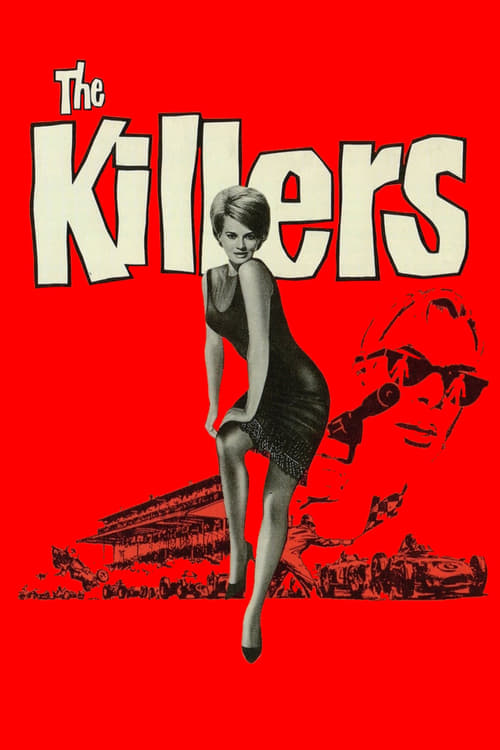
The Killers
1964 · Don Siegel
For when you want your crime lean and nasty — a tight ninety-odd minutes of tough guys, bad decisions, and no sentimentality. Pure pulp pleasure, zero cozy.
What it's about
Two contract killers walk into a school for the blind and execute a former race-car driver who, though warned they were coming, made no move to run. That refusal gnaws at the older hitman, and against every rule of the trade he starts digging backward through the dead man's life — into a fast woman, a heist, and a double-cross — to find out why a man stands still for his own death, and where the money went.
The experience
Hard, flat, and mean in the best way — a brisk pulp machine told in bright daylight instead of shadows, with sudden violence that still lands. It moves fast and keeps a cold grin on its face the whole time.
Performances
Lee Marvin is chilling as the businesslike killer whose curiosity becomes obsession — one of the roles that made him a star of American cool. John Cassavetes brings live-wire desperation to the doomed driver, Angie Dickinson is all silky danger, and Ronald Reagan, cast against type in his final film role, plays a genuine heavy.
The craft
Made for television and rejected as too brutal, it went to theaters instead — and that origin shapes its look: flat bright lighting, punchy close framing, and Don Siegel's ruthless economy, not a wasted scene anywhere. It reworks Hemingway's short story into something faster and more cynical than the 1946 version.
Why it matters
A bridge between classic noir and the harder American crime cinema to come, its blunt violence and Marvin's iron presence pointing straight toward the tough thrillers of the late '60s.
Snapshot
Don Siegel's The Killers is a hard, bright, deliberately unglamorous crime film that occupies a strange seam in American screen history: conceived as one of the first features made expressly for American television, rejected by the network that commissioned it as too brutal, and shunted instead into theaters. It takes Ernest Hemingway's 1927 short story — already the basis for Robert Siodmak's celebrated 1946 noir — and reinvents it for the flat light and direct address of the television era. The premise is a question the killers themselves cannot leave alone: two contract men gun down a former race-car driver who, warned, refuses to run, and the strangeness of that passivity sends them backward into his story. With Lee Marvin and Clu Gulager as the killers, John Cassavetes as the doomed driver, Angie Dickinson as the woman at the center of his ruin, and Ronald Reagan — in his final acting role, and his only turn as a villain — as the criminal financier behind it all, the film is at once a brisk genre exercise and a transitional artifact, looking back to 1940s noir and forward to the cold, professionalized violence of late-1960s American crime cinema.
Industry & production
The film's production history is its most consequential fact. It was made by Revue Studios, the television arm of Universal/MCA, as part of an initiative to produce movies directly for broadcast — what would shortly become the "made-for-TV movie." Intended for NBC, it was completed and then refused by the network, which judged its violence unsuitable for the home audience; the timing, in the immediate aftermath of the November 1963 assassination of President Kennedy, sharpened network anxieties about gun violence on television. Universal redirected the picture to theatrical release in 1964. The episode is usually cited as the moment the made-for-TV movie was born and immediately found its limits.
That origin shaped everything material about the film: a compressed schedule, a modest budget scaled to television economics, and a visual approach geared to the small screen. The screenplay was written by Gene L. Coon, a prolific television writer (later central to the original Star Trek). The result is a studio product of an unusual kind — neither a prestige feature nor a true B-picture, but a TV commission wearing theatrical clothes. I have seen specific budget and box-office figures attached to the film in various accounts, but the documentation is inconsistent enough that I will not assert a number.
Technology
The Killers was shot in color on 35mm at a moment when color was becoming standard for episodic and made-for-TV production. Its technical character is defined by the television destination it never reached: bright, even, high-key lighting designed to read clearly on a small cathode-ray screen, and framing composed for the near-square television ratio rather than for a wide theatrical canvas. This is the opposite of the 1946 version's chiaroscuro. Where Siodmak's film exploited deep shadow and high-contrast black-and-white as expressive instruments, Siegel's exploits color's flatness — a daylight, motel-and-highway palette that refuses atmospheric concealment and makes the violence feel plain and unmediated. The racing sequences make use of process work and second-unit footage of sports-car competition, integrated with studio close-ups of the actors; these inserts are functional rather than seamless, betraying the budget.
Technique
Cinematography
The photography, by Richard L. Rawlings (a cinematographer with a heavy television background), is purposefully unatmospheric. The look is clean, frontal, and legible: medium shots, clear sightlines, color that pops without modeling. This has often been read as a limitation imposed by the TV mandate, and partly it is, but Siegel turns the flatness into an aesthetic. The absence of shadow leaves nowhere for menace to hide, so menace lives instead in faces and behavior — in Marvin's stillness, Gulager's fidgeting. The opening, set at a home (or school) for the blind where the killers arrive to murder Cassavetes's character, is built on the irony of bright, open space invaded by violence; the cruelty of two men terrorizing the sightless plays without expressionist cover, and is the more disturbing for it.
Editing
Cut by Richard Belding, the film is built on the investigative-flashback architecture inherited from the Hemingway adaptation tradition, but reorganized. The present-tense frame — the two killers retracing their victim's past — is intercut with flashbacks that gradually assemble the story of the heist, the woman, and the betrayal. The cutting is brisk and economical, paced to television's tolerance for incident, and it keeps the structural engine visible: each flashback is motivated by the killers' questioning, so the form dramatizes investigation as accumulation. The racing footage is the editorial weak point, where the joins between archival action and staged reaction are most apparent.
Mise-en-scène / staging
Siegel stages for directness. Interiors are unfussy — motel rooms, offices, a diner, a garage — and the blocking favors confrontation: characters placed in hard, frontal opposition. The famous instance is the scene in which Reagan's Browning strikes Dickinson's character; the staging is curt and shocking precisely because the surrounding visual register is so unmelodramatic. Siegel's economy as a director — his career-long preference for clarity, momentum, and the unsentimental observation of professionals at work — is fully present. There is little waste; setups exist to deliver information or violence.
Sound
The score is by John Williams, credited here in his early-career form as "Johnny" Williams, working in the jazz-inflected idiom common to 1960s television crime drama. It is a functional, propulsive score rather than a symphonic one — appropriate to the picture's scale and pre-dating Williams's later orchestral fame. The sound design is otherwise unremarkable in the best sense: gunshots and dialogue carry weight without stylization. (Accounts sometimes attach particular songs or themes to the film; I will not specify one I cannot reliably confirm.)
Performance
Performance is where the film earns its reputation. Lee Marvin's Charlie is the template cold professional: economical, watchful, almost philosophical in his need to understand why a marked man wouldn't flee. Marvin gives the killer an unhurried gravity that makes him the film's moral center of gravity even as he is its agent of death. Clu Gulager, as the younger partner Lee, plays a study in nervy, gum-chewing, almost dandyish sadism — a deliberate contrast in tempo and temperature. John Cassavetes brings a bruised intensity to the race-car driver undone by love and greed, importing some of the raw emotional texture of his own independent work. Angie Dickinson is effective as the duplicitous woman whose loyalties are never quite legible. And Ronald Reagan, cast against type as the crime financier Browning, is stiff but unsettling; the very blandness of his authority, and the shock of seeing him hit a woman, give the role a peculiar charge that history has only amplified.
Narrative & dramatic mode
The film's dramatic mode is investigation-as-eulogy. Like its 1946 predecessor, it begins at the end — with the murder — and reconstructs a life in reverse. But Siegel and Coon make a decisive change: the investigators are not an insurance man or the police, as in the earlier film, but the killers themselves, driven not by justice but by greed and curiosity. They suspect there is money in the dead man's story, and so they exhume it. This reframing converts the noir inquest into something colder and more modern — a procedural conducted by predators. The mode is fatalistic in the genre's classic sense (the outcome is sealed before the telling begins) but stripped of romantic melancholy; the tone is matter-of-fact, transactional, almost clinical.
Genre & cycle
The Killers sits at the hinge between classic film noir and the neo-noir and "professional-criminal" cycle that would dominate American crime film from the mid-1960s onward. It is a crime-mystery built on heist, betrayal, and the femme fatale, but it has shed the visual grammar of noir — the shadow, the night, the rain — in favor of color daylight. In that sense it belongs to the early neo-noir moment, when the genre's narrative conventions outlived its expressionist style. Its emphasis on the killers as competent professionals, indifferent and methodical, anticipates a whole strand of the coming decade's cinema, from caper films to the existential hitman drama.
Authorship & method
Don Siegel is the decisive author. By 1964 he had built a reputation as a fast, tough, intelligent director of genre material — Invasion of the Body Snatchers (1956), Riot in Cell Block 11 (1954), Baby Face Nelson (1957) — known for economy, momentum, and an unsentimental fascination with men who do hard jobs well. The Killers is a quintessential Siegel object: lean, violent, morally cool, interested in professionalism as both subject and method. It belongs to the run of work that would culminate in his collaborations with Clint Eastwood and in Dirty Harry (1971), and it shares their preoccupation with violence as procedure.
His key collaborators reinforce the film's character: screenwriter Gene L. Coon, who supplied a tight, television-honed structure; cinematographer Richard L. Rawlings, whose clean television-trained eye gave the film its distinctive flatness; editor Richard Belding, who kept the flashback machinery legible and quick; and composer John Williams, whose early jazz-crime score served the momentum without competing with it. The casting, too, functions authorially — Marvin and Gulager as paired studies in contrasting menace are central to the film's design.
Movement / national cinema
This is thoroughly American studio filmmaking, but of a transitional kind. It is not part of any self-conscious movement; rather, it is an industrial product caught between two systems — the collapsing classical Hollywood studio model and the rising television-industrial complex that Universal/MCA was pioneering. Its significance to national cinema is largely institutional: it stands at the birth of the made-for-television movie as a form, and at the moment when that form's content boundaries were being negotiated in public. Cassavetes's presence offers an oblique connection to the parallel current of American independent cinema, though the film itself is firmly a commercial genre piece.
Era / period
The film is saturated with the early-to-mid 1960s. Its color modernity, its sports-car milieu, its motels and offices and highways, all locate it in the affluent, mobile America of the period. More pointedly, its troubled passage to release is bound to a specific historical moment: the post-assassination climate of late 1963, in which the depiction of gun violence on television had become acutely sensitive. The film is thus a period document twice over — in its setting and in the cultural anxiety that determined its fate.
Themes
At its core the film is about professionalism and its limits. Marvin's killer is consumed by a question that exceeds his job: why didn't the victim run? The pursuit of that answer is the pursuit of meaning by a man whose trade forbids it, and it destroys him. Around this run the genre's perennial themes — greed, sexual betrayal, the woman whose desire conceals calculation, the man whose competence (on the racetrack, in the heist) cannot protect him from his own susceptibility. Violence is treated as labor: routine, transactional, performed without affect. And there is a quieter theme of mortality and curiosity entwined — the killer's need to understand the dead man becomes a mirror of his own end.
Reception, canon & influence
Backward — influences on the film. The film's deepest debt is to Hemingway's 1927 story, whose terse, behaviorist prose and famous opening — two killers waiting in a diner — supply the title, the premise, and the laconic tone, even though the bulk of the plot is invented around it. Equally present is Siodmak's 1946 The Killers, the canonical noir adaptation that established the investigative-flashback structure Siegel both inherits and revises. Behind both stands the noir tradition generally, which Siegel translates into color and daylight.
Reception. Released as a theatrical feature rather than the television premiere it was made to be, the film was received as a tough, capable genre picture. Its most-remarked features at the time and since have been Marvin's commanding performance and the curiosity of Reagan's casting against type. I should note plainly that detailed contemporary critical and commercial records for the film are thinner and less consistent than for a major prestige release, reflecting its odd status as a repurposed TV commission; I therefore avoid attributing specific reviews or figures I cannot verify.
Forward — legacy. The film's influence runs along two clear lines. First, institutional: it is routinely cited as a landmark in the emergence of the made-for-television movie, and as a cautionary case of the genre's early collision with broadcast standards. Second, aesthetic: its vision of the cold, professional killer — Marvin's especially — fed directly into the harder American crime cinema of the later 1960s, and Marvin would carry a kindred figure into John Boorman's Point Blank (1967), now often discussed alongside this film. The picture also acquired a retrospective charge from Reagan's subsequent political career, which turned his lone villain role into an enduring curiosity. Among later filmmakers, its lineage is felt in the talky, methodical hitmen of the crime films that followed, and it is frequently named in discussions of the genre's modernization. The film endures less as a masterpiece than as a pivot — the place where noir's shadows gave way to flat color, and where the screen killer became, above all, a professional.
A Deleuzian reading
Two men in dark suits walk into a home for the blind at midday.
The full Deleuzian reading of The Killers →
Reception
Dismissed in 1964 as a lurid B-programmer that even NBC wouldn't air, it's since been reclaimed as a foundational neo-noir — Criterion now packages it alongside the 1946 Siodmak version as an equal, not a knockoff.
How The Killers was received, from release to now →
Influences: the films it descends from and the films it influenced
- The Killers (1946) — Direct source remake: Siegel inherits Siodmak's investigative-flashback architecture — reconstructing a dead man's life through interrogations of those who knew him — and revises it by replacing the noir shadows with flat color and daylight.
- Dirty Harry (1971) — Siegel's culmination of violence-as-procedure: the same morally cool fascination with a man performing lethal work efficiently, now in his Eastwood collaboration.
- The Driver (1978) — Terse, business-like professional killers whose flat affect and procedural competence prefigure Hill's treatment of crime as a trade practiced by ciphers.
- Escape from Alcatraz (1979) — Siegel's stripped, momentum-driven economy and the cold professional detachment of its antagonists, a directorial grammar carried directly into Alcatraz.
- Serpent's Path (1998) — Siegel's professionals seize and interrogate civilians to reconstruct a death, shot in flat functional wide setups with no psychological rhetoric and no music under the threat — the exact procedural skeleton and economy that Serpent's Path stretches into duration.
- Citizen Kane (1941) — The investigation-as-eulogy template: a probe into a dead man assembled from fragmentary, conflicting flashbacks given by interviewed witnesses, the structural backbone Siodmak's 1946 film passed to Siegel.
- Baby Face Nelson (1957) — Siegel's own behaviorist study of a violent professional — lean, momentum-driven, morally cool — establishing the unsentimental fascination with men who do hard jobs well that he carries into the hitmen here.
- Riot in Cell Block 11 (1954) — Siegel's documentary-flat, economical staging of institutional violence as procedure, the tough genre-craft economy that defines the director's method in The Killers.
- The Lineup (1958) — Siegel's earlier paired-killers crime film — a methodical professional and his handler executing a contract — prefiguring the Marvin/Gulager study in contrasting menace.
- This Gun for Hire (1942) — The cold professional-killer protagonist as noir's central figure, the screen-hitman archetype Siegel modernizes from shadowed pathos into flat-lit professionalism.
- Point Blank (1967) — Lee Marvin carries the same impassive professional-killer persona into a fractured, color-modernist crime film that extends Siegel's translation of noir into hard, flat-lit 1960s surfaces.
- Le Samouraï (1967) — Extends the laconic, behaviorist hitman as pure professional method — process and craft observed coldly — the same reduction of the killer to his procedure.
- The Outfit (1973) — Inherits the Siegel/Marvin cold-professional-criminal template — methodical revenge executed as a job — in flat-lit color crime craft.
- The Friends of Eddie Coyle (1973) — Extends the talky, methodical, unglamorous professional-criminal milieu in naturalistic daylight, descending from the genre's modernization Siegel helped pivot.
- Pulp Fiction (1994) — Inherits the laconic, talky paired-hitmen opening — two professionals conversing before a job — and the reverse/non-linear chronology that reconstructs a death out of sequence.
- The Killing (1956) — Sibling in fractured crime chronology and the heist-as-professional-operation, dissecting a robbery through non-linear, multi-perspective time the way Siegel dissects the contract.
- Branded to Kill (1967) — Parallel modernization of the contract-killer film into stylized, near-abstract color — the professional assassin's ritual stripped to formal procedure.
Similar films
- Point Blank (1967) — influence & lineage
- The Killers (1946) — influence & lineage
- The Killing (1956) — influence & lineage
- Le Samouraï (1967) — influence & lineage
- Dirty Harry (1971) — influence & lineage
- Murder, My Sweet (1944) — shared sensibility
- The Postman Always Rings Twice (1981) — shared sensibility
- Kiss Me Deadly (1955) — shared sensibility