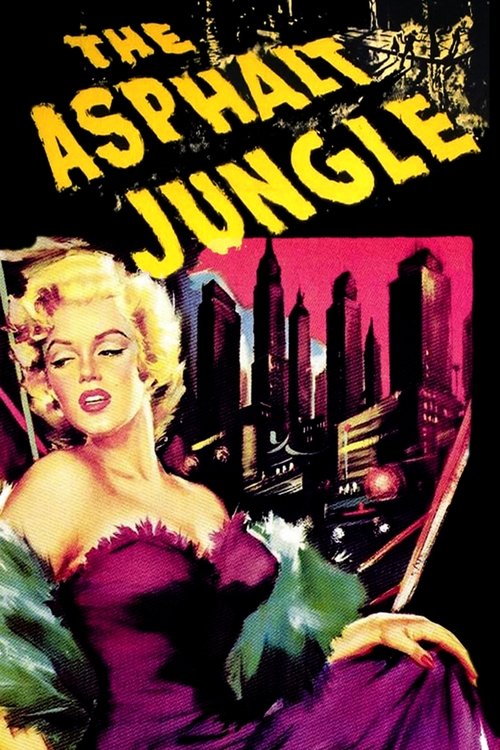
The Asphalt Jungle
1950 · John Huston
For a late night when you want shadowy black-and-white crime done with total confidence — professionals at work, fate closing in, not a wasted minute. Comfort viewing for anyone who loves the genre, and the perfect starting point if you don't yet.
What it's about
Fresh out of prison, criminal mastermind 'Doc' Riedenschneider arrives in a gray Midwestern city with a plan for a million-dollar jewel robbery. A crooked lawyer puts up the money, and Doc assembles a crew of specialists — a safecracker, a driver, a hulking strong-arm man dreaming of buying back his family's horse farm. The film follows the job itself and, just as closely, the private hopes each man is carrying into it.
The experience
Cool, unhurried, and fatalistic — it watches its criminals work with the calm of a documentary, then lets a quiet dread seep in. You end up caring about these men far more than you expect to, which is exactly where the film gets you.
Performances
Sterling Hayden gives the hooligan Dix a wounded, dreaming soul, and Sam Jaffe makes the courtly little mastermind unforgettable. A young Marilyn Monroe turns a small role into one of the film's most remembered.
The craft
John Huston directs with procedural precision — the heist itself plays out in long, nearly wordless stretches of pure craft — and the deep-shadowed black-and-white photography gives the city a grimy, doomed beauty. The ensemble writing sketches a whole criminal ecosystem in quick, sure strokes.
Why it matters
This is the film that invented the heist movie as we know it — assemble the crew, pull the job, watch it come apart — and virtually every caper film since is working from its blueprint.
Snapshot
A dispassionate, procedurally precise account of a jewel heist in an unnamed Midwestern city, The Asphalt Jungle is among the most influential crime films ever made. It crystallized what would become the heist subgenre — assembling specialists, executing the caper, watching it disintegrate — and did so without sentimentality, without a conventional hero, and with a sociological sympathy for its criminals that unsettled studio morality. The film is equally a capstone of classic noir and a bridge toward the more demythologised crime cinema of the 1950s and beyond. Its technical mastery, ensemble characterization, and structural rigor have given it a durability that transcends fashion.
Industry & production
MGM acquired the rights to W.R. Burnham's 1949 novel promptly after publication, and producer Arthur Hornblow Jr. attached John Huston as director. The project was something of an anomaly within MGM's house style: the studio was not the natural home of low-key crime realism, and the film's sympathetic treatment of professional criminals put it in tension with the Production Code's requirement that crime not be presented approvingly. Hornblow and Huston navigated this by framing the narrative through a moralistic police prologue and epilogue — Commissioner Hardy's observations serve as the Code's nominal point of entry — while the body of the film systematically undermines that frame through genuine affection for its characters.
Burnham's novel was a respected piece of literary crime fiction with sociological ambition; Huston and co-screenwriter Ben Maddow retained that ambition while compressing and dramatizing the material for the screen. The film was shot largely on MGM's Culver City backlot and soundstages, with selective location work contributing to its texture of urban grime and authenticity. It received four Academy Award nominations — Best Director, Best Supporting Actor (Sam Jaffe), Best Adapted Screenplay, and Best Cinematography — winning none, though the nominations signaled critical seriousness.
Technology
The Asphalt Jungle was shot in black-and-white widescreen at a time when MGM was still producing most prestige pictures in black-and-white as a matter of course. Harold Rosson used standard Academy aperture, but the compositional decisions and lighting design operate well beyond the merely conventional. The film makes full use of available studio arc and Fresnel lamp technology to create highly directional, low-key illumination. Night exteriors required careful coordination between practical sources — streetlamps, car headlights, shop windows — and fill lighting carefully degraded to preserve the impression of genuine darkness. The heist sequence itself, set in a jewelry vault, was designed to be lit almost entirely by the criminals' own torches, a choice that intensified both atmosphere and viewer identification. No technical innovations specific to this production are on record, but the film's exploitation of existing cinematographic technology at a consistently high level amounts to a kind of mastery.
Technique
Cinematography
Rosson's photography is the film's most immediately striking formal element. His work here belongs to the tradition of expressive studio noir — deep shadow, high contrast, faces half-obscured by dark — but it avoids the more baroque visual flourishes of a film like Laura or Double Indemnity. The look is cooler, more observational. Depth of field is used selectively: foreground and background are often kept simultaneously sharp in scenes of planning or negotiation, suggesting that all parties in the frame are equally important, equally implicated. The heist itself abandons much of the psychological chiaroscuro of the film's first act in favour of a near-functional visual grammar, as though Rosson's camera is recording a skilled procedure rather than commenting on it. The result is a tension that is almost physiological — the viewer is watching people do difficult work under dangerous conditions, and the camera's refusal to editorialise makes the sequence more, not less, suspenseful.
Editing
George Boemler's editing sustains the film's deliberate tempo without ever permitting it to go slack. The pacing of the planning sequences — conversation heavy, requiring that the editing hold on faces long enough to register information — asks the cutter to trust actors and dialogue in ways that faster genre editors might not. The heist itself is edited with a controlled urgency: the crosscutting between the vault team, the watchman's body, the getaway driver, and the street outside achieves a kind of fugue structure in which multiple independent rhythms converge and separate. The aftermath editing is equally deliberate in its casualness, each criminal's unraveling given its own unhurried time before the larger pattern of failure becomes visible.
Mise-en-scène / staging
Huston was a director who conceived shots spatially before he conceived them photographically. His staging in The Asphalt Jungle consistently places characters in relation to each other and to their environments in ways that encode social information. The contrast between Emmerich's lavish suburban house — all deep sofas and anxious bourgeois comfort — and the cramped diner where Cobby receives his instructions is not just atmospheric backdrop but argument. Dix Handley's rented room is filmed as a kind of purgatory between the street and the rural Kentucky farm he is always mentally inhabiting. The celebrated final sequence, in which Dix drives back to Kentucky and collapses in a field while the horses he loved as a boy approach him, is staged and composed with a restraint that is close to devastating: there is no score cue, no close-up on tears, only the flatness of the pastoral landscape receiving what remains of a man.
Sound
Miklós Rózsa's score is characteristically architectural and harmonically complex for the period, functioning less as emotional punctuation than as a continuous tonal environment. The music underscores without Mickey-Mousing; it is capable of going quiet for long stretches during the heist and its immediate consequences, allowing ambient sound — the scrape of tools on metal, the echo of footsteps on stone, the distant wail of a police siren — to carry the scene. This willingness to use silence and ambient texture was somewhat unconventional for MGM productions of the period and contributes significantly to the film's documentary inflection.
Performance
The ensemble acting is the film's most discussed formal achievement. Sam Jaffe's Doc Riedenschneider is a performance of extraordinary economy and intelligence — Jaffe conveys an aging professional's mixture of vanity, competence, and self-knowledge through gesture and cadence rather than exposition. Sterling Hayden brings a physical heaviness to Dix Handley that perfectly embodies the character's mixture of menace and yearning; Hayden was rarely given material equal to his abilities, and this is perhaps the finest performance of his career. Louis Calhern plays Emmerich with a studied urbanity that curdles as the film progresses, his fear breaking through his polish at precisely calibrated moments. Jean Hagen and James Whitmore contribute to a supporting ensemble in which no role feels perfunctory. Marilyn Monroe's brief appearance as Emmerich's mistress Angela Phinlay is often cited in retrospect as presaging her star image, though her screen time is limited; her scenes are nonetheless played with a combination of vulnerability and blankness that creates its own unease.
Narrative & dramatic mode
The film is constructed around a structure that it largely invented for cinema and that subsequent filmmakers would borrow exhaustively: the specialist-assembly heist, dramatized through planning, execution, and dispersal. Each phase receives roughly equal narrative weight, which is unusual. Most crime films of the era concentrated either on detection (from the police side) or on the crime's commission; The Asphalt Jungle is interested in the whole arc of professional criminal enterprise from conception to dissolution.
Crucially, Huston and Maddow do not use this arc ironically or morally. They do not arrange for the criminals to deserve their fates through hubris or violence. Each character is undone by a recognizably human weakness — Doc's susceptibility to beauty (a girl dancing at a jukebox, seconds from his escape), Dix's loyalty to his own impossible dream, Emmerich's financial overextension, Ciavelli's family ties — and these are presented as weaknesses inseparable from what makes each person fully human. The film offers no compensating virtue in the police or the law. Commissioner Hardy's framing speeches feel deliberately hollow set against the texture of what we have watched.
Genre & cycle
The Asphalt Jungle sits at the intersection of film noir and what came to be called the caper or heist film, and its influence on the latter form is foundational. The film did not invent every element of the genre — caper narratives existed in prose fiction and in cinema before 1950 — but it synthesized them into a model of such clarity and confidence that it functioned as a template for the next several decades. The procedural emphasis (specialist skills, technical preparation, contingency planning), the ensemble structure, the "one last job" framing, the irony of competence overwhelmed by contingency: all of these become genre conventions in the wake of this film.
The film also belongs to the noir cycle that ran roughly from Double Indemnity (1944) through the mid-1950s, sharing with that cycle its visual aesthetics, its morally unstable universe, and its engagement with the shadow economies of American capitalism. It stands somewhat apart from the more psychologically expressionist strain of noir in its sociological plainness — less interested in damaged interiority than in the structure of how organized professional crime actually works.
Authorship & method
John Huston arrived at The Asphalt Jungle already established as one of American cinema's premier literary adapters: The Maltese Falcon (1941), Treasure of the Sierra Madre (1948), and Key Largo (1948) had demonstrated his ability to translate complex source fiction into films that retained thematic weight without sacrificing narrative momentum. His characteristic preoccupations — masculine competence and its limits, the futility of obsessive quests, the gap between professional self-image and reality — map directly onto Burnham's material.
Ben Maddow, his co-screenwriter, brought a leftist social realism to the adaptation that is visible in the film's attentiveness to economic class and in its refusal to pathologise its criminal figures. Maddow was later caught up in the Hollywood blacklist and was not credited on some subsequent work; on The Asphalt Jungle his contributions are fully visible and credited, and the screenplay is one of the most precisely written in the crime genre.
Harold Rosson had a career at MGM stretching back to the silent era, and his work here represents the mature application of a lifetime's studio craft. The collaboration between Huston's staging intelligence and Rosson's photographic precision was unusually well-matched.
Movement / national cinema
The film is classical Hollywood cinema — studio-produced, genre-inflected, technically polished within established norms — but its influence extended well beyond American production. French crime filmmakers in the 1950s, working in a tradition that valued American popular culture as raw material for more rigorous artistic treatment, absorbed The Asphalt Jungle's lessons about procedural realism and ensemble structure. This is a film that contributed directly to the conditions under which European crime cinema reimagined itself.
Era / period
The film appears at the beginning of a decade in which American cinema's relationship to its own criminal mythology would be substantially renegotiated. The postwar years brought documentary realism, location shooting, and a willingness to examine social problems into the studio mainstream; The Asphalt Jungle participates in that tendency while remaining firmly within studio production practice. It belongs to an early-1950s moment in which the classical Hollywood apparatus was beginning to show the strains that would culminate in the collapse of the studio system later in the decade — stars being sold off, independent productions increasing, the blacklist distorting the creative workforce.
Themes
The film's central thematic preoccupation is the relationship between professional competence and structural doom. Each of the major criminals is good at what he does — Doc's planning is meticulous, Dix is physically formidable and loyal, Ciavelli is technically expert — and each is destroyed not by inadequacy but by the pressure of the human attachments and desires that make them something other than machines. Burnham and the filmmakers present this as genuinely tragic rather than cautionary: the lesson is not that crime does not pay but that human beings cannot be perfected into instruments of their own will.
The film is also an economic argument, presented obliquely. All of its criminal figures are products of deprivation or blocked aspiration. The one figure of social respectability, Emmerich, is the most morally bankrupt; his position in the legitimate economy is entirely parasitic on the criminal one. The American Dream — embodied in Dix's recurring fantasy of the Kentucky horse farm, the pastoral image of a childhood freedom he cannot recover — is figured as simultaneously the thing that destroys these men and the thing that makes them comprehensible as human beings.
Reception, canon & influence
The film was received seriously and warmly on release, its four Oscar nominations reflecting genuine industry recognition. Critics noted the quality of the ensemble performance, the precision of the direction, and the unusual moral seriousness with which the criminal characters were treated; some found this latter quality troubling. The Production Code required that crime not pay, and the film technically honors this requirement — all the criminals die or are captured — while making its formal sympathies unmistakable.
Influences on the film include Burnham's source novel and the tradition of hard-boiled American crime fiction more broadly; the documentary realism of late-1940s crime films such as The Naked City (1948); and the theatrical staging and literary adaptation methods Huston had developed through his earlier career. Dashiell Hammett's influence on the film's conception of professional criminality — impersonal, competent, finally vulnerable — is palpable throughout.
Its forward legacy is enormous. Jules Dassin's Rififi (1955), the French film that became the gold standard of heist cinema, is directly descended from The Asphalt Jungle in its procedural emphasis and its quiet during the heist sequence itself. Stanley Kubrick's The Killing (1956) — structurally more complex in its use of fractured time but thematically almost a direct homage — acknowledges the Huston film as its primary model. The influence extends forward through Ocean's Eleven (1960), The Italian Job (1969), Michael Mann's Heat (1995), and virtually every ensemble heist film in the subsequent seventy years. The specialist-assembly structure, the contingency that undoes the perfect plan, the elegiac regard for professional criminal competence: these are the film's bequest to genre cinema.
The film has maintained its canonical status through continuous critical reappraisal. It appears consistently on lists of essential American films and essential noirs, and it is frequently taught as the foundational text of the heist genre. Its reputation has not dimmed with the proliferation of its descendants; if anything, familiarity with the form it created has made critics more attentive to the specific formal and moral intelligence that this original brought to that form.
A Deleuzian reading
Doc Riedenschneider is minutes from disappearing for good.
The full Deleuzian reading of The Asphalt Jungle →
Reception
No rescue-from-obscurity story here — it landed four Oscar nominations in 1950 and has only grown in stature since, now enshrined as the founding text of the heist movie and a National Film Registry title.
How The Asphalt Jungle was received, from release to now →
Influences: the films it descends from and the films it influenced
- The Naked City (1948) — Huston absorbed Dassin's semi-documentary location shooting and police procedural rhythm—the insistence that the city itself is a forensic fact—and translated it to the criminal's side of the same streets, grounding the heist milieu in the same unglamourised urban texture.
- The Maltese Falcon (1941) — Huston's own precedent for staging an ensemble of dangerous professionals in tight medium-shot conversation, relying on actor positioning, eye-line cuts, and withheld reaction rather than camera movement to encode hierarchy and concealed motive.
- Force of Evil (1948) — Ben Maddow's social-realist screenplay is in direct dialogue with Polonsky's class analysis of criminal enterprise as a product of economic desperation rather than individual pathology; both writers were later blacklisted, and the leftist structural critique of American capitalism running through both films is not incidental.
- Criss Cross (1949) — Siodmak's armored-car heist devotes extended procedural screen time to the logistics of the robbery itself—positions, timing, disguise—establishing the planning-and-betrayal template Huston refined, and its chiaroscuro low-key photography is the direct visual predecessor to Rosson's work.
- Treasure of the Sierra Madre (1948) — Huston's ensemble of damaged male specialists whose professional competence erodes under the pressure of circumstance and greed—not villainy—directly establishes the emotional and structural logic of the criminal group's dissolution in Asphalt Jungle.
- Double Indemnity (1944) — Wilder's structural template of a meticulous perfect plan narrated in procedural detail and undone not by incompetence but by the specific human contingency the planners could not foresee is the direct formal antecedent to Huston's heist-failure mechanism.
- Key Largo (1948) — Huston extends his Key Largo ensemble-in-criminal-spaces method across multiple locations while retaining its core practice: actor positioning and blocking as the primary tool for mapping shifting moral authority among men under criminal duress.
- High Sierra (1941) — Burnett and Huston rebuild the heist rigorously — specialist crew assembled by trade, the financier's betrayal, the thief dying in pastoral home country — turning the loose Mendoza/Big Mac machinery of High Sierra into the modern caper template.
- Rififi (1955) — Dassin extended Asphalt Jungle's ambient-silence craft into a 28-minute wordless jewelry heist sequence—no score, no dialogue, no sound beyond the physical work—the most cited formal elaboration of Huston's discovery that silence during the act intensifies suspense beyond any scored accompaniment.
- The Killing (1956) — Kubrick radicalized Asphalt Jungle's fugue crosscutting into a fractured multi-POV chronology—showing the same racetrack robbery from multiple temporal positions with explicit time-stamps—while retaining the elegiac specialist-ensemble structure and the contingency-not-hubris failure mechanism as near-direct homage.
- Bob le Flambeur (1956) — Melville's first great crime film translates Asphalt Jungle's professional-criminal procedural mode into a Parisian register, detailing the casino heist plans in the same logistical deadpan and presenting the professional criminal as an elegiac figure defined by code rather than violence.
- Ocean's Eleven (1960) — The first film to directly cite and stylize Asphalt Jungle's specialist-assembly structure as its primary formal conceit: each recruit is introduced by function (the driver, the explosives man, the acrobat), cementing the casting-by-specialty introduction sequence that all subsequent heist films inherit.
- Le Cercle Rouge (1970) — Melville's near-silent Rue de Rivoli jewelry heist—specialists recruited for a single job, working without dialogue using tools prepared in advance over an extended uncut sequence—is the fullest French-cinema elaboration of the procedural craft Huston and Dassin established.
- The Italian Job (1969) — Collinson takes the specialist-assembly and procedural-planning sequences of Asphalt Jungle into self-aware genre stylization, foregrounding the casting-by-function logic as entertainment spectacle—the point at which the template became consciously playful rather than morally earnest.
- Reservoir Dogs (1992) — Tarantino inverts the Asphalt Jungle structure by showing only the aftermath of a heist destroyed by contingency, stripping out the robbery itself to concentrate on the ensemble's mutual recrimination, while retaining the specialist-character gallery and the elegiac regard for professional competence under terminal pressure.
- Heat (1995) — Mann's procedural attention to the actual mechanics of professional criminal work—armored-car choreography, counter-surveillance routines, the division of specialist labor—descends directly from Asphalt Jungle's insistence that how the job is done is the site of moral and cinematic meaning, not merely its premise.
- The Sting (1973) — Huston's heist film established the ensemble competence-procedural as genre template, structuring audience pleasure around watching each specialist's discrete skill displayed before the caper executes; The Sting adapts this architecture wholesale for the confidence trick, with Gondorff's crew demonstrating each role in the long con as a sequential show of professional mastery.
- Army of Shadows (1969) — Melville borrowed Huston's procedural ensemble grammar — criminals defined by specialty and professional code rather than backstory, the operation's unraveling through contingency rather than character failure — as the structural model for his Resistance cell, naming Huston alongside Hawks as his primary American influences.
- Fargo (1996) — Huston's heist-of-doomed-amateurs noir supplies the structural blueprint: ordinary, greedy men whose meticulous plan unravels through human weakness rather than external pursuit.
- Le Doulos (1962) — The heist-procedural treatment of criminals as working professionals undone by a single weak link, lending the policier its sober, sympathetic-to-the-crook gravity that Melville adopts wholesale.
- Classe tous risques (1960) — Sautet absorbed Asphalt Jungle's sympathetic-professional-criminal mode and its social-spatial staging—locations that encode class position—to produce the most precise French-cinema equivalent: a fugitive whose competence is defeated by structural pressure and the logic of the milieu, not moral failing.
- White Heat (1949) — Extends the doomed-criminal fatalism and contained-space caper craft into a cool procedural register, the heist-as-clockwork sibling to White Heat's planning-and-pursuit machinery.
- The Postman Always Rings Twice (1946) — Shares the noir fatalism in which a meticulously plotted criminal scheme is undone by human appetite, the doom feeling structurally preordained rather than accidental.
Similar films
- Rififi (1955) — influence & lineage · same viewing thread
- Reservoir Dogs (1992) — influence & lineage · same viewing thread
- Le Cercle Rouge (1970) — influence & lineage · same viewing thread
- The Maltese Falcon (1941) — influence & lineage
- The Killing (1956) — influence & lineage
- Heat (1995) — influence & lineage
- Double Indemnity (1944) — influence & lineage
- The Naked City (1948) — influence & lineage
All the films related to The Asphalt Jungle →
Watch it with: curated runs of related films
- Cells, Vaults, and Codes of Honor — A run of methodical men — safecrackers, escapees, informers, resistants — filmed as pure process, where the suspense is less whether the job or the escape works than who honors the code and who breaks it first.