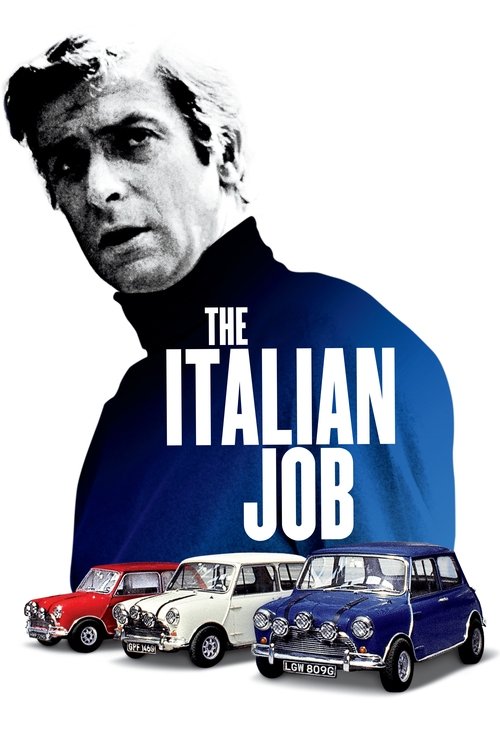
The Italian Job
1969 · Peter Collinson
For a light, feel-good evening when you want charm, cars, and cleverness with zero darkness — Sunday-afternoon viewing at its purest. Total comfort, best shared.
What it's about
Fresh out of prison, a cocky London crook inherits a dead friend's audacious scheme: steal a fortune in gold from under the Mafia's nose in Turin by hacking the city's traffic-control computer, jamming every street solid, and escaping through the gridlock in three nimble Mini Coopers. Bankrolled by a crime boss who runs his empire from inside a prison cell, the job is equal parts military operation and music-hall joke. It's a heist played entirely for swagger and grins.
The experience
Cheeky, brisk, and endlessly quotable — a caper that never takes itself seriously and builds to one of the most joyful extended chases ever filmed. You watch it with a grin that doesn't come off.
Performances
Michael Caine at peak charm carries it on pure cockney confidence, and Noël Coward — in his final film role — is a delight as a crime lord who receives prison-yard adulation like royalty.
The craft
The Mini Cooper chase is the whole reason stunt driving exists: real cars leaping between rooftops, skidding through shopping arcades, and diving into sewers, choreographed with balletic precision and no digital trickery. Quincy Jones's score gives it all an irresistible swing, capped by a singalong anthem that became part of the film's legend.
Why it matters
It became a cornerstone of British pop culture — its lines, its Minis, and its ending endlessly quoted and referenced — and its chase set the template that car-centric action cinema has been chasing ever since.
Snapshot
The Italian Job is a British caper comedy that engineers a gold robbery in Turin around a deliberately absurd premise: paralyze a city's traffic with a sabotaged control computer, then spirit the bullion out in three Mini Coopers small enough to outrun gridlock through pavements, arcades, rooftops, and sewers. Michael Caine's Charlie Croker fronts a gang financed from inside prison by a patriotic crime lord, Mr Bridger (Noël Coward, in his final film role). The film couples a heist's clockwork plotting to a broadly comic, knockabout register and a vein of flag-waving Englishness — British pluck and British cars humiliating Continental order. It is now remembered for three things above all: the Mini chase through and over Turin, choreographed by the French stunt coordinator Rémy Julienne; Quincy Jones's score, including Matt Monro's "On Days Like These" and the terrace-chant finale "Getta Bloomin' Move On (The Self Preservation Society)"; and one of cinema's most famous unresolved endings, a coach see-sawing over an Alpine precipice as Croker promises, "Hang on a minute, lads — I've got a great idea." Modest on first release, it became a durable British cultural touchstone.
Industry & production
The film was produced by Michael Deeley for Oakhurst Productions and released through Paramount Pictures, a configuration typical of the late-1960s moment when American studios were funding British pictures during the post-"swinging London" boom. Deeley, later associated with The Deer Hunter and Blade Runner, assembled the project around Troy Kennedy Martin's original screenplay. Peter Collinson, a young director who had made The Penthouse and Up the Junction, was hired to direct; a frequently repeated account holds that Collinson, raised in part at an actors' orphanage with which Noël Coward was associated, was instrumental in securing Coward for the role of Bridger — a piece of casting that gave the production its theatrical-establishment ballast.
Production was substantially location-based: Turin stands in fully as itself, with the gang's escape staged across recognizable city landmarks, and the climactic mountain sequences shot in the Alps. The single most celebrated location is the rooftop test track of the Fiat Lingotto factory, the banked oval atop the plant, where the Minis are filmed racing along the parapet. Securing cooperation in Turin — a Fiat company town — for a film in which British Minis run rings around Italian authorities and a Fiat-dominated city is a notable production fact; the record on the precise terms of that cooperation is thin and best not overstated. The stunt driving was executed by Rémy Julienne and his team, whose work here effectively launched a long European career in screen vehicle choreography.
On release the film performed respectably in Britain but made little impression in the United States, where its very Englishness and its anticlimactic ending were poorly suited to American distribution expectations. Reliable contemporary box-office figures should be treated cautiously; what is securely established is the gap between a muted initial commercial life and the film's later canonization through television, home video, and nostalgia.
Technology
The production's technological interest is largely automotive and logistical rather than photographic. The Mark I Mini Cooper S is, in effect, a co-star: the film exploits the car's small footprint, agility, and front-wheel-drive handling as the literal mechanism of the plot, and the iconography of red, white, and blue Minis was a deliberate patriotic flourish. The robbery's conceit also reflects a period fascination with computers as both miracle and vulnerability — Benny Hill's Professor Peach sabotages Turin's traffic-control system, dramatizing the then-novel idea that a centralised computer could be a single point of failure for an entire city. The film treats the machine with comic suspicion rather than technical literalism. Beyond that, the picture relies on conventional location-shooting tools of its day; its bravura comes from physical staging and stunt engineering rather than optical or process innovation.
Technique
Cinematography
The director of photography was Douglas Slocombe, one of the most distinguished British cinematographers of his generation — an Ealing veteran who would later shoot the Indiana Jones films. Slocombe's work here balances two modes: the postcard saturation of Turin and the Alps, framed to flatter European glamour before the gang defiles it, and the kinetic, ground-level coverage required by the chase. The action photography favours the car's-eye and pursuer's-eye vantage, keeping the Minis legible as objects in real space — viewers can read the geography of arcades, stairwells, and the Lingotto roof, which is essential to the comedy of the chase being a feat of navigation as much as speed. The opening Alpine sequence, with its sweeping road and the destruction of a Lamborghini Miura, is shot with a travelogue lushness that the film then weaponizes.
Editing
Cut by John Trumper, the film's editing is its rhythmic engine. The chase is constructed for momentum and clarity, intercutting the three Minis, the pursuing police, and the comic reactions of bystanders, with Quincy Jones's score locked to the cutting so that music and motion drive each other. The most consequential editorial decision is the ending: the film commits to a hard freeze on the literally suspended coach, refusing resolution. Whether read as a punchline, a metaphor, or simply an unresolved cliffhanger, that final cut is the film's signature gesture and the clearest evidence of editing used as authorial statement rather than mere assembly.
Mise-en-scène / staging
Staging is built around contrast: the orderly grandeur of Turin — its piazzas, its arcades, the monumental Fiat plant — versus the impudent small scale of the Minis and the gang's cockney irreverence. Coward's scenes inside the prison are staged with mock-regal formality, Bridger ruling a wing like a monarch, while the heist itself is choreographed as a precision ballet of vehicles and timing. The film's compositions repeatedly set British smallness and cheek against Continental monumentality, a visual joke that carries the picture's nationalist subtext.
Sound
Sound is dominated by Quincy Jones's score, a rare and significant commission of a leading American jazz and pop arranger for a British film. "On Days Like These," sung by Matt Monro over the Alpine prologue, supplies wistful glamour; "Getta Bloomin' Move On," better known as "The Self Preservation Society," is a chanted, football-terrace cockney singalong that fuses with the chase to define the film's identity. The mix elsewhere leans on engine noise and the comic clamor of a city in gridlock; dialogue carries the film's quotable wit, and the interplay of Caine's clipped delivery and Coward's plummy diction is itself a sound design of class and accent.
Performance
Michael Caine's Charlie Croker is a definitive performance of a certain English type — chancer, charmer, organizer — pitched between sincerity and send-up, and the source of the film's most enduring lines, including the improvised-feeling reprimand "You're only supposed to blow the bloody doors off!" Noël Coward plays Bridger as imperial caricature, a crime baron whose patriotism and fastidiousness are inseparable; it is a knowing, valedictory turn from a theatrical eminence. Benny Hill brings broad music-hall comedy as the lecherous Professor Peach. The supporting ensemble — including Raf Vallone and Rossano Brazzi on the Italian side, Tony Beckley, and Maggie Blye — fills out a register that is comic before it is criminal, with performances calibrated to caper lightness rather than thriller menace.
Narrative & dramatic mode
The screenplay follows heist convention — assemble the team, plan the job, execute, escape — but bends each beat toward comedy. The "team" is a ramshackle crew; the "plan" hinges on a deliberately preposterous computer gag; the "escape" is the film's true subject and centerpiece. Crucially, the narrative withholds the genre's usual closure. Classic heist films resolve in capture, betrayal, or clean getaway; The Italian Job freezes at the threshold of disaster, the gold and the gang balanced on a literal fulcrum. The dramatic mode is therefore ironic and open-ended: a caper that treats success as a new and possibly fatal problem, and that prizes attitude — cheek, style, nerve — over moral or narrative resolution.
Genre & cycle
The film sits in the heist/caper tradition, descending from the comic-criminal British lineage of Ealing (The Lavender Hill Mob, The Ladykillers) and the international caper cycle of the 1960s (Topkapi, the Rat Pack's Ocean's Eleven, Gambit). Within that cycle it is distinguished by its comic-nationalist inflection and by foregrounding the chase as the genre's climax rather than the robbery itself. It also belongs to the late-1960s British vogue for stylish, modish entertainments riding the international visibility of British pop culture — though, tellingly, it arrives as that moment was already curdling.
Authorship & method
Authorship here is genuinely collaborative, with no single dominating auteur. Peter Collinson directs with energy and a feel for tempo, but the film's lasting identity is as much the work of its key collaborators. Screenwriter Troy Kennedy Martin — also known for the television series Z-Cars and, later, Edge of Darkness — supplies the structure, the patriotic conceit, and the audacious ending. Cinematographer Douglas Slocombe gives the film its visual class and legibility. Composer Quincy Jones contributes a score so central that the film is partly remembered through its music. Editor John Trumper shapes the chase and commits the famous final freeze. Stunt coordinator Rémy Julienne authors the action in the most practical sense. Producer Michael Deeley assembled and protected the project. The film is best understood as a convergence of these talents rather than the expression of one sensibility — a distinction worth keeping, since its later reputation has sometimes attached its authorship loosely to Caine's stardom.
Movement / national cinema
The Italian Job is emphatically a British national film, and it is in some ways about British nationality. Made at the tail end of the "swinging London" era of Anglo-American co-production, it channels British self-image at a moment of anxiety — the late 1960s, with a recently devalued pound and live debates over Britain's place in Europe and entry into the Common Market. The plot literalises that anxiety as farce: a British gang robs Italy of its gold and outmanoeuvres Continental order in British cars, set to a cockney anthem. The film's patriotism is cheeky rather than triumphal — and its precarious ending can be read as a sly acknowledgement that the swagger may not survive contact with reality.
Era / period
The picture is a product of 1969, straddling the end of the optimistic 1960s and the harder decade to come. Its surfaces — fashion, cars, pop scoring, location glamour — belong to the period's tail of mod confidence, while its undertow of uncertainty about money, Europe, and national fortunes anticipates the 1970s. As a time capsule it captures a specific British mood: outwardly stylish and assured, inwardly aware of decline, resolving the tension through comedy and bravado.
Themes
The film's governing themes are national identity and class. British ingenuity, irreverence, and resilience are pitted against Continental wealth and authority, with the Minis embodying small-scale cunning against monumental power. Class is everywhere — Bridger's imperial pretensions, Croker's working-class chancer charm, the gang's collective cheek — and patriotism is treated as both genuine and absurd. Beneath the comedy runs a theme of overreach: the heist succeeds, but the final image suspends the gang between triumph and catastrophe, a perfect emblem of ambition that has carried itself one step too far. Greed, teamwork, and the seductive glamour of style-as-substance round out the film's concerns.
Reception, canon & influence
Critically and commercially, the film's reception was at first uneven: it found a reasonable British audience but underperformed in the United States, where its tone and its non-ending sat awkwardly with prevailing expectations. Over subsequent decades, through repeated television broadcast and home video, it was thoroughly recanonised — in Britain especially it became a beloved national institution, its lines (above all "You're only supposed to blow the bloody doors off!") and its imagery (the red, white, and blue Minis; the teetering coach) absorbed into popular memory.
Looking backward, the film draws on the Ealing tradition of genteel-criminal British comedy and on the 1960s international caper cycle, refracting both through a brasher, more modish sensibility and Troy Kennedy Martin's structural daring. Looking forward, its influence runs along several lines: it helped cement the chase sequence as a self-justifying set piece and the Mini Cooper as a pop-cultural icon; it modeled a comic, attitude-forward strain of the heist film; and Rémy Julienne's practical vehicle choreography set a template for European stunt work. Its most visible legacy is the 2003 American remake, which retained the premise and the Minis while jettisoning the original's English specificity and its irresolution — a contrast that clarifies what made the 1969 film distinctive. The original endures less as a tightly plotted thriller than as a national mood-piece: stylish, funny, patriotic, and willing to end its story balanced on a knife-edge rather than resolve it.
A Deleuzian reading
The coach is half off the cliff.
The full Deleuzian reading of The Italian Job →
Reception
A modest performer in 1969 that flopped badly in America, it was slowly rescued by decades of British TV airings and the Cool Britannia nostalgia wave of the 1990s — now it's routinely voted one of the best-loved British films ever made.
How The Italian Job was received, from release to now →
Influences: the films it descends from and the films it influenced
- The Lavender Hill Mob (1951) — The Ealing template of bowler-hatted, mild-mannered Englishmen executing a gold robbery as polite comedy supplies the comic-criminal national archetype Charlie Croker inherits.
- The League of Gentlemen (1960) — Assembles a crew of specialists for a military-precision robbery, establishing the British 'plan-and-recruit' caper architecture Troy Kennedy Martin restructures.
- Rififi (1955) — Its near-wordless, meticulously choreographed heist-as-procedure centerpiece is the silent-precision model the comic Turin traffic-jam sequence inverts.
- Topkapi (1964) — Defines the 1960s international caper cycle — exotic-location ensemble, acrobatic theft, light tone — the exact commercial slot The Italian Job moves into with a brasher accent.
- Ocean's Eleven (1960) — The attitude-forward star-ensemble caper with an ironic downbeat coda where the loot slips away models the cool-over-plot register and the refusal of a clean payoff.
- Robbery (1967) — Yates's Great Train Robbery reconstruction opens with a documentary-hard British car chase that primes the pursuit-as-set-piece grammar the film amplifies.
- The 400 Blows (1959) — The freeze-frame held on an unresolved image is the precise editing device Trumper deploys to suspend the coach over the cliff.
- The Asphalt Jungle (1950) — Collinson takes the specialist-assembly and procedural-planning sequences of Asphalt Jungle into self-aware genre stylization, foregrounding the casting-by-function logic as entertainment spectacle—the point at which the template became consciously playful rather than morally earnest.
- The Thomas Crown Affair (1968) — Extends the stylish-caper cycle with mod gloss and a front-loaded mechanized heist, inheriting Crown's fusion of design-object fetishism and theft-as-spectacle.
- The French Connection (1971) — Elevates the intercut, kinetic vehicle chase into Oscar-grade cinema, carrying forward the self-justifying pursuit set piece the film helped legitimize.
- The Blues Brothers (1980) — Builds comic mass-vehicle carnage as a musical number, scoring escalating car destruction to pop in the lineage of Quincy Jones's chase cues.
- For Your Eyes Only (1981) — Rémy Julienne's practical, real-vehicle stunt choreography — first templated on the Minis — becomes the house style of the Bond series' car action.
- Lock, Stock and Two Smoking Barrels (1998) — Revives the cockney, attitude-forward British crime caper with mod-pop energy and ensemble banter, the direct stylistic heir to Croker's London.
- The Italian Job (2003) — The literal remake retaining the Mini-Cooper getaway mechanism while jettisoning the English class specificity and the cliffhanger irresolution, clarifying by contrast what the original's non-ending achieved.
- Baby Driver (2017) — Synchronizes getaway-driving choreography beat-for-beat to a pop soundtrack, fully realizing the score-as-engine principle Quincy Jones's cockney anthem and chase music prefigured.
- Bullitt (1968) — Yates's San Francisco pursuit established the year prior that a car chase could be a self-justifying, intercut set piece; John Trumper extends that intercutting into comic Mini choreography.
- Butch Cassidy and the Sundance Kid (1969) — Same-year freeze-frame finale leaving its protagonists eternally suspended at the brink — the period's twin demonstration of the frozen, unresolved ending.
- Kelly's Heroes (1970) — A comic, attitude-forward ensemble gold-heist that fuses irreverent banter and scale-contrast (small crew, huge prize) in the same key, scored with anachronistic pop.
- Get Carter (1971) — The contemporaneous Michael Caine British-crime film working the same star and milieu in a harder, unsentimental register — the dark mirror of Croker's swagger.
Similar films
- Lock, Stock and Two Smoking Barrels (1998) — influence & lineage · same viewing thread
- Rififi (1955) — influence & lineage
- Bullitt (1968) — influence & lineage
- Snatch (2000) — same viewing thread · often watched together
- Big Deal on Madonna Street (1958) — same viewing thread
- Il Sorpasso (1962) — often watched together
- The Castle of Cagliostro (1979) — shared sensibility
- Alfie (1966) — shared sensibility
All the films related to The Italian Job →
Watch it with: curated runs of related films
- Schemers, Crews, and the Big Score — A run of witty crime pictures where somebody always has an angle — watch these together for intricate plans, colliding crooks, and heists that go gloriously sideways.