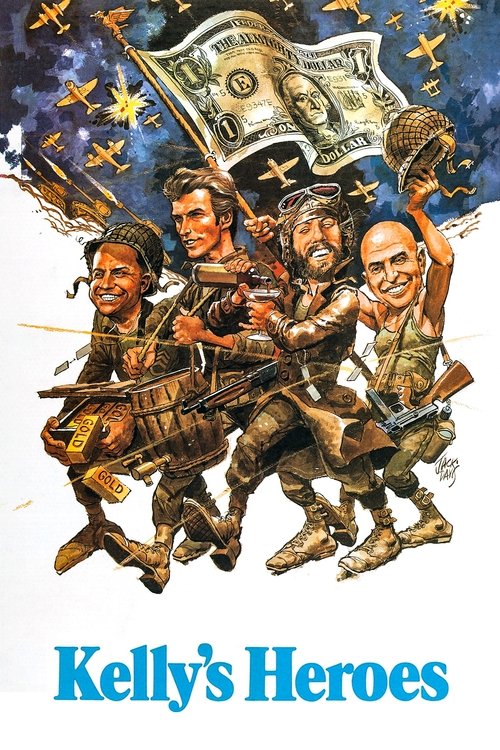
Kelly's Heroes
1970 · Brian G. Hutton
For when you want a war movie without the homework — something rousing and irreverent you can put on with friends, pizza in hand, and enjoy both the banter and the tank battles. Pure comfort with a smirk.
What it's about
In the middle of World War II, a demoted American lieutenant learns from a captured German officer that a fortune in gold bars is sitting in a bank vault thirty miles behind enemy lines. So he quietly assembles his own crew — a gruff pragmatic sergeant, a wheeler-dealer supply clerk, and a laid-back tank commander who seems beamed in from another decade — and leads them AWOL through the front to pull off a heist in the middle of a war. It's a caper picture wearing a combat film's uniform, with real tanks, real explosions, and thoroughly unheroic motives.
The experience
Loose, funny, and surprisingly big — it ambles like a hangout comedy, then drops you into staged combat with genuine scale and crunch. The tone keeps you grinning even as the stakes get loud, and there's a sly cynicism underneath the jokes: nobody here is fighting for glory.
Performances
Clint Eastwood anchors it with dry, watchful cool, Telly Savalas gives the crew its gravel and spine, Don Rickles brings fast-talking hustle, and Donald Sutherland walks off with the picture as Oddball, a proto-hippie tank commander whose every line lands like a shrug from 1970 dropped into 1944.
The craft
The production spends real money on real hardware: full-scale tank sequences, a town shot to pieces, combat staged with width and weight that rewards a big screen. Brian G. Hutton keeps two registers running at once — broad service comedy and legitimate war-movie action — and lets the anachronistic, counterculture-flavored humor rub deliberately against the period setting.
Why it matters
A cult favorite that read World War II through a Vietnam-era lens — soldiers as freelancers, brass as a joke — and became a touchstone for the men-on-a-mission caper, endlessly quoted and rewatched by war-movie fans.
Confirmed the credits I was unsure about. Writing the dossier now.
Snapshot
Kelly's Heroes is a 1970 MGM release that smuggles a heist picture inside a World War II combat film and, in the process, quietly editorializes about both. A disillusioned ex-lieutenant, Kelly (Clint Eastwood), learns from a captured German officer that a fortune in gold bars sits in a bank vault in a town some thirty miles behind enemy lines. Rather than report it, he assembles a platoon of the indifferent and the larcenous — the pragmatic sergeant Big Joe (Telly Savalas), the black-market quartermaster Crapgame (Don Rickles), and the anachronistically hip tank commander Oddball (Donald Sutherland) — and goes, in effect, absent without leave to rob it. The film runs long, spends lavishly on staged combat, and modulates between broad service comedy and genuine battlefield attrition. Released at the height of American disenchantment with Vietnam, it arrives as a war movie whose soldiers have stopped believing in the war, and it treats their private capitalism as the only rational response to institutional absurdity. It is remembered today as a robust, star-driven studio entertainment and as an unusually cynical entry in the twilight of the traditional Hollywood combat film.
Industry & production
The picture belongs to a specific late-1960s production model: the runaway international co-production, financed by an American major but shot cheaply and expansively in Europe. It was produced through MGM at a moment when the studio was contracting sharply, and it was filmed largely on location in Yugoslavia, whose landscapes, cheap skilled labor, and access to military-style materiel had made it a favored backlot for large-scale European war filmmaking. Yugoslav locations stand in for the French and Central European countryside of the 1944 advance, and the scale of the staged armored combat — tanks, artillery, demolition of a mocked-up town — reflects the economics that drew such productions abroad in the first place.
The film reunited director Brian G. Hutton and Clint Eastwood after their successful Where Eagles Dare (1968), another MGM-backed, European-shot war adventure, and it slots into Eastwood's deliberate diversification away from the Italian Westerns that had made him a star. Here he is a marquee lead sharing a genuine ensemble rather than dominating it, a choice consistent with his career management in this period. The exact budget and box-office figures I won't assert, as I can't verify specific numbers; what is clear from the finished film is that money went onto the screen in the form of hardware and destruction rather than into interiors or stars' salaries alone.
Technology
Kelly's Heroes was photographed in anamorphic widescreen — a Panavision-format image in Metrocolor — the standard prestige large-format presentation for a roadshow-adjacent action picture of the period. The wide frame is functional to the material: it accommodates the horizontal sweep of tanks crossing open ground and the lateral choreography of a squad advancing through a ruined street. The production's core technological effort, however, is practical rather than optical. This is a film built on live pyrotechnics, mechanical squibs, and full-scale physical effects — real armored vehicles maneuvering, buildings rigged to blow, dust and debris generated in-camera. There are no significant optical or process innovations to claim here; its ambition is the older studio ambition of staging destruction at scale for the lens, and the technology on display is that of a large second unit and an effects crew working with ordnance and heavy vehicles on open Yugoslav terrain.
Technique
Cinematography
Cinematography is credited to Gabriel Figueroa, the celebrated Mexican cinematographer long associated with Emilio Fernández and later with Luis Buñuel — an unusual and prestigious hire for an American war comedy shot in Yugoslavia. The look he delivers is not the high-contrast, cloud-stacked pictorialism of his classic Mexican work but a sun-flattened, dust-laden naturalism suited to combat: hard daylight, deep-focus long shots that keep men legible against landscape, and a preference for staging armor and infantry across the width of the anamorphic frame. The battle photography favors clarity of geography over impressionism — the viewer generally understands where the tanks are and where the objective lies — which is essential to a heist-through-a-front-line premise that depends on spatial logic. Given the material, Figueroa's contribution reads less as personal signature than as disciplined coverage of large, dangerous, physically staged action.
Editing
The film was cut by John Jympson, a British editor whose task here was to reconcile two tempos: the loose, digressive comic rhythm of the ensemble scenes and the accelerated cross-cut logic of the combat and heist set pieces. The picture is long and, by design, unhurried in its early and middle passages, letting comic riffs and character business breathe; the editing tightens markedly for the mission's execution, most famously in the climactic advance into the town, which is intercut for suspense against the ticking logic of the robbery. The much-discussed final confrontation — a tank rolling slowly up the town's main street scored like a Western standoff — is as much an editorial construction as a directorial one, its dead-air pauses and reaction cuts imported wholesale from the grammar of the Leone-era gunfight.
Mise-en-scène / staging
The staging is the film's real spectacle. Hutton and his crew mount extended, spatially coherent combat — a river-crossing under fire, a minefield, an assault on a defended town — with large numbers of vehicles and extras, and the mise-en-scène consistently subordinates individual heroics to the grinding, materiel-heavy reality of moving an armored column forward. The single most cited image is the entry into the objective town, deliberately restaged as a Western: three tanks abreast advancing down an empty street, the townsfolk cleared, the German Tiger crew and the Americans facing off in a parody of The Good, the Bad and the Ugly. The set-dressing of the war — mud, requisitioned French wine, black-market goods, a bombed bridge — grounds the fantasy of the gold in a persuasively grubby physical world.
Sound
The soundscape alternates the concussive — ordnance, tank engines, small-arms fire staged and mixed for weight — with the pointedly incongruous. The film's most audacious sonic gesture is the use of a period-anachronistic sensibility, above all Oddball's "positive waves" hippie patter and the folk-pop of the score, laid over 1944 combat. The title song, "Burning Bridges," recurs as a marching motif and closes the picture, a soft, ironic country-pop refrain that comments on soldiers who have, literally and figuratively, decided to walk away. Dialogue is foregrounded in the comic scenes, where the ensemble's overlapping vernacular — Rickles's fast patter, Sutherland's stoned drawl — carries much of the film's tone.
Performance
Performance is where the film's split personality is negotiated. Eastwood underplays deliberately, using the flat, watchful minimalism of his Western persona to anchor an otherwise raucous cast; Kelly is the still center, motivated by grievance and greed rather than heroism. Savalas gives the film its spine of plausibility as a career sergeant who wants to survive, not to win. Rickles imports his stand-up rhythm essentially intact. The defining performance, and the one most often written about, is Sutherland's Oddball, a proto-hippie transplanted into 1944 whose vocabulary and worldview belong wholly to 1970 — an anachronism the film embraces as its central joke and its thesis. Carroll O'Connor, as a fatuous, glory-hunting general who mistakes the AWOL heist for a heroic breakthrough, supplies the satirical counterweight from the top of the chain of command.
Narrative & dramatic mode
The screenplay grafts the structure of a caper — the tip, the crew, the plan, the obstacles, the split — onto the itinerary of a combat mission. This is its cleverest and most subversive move: every convention of the war-film objective (take the town, cross the river, knock out the tanks) is retained but re-motivated by private profit rather than patriotic duty. The dramatic mode is picaresque and episodic, closer to the "men on a mission" adventure of The Dirty Dozen (1967) than to a tightly plotted thriller, and it tolerates long comic digressions that a leaner heist film would cut. Tonally it lives in irony: the soldiers' cynicism is the sanest thing in the film, and the narrative repeatedly rewards initiative-for-gain while the official war effort is shown as vain, ignorant, or absurd. The climactic negotiation — Americans and the German tank crew agreeing to split the gold rather than fight — is the mode's logical endpoint: the enemy is not the other side but the system that put both in the street.
Genre & cycle
The film sits at the intersection of two cycles. It is a late example of the big-budget WWII adventure that ran from The Guns of Navarone (1961) through The Dirty Dozen (1967) and Where Eagles Dare (1968) — spectacle-driven, star-packed, mission-structured. But it is also an early instance of the genre curdling into anti-war satire, kin to Catch-22 and MASH* (both 1970), in which the institutional war is treated as farce and the protagonists opt out of its official meaning. Its heist-inside-a-war premise makes it a genuine hybrid, and its self-conscious quotation of the Western — the town showdown, the Leone-style standoff, the Schifrin scoring — folds a third genre into the mix. It is best understood as a transitional object: the machinery of the classic combat epic operated by characters who no longer believe in the ideology that machinery was built to celebrate.
Authorship & method
Authorship here is diffuse in the classic studio manner, distributed across a strong hired team rather than concentrated in a single vision.
- Director — Brian G. Hutton. A capable, unflashy studio craftsman best known precisely for this run of Eastwood war-adventures (Where Eagles Dare, then Kelly's Heroes). His method favors legible large-scale action and a light touch with a loose ensemble; he is not an auteur in the critical sense, and the film's tonal control — its ability to hold comedy and carnage in the same frame — is his most notable directorial achievement.
- Writer — Troy Kennedy Martin. The British screenwriter (later celebrated for the television serial Edge of Darkness) supplies the film's sharpest asset: a script that is structurally a caper and thematically a satire of institutional war. The anachronistic, counter-cultural attitude that gives the film its 1970 charge is fundamentally a writing choice.
- Cinematographer — Gabriel Figueroa. A prestige name from Mexican art cinema deployed on a commercial war picture; see above.
- Composer — Lalo Schifrin. Schifrin's score is central to the film's ironic register, alternating driving action cues with the film's folk-pop signature; the recurring "Burning Bridges" (performed by the Mike Curb Congregation) functions as the picture's thematic and tonal thesis statement in song.
- Editor — John Jympson. Responsible for reconciling the film's two tempos and for the suspense architecture of the climax.
The "method," such as it is, is the high-competence assembly-line of a declining major: import strong specialists, shoot big and cheap abroad, and let a bankable star and a strong comic ensemble carry a genre hybrid.
Movement / national cinema
Kelly's Heroes is not the product of a film movement; it is a mainstream Hollywood studio picture. Its interest for a national-cinema account lies in its hybrid, border-crossing production identity: American financing and stars, a British director and screenwriter, a Mexican cinematographer of art-cinema pedigree, and Yugoslav locations and crews. That configuration is itself characteristic of the internationalized, cost-driven American filmmaking of the late 1960s and early 1970s, when the majors routinely exported production. The one movement it responds to indirectly is the American counterculture, whose sensibility it imports through character and score rather than through form.
Era / period
Two periods matter. The film depicts the summer of 1944 and the Allied advance across France after the Normandy breakout — a moment of momentum and confusion at the front. But it is unmistakably a document of its production era, 1970, and cannot be read apart from it. Made as the Vietnam War eroded American faith in military institutions and official narratives, it projects that disillusion backward onto the "good war," inverting the WWII combat film's traditional certainties. Its soldiers' entrepreneurial mutiny, its buffoonish general, and above all Oddball's transplanted hippie ethos are 1970 speaking through 1944. It belongs to the brief window when the classical studio system's production capacity still existed but its ideological confidence did not.
Themes
The organizing theme is the substitution of private profit for public duty as the only sane motive in an insane institution. War, in this film, is a system that squanders men and materiel for abstractions; the heist is the characters' rational refusal of that bargain, and the film largely endorses their choice. Around this sit several linked concerns: the gap between the men who fight and the commanders who claim their victories (embodied by O'Connor's self-aggrandizing general); the anachronistic intrusion of counter-cultural values into the archetypal "good war," which both dates the film and gives it its satirical edge; and a running deflation of heroism, in which courage is repeatedly revealed to be greed, accident, or exhaustion. The climactic gold-splitting truce advances a final, almost utopian-cynical idea: that self-interest, not ideology, is the common ground on which even enemies can meet.
Reception, canon & influence
Contemporary critical reception was mixed and is, in the specifics, thinly documented in what I can reliably cite; the recurring reservations concerned the film's length, its tonal oscillation between broad comedy and grim combat, and a sense that its satire and its spectacle sat uneasily together. Over time its standing has been that of a durable, well-liked studio entertainment rather than a canonized classic — a staple of television broadcast and home video, cherished especially for its ensemble and for Sutherland's Oddball, and periodically reassessed as a sharper anti-war statement than its rollicking surface suggests.
Its influences, looking backward, are legible on the screen: the "men on a mission" WWII adventure template of The Dirty Dozen and The Guns of Navarone; the caper film's crew-and-plan architecture; and, most explicitly, the Sergio Leone Western, quoted directly in the town showdown and reinforced by Schifrin's scoring — a debt the film wears openly given Eastwood's own origins in that idiom. Looking forward, its clearest legacy is as a template for the comic war-heist and for the ironic, institution-skeptical war picture that treats soldiering as a job and the war as an absurdity; the "positive waves" figure of the anachronistic hippie-soldier became a durable pop-cultural touchstone, and the film is frequently invoked as a spiritual ancestor of later gold-heist-in-wartime stories, most often Three Kings (1999), which relocates essentially the same premise to the aftermath of the Gulf War. I'd flag that such lineage is a matter of thematic resemblance and common critical comparison rather than documented, credited influence.
Sources: Wikipedia, IMDb full credits, TMDB
Reception
Dismissed by many 1970 critics as an overlong, tonally confused war caper — and Clint Eastwood himself griped that MGM's re-edit gutted its anti-war edge — it's since settled in as a beloved cable-era classic and one of the great 'men on a mission' hangout movies.
How Kelly's Heroes was received, from release to now →
Influences: the films it descends from and the films it influenced
- The Asphalt Jungle (1950) — Supplies the caper blueprint Kelly's grafts onto combat — the methodical assemble-a-specialist-crew, brief-the-plan, execute-the-score procedural architecture that structures the whole gold raid.
- Los Olvidados (1950) — Showcases cinematographer Gabriel Figueroa's high-contrast, deep-focus compositions and towering skies — the prestige art-cinema eye he later brings to Kelly's widescreen combat and town-square staging.
- Ocean's 11 (1960) — Establishes the star-ensemble heist played in a loose, wisecracking register, the light comic tone Kelly's transplants from Vegas casino to war-zone bank vault.
- The Guns of Navarone (1961) — Defines the objective-driven WWII commando-mission template — small unit, fixed target, countdown suspense — that Kelly's adopts as its adventure skeleton before subverting the motive from duty to loot.
- The Good, the Bad and the Ugly (1966) — Directly restaged in Kelly's town showdown: the tight-eyes-versus-empty-street anamorphic standoff geometry and the treasure-hunt greed plot, with Eastwood importing the very squint Leone built around him.
- The Dirty Dozen (1967) — Provides the roster of insubordinate soldier-rogues and the roll-call character-introduction structure, recasting the mission film as a gallery of cynical misfits rather than dutiful heroes.
- Bullitt (1968) — Foregrounds Lalo Schifrin's cool, jazz-inflected, riff-driven action scoring — the same composer's ironic cue idiom that gives Kelly's its anachronistic tonal charge.
- Once Upon a Time in the West (1968) — Models the protracted, telephoto-flattened multi-party standoff and its ritual pauses, choreography Kelly's quotes in the slow face-off between GIs and the lone Tiger tank.
- Where Eagles Dare (1968) — The immediate director-and-star reteam: same appetite for large-scale practical pyrotechnics and the same use of Eastwood as a taciturn, near-silent action anchor amid a busier ensemble.
- Three Kings (1999) — Explicitly relocates Kelly's premise — soldiers going AWOL to steal a fortune in gold bullion — to the Gulf War aftermath, reprising the heist-inside-a-war structure and its institution-skeptic irony.
- Buffalo Soldiers (2001) — Extends the army-as-racket vision, treating the peacetime military as a black-market hustle where soldiering is a profiteering job, the cynical inheritance of Kelly's 'profit over duty' thesis.
- Inglourious Basterds (2009) — Crosses the men-on-a-mission WWII adventure with spaghetti-Western grammar — anachronistic Morricone-style scoring, ritual standoff staging, and rogue-squad ensemble — the same genre-hybrid gambit Kelly's pioneered.
- Play Dirty (1969) — Strips the desert-mission film to mercenary self-interest, sharing Kelly's demolition of heroic motive in favor of soldiering as venal, expendable transaction.
- The Wild Bunch (1969) — Cross-cuts large-scale gunfire into rhythmic combat montage and casts Western mercenaries chasing a payroll, channeling the same Vietnam-era disillusion into a greed-driven restaging of genre.
- MASH (1970) — The same-year anti-war satire that treats war as an absurd day-job, holding broad comedy and sudden gore in one frame exactly as Kelly's oscillates between caper romp and carnage.
- Catch-22 (1970) — Dramatizes war-as-business through Milo's syndicate, the same profit-over-duty absurdism that drives Kelly's soldiers to rob a bank instead of fight.
- The Italian Job (1969) — A comic, attitude-forward ensemble gold-heist that fuses irreverent banter and scale-contrast (small crew, huge prize) in the same key, scored with anachronistic pop.
Similar films
- M*A*S*H (1970) — influence & lineage
- Where Eagles Dare (1968) — influence & lineage
- The Dirty Dozen (1967) — influence & lineage
- Catch-22 (1970) — influence & lineage
- The Good, the Bad and the Ugly (1966) — influence & lineage
- The Guns of Navarone (1961) — influence & lineage
- Three Kings (1999) — influence & lineage
- Dirty Harry (1971) — shared sensibility