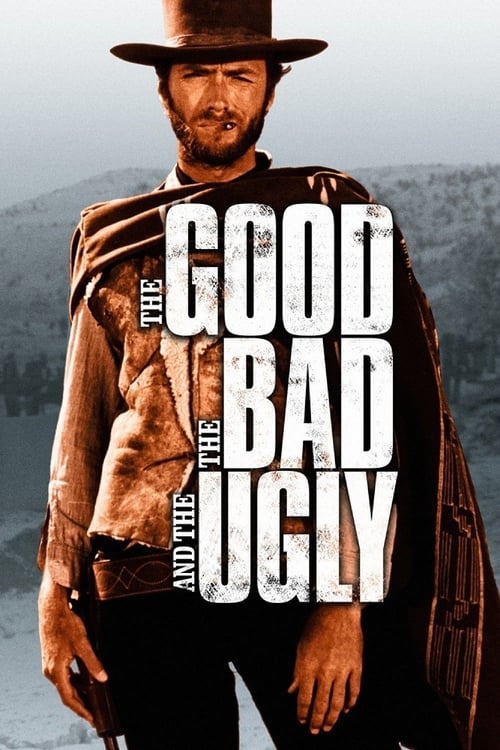
The Good, the Bad and the Ugly
1966 · Sergio Leone
For when you want a big, mythic, swaggering epic — a Saturday-afternoon adventure elevated to opera. Great with friends, great alone, endlessly rewatchable.
What it's about
As the Civil War tears through the Southwest, three men chase a strongbox holding $200,000 in stolen Confederate gold: a laconic drifter, a sadistic hired killer, and a motor-mouthed Mexican bandit. Each knows only part of the secret to finding it, so they need each other alive — which doesn't stop any of them from trying to get the upper hand. Around their private treasure hunt, the war grinds on, vast and pointless.
The experience
Grand, sly, and operatic — it alternates dusty deadpan comedy with stretches of almost unbearable suspense, where Leone holds a close-up so long you forget to breathe. At nearly three hours it earns its length; the finale is one of cinema's great crescendos.
Performances
Clint Eastwood's squinting cool made him an icon, and Lee Van Cleef is pure menace, but Eli Wallach steals the film as Tuco — vulgar, funny, pitiable, and alive in a way few screen characters ever are.
The craft
Leone's style is the star: vast widescreen desert vistas smash-cut against extreme close-ups of eyes and trigger fingers, with Ennio Morricone's legendary score — the coyote-howl theme, the soaring 'Ecstasy of the Gold' — doing as much storytelling as the camera. The final three-way standoff, built from music and editing alone, demands the biggest screen and best sound you have.
Why it matters
The most famous and imitated of all Spaghetti Westerns, it turned the genre's myths inside out and its climactic standoff into a universal cultural shorthand, influencing generations of filmmakers.
Snapshot
The concluding chapter of Sergio Leone's "Dollars Trilogy," Il buono, il brutto, il cattivo sets three morally undifferentiated predators—a taciturn drifter, a contract killer, and a Mexican bandit—against the backdrop of the American Civil War in pursuit of a buried cache of Confederate gold. At once the apotheosis and self-conscious dismantling of the Western hero myth, the film extended the genre's formal vocabulary to extremes it had never reached: the close-up held past comfort, the pause weaponized, music deployed as dramatic architecture rather than accompaniment. It remains the most widely seen and imitated Spaghetti Western ever made, and its climactic three-way standoff—the triello—has entered cinema's permanent shorthand for tension.
Industry & production
Leone had made his name internationally with A Fistful of Dollars (1964) and For a Few Dollars More (1965), both produced on tight budgets for the lower reaches of the Italian market. By 1966, the commercial success of those films—particularly after their American release by United Artists—gave him considerably more leverage. The Good, the Bad and the Ugly was produced by Alberto Grimaldi's PEA (Produzioni Europee Associate) and co-distributed through United Artists, with a substantially enlarged budget that allowed Leone larger sets, more extras, and extended shooting in Spain's Almería province and some Italian locations.
The Civil War setting was Leone's deliberate escalation: he wanted a historical context that would lend gravity to what had been an essentially mythical landscape in the earlier films, and the war's moral chaos suited his thesis that heroism and villainy are costumes, not character. The construction of the Sad Hill Cemetery—a vast circular amphitheater of graves built for the climax—was a major practical undertaking, reportedly employing hundreds of workers and soldiers provided by the Spanish army as extras for the battle sequences.
The screenplay passed through several hands. Luciano Vincenzoni, who had written For a Few Dollars More, is credited alongside Leone and the team of Age & Scarpelli (Agenore Incrocci and Furio Scarpelli), experienced Italian comedy writers whose involvement shaped the darkly farcical register of Tuco's scenes. Leone's method involved extended verbal sketching of situations and characters before anything was written down; formal screenplay structure was something he approached late.
The film premiered in Italy in December 1966. For the American market, United Artists released a substantially shortened version in 1967—trimming approximately fifteen minutes—partly to accelerate pacing for presumed audience expectations, partly due to distributor discomfort with the film's length and ambiguity. Restored versions have since returned most of the excised footage; the most comprehensive reconstruction, including redubbed dialogue by Eastwood and Van Cleef for scenes in which their voices had been lost, was prepared for MGM's 2014 4K restoration.
Technology
Leone and cinematographer Tonino Delli Colli shot in Techniscope, a two-perforation 35mm format developed by Technicolor Italia in the early 1960s. Unlike CinemaScope's anamorphic squeeze, Techniscope achieved its widescreen ratio (approximately 2.35:1) optically, using half the film stock per frame. The format was economical—important for Italian genre productions—but carried a characteristic texture: a slightly grainier, earthier image than anamorphic widescreen, qualities that suited Leone's dusty, sun-bleached aesthetic far better than pristine CinemaScope would have. The optical blowup required for theatrical prints added further grain, embedding the film's look in the materiality of its production.
The production mixed location photography in Almería with studio work at Cinecittà in Rome, and built several exterior sets—notably the Union prisoner-of-war camp—in Spain. The vast Sad Hill set, constructed for the climax, required coordination well beyond what the earlier films had demanded.
Technique
Cinematography
Delli Colli, who would continue working with Leone through Once Upon a Time in the West (1968) and Once Upon a Time in America (1984), brought a rigorous command of the Techniscope frame's horizontal expanse. His most distinctive contribution is the systematic extremity of his focal register: the film moves without apology from ultra-wide establishing shots—figures reduced to specks in scorched landscape—to extreme close-ups of eyes, gun hands, trigger fingers, and sweat-dampened faces. This is not mere stylistic extravagance; the alternation is the film's primary rhythmic device, and Delli Colli calibrates exposure and depth of field to make each register feel existentially different. The extreme close-up is a zone of pure interiority and threat; the long shot is the world's indifference. Leone composed the triello almost entirely within this binary, using the grammar of the close-up/wide oscillation to conduct the duel's three-way geometric tension.
Editing
Nino Baragli, one of the most prolific and respected Italian editors of his generation, cut the film in close collaboration with Leone. The editing is inseparable from Morricone's score: Leone's habit of cutting to pre-composed music—rather than the conventional inverse—gave Baragli rhythms that were melodic and metrically precise rather than emerging from action alone. The triello sequence is the most studied example: a passage of several minutes in which almost nothing physically happens is sustained entirely by the editing's management of duration, eyeline, and the music's mounting tension. The cutting accelerates and decelerates not according to dramatic event but according to musical phrase, a method Leone had refined across all three films but perfected here.
Mise-en-scène / staging
Leone's staging is operatic in the technical sense: he composes for the frame as a proscenium, with figure placement, movement, and stillness choreographed for maximum visual rhetoric. The film's most celebrated set pieces—the opening ambush (a nearly wordless three-minute sequence establishing the film's entire tonal register before the title card), the prisoner camp scenes, the bridge confrontation—demonstrate his ability to sustain and release tension through geography and blocking rather than dialogue. The bridge sequence, in which Blondie and Tuco blow up a strategically vital crossing to strand two armies in mutual slaughter, is staged with a comic-absurdist detachment that pointedly refuses heroism; the soldiers simply begin dying again once the bridge is rebuilt. Leone places his characters in the landscape of history without letting them matter to it.
Sound
Ennio Morricone's score for this film is among the most structurally integrated in cinema. The main theme—built around a two-note motif mimicking a coyote's howl, layered with whistling, electric guitar, voices, and a driving rhythm section—was composed before shooting began, a practice that was central to Leone's method across the trilogy. Leone would play music on set and use it in the editing room to set rhythms; the score was not applied to images but conceived as their skeleton. Specific cues such as "The Ecstasy of Gold" (Tuco's manic run through the cemetery) and "Il triello" are constructed as through-composed dramatic forms, not background underscore. The film also employs sound design with unusual intelligence: the near-silence before gunshots, the wind through barren landscape, the clank of prisoner chains are treated as musical elements within the overall sonic architecture.
Performance
Clint Eastwood's performance as Blondie is defined by subtraction. A veteran of Leone's two previous films, he had by this point fully inhabited the squint-and-poncho persona, but the Civil War context forces a slight thaw: the bridge scene, in particular, shows Blondie registering something approaching moral disgust. Eastwood's control of stillness—the deliberate refusal of expressive reaction—is what Leone's close-up grammar depends on; the face must hold the frame without signaling.
Lee Van Cleef's Angel Eyes is the film's most purely composed performance—methodical, cold, almost affectless. Van Cleef had been cast in For a Few Dollars More partly for his extraordinary eyes and the natural menace of his angular features; here Leone allows him less interiority, using him as a function: the organizing threat that keeps the three-way dynamic from collapsing.
Eli Wallach's Tuco is the film's great surprise and its moral center. Wallach, an Actor's Studio-trained performer with Broadway experience (The Rose Tattoo, Camino Real), brought genuine craft to a role that could have been ethnic caricature. His Tuco is garrulous, cowardly, resourceful, pathetic, and intermittently sympathetic; the scene in which he discovers his brother has become a priest, and the estrangement between them is revealed, is the film's most emotionally direct passage, and Wallach earns it.
Narrative & dramatic mode
The film is structured as a picaresque: three characters whose paths intersect, separate, and re-converge across a landscape shaped by war. There is no protagonist in any conventional sense—the "Good" of the title is an irony, and Blondie's moral superiority over his rivals is largely a matter of degree. The Civil War functions not as historical backdrop but as dramatic environment: it provides death, chaos, and opportunity in equal measure, and Leone uses it to strip the Western landscape of its mythological insularity. The buried gold at the film's center is a MacGuffin in the classic sense, but the film is genuinely interested in it—in greed as elemental motivation, stripped of any heroic justification.
The Italian release ran approximately 177 minutes; even the shortened American version exceeded the length of most Hollywood Westerns. Leone used this duration not for narrative complexity but for sustained mood, allowing scenes to breathe past commercial convention.
Genre & cycle
The Good, the Bad and the Ugly is the defining work of the Spaghetti Western—the term, initially derogatory, eventually became a genre designation of its own. The form had precedents in Italian genre production (the peplum cycle of the late 1950s, the tradition of American-co-produced Westerns shot in Spain), but Leone's trilogy established its aesthetic grammar: moral ambiguity in place of cowboy virtue, stylized violence in place of action-film choreography, Mediterranean landscapes standing in for the American Southwest, and an operatic relationship to time and music that distinguished it categorically from the Hollywood product it was riffing on.
By 1966, the form had spawned hundreds of imitations across the Italian industry, most of them exploitative and disposable. Leone was aware of this; The Good, the Bad and the Ugly is partly a reflexive text, a meditation on the genre conventions his own earlier films had crystallized.
Authorship & method
Leone's auteur signature is inseparable from his collaborators, and he was consistent in acknowledging this. His working relationship with Morricone—both had attended the same Roman elementary school—was foundational: the music-first method meant that the composer's architecture shaped the director's visual decisions at the level of cutting rhythm and scene duration. Leone called Morricone's scores "screenplays in music."
Tonino Delli Colli's cinematography was a precise instrument for Leone's compositional ideas. Nino Baragli's editing transformed Leone's vision into achieved form. Luciano Vincenzoni contributed narrative architecture and the Civil War setting as a dramatic frame. The screenplay's tonal range—from brutal to farcical—reflects the multiple hands involved, unified by Leone's taste for extreme contrast.
Movement / national cinema
The film belongs to Italian popular cinema of the mid-1960s at its most commercially confident and formally inventive. The same period produced the maturation of the giallo (Bava, early Argento), the last cycles of the peplum, and the beginning of the poliziottesco. Leone's Westerns were the most internationally successful expression of Italian genre production, and their aesthetic—the willingness to treat genre as a formal system to be pushed past its own limits—influenced how Italian filmmakers across modes thought about the relationship between commerce and style.
The use of Spain, particularly Almería's desert plains, as a location gave the Spaghetti Western its specific visual identity: this was not the Monument Valley of John Ford but a bleaker, more desolate, geologically older terrain that suited Leone's demythologizing purposes.
Era / period
The film belongs to the mid-1960s moment in world cinema when the received structures of genre were being interrogated from multiple directions simultaneously—the French New Wave, the Hollywood Renaissance just beginning to stir, and in Italy, a genre industry pushing its own conventions toward self-consciousness. Leone was not a New Wave director and did not identify with European art cinema; he was a genre filmmaker who happened to be a formalist of the highest order.
The Civil War setting in a 1966 Italian Western carries no traceable political allegory, but the film's refusal of any distinction between sides—the Union camp is as brutal as the Confederate—is consistent with a broader European skepticism toward American historical mythologies that characterized the era.
Themes
Greed is the film's most explicit theme, and Leone treats it without condescension: the drive to possess the gold is presented as simply human, neither heroic nor villainous, the common denominator beneath all the film's moral posturing. The title's categories—good, bad, ugly—are bracketed in irony from the opening frames; by the end, Blondie's "goodness" amounts to slightly better aim and a residual scruple that prevents him from shooting a man with tied hands.
The Civil War permits a sustained engagement with the absurdity and scale of organized death. The bridge sequence, in which both armies keep dying for a crossing that neither controls, is among the most direct anti-war statements in American-adjacent cinema of the period. Leone's treatment of war is not satirical in the Kubrick sense—it is not polemical—but it is unambiguous in its indifference to the stated justifications of historical conflict.
The landscape carries thematic weight as well. The film's Spain-as-America is a terrain that offers neither shelter nor meaning; characters move through it, endure it, and occasionally are consumed by it.
Reception, canon & influence
Initial American critical reception in 1967 was mixed; mainstream reviewers tended to treat the film as violent exploitation, and the moral ambiguity of the title's categories puzzled critics expecting a conventional Western moral economy. Italian and European critics had been more receptive on release. The film performed strongly at the box office on both sides of the Atlantic, cementing the Spaghetti Western's commercial viability for the remainder of the decade.
The film's canonical standing grew steadily over subsequent decades. It now appears regularly on lists of the greatest films ever made—it has ranked highly in both the Sight & Sound polls and in audience-driven rankings—and is widely taught in film schools as a primary text in editing, sound design, and widescreen composition. The triello is among the most analyzed sequences in genre cinema.
Influences on the film: Leone drew extensively on the classical Hollywood Westerns of John Ford, Howard Hawks, and Anthony Mann; the epic scale and moral seriousness of Mann's later Westerns (Man of the West, The Tin Star) are legible in Leone's approach. Akira Kurosawa's influence—particularly Yojimbo (1961), the direct source for A Fistful of Dollars—had receded by this third film, though the three-way structural geometry arguably echoes Sanjuro. The American comic-strip tradition (Leone was a devoted reader) inflected his character design and compositional sensibility. Sergio Corbucci's concurrent Spaghetti Westerns, particularly Django (1966), established a parallel strand Leone was aware of.
Legacy: The film's influence on subsequent cinema is vast and difficult to bound. Quentin Tarantino has cited Leone extensively as a foundational influence, and the structural logic, tonal register, and musical deployment of Django Unchained (2012) and The Hateful Eight (2015) are direct descendants. The triello has been quoted, homaged, and parodied across global cinema for six decades. Morricone's score—particularly the main theme—became one of the most recognizable musical signatures in cinematic history, covered and sampled across popular music, advertising, and film scores innumerable times. The film's compositional vocabulary (the extreme close-up / extreme wide shot binary, the music-driven edit) passed into action cinema as received technique, often without awareness of its origin. Leone's approach to duration—the refusal to accelerate past what the scene requires—has been most influentially absorbed by filmmakers who, like Leone himself, treat genre as a serious formal system: Walter Hill, Michael Mann, and Park Chan-wook among them.
A Deleuzian reading
Three faces in a ring of graves.
The full Deleuzian reading of The Good, the Bad and the Ugly →
Reception
Sneered at on release as another violent 'spaghetti western' — American critics were largely dismissive — it's now routinely ranked among the greatest films ever made and has spent years parked near the top of the IMDb Top 250.
How The Good, the Bad and the Ugly was received, from release to now →
Influences: the films it descends from and the films it influenced
- High Noon (1952) — Tiomkin's 'Do Not Forsake Me' ballad structures the film's entire temporal architecture as a score-first experience—the direct precedent for Morricone's practice of composing before photography so Leone could cut to pre-existing music rather than scoring to picture.
- Shane (1953) — Stevens' staging of the Western gunfight as ceremonial, liturgical performance—opponents entering a defined proscenium space, each movement deliberate and watched by the town—established the operatic staging convention Leone inflated into the triello's three-way geometric standoff ritual.
- Vera Cruz (1954) — The narrative engine of two morally equivalent, self-interested mercenaries (Cooper and Lancaster) in unstable mutual alliance—neither hero nor villain, both calculating advantage—directly modeled GBU's tripartite structure of undifferentiated predators pursuing the same buried MacGuffin.
- The Searchers (1956) — Ford's systematic cutting between extreme widescreen landscape shots (Monument Valley reducing figures to specks) and tight close-ups on faces established the close-up/wide oscillation grammar that Leone and Delli Colli radicalized by eliminating all middle-ground focal distance entirely.
- Yojimbo (1961) — Leone directly transplanted Mifune's minimalist-stillness behavioral code—the withheld reaction, the shoulder-shrug, the face that processes lethal threat without registering it—into Eastwood's performance, making GBU's taciturn drifter a Japanese ronin in American costume.
- The Man Who Shot Liberty Valance (1962) — Ford's 'print the legend' revelation—that the heroic myth is a deliberate fiction built over a squalid truth—is the narrative demythologization thesis GBU inherits and radicalizes by removing the squalid truth entirely, leaving only the myth's hollow performance.
- Seven Samurai (1954) — Leone applies Seven Samurai's accelerating-compression editing logic — progressively shorter takes ratcheting tension toward a single decisive cut — to the three-way standoff, substituting slow telephoto zooms into faces for Kurosawa's wider-field staging while preserving the rhythm of compression-then-rupture.
- For a Few Dollars More (1965) — The film extends FAFDM's circular-arena duel into its definitive formal expression at Sad Hill Cemetery; Morricone's 'Il Triello' sequence develops FAFDM's pocket-watch diegetic-music architecture into a complete structural system in which music functions as the editing grammar, not its accompaniment.
- Once Upon a Time in the West (1968) — Leone perfected the music-first editing method by having Morricone compose the complete score—including all character leitmotifs—before a frame was photographed; the opening sequence's twelve-minute diegetic silence systematizes GBU's weaponized pause into the film's foundational formal gesture.
- The Great Silence (1968) — Corbucci pushes GBU's weaponized diegetic silence to its logical extreme by making the protagonist literally mute—silence becomes characterological rather than tactical—while Morricone's score maintains the dramatic-architecture function; the refusal of the triello's implicit contract (the better man survives) literalizes GBU's nihilist demythologization.
- The Wild Bunch (1969) — Peckinpah extended GBU's demythologization thesis by replacing music-first editorial scoring with six-camera slow-motion ballet: where Leone made the anticipation of violence operatic through cutting rhythms, Peckinpah made the violence itself operatic, choreographing bullet-impacts and body-falls with the same proscenium deliberateness Leone applied to the standoff.
- Apocalypse Now (1979) — The Ride of the Valkyries sequence deploys score-as-dramatic-architecture in the Leone manner—pre-existing music played diegetically drives editorial rhythm and invests carnage with operatic scale—while the picaresque MacGuffin journey (find Kurtz) is structurally homologous to GBU's three-way race toward buried Confederate gold.
- Unforgiven (1992) — Eastwood conducts a systematic demythologization of the Western hero persona he embodied under Leone, deploying the same minimalist-stillness performance code—withheld affect, economical movement—now against itself to expose the psychology of damage and self-deception beneath the iconic silence.
- Kill Bill Vol. 1 (2003) — Tarantino deploys Morricone's 'L'estasi dell'oro' and other GBU cues as dramatic architecture at climactic moments, reproducing the music-first editorial principle; the extreme close-up/wide oscillation—eyes, sword hands, arena geography—structures the Crazy 88 sequence according to GBU's facial-register binary.
- No Country for Old Men (2007) — Chigurh's minimalist-stillness performance (Bardem: no inflection, no visible threat-signal, maximum danger) is GBU's performance method pushed to pathological abstraction; the film's near-total diegetic silence—virtually no non-diegetic score—extends Leone's weaponized silence from technique to encompassing aesthetic philosophy.
- Django Unchained (2012) — Tarantino quotes Morricone's GBU-era cues—including the main theme—at dramatically loaded moments, deploying score-as-dramatic-architecture to invest revisionist Western confrontations with inherited operatic weight; the demythologization framework extends GBU's thesis that heroism and villainy are costumes to American chattel slavery.
- The Hateful Eight (2015) — Tarantino commissioned Morricone's first Western score since the spaghetti-western era—partly drawing on previously unreleased GBU-period cues—deploying it as dramatic architecture in the Leone manner; the closed-room setting transforms GBU's outdoor triello spatial geometry into an interior variant using the same logic of mutual surveillance and withheld violence.
- Inglourious Basterds (2009) — Leone's technique of expanding moments of peak tension to operatic length through alternating close-ups and environmental reaction shots — treating time itself as dramatic material — is the governing grammar of IB's standoff logic and the direct source of the Morricone cues deployed intact.
- Mad Max: Fury Road (2015) — Miller acknowledged Leone as a primary influence: the rhythmic alternation between extreme facial close-up and vast anamorphic desert landscape, with editing beats synchronized to Morricone's score, is the formal template for Seale's close/wide grammar and Holkenborg's score-as-structural-force.
- Once Upon a Time in America (1984) — Establishes the operatic standoff grammar Leone carries forward: extreme-telephoto monumental close-ups rhythmically intercut against a prescored Morricone cue that dictates the editing tempo.
- Django (1966) — Shot in the same Techniscope format with the same earthen grain texture, Django deploys Bacalov's Morricone-school score architecture—expressive diegetic silence punctuated by thematic stings—while Nero's near-mute, coffin-dragging anti-hero adopts the same minimalist-stillness performance code established by Eastwood under Leone.
- A Fistful of Dollars (1964) — Leone pushed temporal extension to its structural limit in the triadic Mexican standoff—nearly ten minutes of extreme close-ups on eyes, hands, and holsters intercut with wide arena establishing shots, locked throughout to Morricone's climactic cue—making the pre-gunfight duration itself the film's formal and emotional climax.
- The Hidden Fortress (1958) — Leone's picaresque trio traversing a war-torn landscape transposes Hidden Fortress's three-protagonist road structure and uneasy alliance into the Western; his rhythmic contrast editing—extreme stillness before explosive violence, with Morricone's silence-and-sound dynamic mirroring Kurosawa's silence-as-punctuation—constitutes an Italian translation of the same editing grammar.
- The Great War (1959) — Co-writer Luciano Vincenzoni carries the film's absurd, anti-monumental view of war directly into the Western's Civil War set-piece, where a pointless battle is staged as senseless waste rather than glory.
- Mafioso (1962) — Cut by Mafioso's editor Nino Baragli, whose rhythmic control of tonal whiplash—stretching lulls then compressing violence—is the same cutting sensibility that accelerates Mafioso's final reel.
Similar films
- Once Upon a Time in the West (1968) — influence & lineage · same viewing thread
- The Great Silence (1968) — influence & lineage · same viewing thread
- Django (1966) — influence & lineage · same viewing thread
- The Hateful Eight (2015) — influence & lineage · same viewing thread
- Django Unchained (2012) — influence & lineage · same viewing thread
- The Wild Bunch (1969) — influence & lineage
- For a Few Dollars More (1965) — same viewing thread · often watched together
- The Searchers (1956) — influence & lineage
All the films related to The Good, the Bad and the Ugly →
Watch it with: curated runs of related films
- The Operatic West — A run of operatic gunfighter cinema — Leone's mythic widescreen scale, Corbucci's colder cruelty, and the Tarantino homages that quote both — best watched close together to hear the same Morricone-scaled myth mutate.