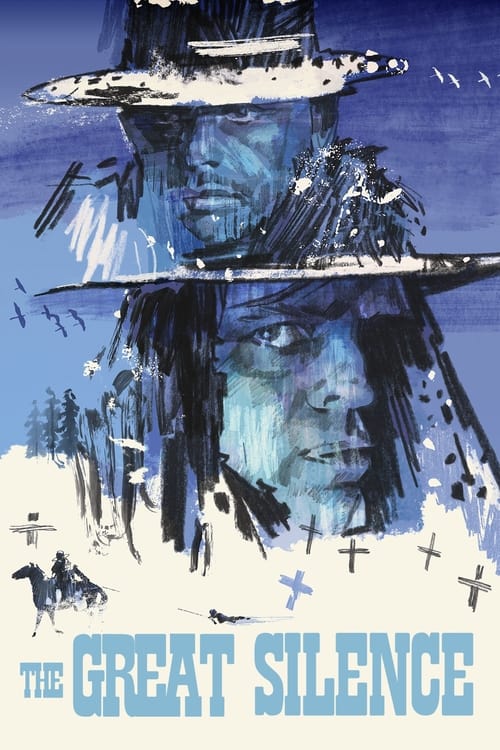
The Great Silence
1968 · Sergio Corbucci
For when you want a western that hurts — bleak, gorgeous, and morally serious, the opposite of comfort viewing. Save it for a night you can handle a film that refuses to blink.
What it's about
In the frozen mountains of Utah, starving farmers driven off their land have been branded outlaws, and a pack of bounty hunters — led by the silkily sadistic Loco — is picking them off for cash. Into this arrives Silence, a mute gunfighter with his own scars and a peculiar code: he provokes killers into drawing first, then shoots them legally. A young widow hires him to avenge her murdered husband, and the collision course is set.
The experience
Cold in every sense — mournful, tense, and genuinely merciless, with a beauty that makes the cruelty cut deeper. It builds a slow dread toward a finale famous for how far it's willing to go; you come out shaken.
Performances
Jean-Louis Trintignant makes Silence riveting without a single word, all eyes and stillness, while Klaus Kinski gives one of his great villain turns — soft-spoken, courteous, and utterly chilling.
The craft
Sergio Corbucci buries the sun-baked spaghetti-western formula under snow, and the whiteness changes everything — gunmen wade through drifts, blood shows stark against powder, the landscape itself feels hostile. Ennio Morricone supplies one of his most mournful scores, tender where the film is brutal. On a good screen with good sound, the snow and the music do half the storytelling.
Why it matters
Barely distributed in America for decades, it became a legendary cult object and a touchstone for filmmakers drawn to the western's dark side — its snowbound setting and pitiless ending have echoed through the genre ever since.
Snapshot
Il grande silenzio is Sergio Corbucci's snowbound anti-Western, a film that takes the sun-scorched conventions of the Italian oater and buries them under drifts of white. A mute gunfighter known only as Silence (Jean-Louis Trintignant) rides into the wintry mountains of Utah, where a cabal of bounty hunters led by the reptilian Loco (Klaus Kinski) is exterminating "outlaws" who are in truth starving farmers and refugees driven off their land by a corrupt banker-magistrate. Hired by a vengeful widow, Pauline (Vonetta McGee), to kill the man who murdered her husband, Silence wages a lonely, legalistic war — provoking his enemies to draw first so that he may kill them in "self-defense." The film is best remembered for its almost unbearable ending, one of the bleakest in the genre's history, and for Ennio Morricone's mournful, waltz-like score. Long unseen in the United States, it has become a touchstone of revisionist and cult film culture. Runtime is roughly 105 minutes; language, Italian.
Industry & production
The Great Silence was produced within the industrial machinery of the late-1960s Italian genre boom, when the spaghetti Western — supercharged by the international success of Sergio Leone's Dollars trilogy — had become one of Cinecittà's most reliable exports. It was an Italian–French co-production (the involvement of French capital and the casting of Trintignant, then one of France's most respected screen actors fresh off A Man and a Woman, reflect that arrangement). Corbucci arrived at the project as a proven commercial hand: his Django (1966) had spawned an entire unofficial franchise and dozens of imitators, giving him considerable latitude within the genre economy.
The film's defining production decision was its setting. Rather than shoot in the Almería deserts of southern Spain — the standard back-lot "American West" for these productions — Corbucci moved the unit into the snowbound Italian Dolomites, in the mountains near Cortina d'Ampezzo, with interiors completed at Elios Studios in Rome. The snow was both aesthetic gambit and logistical hazard; cold-weather location shooting introduced difficulties uncommon to the sun-baked norms of the cycle. This physical inversion of the genre's iconography is the film's first and most conspicuous authorial statement.
A widely repeated production anecdote holds that Trintignant accepted the role partly because the character is mute and required no dialogue — a convenience for a French actor working in an Italian production. It should be flagged that this account, while frequently cited, is anecdotal. Corbucci also assembled a cast fluent in the genre's polyglot economy: Kinski, already a fixture of Italian and German genre cinema; American expatriate Frank Wolff; the Italian character actor Luigi Pistilli; and, in her screen debut, the young American actress Vonetta McGee, who would soon become a leading figure in Blaxploitation cinema.
Technology
Like the great majority of spaghetti Westerns of its era, The Great Silence was made on the economical technical infrastructure that made the cycle financially viable. It was shot in color (Eastmancolor-derived stock) and in a widescreen anamorphic-look format; sources commonly identify the process as Techniscope, the cost-saving two-perforation 35mm system favored across Italian genre production because it halved raw stock consumption while yielding a scope aspect ratio. The precise process attribution should be treated as the standard reported figure rather than an item I can independently verify here.
The film was post-synchronized in the customary Italian manner — shot without usable location sound and dubbed entirely in post — a workflow that shaped performance and, crucially, the treatment of a protagonist who never speaks. The snow itself functioned as a kind of technology: a naturally reflective surface that flooded shadows with cold, diffuse light and gave the image a flat, silvery quality utterly unlike the warm, high-contrast desert cinematography that defined the genre.
Technique
Cinematography
The photography, by Silvano Ippoliti, is the film's most immediately striking formal element. Working in a landscape of snow, fog, and bare black timber, Ippoliti produces images that are simultaneously beautiful and deadening — the white ground eliminating the deep chiaroscuro that Leone's cameramen had made synonymous with the genre. Corbucci and Ippoliti favor a mixture of stark long shots that dwarf the human figure against the mountains and unusually intimate close-ups; the film's recurring compositional motif is the isolated dark silhouette against an expanse of white, an image of existential smallness. Where the classic spaghetti Western is a genre of heat, dust, and squint, The Great Silence is a genre of cold, silence, and blankness, and the camera insists on that inversion in nearly every frame.
Editing
Cut by Amedeo Salfa, the film alternates the genre's expected rhythm — the slow ritual build toward a duel — with abrupt, curt eruptions of violence. Corbucci is less interested than Leone in the operatic dilation of the standoff; his gunfights tend to be quick, ugly, and anticlimactic, an editorial choice that culminates in the film's notorious finale, where the accumulated tension of the entire picture is discharged in a burst of brutal, unresolved cross-cutting rather than a satisfying release.
Mise-en-scène / staging
The staging turns on a single grim invention: Silence's method. Barred from murder, he goads his opponents into drawing first, transforming each confrontation into a piece of legalistic theater in which the hunter must manufacture his own justification. Corbucci stages these encounters to expose the thin membrane between sanctioned and unsanctioned killing — the bounty hunter and the gunfighter distinguished only by paperwork. The town of "Snow Hill," a frozen, half-buried settlement of desperate people, and the outlaws' mountain hideouts are dressed to convey deprivation rather than frontier romance.
Sound
The film's title is also its central sonic idea. Its hero cannot speak; his throat was cut by bounty hunters when he was a child, and muteness is both wound and identity. The absence of the protagonist's voice throws enormous dramatic weight onto gesture, onto the reactions of others, and above all onto Morricone's score, which functions as Silence's displaced interior voice. The dubbed soundscape and the muffling quality of snow reinforce a pervasive sense of hush punctuated by gunfire.
Performance
Trintignant gives a performance built entirely from stillness, gaze, and economy of movement — a study in expressive silence that anchors the film's melancholy. Kinski, cast against his own reputation for manic intensity, is chillingly controlled as Loco: soft-spoken, businesslike, and all the more frightening for treating mass murder as bookkeeping. Vonetta McGee brings gravity and grief to Pauline, and Frank Wolff, as the well-meaning sheriff dispatched to restore order, embodies the film's doomed liberal decency. The ensemble collectively refuses the swagger typical of the cycle.
Narrative & dramatic mode
Dramatically, The Great Silence is a tragedy in Western dress — a revenge narrative deliberately engineered to deny the catharsis such narratives promise. It follows the familiar spaghetti template (a mysterious gunman, a corrupt power structure, a persecuted community, a personal vendetta) only to systematically dismantle the moral machinery that usually makes those elements pay off. Where the genre trades on the fantasy of righteous violence restoring order, Corbucci constructs a world in which competence, courage, and moral clarity guarantee nothing. The result is closer to fatalist parable than adventure: the mode is elegiac, ironic, and finally despairing.
Genre & cycle
The film belongs to the mature phase of the spaghetti Western, the moment when the cycle turned self-critical and overtly political. It is a foundational text of what is often called the "twilight" or "Zapata" strand of Italian Westerns — films inflected by New Left politics and disillusionment. Within Corbucci's own filmography it sits among his most explicitly ideological Westerns, alongside The Mercenary and Compañeros, and it stands as the cycle's great winter film, an anomaly whose snow deliberately negates the genre's defining desert. Its inversions — mute hero, victorious villain, frozen landscape — read as a running critique of the very conventions Corbucci had helped popularize with Django.
Authorship & method
Corbucci is frequently and fairly described as "the other Sergio," the second major auteur of the spaghetti Western after Leone, and The Great Silence is often cited as his masterpiece. His method here fuses commercial genre craftsmanship with a genuinely bleak political sensibility and a taste for the grotesque and the cruel. Corbucci himself indicated that the film's ending and its worldview were shaped by the political violence of the 1960s — the assassinations of figures such as Che Guevara and Malcolm X are commonly cited in his own account of the film's inspiration — recasting the Western as a meditation on the murder of revolutionaries and the impunity of power.
His key collaborators: cinematographer Silvano Ippoliti, whose snow photography is inseparable from the film's meaning; composer Ennio Morricone, who supplies one of his most beautiful and sorrowful scores, trading the trumpet-and-whip flamboyance of the Leone films for strings and a lilting, funereal main theme; editor Amedeo Salfa; and a writing team including Corbucci with his brother Bruno Corbucci, Vittoriano Petrilli, and Mario Amendola. The screenplay's conceptual audacity — its refusal of a redemptive ending — is the collaboration's signal achievement.
A notable point of production history: an alternate, more consoling ending is known to have been shot, reportedly to satisfy distributors in certain markets who found the original finale intolerable; it survives as a curiosity on home-video releases and is generally regarded as a travesty of the film's intent. The specifics of which markets demanded it are recounted variously and should be treated with some caution.
Movement / national cinema
The film is a product of Italian popular cinema at its most industrially confident and, simultaneously, at its most politically engaged. It emerges from the same national-cinema moment that produced the politicized genre films of the late 1960s, when Cinecittà's exploitation machinery became an unexpected vehicle for anti-authoritarian and anti-capitalist allegory. As an Italian–French co-production it also reflects the pan-European financing structures that sustained the cycle. It is emphatically not Hollywood; its relationship to the American Western is one of appropriation and critique rather than homage.
Era / period
The Great Silence is stamped by 1968 — arguably the most turbulent year of the postwar West, the year of global student revolt, the Prague Spring and its crushing, the Tet Offensive, and a wave of political assassinations. The film's despair, its sympathy for a hunted underclass, and its vision of legalized murder carried out by state-sanctioned killers are legible as a direct expression of that political moment. Its diegetic setting — a snowbound Utah during a historically severe winter around the turn of the century, with destitute people criminalized simply for trying to survive — functions as a period displacement of contemporary anxieties about power, poverty, and repression.
Themes
The film's governing themes are the corruption of justice and the fragility of the innocent. It draws a merciless equation between law and predation: the bounty hunters kill legally, for money, under color of authority, while their victims are "outlaws" only because a rigged system has made survival a crime. Silence — mute, scarred, self-appointed avenger — embodies resistance to that order, and the film's tragedy lies in the futility of even the most skilled and righteous resistance against organized, sanctioned power. Related themes include the muteness of the oppressed (literalized in the hero), the coldness of a universe indifferent to virtue, and the collapse of the Western's foundational myth that violence can redeem. Its refusal of consolation is itself the thesis.
Reception, canon & influence
On release, The Great Silence circulated within the ordinary channels of Italian genre distribution, but — in a fact central to its reputation — it was not given a proper theatrical release in the United States, its uncompromising ending reportedly a barrier to American distribution. For years it remained obscure to English-language audiences, surviving as a rumor among aficionados before repertory screenings, festival revivals, and eventual restoration brought it to a wider public. Its critical stock rose steadily in the decades after, and it is now routinely ranked among the greatest spaghetti Westerns and Corbucci's finest achievement; critic and filmmaker Alex Cox was among its notable early champions.
Influences on the film run backward to Leone's genre-defining work (which established the conventions Corbucci inverts) and to Corbucci's own Django, whose commercial success bought him the freedom to make something darker. Its politics reflect the ambient New Left culture of the late 1960s.
Its legacy forward is substantial and disproportionate to its original obscurity. The film is the most frequently cited precedent for Quentin Tarantino's The Hateful Eight (2015), which adopts its snowbound Western setting and much of its cold, enclosed brutality; Tarantino has also repeatedly acknowledged Corbucci's influence, and Django Unchained takes its hero's name from the earlier Corbucci franchise. More broadly, The Great Silence stands as a foundational reference point for the revisionist Western's darker, anti-heroic strain and for later filmmakers drawn to its fatalism. Vonetta McGee's debut here preceded her prominence in 1970s American genre cinema. Its afterlife — from cult obscurity to canonical status — has itself become part of the film's story, an object lesson in how a commercial genre picture can outlast its market to be recognized as art.
Reception
Barely seen outside Europe for decades — it never got a proper US theatrical release until a 2018 restoration — but home video and vocal champions like Alex Cox turned it into arguably the most revered non-Leone spaghetti western.
How The Great Silence was received, from release to now →
How to watch The Great Silence: what to notice on a first viewing
- Watch dark silhouettes stand isolated against an expanse of white. Ippoliti shoots snow, fog, and bare black timber so the white ground eliminates the deep shadow that usually defines this kind of Western. The cold, blank landscape makes the human figures look small before anything violent even happens.
- Watch gunfights land quick, ugly, and over almost instantly. Salfa cuts the standoffs abruptly rather than dilating them the way Leone does, denying the operatic buildup this genre usually promises before a duel. There's no release valve here. The tension just gets cut off rather than discharged.
- Listen for Morricone's mournful, waltz-like score threading through the cold. Strings carry a lilting, funereal main melody in place of the trumpet-and-whip flamboyance Morricone used for Leone, standing in for a hero who cannot speak. The score functions as the mute gunfighter's interior voice throughout the whole film.
- Watch Silence wait for his opponent to draw first. Barred from outright murder, he goads each bounty hunter into drawing on him, turning every confrontation into a piece of legalistic theater he didn't start. The killing has to look like self-defense, which exposes how thin that legal line really is.
The whole guide to watching The Great Silence, with the keys for a rewatch →
Influences: the films it descends from and the films it influenced
- High Noon (1952) — Supplies the legalistic-duel armature Corbucci weaponizes — a town whose institutions and citizens legally sanction the killer, so justice becomes procedure abandoning its victim rather than melodrama rescuing him.
- Day of the Outlaw (1959) — The template for the snowbound Western: a blizzard-locked frontier where the white void erases footing and morality alike, and human figures read as dark silhouettes stamped on blank snow — Ippoliti's exact visual grammar.
- A Fistful of Dollars (1964) — Codifies the invincible, laconic mercenary-hero whose expertise guarantees survival — precisely the convention Corbucci inverts by having his gunfighter's competence fail and his hero die.
- Django (1966) — Corbucci's own prototype for grotesque cruelty as method — a maimed protagonist with ruined hands, mud-and-misery squalor replacing Leone's sunlit grandeur — whose box-office success financed the freedom to make something bleaker.
- The Good, the Bad and the Ugly (1966) — Establishes the two-perf Techniscope widescreen frame and the Leone/Morricone partnership as house style — the flamboyant trumpet-and-whip idiom that Morricone here consciously trades for funereal strings.
- The Specialists (1969) — Corbucci immediately reworks his own innovations — an alpine, snow-bound frontier town whose 'respectable' citizens turn cruel — extending the snow setting and the community-as-predator staging.
- Cut-Throats Nine (1972) — Pushes the snowbound-Western into pure nihilism: a chain-gang trek through frozen mountains rendered with graphic, catharsis-denying violence, inheriting the white-wilderness-as-abattoir logic.
- McCabe & Mrs. Miller (1971) — The revisionist snow-Western's key inheritor — its anti-hero gunned down in falling snow, unwitnessed and unmourned while the town's attention drifts elsewhere, formalizing denied catharsis.
- Dead Man (1995) — A Western structured entirely around a mortally wounded man drifting toward inevitable, unredeemed death, using landscape and a dirge-like score to refuse the genre's promise of survival or meaning.
- The Proposition (2005) — Extends the grotesque-cruelty strain and law-as-predation theme, where colonial 'justice' is itself the engine of atrocity and violence arrives with the same brutal, unglamorized abruptness.
- No Country for Old Men (2007) — Inherits the abrupt, off-rhythm editing of violence and the structural refusal of catharsis — the pursuer never punished, the protagonist killed offscreen, resolution withheld from the audience.
- Django Unchained (2012) — Directly appropriates the hero's name and franchise identity from Corbucci's Django, part of Tarantino's explicit, repeated homage to Corbucci as the cruel counter-Leone.
- The Hateful Eight (2015) — The most frequently cited descendant: it lifts the snowbound, enclosed-brutality setting and cold fatalism wholesale, and secured an original Morricone Western score in direct dialogue with the model.
- The Big Gundown (1966) — The political spaghetti Western built on a legalistic manhunt where the machinery of law serves the powerful and preys on the poor — the same law-as-predation thesis, scored by Morricone.
- Once Upon a Time in the West (1968) — Same-year turn toward the elegiac: Morricone's shift to mournful, string-and-voice lyricism over brass bombast, and violence formalized as slow ritual — parallel evolution of the score-as-lament.
- The Mercenary (1968) — Corbucci's concurrent Zapata-Western, foregrounding revolutionary politics and the murder of insurgents that he cited as this film's animating subject, again scored by Morricone.
- For a Few Dollars More (1965) — Corbucci borrows Leone's circular-arena duel staging and minimalist hired-killer archetype (Kinski's Loco mirrors Van Cleef's Mortimer in cold severity) but inverts the genre's moral economy—staging Leone's formal apparatus to deliver not triumph but massacre, proving that the grammar is neutral and the myth it carries is chosen.
- Lady Snowblood (1973) — Independently marries a white snow landscape to blood in a near-wordless revenge western, a parallel snow-and-blood-contrast palette and silence-punctuated violence.
- Duck, You Sucker (1971) — Kin in its refusal of genre consolation — it denies the heroic myth its payoff, prefiguring Duck's status as a sustained argument against the revolutionary/heroic fable.
Similar films
- Django (1966) — influence & lineage · same viewing thread · often watched together
- Once Upon a Time in the West (1968) — influence & lineage · same viewing thread · often watched together
- The Hateful Eight (2015) — influence & lineage · same viewing thread
- The Good, the Bad and the Ugly (1966) — influence & lineage · same viewing thread
- A Fistful of Dollars (1964) — influence & lineage · same viewing thread
- Django Unchained (2012) — influence & lineage · same viewing thread
- No Country for Old Men (2007) — influence & lineage
- For a Few Dollars More (1965) — same viewing thread
All the films related to The Great Silence →
Watch it with: curated runs of related films
- The Operatic West — A run of operatic gunfighter cinema — Leone's mythic widescreen scale, Corbucci's colder cruelty, and the Tarantino homages that quote both — best watched close together to hear the same Morricone-scaled myth mutate.