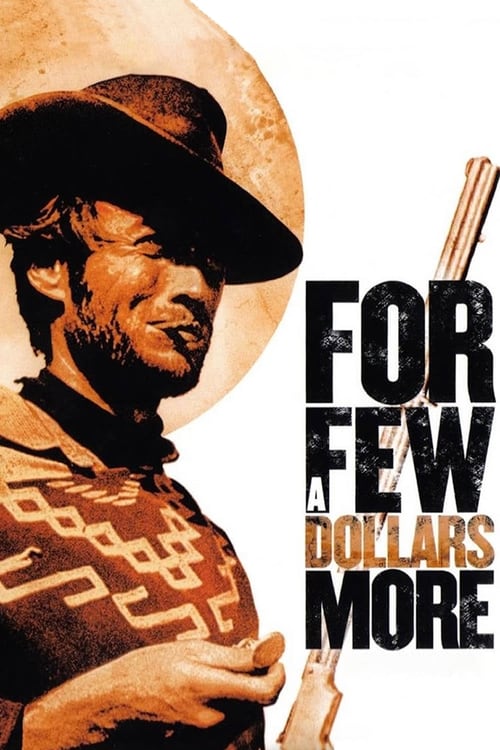
For a Few Dollars More
1965 · Sergio Leone
For when you want to sink into a big, iconic Western — something swaggering and stylish for a long evening, where you can savor every standoff. Comfort viewing for anyone who loves cinema that takes its time.
What it's about
Two bounty hunters — a laconic young gun and a precise, black-clad colonel with his own private reasons — separately track El Indio, a sadistic bank robber with a huge price on his head. Rivals first, uneasy partners after, they close in on a heavily guarded bank in El Paso and a showdown that has been years in the making.
The experience
Cool, stylish, and patient in a way that makes every eruption of violence feel operatic — long silences, close-ups of squinting eyes, then thunder. It's pure pleasure: mythic, a little cruel, and effortlessly entertaining.
Performances
Clint Eastwood's poncho-clad drifter is charisma at its most economical, but Lee Van Cleef, as the mourning Colonel Mortimer, quietly steals the film — and Gian Maria Volonté makes El Indio a genuinely disturbing, haunted villain rather than a stock heavy.
The craft
This is where Sergio Leone's style locked into place: vast desert long shots cut against enormous close-ups, ritualized duels staged like arias, and Ennio Morricone's score — including a musical pocket watch woven into the plot — doing half the storytelling. On a big screen with good sound, it's overwhelming.
Why it matters
The film that defined the spaghetti Western as a genre and set up Leone and Morricone's legendary run, its visual and musical grammar echoing through decades of action and crime cinema.
Snapshot
The second panel of Sergio Leone's so-called Dollars Trilogy and the pivot on which his entire career turns, For a Few Dollars More is the film in which Leone's instincts crystallized into a coherent aesthetic system. Where A Fistful of Dollars (1964) had been a tightly borrowed structure—a declared Kurosawa riff made on a shoestring—its sequel arrived with a larger budget, a grander scope, and a story genuinely Leone's own in dramatic design. It paired Clint Eastwood's laconic bounty hunter Manco against Lee Van Cleef's Colonel Douglas Mortimer, two men competing to collect the head of the psychopathic outlaw El Indio (Gian Maria Volonté), whose gang has just raided a bank in El Paso. The formal signatures that would define the Spaghetti Western as a genre—the extreme-close-up/extreme-long-shot dialectic, Ennio Morricone's music woven into the narrative fabric, the baroque slow-build duel—are all present here in their near-complete form. That the film works simultaneously as mythic spectacle, generic deconstruction, and psychological study of vendetta places it among the essential Westerns.
Industry & production
The success of A Fistful of Dollars transformed the landscape that produced the sequel. Where the first film had been a co-production scrambled together under pseudonyms (Leone was billed as "Bob Robertson") partly to disguise the film's Italian origins from American distributors, Per qualche dollaro in più was mounted with real resources. Producer Alberto Grimaldi at PEA (Produzioni Europee Associate) backed a larger budget, and the Italian-Spanish-West German co-production model that underpinned the Spaghetti Western industry was now operating with the confidence of a commercially proven formula. The film shot primarily in the Almería region of southeastern Spain—the arid badlands around Tabernas that had already served A Fistful of Dollars—alongside interiors at Cinecittà in Rome. Eastwood returned as the film's commercial anchor, but the crucial new casting was Lee Van Cleef as Colonel Mortimer. Van Cleef had been a recognizable face in Hollywood Westerns—notably as one of the gunmen awaiting Gary Cooper in High Noon (1952)—but his American career had stalled badly; Leone, a devoted student of the classical Western, recognized Van Cleef's lean severity as ideally suited to a protagonist with a hidden wound. The choice gave the film its structural spine: Mortimer is not simply a foil for Manco but an equal and opposite force, older, colder, and driven by grief rather than greed.
The screenplay was written by Leone with Luciano Vincenzoni, who would also co-write The Good, the Bad and the Ugly. Vincenzoni's contribution helped impose a cleaner dramatic architecture on Leone's instincts—particularly the structural device of the two antagonistic bounty hunters whose rivalry gradually converts to alliance, and the embedded backstory of Mortimer's murdered sister that turns the film's final act into something approaching tragedy.
Technology
Leone shot in Techniscope, the two-perf 35mm process developed by Technicolor Rome that yielded a 2.35:1 widescreen image at roughly half the film cost of a true anamorphic format. Techniscope was widely adopted in Italian genre cinema precisely because it was economical, and its slight softness at the frame edge—where optical blow-up artifacts could accumulate—suited the sun-bleached, dust-hazed look Leone wanted. The format rewards Leone's compositional extremes: the vast Spanish landscapes sit comfortably in the elongated frame, and the extreme close-ups of eyes and hands fill it with an almost abstract physicality.
Morricone recorded the score in Rome, as was standard practice for Italian productions that post-synchronized all dialogue (even when actors spoke their own languages, the final mix was re-dubbed). This workflow, which Leone embraced fully, freed him to treat sound as a compositional element rather than a documentary record of performance.
Technique
Cinematography
Massimo Dallamano, who had photographed A Fistful of Dollars, returned for the sequel and refined the visual grammar the two had begun to develop together. The governing principle is a radical oscillation in focal length and spatial scale: a sequence will move from a shot establishing the full desert immensity—tiny figures dwarfed by rock and sky—to an extreme close-up of an eye, a hand hovering near a holster, or the barrel of a rifle, all within a few cuts. This grammar is not merely stylistic; it encodes the Western's central drama (man against landscape, the minute calculation of violent advantage) in formal terms. The close-ups carry an almost forensic intensity—Dallamano lights faces harshly, from the side, so that texture and expression register as almost sculptural information. The wide shots invoke a classical Western sublimity before puncturing it with the bathos of mercenary calculation.
The Spanish landscape is used with deliberate anachronism: the Tabernas badlands bear no geographical resemblance to the Texas/Mexico border territory the film nominally inhabits, and Leone makes no attempt to naturalize the substitution. The locations feel frankly alien, which serves the films's mythologizing purpose—this is not a place but an archetype of place.
Editing
The editing (credited to Giorgio Serralonga and Eugenio Alabiso) operates on a principle of rhythmic accumulation and delay. Leone's standoff sequences—of which the film contains several—extend duration to an almost unbearable length, cutting between faces and hands and the landscape between them in loops that refuse narrative resolution until the climactic release. This is directly opposed to the classical Hollywood action cut, which subordinates duration to clarity of action. Leone's editing makes duration itself the dramatic substance: the audience is made to feel the weight of imminent violence as physical pressure.
The structural counterpoint to this slowness is the film's use of intercutting—the parallel development of Manco and Mortimer's independent investigations converging on El Indio—which is handled with comparative economy.
Mise-en-scène / staging
Leone stages his principal sequences with a theatrical clarity that owes something to Italian opera and something to the Noh-like rituals he absorbed from Kurosawa. Figures are positioned with extreme deliberateness; movement is purposeful and almost always legible in terms of dominance and submission, advance and retreat. The towns—low, horizontal, windswept non-places—function as arenas rather than communities, emptied of civilian life at the moment of confrontation. The film's most expressive staging occurs in the final duel, where the musical watch mechanism organizes not only the editing rhythm but the spatial choreography: the three men arranged within a circular arena (the walls of a ruined structure), the score counting down, the camera circling. It is a formal tour de force that makes explicit what the film has been arguing throughout—that violence in Leone's West is ritual, not event.
El Indio's drug-induced flashback sequences—brief, recurring visions of the rape and suicide that preceded Mortimer's vendetta—are staged with an expressionistic dissociation rare in genre filmmaking of the period. The bleached, flare-blown imagery marks them as intrusive memory rather than narrative information.
Sound
Morricone's score for For a Few Dollars More is the point at which his collaboration with Leone becomes something more than accompaniment. The musical pocket watch, given to Mortimer's sister by El Indio and recovered after her death, plays a repeated melody throughout the film. Crucially, this melody is non-diegetic in its first several appearances—part of the score, seemingly—before being revealed as a physical object within the story world. The effect is a deliberate blurring of the boundary between music and narrative, scoring and drama. The watch's final appearance, in the three-way standoff, cues the duel itself: when the music stops, someone dies. This integration of composed score into plot mechanism was essentially unprecedented and has been widely acknowledged as a formal breakthrough in the use of film music.
Beyond the score, Leone's sound design is characteristically heightened: gunshots are enormous, the creak of leather and boot on dry earth are present in the mix with unusual clarity. The film's sound world is expressive rather than naturalistic.
Performance
Eastwood's performance refines the persona established in A Fistful of Dollars: minimalist, sardonic, economical to the point of opacity. He had by this point fully inhabited what would become one of the defining masculine archetypes of late-twentieth-century cinema. But the film's performance revelation is Van Cleef, whose Colonel Mortimer is allowed a register of controlled grief unavailable to Eastwood's essentially affectless character. Van Cleef communicates the backstory through bearing rather than exposition—a quality of stillness weighted with unspoken history. Volonté's El Indio, meanwhile, is one of the great Western villains: charismatic, genuinely psychopathic, and given an unusual interiority by the flashback sequences and the drug-taking that marks him as damaged rather than simply evil.
Narrative & dramatic mode
The film operates in a register that Leone called the "fairy tale for adults"—heightened, mythic, stripped of psychological realism but not of psychological truth. Its central structural innovation over the first film is the introduction of genuine backstory: Mortimer's motivation is not professional but personal, and the revelation of that personal history (delayed until the final act) transforms what has appeared to be a mercenary adventure into a story about grief, obsession, and the cost of revenge. This is a mode—the Western as elegiac revenge tragedy—that Leone will develop further in Once Upon a Time in the West.
Genre & cycle
For a Few Dollars More both belongs to and substantially defines the Spaghetti Western cycle that dominated Italian and European genre cinema through the mid-to-late 1960s. The Spaghetti Western as a form is distinguished from its Hollywood antecedents by its moral cynicism (protagonists are motivated by money, not justice), its aesthetic excess (operatic scoring, extreme editing, stylized violence), its displacement of production to Spanish locations, and its denaturalization of the classical Western's ideological furniture. Leone did not invent this form—Sergio Corbucci, Duccio Tessari, and others were working in the same space—but he gave it its most formally sophisticated expression, and For a Few Dollars More is the film in which his version of the form became paradigmatic.
Authorship & method
Leone's working method was unusually music-centered: he worked extensively with Morricone before and during production, and it is documented that he played Morricone's recordings on set during the filming of key sequences, using the music to pace actors and establish rhythm. This practice—essentially the reverse of the standard industry workflow, in which music is added in post-production—produced the tight integration of image and score that distinguishes the Leone/Morricone films from any other body of work in cinema.
Luciano Vincenzoni brought a dramatist's attention to structure and motivation that grounded Leone's more operatic instincts. Dallamano's cinematography, subsequently replaced by Tonino Delli Colli from The Good, the Bad and the Ugly onward, is somewhat less formally daring than the later trilogy films but establishes the visual template. Editors Serralonga and Alabiso developed the duel-editing grammar that became definitional for the form.
Movement / national cinema
The film belongs to the phenomenon of Italian genre cinema—cinema di genere—of the 1960s, a commercial and cultural formation in which Italian producers exploited the global appetite for popular genre filmmaking with a distinctive aesthetic irreverence toward their own source material. The Spaghetti Western is the most internationally visible of these cycles, alongside the poliziottesco and giallo. Leone's films occupy an unusual position within Italian cinema: too popular and too generically committed for the critical prestige associated with the art cinema of Antonioni, Fellini, or Pasolini, but now widely recognized as formally innovative on their own terms.
Era / period
The film arrives at the precise moment when the classical Hollywood Western was in crisis. The genre that had sustained American cinema since its origins was entering the period of revisionism and eventual exhaustion that would produce The Wild Bunch (1969), McCabe & Mrs. Miller (1971), and Pat Garrett and Billy the Kid (1973). Leone's Westerns participated in this revision from outside the Hollywood system, denaturalizing the genre's ideological pieties (Manifest Destiny, frontier justice, the redemptive community) by exporting its iconography to Spain and filling it with Italian nihilism.
Themes
Vengeance and its costs; the bounty hunter as a figure who monetizes death without taking moral responsibility for it; the American West as myth rather than history—a landscape of archetypes available for European reimagination. The film is also, distinctly, about masculinity as performance: the ritualized posturing of the standoff, the careful management of information and advantage, the suppression of feeling as survival strategy. Mortimer's grief, when it finally becomes visible, registers as a violation of the film's own code, and that violation is the source of its emotional power.
Reception, canon & influence
For a Few Dollars More was the highest-grossing Italian film of 1965 and a major commercial success across European markets. American distribution, through United Artists, came later (1967), and initial critical reception in the anglophone press was, as with most Spaghetti Westerns, dismissive—critics who took the classical Western seriously tended to regard Leone's films as cynical pastiche. That dismissal has been thoroughly revised.
Influences on the film: Leone's declared debts are to Kurosawa (whose formal influence is less direct here than in A Fistful of Dollars but still operative in the choreography of violence), and to the psychological Westerns of Anthony Mann—The Naked Spur (1953), Man of the West (1958)—whose protagonists were haunted men rather than classical heroes. The revenge-backstory structure, in particular, reads as a response to Mann. Leone was also steeped in American studio Westerns from Ford to Budd Boetticher, whose Ranown cycle similarly stripped the genre to elemental confrontation.
Legacy: The film's influence forward is vast and still active. The Good, the Bad and the Ugly (1966) and Once Upon a Time in the West (1968) are its direct successors, and together the trilogy constitutes the most influential body of work in the Western's post-classical history. The formal vocabulary Leone developed—the extreme-close-up standoff, the Morricone integration, the operatic slow build—was absorbed into global action cinema. Quentin Tarantino's engagement with Leone is deep and sustained, surfacing in Kill Bill, Inglourious Basterds, and most directly in Django Unchained and The Hateful Eight. Lee Van Cleef's career was entirely remade by the film; he became a major star in European genre cinema and his particular lean menace became a template for an entire subcategory of Western protagonist. The bounty-hunter film as a distinct subgenre—figures collecting bodies for money, outside the law while nominally serving it—owes much of its current form to Leone's two-film development of the type. Morricone's musical strategies, particularly the narrative integration of a recurring melodic motif as plot mechanism, have been widely studied and imitated; they represent a contribution to film scoring independent of the Westerns that contain them.
A Deleuzian reading
The hand fills the whole screen.
The full Deleuzian reading of For a Few Dollars More →
Reception
Dismissed by most American critics on its 1967 US release as just another violent 'spaghetti western' cash-in, it's since been reclaimed as the moment Leone's style fully arrived — and a fixture near the top of best-western lists.
How For a Few Dollars More was received, from release to now →
Influences: the films it descends from and the films it influenced
- Yojimbo (1961) — Leone transposes Kurosawa's ronin structure—the lone professional who manipulates rival factions while feigning allegiance to both—directly into FAFDM's bounty hunter premise; the ronin's laconic physical stillness under provocation becomes the template for Manco's minimalist performance archetype.
- Sanjuro (1962) — Kurosawa's rhythm of extreme tension-prolongation before sudden explosive violence—standoffs in compressed spaces with precise cutting between hands and weapons—directly precedes Leone's duration-extension editing grammar; the standoff's refusal to resolve until a single muscle twitches is the formal model for FAFDM's duel sequences.
- High Noon (1952) — Leone's pocket watch—the murdered sister's musical box that Mortimer triggers as El Indio's death clock—is a deliberate formal transformation of Zinnemann's ticking-clock device, converting a public civic countdown into a private grief object with diegetic narrative function built around a specific melody.
- The Searchers (1956) — Mortimer's arc—years-long obsessive revenge driven by a family trauma withheld until the climactic reveal—descends from Ethan Edwards' structure; Leone adopts Ford's device of withholding the backstory wound to retroactively reframe all prior mercenary action as grief at the moment of revelation.
- Ride the High Country (1962) — The dual-protagonist structure of two veteran gunfighters with opposing codes forced into reluctant alliance is the direct structural precursor to Manco and Mortimer's rivalry-to-partnership arc; Peckinpah's elegiac framing of professional violence as the occupation of men with no future shapes Leone's treatment of the bounty hunter as tragic type.
- A Fistful of Dollars (1964) — FAFDM inherits and amplifies the Techniscope visual grammar, Morricone diegetic-music architecture, and laconic performance template established in the first film; the expanded budget allows the extreme-close-up/extreme-long-shot dialectic to be deployed across a more architecturally complex dual-protagonist narrative than the first film's single-hero structure permitted.
- The Naked Spur (1953) — Builds an entire economy on the bounty as a contested sum between partners who cannot trust each other, the transactional structure Mann and Rolfe stripped down to five people and a price.
- The Good, the Bad and the Ugly (1966) — The film extends FAFDM's circular-arena duel into its definitive formal expression at Sad Hill Cemetery; Morricone's 'Il Triello' sequence develops FAFDM's pocket-watch diegetic-music architecture into a complete structural system in which music functions as the editing grammar, not its accompaniment.
- Once Upon a Time in the West (1968) — The expressionistic flashback-as-wound that FAFDM sketches in Mortimer's backstory becomes the film's primary structural device: Harmonica's childhood trauma is withheld in fragments and delivered in full at the climax, refining FAFDM's backstory-revelation architecture into its supreme articulation; the Flagstone opening extends FAFDM's duration-extension editing to pure temporal suspension across eleven wordless minutes.
- Duck, You Sucker (1971) — Leone extends FAFDM's expressionistic flashback technique—a character's concealed wound retroactively reframing all prior action—to a revolutionary-war context; John Mallory's fragmented Irish trauma sequences develop the Mortimer flashback grammar into a more formally disjointed, psychologically interior register, pushed further by the loss of linear backstory control.
- The Wild Bunch (1969) — Peckinpah cites Leone's editing rhythms as direct influence; the slow-motion choreography of the final battle extends FAFDM's duration-extension principle—making audiences inhabit violent time rather than observe it—while the multi-angle parallel-intercutting of the Starbuck opening massacre develops Leone's standoff-editing grammar into a kinetic successor operating at scale.
- Pat Garrett and Billy the Kid (1973) — Bob Dylan's ballad score is integrated as a structural narrative element—'Knockin' on Heaven's Door' scoring a death from within the diegesis—extending the Leone/Morricone diegetic-music-as-architecture model into the New Hollywood Western; the dual-protagonist structure of two former allies on opposite sides of the law develops FAFDM's rivalry-to-alliance arc into elegiac tragedy by reversing its resolution.
- Unforgiven (1992) — Eastwood constructs William Munny as a direct deconstruction of the minimalist archetype he embodied for Leone: where FAFDM aestheticizes the laconic hired killer through formal elevation, Unforgiven subjects the same performance grammar to moral examination—the performance of masculine violence that Leone mythologized becomes the film's explicit and corrosive subject.
- Kill Bill: Volume 2 (2004) — Tarantino explicitly adopts Leone's extreme-close-up/extreme-long-shot dialectic for the desert duel sequences, and the Bride's backstory-wound revelation—withheld across two films and delivered in a climactic flashback—directly extends FAFDM's structural device of concealing grief that retroactively reframes mercenary violence as personal tragedy.
- No Country for Old Men (2007) — Chigurh's minimalist archetype—an implacable hired killer defined entirely by a single behavioral code—extends Leone's performance-of-masculinity grammar, while the Coens apply FAFDM's duration-extension principle to the hotel-room confrontations; the coin functions as a mechanical fate-object with diegetic symbolic weight structurally parallel to Mortimer's musical pocket watch.
- Escape from New York (1981) — Models the withholding man-with-no-name performance Russell adopts as Snake, and Carpenter casts Leone veteran Lee Van Cleef as Hauk in a direct lineage nod.
- Sholay (1975) — Establishes the two-bounty-hunter partnership working a reward for cash that Sholay reframes as Jai and Veeru being paid by Thakur, including the mercenary-turns-loyal arc.
- Django (1966) — Shot in Techniscope with Luis Bacalov scoring in explicit imitation of Morricone's post-sync sound design method, Django lifts Leone's heightened sound grammar—amplified spurs, loaded silences, diegetic musical cues—and deploys them with greater brutality, demonstrating the immediate portability of FAFDM's formal system within Italian genre production.
- The Great Silence (1968) — Corbucci borrows Leone's circular-arena duel staging and minimalist hired-killer archetype (Kinski's Loco mirrors Van Cleef's Mortimer in cold severity) but inverts the genre's moral economy—staging Leone's formal apparatus to deliver not triumph but massacre, proving that the grammar is neutral and the myth it carries is chosen.
- Django Unchained (2012) — Model for the two-man bounty-hunter partnership structure — older European professional plus avenging junior — that organizes the film's first act.
Similar films
- The Good, the Bad and the Ugly (1966) — influence & lineage · same viewing thread · often watched together
- A Fistful of Dollars (1964) — influence & lineage · same viewing thread
- Once Upon a Time in the West (1968) — influence & lineage · same viewing thread
- Django (1966) — influence & lineage · same viewing thread
- The Great Silence (1968) — influence & lineage · same viewing thread
- Duck, You Sucker (1971) — influence & lineage · same viewing thread
- Unforgiven (1992) — influence & lineage
- No Country for Old Men (2007) — influence & lineage
All the films related to For a Few Dollars More →
Watch it with: curated runs of related films
- The Operatic West — A run of operatic gunfighter cinema — Leone's mythic widescreen scale, Corbucci's colder cruelty, and the Tarantino homages that quote both — best watched close together to hear the same Morricone-scaled myth mutate.