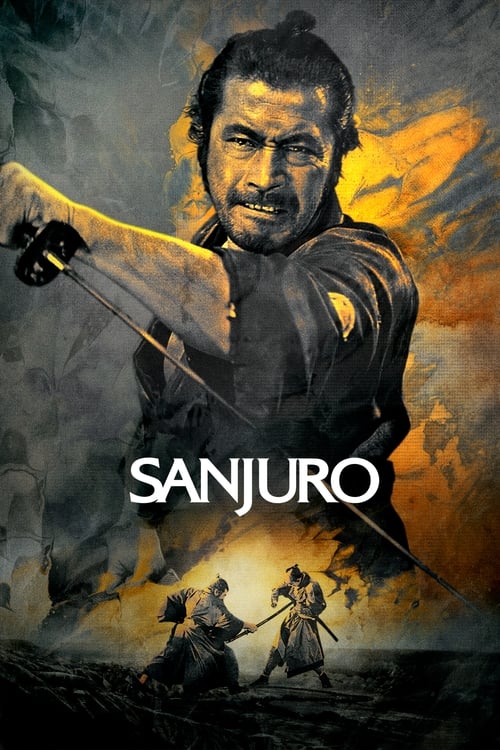
Sanjuro
1962 · Akira Kurosawa
For when you want a smart, fast adventure that entertains without insulting you — an easy, satisfying watch that still leaves a mark. Pure pleasure with a twist of steel.
What it's about
A scruffy, nameless ronin stumbles into a plot by nine earnest young samurai to root out corruption in their clan — and realizes within minutes that their idealism is going to get them all killed. Against his better judgment he takes charge, dragging them back from one reckless plan after another while outthinking the schemers on the other side.
The experience
Light on its feet and genuinely funny — a comedy of manners where the joke is watching a slouching pragmatist run circles around everyone bound by etiquette. The humor keeps tightening toward something sharper, and the violence, when it comes, actually stings.
Performances
Toshiro Mifune is magnificent as Sanjuro — scratching, yawning, radiating boredom, then moving like lightning; every deflating line lands because of how completely he inhabits the slob-genius.
The craft
Kurosawa's black-and-white compositions turn the nine identical young samurai into a running visual gag, herding them through frames like ducklings. The swordplay is staged with startling economy, and the film builds to a single burst of violence famous enough to change how sword films looked afterward.
Why it matters
Its climactic image reset the standard for on-screen violence in samurai cinema, and the film's wry deconstruction of samurai honor rippled through the genre and its Western imitators for decades.
Snapshot
Released on New Year's Day 1962 — an unusual premiere date that signaled both the film's crowd-pleasing ambitions and Toho's confidence in its commercial appeal — Sanjuro (Japanese title: Tsubaki Sanjūrō, or "Camellia Thirty-Something") arrives as a formally assured, tonally complex companion piece to Yojimbo (1961). Where its predecessor was austere and violent, Sanjuro is predominantly a comedy of manners, a genre critique dressed in the robes of a chambara adventure. A scruffy, morally unfinished ronin finds himself herding nine idealistic but incompetent young samurai through a clan corruption scandal, repeatedly dragging them back from reckless action while his own capacity for lethal violence accumulates offscreen pressure. The film ends with one of the most shocking single images in Japanese cinema history: a geyser of arterial blood that lasts several seconds and functions as a punctuation mark — darkly ironic, almost sickening — on everything the preceding ninety minutes have argued about heroism and restraint. Sanjuro operates at two registers simultaneously, and handles both with the confidence of a filmmaker working at peak command of his medium.
Industry & production
Sanjuro was produced by Toho Studios, with Tomoyuki Tanaka serving as producer alongside Ryuzo Kikushima. The screenplay had an unusual genesis: Kikushima and Hideo Oguni had already developed an adaptation of the Shūgorō Yamamoto short story "Hibi Heion" ("Peaceful Days") before Kurosawa came aboard. Kurosawa was persuaded to direct when the project was presented as a vehicle for Toshiro Mifune continuing the Sanjuro persona — a character who had proven enormously popular in Yojimbo. Kurosawa subsequently rewrote the script substantially, and the final screenplay carries three credits: Kikushima, Oguni, and Kurosawa himself. Yamamoto's source story, set in the Edo period and centered on a low-stakes mystery of clan factionalism, provided the structural premise but little of the film's tonal complexity, which Kurosawa largely invented in adaptation.
The production moved quickly, benefiting from the accumulated momentum of Yojimbo's production crew and the familiarity of cast and collaborators. The principal cast places Mifune at the center, but the film's ensemble architecture is notable: Tatsuya Nakadai appears as Muroto, the antagonist, making the film the first time Nakadai and Mifune faced each other as genuine screen opponents rather than colleagues within the same moral alignment. Yuzo Kayama plays Iori Izaka, the idealistic young samurai who functions as a surrogate audience — his admiration for Sanjuro registers what is genuinely admirable beneath the ronin's slovenly surface. Reiko Dan appears as Chidori, the daughter of the virtuous Superintendent Mutsuta (Yunosuke Ito). The superintendent's wife, memorably played by Takako Irie, delivers the film's thematic key — her observation about camellias and swords in unadorned sheaths — with a gentle, unemphatic authority that makes it land as earned rather than schematic.
Technology
Sanjuro was shot in Tohoscope, Toho's anamorphic widescreen format producing a 2.35:1 aspect ratio, the same process used for Yojimbo. The film was photographed in black and white at a moment when color was increasingly available and commercially viable in Japanese cinema — a deliberate aesthetic choice rather than a budgetary limitation. The widescreen frame, combined with monochrome photography, allows for extreme spatial contrasts: the cramped, dark interior of the shrine where the young samurai hide presses against the open, luminous exteriors where Sanjuro maneuvers.
The most technologically remarkable moment in the film is the blood geyser of the final duel — an effect achieved practically, using pressurized bags or bladders concealed beneath the costume and timed to rupture on cue. The volume and velocity of the blood spray was intentionally excessive, far beyond any anatomically realistic representation. Kurosawa and his production team engineered the effect to be shocking in duration as well as force: it spurts and does not immediately stop, transforming a split-second of cinematic violence into a sustained spectacle. The effect was unprecedented at the time of its release and remained technically distinctive for decades. Quentin Tarantino's production designer on Kill Bill: Vol. 1 (2003) openly acknowledged the direct debt when replicating the image with O-Ren Ishii's death.
Technique
Cinematography
The cinematography of Sanjuro — credited to Fukuzo Koizumi — builds on the widescreen compositional strategies Kurosawa had developed across his late-1950s work but applies them to a more consistently interior, shadowed visual palette. Much of the film unfolds in enclosed domestic and semi-domestic spaces: the shrine, the Mutsuta household, the stone garden in which captives are held. Koizumi and Kurosawa use deep staging within the wide frame to isolate Sanjuro at left or right while the young samurai cluster, blurring the background into diffuse depth — a spatial metaphor for the ronin's categorical separateness from the group's naivety. The two dueling scenes — the brisk, unceremonious confrontations throughout the film, and the final duel — are photographed with maximal economy: the climactic face-off is framed in a sustained medium shot that refuses to cut away, holding the stillness until the single explosive action.
Editing
Kurosawa maintained close oversight of the editing process throughout his career, treating the cutting room as an extension of directorial intention rather than a separate craft domain. Sanjuro's editing rhythm exploits comedic timing with unusual precision for an action film: scenes of the young samurai's anxious deliberation are cut with comic patience, allowing their collective ineptitude to accumulate before Sanjuro's laconic intervention punctures it. The tonal gear-shifts — from farce to tense procedural to sudden violence — are managed through cutting speed: the film moves at an easy, deliberate pace until the rare moments of action, which arrive at a tempo that denies the audience comfortable preparation. The final duel is surrounded by editing so unhurried it borders on silence.
Mise-en-scène / staging
The camellia motif is the film's central piece of staging intelligence. The superintendent's wife compares Sanjuro to a good sword in an unsheathed, plain scabbard — she extends this by noting that camellias fall whole, as opposed to cherry blossoms that scatter petal by petal. The observation frames the film's central irony: the decorated, formally poised antagonists are the empty ones; the disreputable, slouching ronin is the genuine article. When camellias appear in the frame — floating in a garden stream as a coded signal system between Sanjuro and the captive Mutsuta — their presence carries the weight of this earlier speech. The staging of the shrine scenes uses horizontal blocking to emphasize group dynamics: the nine samurai repeatedly positioned as a crowd that Sanjuro faces, their formal alignment against his loose, asymmetric posture constituting a visual argument about institutional deference versus individual judgment.
Sound
Masaru Satō's score for Sanjuro is notably lighter and more playful than his work on Yojimbo, incorporating quasi-comic brass and woodwind passages that underscore the film's tonal distance from conventional chambara seriousness. Where Yojimbo's score had an existential bleakness, Sanjuro's music is occasionally almost whimsical — signaling to the audience that the film is in on its own joke. The score pulls back sharply during the film's tense procedural sequences, and goes nearly silent around the final duel, allowing the ambient sound of wind and distant water to carry the climax's weight.
Performance
Mifune's physical performance in Sanjuro is among his most technically accomplished comedic work. The character's constant scratching, slouching, and yawning — his refusal to adopt the formal postures expected of a skilled warrior — is performed with a precision that keeps it from becoming mere shtick: each gesture is timed to deflate a specific surrounding pomposity, and the ease with which he snaps from relaxed to lethally focused gives the comedy its edge. Nakadai's Muroto functions as the film's tonal anchor from the other direction: where Sanjuro is disheveled and animated, Muroto is composed and still, his violence implied by an absolute economy of expression. The final scene between them is a study in contrasting physical grammars arriving at the same conclusion.
Narrative & dramatic mode
Sanjuro operates primarily as an ironic procedural: the puzzle of freeing the superintendent, routing the corrupt officials, and protecting the young samurai's lives is laid out with clarity, then executed through a series of maneuvers that continually subvert expectation. The film's dominant mode is comic deflation — each instance of samurai ritual or formal posture is undercut by Sanjuro's pragmatic contempt for ceremony. But the comedy is not purely satirical; it is inflected with a genuine affection for the young samurai's moral seriousness, even as their tactical ineptitude is the source of most of the film's danger. The dramatic tension that accumulates beneath the comedy is the question of what exactly Sanjuro costs — his violence is useful, he is genuinely heroic, but the final image registers that the capacity for such destruction is not a neutral instrument. The film refuses to fully resolve this question and is richer for that refusal.
Genre & cycle
Sanjuro belongs to the jidaigeki (period drama) tradition and more specifically to the chambara (sword-fighting) subgenre that flourished in Japanese cinema from the silent era through the 1960s. By 1962, the chambara film had produced its own conventions — the wandering ronin hero, the corrupt official, the climactic duel — that were sufficiently codified to enable ironic citation. Sanjuro is among the earliest major examples of a meta-chambara: a film that deploys genre conventions while simultaneously commenting on them. The film's self-awareness is never arch or disruptive; it inhabits the genre even as it queries it, which is why it succeeded commercially where a purely satirical approach might not have.
The film also stands within the early-1960s cycle of Kurosawa-Mifune collaboration that collectively reimagined the ronin figure as a vehicle for postwar Japanese self-examination — a man of genuine ability in a society whose institutions do not deserve that ability, operating outside the structures that are supposed to organize such gifts. This cycle runs from Rashomon (1950) through Yojimbo and Sanjuro and exerts pressure on both the domestic jidaigeki tradition and, through international distribution, on the Spaghetti Western's development of the morally ambiguous gunfighter.
Authorship & method
Kurosawa's authorial signature in Sanjuro is visible in the precision of its structure, the centrality of a morally complex lone protagonist, and the dialectic between action and restraint that recurs throughout his work. His method of collaborative screenplay development — involving trusted writers like Oguni and Kikushima as extended thinking partners rather than simple technicians — produced scripts that arrived on set structurally complete, allowing the production period to focus on execution. Kurosawa's close oversight of cinematography and editing meant that the visual rhythms of Sanjuro reflect directorial intention at every level.
Fukuzo Koizumi's cinematography contributes a visual discipline that serves Kurosawa's compositional instincts without overwhelming them. Masaru Satō, who scored Yojimbo and several other Kurosawa films of this period, functions here as a tonal commentator rather than a dramatic underliner — his score shapes how the audience frames the comedy without hammering interpretive instructions. The core production and creative team had accumulated enough shared working experience by 1962 that Sanjuro could be made efficiently and with remarkable coherence of effect.
Movement / national cinema
Sanjuro was made in the same moment that the Japanese New Wave — Nagisa Oshima, Masahiro Shinoda, Yoshishige Yoshida — was producing its most radical challenges to mainstream Japanese cinema. Kurosawa occupied a different position: he was the establishment figure, already internationally celebrated, working within Toho's studio infrastructure and the commercial jidaigeki tradition. Sanjuro is not a New Wave film; it does not share the New Wave's interest in radical form, social critique from a Marxist or existentialist left perspective, or the rejection of narrative pleasure. Yet its ironic relation to its own genre and its protagonist's refusal of institutional affiliation place it in oblique conversation with the cultural skepticism that animated that broader moment in Japanese filmmaking. The film's comedy about corrupt institutions and incompetent authority carries a mild but genuine social charge that the New Wave directors would have recognized, even as they would have found its form insufficiently disruptive.
Era / period
Japan in 1962 was in the middle of its postwar economic miracle — a period of rapid industrial growth, rising urban prosperity, and the renegotiation of traditional social structures under the pressure of modernization. The jidaigeki, set in the Edo period or earlier, had long served as a displaced arena for processing contemporary anxieties, and Sanjuro's comedy about corrupt bureaucrats and young reformers who lack the experience to act effectively on their ideals spoke, in transposed form, to recognizable tensions in early-1960s Japanese life. The figure of the ronin — skilled, masterless, floating outside institutional structures that have failed or corrupted the social contract — had particular resonance for postwar audiences navigating the dismantling of older hierarchies and their replacement with new but not obviously more trustworthy ones.
Themes
The film's central argument, articulated through the camellia metaphor and dramatized through every scene, is the gap between appearance and genuine quality. The young samurai valorize formal correctness — correct posture, correct speech, correct alliance — and are repeatedly unable to distinguish the trustworthy from the corrupt because both perform institutional virtue convincingly. Sanjuro, who performs nothing, is paradoxically the most reliably readable figure in the film: what you see is what you get, including the violence. The film extends this into a meditation on the cost of capability: Sanjuro's lethality is presented as genuinely useful, even heroic, and the film does not sentimentalize it — but the final image insists that such capability is not clean, does not leave its practitioner unblemished, and should not be celebrated without remainder.
Generational tension between idealism and experience runs throughout: the young samurai's impulse to act is consistently what creates danger; Sanjuro's value is almost entirely in restraint — in holding them back, in waiting, in refusing the emotionally satisfying premature move. This is an unusual position for a chambara hero, whose genre-conventional function is to act, and the film makes something quietly radical of it.
Reception, canon & influence
Sanjuro was warmly received on its domestic release, performing strongly commercially and earning recognition at the Blue Ribbon Awards, one of Japan's major film prizes. Critics recognized it as formally accomplished and tonally sophisticated, if lighter in ambition than Kurosawa's most celebrated works. Internationally, the film's reputation took longer to consolidate — it was distributed abroad in the wake of Yojimbo's success and Seven Samurai's canonical status, but was sometimes treated as an appendix rather than an independent achievement.
The film's major identifiable influences incoming are the chambara tradition itself (particularly the Zatoichi cycle's dark comedy), the picaresque structure of Edo-period popular fiction, and Kurosawa's own preceding work with Mifune in establishing the ronin archetype. The influence of John Ford's Westerns on Kurosawa's staging and his understanding of the relationship between landscape, community, and individual heroism is present here as a background pressure, though Sanjuro's primarily interior settings minimize its most direct expression.
Looking forward, the film's influence has operated through two channels. The first is the direct formal legacy of the blood geyser, which entered the vocabulary of extreme cinema and was explicitly cited and reproduced by Tarantino in Kill Bill: Vol. 1 (2003), in the Crazy 88 sequence. The effect had been referenced and approached by various directors in the intervening decades, but Tarantino's homage made the lineage unmistakable and reintroduced the image to a generation unfamiliar with the source. The second channel is more diffuse but arguably more consequential: the meta-genre sensibility of Sanjuro — a film that is fully functional as genre entertainment while simultaneously interrogating genre assumptions — contributed to a tradition of self-aware action cinema that runs through Leone's Spaghetti Westerns, the revisionist Western cycle of the late 1960s and 1970s, and into the contemporary superhero and action comedy genres. The specific posture of the disheveled, reluctant, irony-inflected hero who is nevertheless the most capable person in the room is now so ubiquitous it has become a cliché, which is one measure of how completely Sanjuro colonized the imagination of popular action cinema in the decades following its release.
A Deleuzian reading
Watch how he sits.
The full Deleuzian reading of Sanjuro →
Reception
A hit in Japan on release, Sanjuro spent decades filed as 'the lighter Yojimbo sequel' — but it's since been reappraised as one of Kurosawa's funniest, most purely entertaining films, no longer just a footnote to its predecessor.
How Sanjuro was received, from release to now →
Influences: the films it descends from and the films it influenced
- Yojimbo (1961) — Sanjuro is a direct sequel: Mifune's contrasting-physicality performance as the disheveled-yet-supreme ronin, Masaru Satō's quasi-comic brass scoring, and the ironic-procedural meta-chambara structure are all carried unchanged, making Yojimbo the immediate formal source for every signature device Sanjuro deploys.
- Seven Samurai (1954) — Kurosawa's sustained-medium-shot grammar for staging ensemble confrontations and his use of contrasting body types — Kikuchiyo's physical buffoonery against veteran stillness — as simultaneous comedy and thematic device are the direct formal model Sanjuro compresses into chamber comedy.
- The Hidden Fortress (1958) — Kurosawa's first systematic anamorphic widescreen production, where he developed the tonal gear-shift technique — slapstick peasant-comedy sequences pivoting abruptly to lethal action within continuous scenes — that Sanjuro inherits and refines into its signature narrative mode.
- My Darling Clementine (1946) — Ford's deep-focus staging of genre confrontations with horizontal group blocking — comic community sequences yielding to abrupt deadly violence — is the acknowledged compositional template Kurosawa adapted for the chambara genre's interior and courtyard settings.
- Sanshiro Sugata (1943) — Kurosawa's inaugural articulation of the stillness-then-single-decisive-violent-action climax: the judo match structured around concentrated restraint punctuated by one lethal technique, the formal rhythm Sanjuro's final duel enacts as its ultimate refinement.
- A Fistful of Dollars (1964) — Leone's direct remake of Yojimbo transplanted Sanjuro's meta-genre ironist-hero grammar into the Spaghetti Western; his extreme close-up/extreme long-shot cutting pattern for staging confrontations is the Scope elaboration of the horizontal blocking Kurosawa developed for the same dramatic problem.
- Kill Bill: Vol. 1 (2003) — The Crazy 88 sequence directly cites and reproduces Sanjuro's blood-geyser practical effect — the sudden high-pressure arterial spray from a severed vessel — as explicit homage, reintroducing the technique to contemporary cinema with the lineage made unmistakable.
- Lone Wolf and Cub: Baby Cart at the River Styx (1972) — Scales Sanjuro's practical blood-geyser effect into systematic choreographic excess across the series, while retaining the widescreen horizontal staging of samurai confrontations and the reluctant-ronin-compelled-to-violence structure that Sanjuro codified.
- The Wild Bunch (1969) — Peckinpah's slow-motion multi-camera choreography of bullet-impact violence is the American elaboration of the formal problem Sanjuro's blood geyser posed: that depicting violence honestly requires special cinematic means beyond conventional staging.
- Unforgiven (1992) — Inherits Sanjuro's violence-and-restraint dialectic — the ironically capable hero reluctant to act, whose eventual violence is both shocking and morally ambiguous — and extends the same interrogation of genre heroism into explicit revisionist critique.
- Once Upon a Time in the West (1968) — Leone's most formal elaboration of the meta-genre irony-inflected hero deploys deliberate diegetic silence and score withdrawal before violence — directly analogous to Satō's technique in Sanjuro — turning confrontations into exercises in pure duration as tension.
- For a Few Dollars More (1965) — Kurosawa's rhythm of extreme tension-prolongation before sudden explosive violence—standoffs in compressed spaces with precise cutting between hands and weapons—directly precedes Leone's duration-extension editing grammar; the standoff's refusal to resolve until a single muscle twitches is the formal model for FAFDM's duel sequences.
- The Man from Nowhere (2010) — Kurosawa's grammar of the deferred warrior — the apparently ordinary withdrawn figure whose sudden eruption of physical mastery constitutes a moral disclosure, structuring the entire logic of Tae-sik's pawnshop first act and establishing the chambara convention Lee's eskrima choreography inherits.
- Zatoichi (2003) — Its climactic single elliptical sword-stroke answered by an eruptive arterial geyser is the direct prototype for Kitano's strike-then-spurt rhythm, here rendered in CGI blood.
- Come Drink with Me (1966) — Supplied the explosive single-cut release of long-coiled tension that informs King Hu's percussive punctuation of a duel's climactic blow.
- Lady Snowblood (1973) — Its climactic geyser of pressurized arterial blood against a frozen tableau standoff pioneered the chanbara blood-spray shock Fujita restages against white snow.
- Ninja Scroll (1993) — The final duel's shocking geyser of arterial blood is the live-action precedent for the graphic-spray killing that anime action, including Jubei's, stylizes.
- Harakiri (1962) — Contemporary meta-chambara using the same genre-interrogation method: a functional jidaigeki procedural that simultaneously dismantles the samurai code's assumptions, composed in anamorphic widescreen with horizontal staging of confrontations — though through tragic irony rather than comic irony.
- Sword of Doom (1966) — The violence-and-restraint dialectic taken to nihilistic inversion: Nakadai's compulsive killer is the dark counterpart to Mifune's restrained ironist, both films using sustained-medium-shot grammar and the wide frame to build confrontation psychology from stillness.
- Butch Cassidy and the Sundance Kid (1969) — Applies Sanjuro's irony-inflected hero formula — supremely capable protagonists who defuse tension with comic banter — to the American Western, with tonal gear-shifts between buddy comedy and sudden violence constituting the same narrative mode Kurosawa developed.
- Zatoichi the Tale of Zatoichi (1962) — The concurrent dark-comedy chambara tradition, where the blind swordsman's apparent disorder conceals supreme skill — the same genre convention Sanjuro's disheveled ronin inhabits — with restraint punctuated by a single decisive stroke as the shared structural climax device.
- Samurai III: Duel at Ganryu Island (1956) — Climaxes on a single instantaneous duel resolved after prolonged stillness, the same anticipation-then-flash grammar as the Ganryu Island finale.
Similar films
- Yojimbo (1961) — influence & lineage
- Seven Samurai (1954) — influence & lineage
- Harakiri (1962) — influence & lineage
- Throne of Blood (1957) — shared sensibility
- The Tale of Zatoichi (1962) — shared sensibility
- Drunken Angel (1948) — shared sensibility
- Ran (1985) — shared sensibility
- The Twilight Samurai (2002) — shared sensibility
All the films related to Sanjuro →