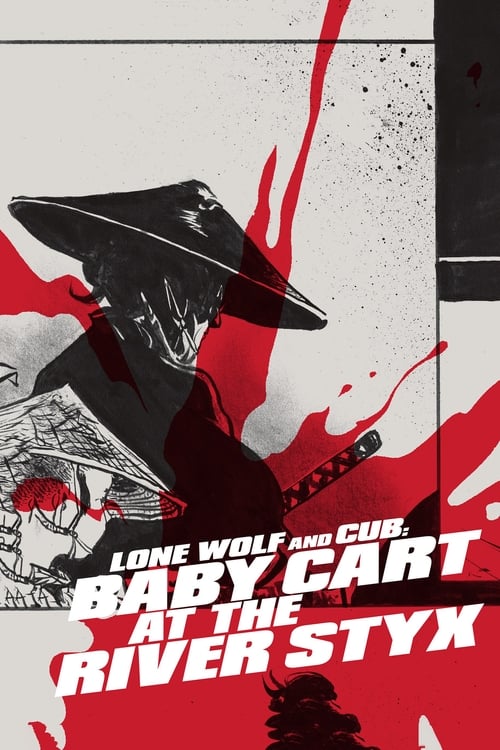
Lone Wolf and Cub: Baby Cart at the River Styx
1972 · Kenji Misumi
For a night when you want pure genre pleasure: swordplay, style, and a body count, delivered with total conviction. Comfort food for action fans, though the gore means it's not for the squeamish.
What it's about
A disgraced executioner turned assassin-for-hire wanders feudal Japan pushing his infant son in a wooden cart that hides an arsenal. Hired to eliminate a traitor selling clan secrets to the Shogunate, he's stalked at every turn by a squad of female ninja and a trio of masterless killers, the road building toward a showdown on open sand dunes.
The experience
Stylized, bloody, and strangely serene — long stretches of stone-faced calm detonating into geysers of violence. The father-and-son tenderness at its center makes the carnage land differently than you expect, and the whole thing moves with pulpy, confident swagger.
Performances
Tomisaburo Wakayama makes Ogami Itto unforgettable — a heavy, unhurried presence who barely changes expression yet radiates both lethality and paternal warmth.
The craft
Kenji Misumi stages violence as graphic design: arterial sprays against pale sand, weapons hidden in a baby cart, duels composed like woodblock prints. The dune-set climax is one of the great samurai set pieces, and the film's inventive weaponry and widescreen framing reward the biggest screen you can find.
Why it matters
The film that locked in the Lone Wolf and Cub formula and became the series' most celebrated entry, its stylized bloodshed echoing through decades of action cinema and grindhouse homage.
Snapshot
Baby Cart at the River Styx (Japanese: Kozure Ōkami: Sanzu no kawa no ubaguruma, literally "Wolf with Child: Baby Cart on the River of the Three Crossings") is the second of six films in the Lone Wolf and Cub series produced by Katsu Productions in 1972–74. Released roughly six months after the inaugural Sword of Vengeance, it consolidates the franchise's identity: the disgraced shogunal executioner Ogami Ittō, now a wandering assassin-for-hire, pushes his infant son Daigorō in a wooden cart bristling with concealed weaponry along the meifumadō—the Buddhist "road to hell." The film pits Ittō against a cadre of female ninja of the Yagyū-allied Akashi clan and a trio of masterless killers, the Hidari brothers, culminating in a celebrated set piece across sun-blasted sand dunes. Directed by genre specialist Kenji Misumi from a screenplay by Kazuo Koike (co-creator of the source manga) and photographed by Chikashi Makiura, it is the entry that most decisively fixed the series' tone of stylized cruelty and arterial spectacle. It is also, for Western audiences, the single most consequential film in the cycle: the bulk of the 1980 American recut Shogun Assassin is drawn from it, seeding a long afterlife in hip-hop and in the cinema of Quentin Tarantino.
Industry & production
The film is a product of Katsu Productions, the independent company founded by star Shintarō Katsu—famous as the blind swordsman Zatōichi at Daiei—during the collapse of Japan's studio system. By the early 1970s the great studios were contracting sharply; Daiei itself went bankrupt in 1971. In this climate the Lone Wolf and Cub films represented a canny independent gambit: adapt a wildly popular, ongoing manga (Kazuo Koike and Gōseki Kojima's Kozure Ōkami, serialized from 1970) as a rapid succession of theatrical features built around a bankable star. That star was Tomisaburō Wakayama, Katsu's elder brother, a heavyset, powerfully physical actor whose casting against the lean-samurai archetype became one of the series' signatures.
Distribution was handled by Toho. The films were produced quickly and economically on a serial model—six features across roughly three years—which shaped both their consistency and their occasional roughness. Precise budget and box-office figures for this individual entry are not well documented in English-language sources, and I will not invent them; what is clear from the production history is that the series was successful enough to sustain rapid sequelization and to run in parallel with a television adaptation later in the decade. The manga's ongoing popularity supplied a ready-made narrative engine, and Koike's direct involvement as screenwriter kept the films closely tethered to their source.
Technology
River Styx was shot on 35mm color film in an anamorphic widescreen format—the standard "scope" ratio of roughly 2.35:1 that Japanese studios had adopted through the late 1950s and 1960s. Color and the wide frame are integral to the film's effects rather than incidental: the deep reds of stylized blood read vividly against muted period browns and the bleached neutrals of the dune finale, and the elongated frame is exploited for lateral compositions in which figures are strung across broad landscapes. The technology here is essentially conventional studio-era Japanese practice deployed with unusual attention to graphic impact; there is no evidence of novel optical or mechanical innovation beyond the elaborate practical rigging of the film's most famous prop, the armored baby cart, whose concealed blades and (in the series) firearm mechanisms are realized through in-camera practical effects and staging rather than any post-production trickery.
Technique
Cinematography
Chikashi Makiura's photography is the film's most sophisticated craft element. Working in scope, he favors strong graphic compositions—isolated figures against sky, sand, water, and stone—that lend the material a spare, almost abstract monumentality. The visual approach oscillates between two registers: static, painterly tableaux that hold on Ittō and Daigorō as near-iconic silhouettes, and bursts of kinetic coverage during combat. Makiura and Misumi make repeated expressive use of natural elements—running water (the "three crossings" motif), open sand, and light—as compositional and thematic material. The dune-set climax is the showcase, where the emptiness of the frame becomes a stage for choreographed violence and the wide format renders the advancing killers as small, ominous marks on a vast ground.
Editing
The cutting alternates deliberate stillness with sudden violence, a rhythm characteristic of the "cruel" jidaigeki of the period. Duels are frequently built around a long charge of stasis broken by an eruption of movement and blood, the edit timed to the instant of the strike. English-language documentation of the specific editor's credit for this entry is thin, and I will not attribute the role to a named individual without certainty; the editorial signature, in any case, is inseparable from Misumi's staging, which choreographs violence to be legible in a small number of decisive cuts.
Mise-en-scène / staging
Misumi stages combat with a graphic clarity that verges on the emblematic. Ittō's technique with the dōtanuki battle sword is presented as ritualized craft; opponents are dispatched in patterned, escalating encounters. The arterial blood geysers—exaggerated far beyond realism—are a deliberate stylization inherited from the late-1960s trend of zankoku (cruel) period cinema, functioning as punctuation and spectacle rather than gore for its own sake. The recurring image of father and child as a single unit—warrior and pram—organizes the mise-en-scène throughout, the cart transformed from domestic object into weapon and, symbolically, into the vessel carrying both figures down the road to hell.
Sound
The score is credited to Hideaki Sakurai (also romanized Hideakira Sakurai), who scored the series. The music blends traditional Japanese instrumentation with the propulsive, occasionally funk- and jazz-inflected textures that period Japanese genre films of the early 1970s often favored, giving the ancient setting a contemporary charge. Sound design leans on stark contrasts—long passages of wind, water, and silence set against the sharp report of steel—reinforcing the editing's stillness-to-violence rhythm.
Performance
Tomisaburō Wakayama's Ogami Ittō is a study in impassive control; the performance is built on stillness, weight, and economy of gesture, the actor's bulk lending an implacable, tank-like quality to the fight choreography that he executed with genuine martial skill. Opposite him, the female ninja of the Akashi Yagyū—led by the assassin Sayaka—supply a more theatrical menace; the leader is played by Kayo Matsuo. The infant Daigorō is played by Akihiro Tomikawa, whose largely silent presence is essential to the series' emotional register: the child is both stake and witness. The performances are keyed to the film's stylization rather than to psychological naturalism, functioning as fixed archetypes within a near-mythic scheme.
Narrative & dramatic mode
The film's dramatic mode is episodic and picaresque, a structure inherited directly from the serialized manga: Ittō takes a commission, travels, is tested by successive waves of assailants, and executes his target. The overarching revenge plot—Ittō's vendetta against the Yagyū clan, who destroyed his house and murdered his wife—supplies a backdrop rather than a tightly plotted throughline. Within this loose frame, the film advances by set pieces: the confrontation with the female ninja, the pursuit by the three Hidari brothers, and the desert climax. The mode is tragic and fatalistic, framed by the Buddhist iconography of the Sanzu River (the crossing of the dead) and the meifumadō; Ittō and Daigorō are understood as souls already committed to a path of damnation, and the drama derives its gravity from that foreknowledge rather than from suspense over survival.
Genre & cycle
River Styx sits squarely within chanbara (sword-fighting) cinema, a subset of the broader jidaigeki (period drama) tradition. More specifically it belongs to the early-1970s cycle of stylized, nihilistic samurai films that had moved decisively away from the humanist gravity of Kurosawa and Kobayashi toward graphic violence, antiheroism, and pulp spectacle—a shift often associated with the "cruel" jidaigeki and with the exploitation-inflected genre output that filled the vacuum left by the studios' decline. The Lone Wolf and Cub series is a flagship of this cycle, adjacent to Katsu's own Zatōichi films and to Misumi and Koike's later, more transgressive Hanzo the Razor. Its innovation within the genre is the fusion of hard-boiled assassin narrative with the sentimental hook of the wandering father and child.
Authorship & method
Director — Kenji Misumi. Misumi is the presiding authorial hand of the series, directing four of the six films and setting the visual template that the others follow. A veteran of Daiei, he had directed the very first Zatōichi film (1962) and numerous period pictures; his sensibility marries classical compositional elegance to a taste for the graphically extreme. His method here is one of controlled stylization—privileging iconic image, ritual pacing, and elemental landscape over realism.
Writer — Kazuo Koike. Koike, co-creator (with artist Gōseki Kojima) of the manga, wrote the screenplays, ensuring an unusually faithful transposition of the source's tone, iconography, and moral universe. His authorship binds the films to the manga's distinctive blend of terse violence and Buddhist fatalism.
Cinematographer — Chikashi Makiura, whose scope compositions define the series' look. Composer — Hideaki Sakurai (Hideakira Sakurai), supplying the modern-traditional hybrid score. Star/producer axis — Shintarō Katsu and Tomisaburō Wakayama, the brothers whose independent company and physical star presence made the enterprise possible. The editor's credit for this entry is not something I can attribute with confidence from available English-language documentation.
Movement / national cinema
The film belongs to Japanese commercial genre cinema at a hinge moment: the transition from studio dominance to independent and exploitation-driven production in the early 1970s. It is not part of the Japanese New Wave (the politically radical art cinema of Ōshima, Yoshida, and Imamura), but it shares that era's appetite for violence and disenchantment, refracted through popular genre rather than avant-garde form. As a Katsu Productions release distributed by Toho, it exemplifies the star-driven independent model that kept jidaigeki commercially viable as the studios retreated—and it stands as one of the tradition's last great flowerings before television absorbed much of the period-drama audience.
Era / period
Produced in 1972, the film reflects a moment when Japanese popular cinema was competing hard against television and courting audiences with heightened sensation. The manga boom of the era supplied proven properties; the loosening of on-screen taboos permitted the blood spectacle; and the contraction of the studios encouraged fast, serial, independent production. The film's diegetic setting is the Edo period (the world of the Tokugawa shogunate, the Yagyū clan, and shogunal officials), but its sensibility—hard, cynical, kinetic—is unmistakably that of the early 1970s.
Themes
The governing theme is the path of damnation freely chosen. Ittō and Daigorō travel the meifumadō, and the title's Sanzu River—the Buddhist Styx that the dead must cross—frames their journey as a passage already among the dead. Fatherhood is inseparable from death: the pram is both cradle and armory, and the child is raised in and by violence. Loyalty, betrayal, and the corruption of clan politics supply the narrative's moral machinery (the plot turns on a traitor selling clan secrets), while honor is presented as a code emptied of righteousness and reduced to lethal craft. Underneath runs a persistent Buddhist fatalism: suffering, impermanence, and the inescapability of the road once taken.
Reception, canon & influence
Critical reception. In Japan the Lone Wolf and Cub films were popular genre entertainments rather than prestige objects, and detailed contemporaneous critical documentation in English is limited. Their canonical reappraisal came later and largely from the West, where the 2000s home-video restorations (notably the Criterion-adjacent and specialty-label releases) prompted serious critical attention to Misumi's craft and the series' stylistic coherence. Within that reassessment, River Styx is frequently singled out as the strongest and most representative entry.
Influences on the film (backward). The film draws on the classical jidaigeki and chanbara traditions and, more immediately, on the late-1960s "cruel" period cinema that legitimized graphic blood spectacle. Its most direct source is the Koike–Kojima manga, whose panel-like compositions, terse violence, and Buddhist iconography Misumi translates faithfully to the screen. Katsu's Zatōichi films—another wandering-swordsman serial from the same creative milieu—form an obvious familial precedent.
Legacy (forward). The film's afterlife is unusually rich. In 1980 producers Robert Houston and David Weisman recut and dubbed the series' opening entries—drawing predominantly on Baby Cart at the River Styx, with material from Sword of Vengeance—into the English-language feature Shogun Assassin. That version became an enduring cult item in the United States: its narration and imagery were later sampled by the Wu-Tang Clan's GZA on the album Liquid Swords (1995), and Quentin Tarantino folds it directly into Kill Bill: Vol. 2 (2004), in which the character B.B. watches Shogun Assassin—an homage that also acknowledges the series' broader influence on Tarantino's stylized violence. The parent manga, translated in the 1980s by First Comics with covers by Frank Miller, shaped a generation of American comics creators; its DNA is explicit in Max Allan Collins's Road to Perdition (adapted by Sam Mendes in 2002), which openly reworks the wandering father-and-son-assassin premise. Through these channels—recut, sampled, quoted, and adapted—Baby Cart at the River Styx became one of the most globally influential Japanese genre films of its decade, its image of the warrior and the pram lodged permanently in world pop culture.
Reception
Sold abroad as pure grindhouse gore in the 70s, it spent decades as a video-store legend before Criterion boxed up the whole series in 2016 — the exploitation shocker turned certified classic.
How Lone Wolf and Cub: Baby Cart at the River Styx was received, from release to now →
Influences: the films it descends from and the films it influenced
- Sanjuro (1962) — The film's climactic single-cut duel, in which a severed artery fires a pressurized fountain of blood, is the pioneering staging/arterial-blood-geysers effect that River Styx amplifies into a house style.
- Yojimbo (1961) — Establishes the impassive, economical lone-swordsman body-language and the shock of graphic mutilation (the severed arm) that Wakayama's Ogami Ittō inherits as performance/impassive-control.
- Harakiri (1962) — Its rigorous anamorphic-scope symmetry and long ritual stillness detonating into violence is the formal editing/stillness-to-violence grammar, and its bushido-as-cruelty critique founds the zankoku jidaigeki.
- The Tale of Zatoichi (1962) — Misumi's own launch of the Katsu-produced wandering-swordsman serial supplies the episodic-picaresque structure and blind-masseur impassivity that River Styx directly extends as the Zatōichi lineage.
- The Sword of Doom (1966) — Its amoral, Buddhist-doomed swordsman and swarming multi-opponent set-pieces model the theme/buddhist-fatalism and the cruel-swordplay choreography Misumi ritualizes.
- Goyokin (1969) — Gosha weds widescreen framing to elemental terrain (snow, surf, wind) so landscape dwarfs the swordsman — the cinematography/elemental-landscape principle that governs River Styx's dunes and rivers.
- Kwaidan (1964) — Its painterly, artificially stylized elemental backdrops privilege iconic design over realism, the same anti-naturalist image-first approach Misumi uses for weather and terrain.
- Shogun Assassin (1980) — A literal recut-and-dub built predominantly from River Styx, reordering Misumi's footage and adding narration — the vector by which this film's images entered Western cult culture.
- Kill Bill: Vol. 1 (2003) — The House of Blue Leaves massacre resurrects the pressurized arterial-blood-geyser as pure aesthetic spectacle, directly quoting chanbara staging Tarantino traces to this series.
- Kill Bill: Vol. 2 (2004) — B.B. watches Shogun Assassin onscreen, an explicit citation that also imports River Styx's theme/fatherhood-and-death into the film's mother-child assassin frame.
- Road to Perdition (2002) — Adapts Max Allan Collins's graphic novel that openly reworks the wandering father-and-son-assassin premise, transposing the pram-and-warrior dyad into Depression-era America.
- Ghost Dog: The Way of the Samurai (1999) — Its lone-assassin-under-a-bushido-code, scored by RZA, arrives through the Wu-Tang/GZA channel that sampled Shogun Assassin — the same sound/traditional-hybrid-over-samurai-iconography fusion.
- Blade of the Immortal (2017) — A faithful manga-to-screen translation that preserves Kojima-style panel compositions and arterial-blood set-pieces, extending the episodic sword-picaresque into contemporary jidaigeki.
- Sword of Vengeance (1972) — The series' first entry, sharing the identical Koike script method, Kojima-panel compositions, and practical baby-cart apparatus — half its footage was recut with River Styx into Shogun Assassin.
- Lady Snowblood (1973) — Another Kazuo Koike manga adaptation that reproduces the arterial-blood geysers against snow and the panel-like tableau staging, sharing the writer's terse-violence-plus-fatalism signature.
- Hanzo the Razor: Sword of Justice (1972) — Koike-scripted, Katsu-produced exploitation jidaigeki from the same independent milieu, extending the movement/independent-exploitation-genre production model into contemporary pulp.
Similar films
- Lady Snowblood (1973) — influence & lineage
- The Tale of Zatoichi (1962) — influence & lineage
- The Sword of Doom (1966) — influence & lineage
- Kill Bill: Vol. 1 (2003) — influence & lineage
- Yojimbo (1961) — influence & lineage
- Harakiri (1962) — influence & lineage
- Sanjuro (1962) — influence & lineage
- Sword of the Stranger (2007) — shared sensibility
All the films related to Lone Wolf and Cub: Baby Cart at the River Styx →