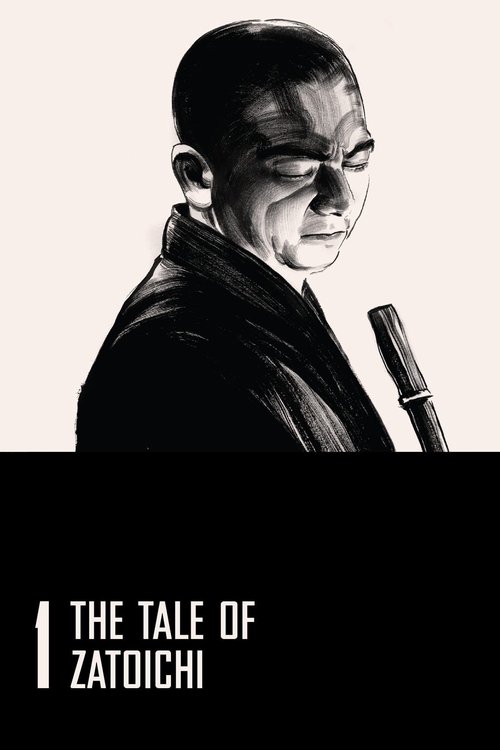
The Tale of Zatoichi
1962 · Kenji Misumi
For when you want a samurai film with soul — more contemplative evening than popcorn night, though the swordplay, when it comes, lands hard. Reach for it when an underdog with hidden depths sounds like exactly the right company.
What it's about
Ichi is a blind, wandering masseur who gambles for a living and hides a master swordsman's skill in his cane. He drifts into a village where a yakuza boss is preparing for war with a rival town's gang, and both sides start calculating what a blind swordsman is worth. Across the lines he meets a sickly, world-weary ronin hired by the enemy — and the two doomed men recognize a shared dignity that the coming fight will not spare.
The experience
Slower and more melancholy than you'd expect from the start of a famous action franchise — this is a mood piece about loneliness and honor, punctuated by brief, decisive flashes of violence. It's warm toward its humble hero and quietly sad about the world he moves through.
Performances
Shintaro Katsu, in the role that defined his career, makes Ichi unforgettable: self-deprecating, sly, humble to the point of invisibility, then suddenly, frighteningly capable — all while playing blindness with uncanny physical conviction.
The craft
Kenji Misumi shoots this black-and-white period piece with classical patience, letting gambling dens, riverbanks, and gang politics breathe before the blade comes out. The action is spare and staged for maximum meaning rather than spectacle — every draw of the sword counts.
Why it matters
It launched one of the most durable characters in Japanese popular cinema, spawning more than two dozen films and a long-running TV series, and set the template for the humble drifter-hero whose skill the world constantly underestimates.
Snapshot
The Tale of Zatoichi (Zatōichi monogatari) is the film that launched one of the most durable characters in Japanese popular cinema: Ichi, a blind, itinerant masseur, gambler, and — beneath the humble surface — a master of the cane sword. Produced by Daiei and directed by Kenji Misumi, it introduced Shintarō Katsu in the role that would define his career and spawn a franchise of more than two dozen features plus a long-running television series. Yet the first film is notably unlike the brisk action pictures that followed it. It is a slow, melancholy, character-driven jidaigeki about two doomed men — a blind commoner and a consumptive rōnin — who recognize in each other a shared dignity, even as the machinery of yakuza politics forces them toward a duel neither wants. Adapted from a passing character in the writing of Kan Shimozawa, it is best understood not as a proto-action franchise-starter but as an elegiac studio drama that happened to contain a star-making performance.
Industry & production
The film was a program picture from Daiei Studios, one of the major vertically integrated Japanese studios of the postwar era, headed by the powerful producer Masaichi Nagata. By 1962 Daiei was a prolific producer of period entertainment (jidaigeki) and competed directly with Toei's chanbara output and Tōhō's prestige productions. Films of this kind were made quickly and economically within a studio contract system that kept directors, stars, writers, cinematographers, and composers under long-term employment, cycling them through multiple productions a year.
The Tale of Zatoichi was modestly scaled and shot in black and white at a time when color and widescreen spectacle were increasingly the norm for prestige titles — a choice consonant with its status as a mid-budget genre picture rather than an event film. Its commercial success, driven substantially by Katsu's performance and the appeal of the character, prompted Daiei to greenlight a sequel almost immediately (The Tale of Zatoichi Continues, 1962), and the studio would go on to build a house franchise around the role. In later years, as Daiei's finances deteriorated (the studio would collapse into bankruptcy in 1971), Katsu's own company, Katsu Productions, took increasing control of the character, eventually carrying it into television. The specific budget and box-office figures for this first entry are not reliably documented in accessible English-language sources, and I will not invent them; what is clear from the production history is that the film performed well enough to found a series.
Technology
The film was photographed in black-and-white anamorphic widescreen — Daiei's proprietary DaieiScope process, the studio's equivalent of CinemaScope. This is a meaningful technical choice: by 1962 widescreen was standard, but shooting in monochrome rather than color kept the picture within program-picture economics while allowing Misumi to exploit the wide frame for landscape, group staging, and the horizontal geometry of the duel. The technology is otherwise unremarkable for its moment — conventional optical sound, studio and location shooting typical of early-1960s Japanese production — and its interest lies less in innovation than in how skillfully the filmmakers used the established widescreen monochrome toolkit for atmosphere.
Technique
Cinematography
The film's visual character is one of restraint and composed stillness rather than kineticism. The DaieiScope frame is used for balance and depth — figures placed against reeds, water, and the plain interiors of gambling dens and inns, with the wide aspect ratio lending a horizontal calm that suits the film's contemplative pace. Shadow and gray tonality carry emotional weight: the monochrome photography renders the world of wandering gamblers as muted and autumnal. The cinematography privileges the eloquence of a held composition over camera movement, and it reserves visual energy for the sword sequences, where framing suddenly tightens and clarifies. English-language documentation of the specific camera crew on this first entry is comparatively thin; where the record is uncertain I decline to assign credits I cannot confirm.
Editing
Cutting is patient and classical. The film builds through scenes allowed to breathe — conversations, a fishing outing, the rituals of the gambling table — rather than through rapid montage. The editing's most striking effect is reserved for the swordplay, which Misumi and his collaborators tend to render in brief, decisive bursts: long stretches of stillness broken by a sudden, economically cut exchange of violence, after which the film returns to quiet. This rhythmic contrast — patience, then a flash of lethal action, then stillness again — became a signature of the series and of the chanbara mode more broadly.
Mise-en-scène / staging
Misumi stages the film with an attentiveness to physical detail and ritual that grounds its melodrama. The gambling dens, with their dice, mats, and coded etiquette, are rendered as a specific social world; the yakuza hierarchies are legible through blocking and deference. Crucially, the staging is organized around Ichi's blindness: the film choreographs how a sightless man navigates a room, reads a space through sound and touch, and conceals his true competence behind the posture of a lowly masseur. The recurring motifs — water, fishing, the exchange of small courtesies between Ichi and the rōnin Hirate — are staged as islands of humane calm within a violent milieu.
Sound
The score is by Akira Ifukube, one of the towering figures of Japanese film music, best known internationally for Godzilla (1954). Ifukube's contribution lends the film a weight and gravity beyond its modest scale — his idiom, drawing on Japanese and modernist orchestral traditions, underscores the tragic dimension of the story rather than merely punctuating action. Sound design also foregrounds Ichi's sensory world: the film is attentive to the aural cues by which a blind man orients himself, making sound a thematic as well as atmospheric element.
Performance
The film is, finally, a performance showcase. Shintarō Katsu, kabuki-trained and previously a second-tier studio player, transforms Ichi into a fully realized figure: shuffling, self-deprecating, quick to laugh and to feign helplessness, then abruptly, shockingly capable. Katsu's physical characterization — the tilted head, the unfocused gaze, the sudden precision of the reverse-grip draw — is the foundation on which the entire franchise rests. Opposite him, Shigeru Amachi (memorable from Nakagawa's Jigoku, 1960) plays Hirate Miki, the tubercular masterless samurai, with a weary nobility that makes the friendship between the two men, and its tragic resolution, genuinely affecting.
Narrative & dramatic mode
The dramatic mode is tragedy in a genre wrapper. Ichi arrives in a village under the sway of the yakuza boss Sukegoro of Iioka, who is drifting toward war with a rival gang led by Shigezo of Sasagawa. The rival camp has retained Hirate, a dying rōnin, as its swordsman. The film's emotional core is not the gang war but the bond that forms between Ichi and Hirate — two outsiders, one blind and low-born, the other a disgraced samurai wasting away from consumption, who share a mutual recognition that transcends the factional lines drawn around them. They fish together, drink together, and understand that they are the only two men of honor in a world of grasping opportunists. The tragedy is that the yakuza conflict compels them into a duel, and that Hirate — already doomed by illness — half-welcomes death at the hands of the one man he respects. The narrative thus subordinates action spectacle to an almost novelistic study of loneliness, dignity, and the futility of the violence around which the characters' lives are organized.
Genre & cycle
The film sits at the intersection of several established Japanese genre traditions. It is a jidaigeki (period drama) set in the late Edo era; a chanbara (sword-fighting film); and specifically a matatabi-mono, the sub-genre of tales about wandering gamblers and outlaw drifters that had long been a staple of Japanese popular fiction, theater, and film. Its yakuza-feud plot draws on the same well of late-Edo outlaw legend — the rivalries of historical gambler bosses such as Sukegoro of Iioka and Shigezo of Sasagawa — that animated many earlier matatabi tales, including the widely dramatized Kunisada Chūji legends. Within the cycle it inaugurated, The Tale of Zatoichi is the tonal outlier: the first film is graver and more restrained, and subsequent entries progressively foregrounded action, humor, and set-piece swordplay as the series found its commercial rhythm.
Authorship & method
Kenji Misumi (1921–1975) is the film's decisive authorial presence. A Daiei contract director specializing in period material, Misumi was among the most visually refined of the studio's chanbara filmmakers, known for elegant compositions, a Buddhist-inflected sensibility, and a capacity to invest genre violence with lyricism and moral seriousness. He would direct several further Zatoichi films and later the celebrated Lone Wolf and Cub (Kozure Ōkami) series and Hanzo the Razor, becoming one of the defining stylists of Japanese period action. His method here favors atmosphere and character over incident, treating the chanbara form as a vehicle for tragedy.
Among his collaborators, the composer Akira Ifukube is the most consequential named contributor, lending the film its tragic musical gravity. The screenplay is credited to Minoru Inuzuka, working from the source material of Kan Shimozawa, the popular novelist and essayist in whose writing the character of the blind masseur Ichi first appeared — reportedly as a minor figure rather than the hero of a full narrative, which left the filmmakers considerable freedom to build a character around him. The star, Shintarō Katsu, must also be counted as a co-author of the figure in practice: his physical and vocal invention shaped Ichi so completely that the role became inseparable from him, and he later assumed producorial control of the series. For the cinematographer and editor of this specific first entry, English-language sources are inconsistent, and I refrain from asserting attributions I cannot verify.
Movement / national cinema
The film belongs to the late flowering of the classical Japanese studio system — the tail end of the "golden age" of the 1950s and early 1960s, when the major studios produced genre pictures at industrial scale with a deep bench of craft talent. It is not an art-cinema or "New Wave" work; it arrives at the same moment as the emergent Japanese New Wave (Ōshima, Yoshida, Imamura) but stands apart from it, representing instead the high competence of mainstream studio genre production. Its relationship to national cinema is that of the popular chanbara tradition — the sword film as a mass entertainment form with deep roots in kabuki and in the serialized outlaw fiction of writers like Shimozawa.
Era / period
1962 was a rich year for the Japanese period film and for a particular current within it: the disillusioned, morally ambiguous swordsman. Kurosawa's Yojimbo (1961) and Sanjuro (1962) had recast the wandering rōnin as a cynical, self-interested figure, and Kobayashi's Harakiri (1962) delivered a scathing critique of samurai codes. The Tale of Zatoichi participates in this broader early-1960s reconsideration of the sword hero — but it relocates the archetype downward, from masterless samurai to a blind commoner masseur, an outsider defined by disability and low birth rather than lost caste. In doing so it reflects a period appetite for anti-heroes and marginal protagonists, while its elegiac tone speaks to a postwar sensibility attuned to loss and the futility of violence.
Themes
The film's governing themes are dignity in marginality, the loneliness of the outsider, and the tragic waste of violence. Ichi's blindness and low status make him the object of contempt, and the film's moral drama lies in the gap between how the world sees him and what he actually is — a man of honor and lethal skill who conceals both. The doubling of Ichi and Hirate stages a meditation on kinship among outcasts: the blind commoner and the dying rōnin are mirror images, each honorable in a dishonorable world, each fated to lose. Mortality suffuses the film — Hirate's consumption, the certainty of the duel — giving it a valedictory, autumnal cast. Running beneath is a quiet critique of the yakuza social order and of a code of loyalty that turns men of worth into instruments of petty gang war.
Reception, canon & influence
The film was successful enough to found a franchise, and Katsu's performance was recognized as its engine; the immediate production of sequels is the clearest contemporary evidence of its impact. In retrospective criticism it is generally regarded as the finest, or at least the most artistically serious, of the early entries — praised precisely for the restraint and tragic depth that later, more action-oriented installments set aside. It occupies a secure place in the canon of Japanese genre cinema as an origin point rather than as a lone masterpiece; its stature is inseparable from the series and character it began.
Influences on the film (backward): it draws on Kan Shimozawa's fiction for its protagonist; on the deep matatabi tradition of wandering-gambler tales and the historical late-Edo yakuza feuds that fed them; on kabuki performance conventions transmitted through Katsu's training; and on the early-1960s vogue for morally complex sword heroes exemplified by Kurosawa's rōnin films.
Legacy (forward): the film's influence is enormous by franchise standards. It launched some two dozen further Daiei features, Katsu's own later productions, and a long-running television series, making Zatoichi one of the most-portrayed characters in Japanese screen history. The blind-swordsman archetype it crystallized rippled outward internationally — into the American remake Blind Fury (1989) with Rutger Hauer, into Takeshi Kitano's stylized reinvention Zatoichi (2003), and into a broad lineage of capable disabled heroes across action cinema and comics (the figure is frequently invoked in discussions of characters such as Daredevil). Misumi's fusion of contemplative stillness and sudden, decisive violence, refined here, became a template he carried into Lone Wolf and Cub and that echoes through subsequent chanbara and its global admirers. What began as a modest black-and-white program picture thus became a foundational text of the modern sword film.
Reception
In 1962 it was a modest black-and-white Daiei programmer that unexpectedly connected with audiences, spawning a sequel that same year; now it's revered as the surprisingly melancholy, character-first origin of one of cinema's longest-running franchises — 25 sequels and a TV series followed.
How The Tale of Zatoichi was received, from release to now →
Influences: the films it descends from and the films it influenced
- Yojimbo (1961) — Crystallized the masterless wandering anti-hero who sets rival yakuza factions against each other and dispatches them in sudden, decisive telephoto sword-bursts — the morally ambiguous swordsman template Ichi directly inherits.
- Sanjuro (1962) — Its held-breath stillness ruptured by a single explosive draw-cut (the geyser-blood duel) codified the 'patient-then-burst' editing rhythm Misumi stages around Ichi.
- Sansho the Bailiff (1954) — Established the Daiei lineage of tragic dignity among society's outcasts rendered in luminous deep-focus monochrome long takes, the pictorial and moral register Misumi's composed stillness descends from.
- Ugetsu (1953) — Kazuo Miyagawa's flowing, painterly black-and-white mise-en-scène set the Daiei house visual grammar of gliding camera and balanced monochrome composition Misumi worked inside.
- Godzilla (1954) — Composer Akira Ifukube's tragic, march-like minor-key ostinato — the same funereal musical gravity he lends Zatoichi, a direct collaborator method carried across films.
- The Rickshaw Man (1958) — A humble, marginalized commoner ennobled into tragic hero — the 'dignity in marginality' pathos, transmitted through popular period drama, that Ichi's blind masseur reworks.
- Samurai I: Musashi Miyamoto (1954) — The first Zatoichi film inherits the commercially viable serialized wandering-swordsman legend format Inagaki's trilogy proved workable: a recurring hero defined by a spiritual code, episodic encounters, and a disability that displaces martial power onto inner discipline.
- Samurai II: Duel at Ichijoji Temple (1955) — The franchise-launching Zatoichi film inherits the chanbara action grammar the Samurai trilogy codified—lone expert, precision against superior numbers, mastery of spatial ambush—transposing it into a new character register while retaining the exact set-piece structure.
- Samurai III: Duel at Ganryu Island (1956) — Popularizes the wandering-master-swordsman archetype the Musashi trilogy fixed for audiences, resolving on a single decisive duel after a long itinerant setup.
- Three Outlaw Samurai (1964) — Wandering swordsmen siding with the downtrodden, framed in terse widescreen tableaux that snap into abrupt lethal duels — the same anti-hero-swordsman-cycle idiom.
- Zatoichi Meets Yojimbo (1970) — Direct franchise extension pairing Katsu's Ichi with Mifune's rōnin, explicitly fusing the two anti-hero-swordsman lineages this film helped found.
- Lone Wolf and Cub: Sword of Vengeance (1972) — Misumi carrying his contemplative-stillness-then-arterial-burst template forward into the ronin-assassin saga, with the same patient framing and sudden decisive cuts.
- Hanzo the Razor (1972) — A Katsu-produced period vehicle extending the tactile, physically- and vocally-invented anti-hero Katsu authored as Ichi, now under his own producorial control.
- Blind Fury (1989) — American remake transposing the blind swordsman's aural-cue choreography — fighting by sound and touch — onto a Vietnam-vet action hero.
- Zatoichi (2003) — Stylized reinvention that keeps the deadpan-stillness/instant-kill rhythm and blindness choreography while restaging the sword-bursts with digital blood and rhythmic sound design.
- Kill Bill: Vol. 1 (2003) — Chanbara pastiche built on the pregnant pause before a single decisive cut and the sensory-master swordsman trope, consciously channeling the stillness-then-burst grammar this film refined.
- Lone Wolf and Cub: Baby Cart at the River Styx (1972) — Misumi's own launch of the Katsu-produced wandering-swordsman serial supplies the episodic-picaresque structure and blind-masseur impassivity that River Styx directly extends as the Zatōichi lineage.
- Harakiri (1962) — Contemporaneous anamorphic black-and-white chanbara that weaponizes ceremonial stillness and slow composure before a devastating burst of swordplay — tragedy delivered inside the genre wrapper.
- Kiru (1962) — Misumi's own same-year chanbara refining the lyrical-stillness-versus-sudden-violence dialectic across elegant DaieiScope compositions.
- The Sword of Doom (1966) — Nihilistic swordsman in black-and-white 'scope whose composed calm is shattered by eruptions of carnage, extending the stillness-then-slaughter cutting logic.
- Samurai Rebellion (1967) — Rigorous compositional stillness and geometric framing that detonate into decisive violence, treating chanbara as vehicle for tragedy.
Similar films
- Zatoichi (2003) — influence & lineage
- Yojimbo (1961) — influence & lineage
- Sanjuro (1962) — influence & lineage
- Harakiri (1962) — influence & lineage
- The Sword of Doom (1966) — influence & lineage
- Ugetsu (1953) — influence & lineage
- Sansho the Bailiff (1954) — influence & lineage
- Three Outlaw Samurai (1964) — influence & lineage