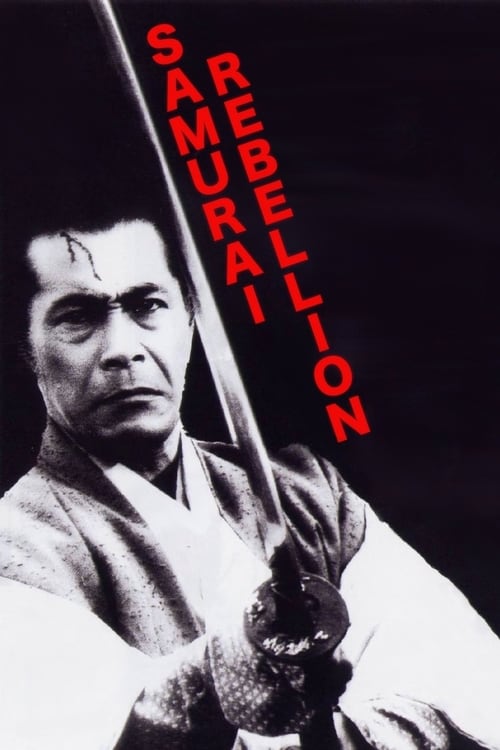
Samurai Rebellion
1967 · Masaki Kobayashi
For when you want moral weight with your swordplay — a film to sit with in full attention, more gripping courtroom standoff than action romp until it suddenly, unforgettably, is both.
What it's about
In feudal Japan, an aging master swordsman who has spent his life in dutiful submission watches his clan lord force a discarded mistress onto his son as a wife — and then, once the couple have genuinely fallen in love and had a child, demand her back. The family must choose between surrendering the woman they love and defying an authority that can erase them. It's a story about the exact moment obedience becomes unbearable.
The experience
Slow-burning and formal, then devastating — the film holds you in rigid ceremony for so long that when the fury finally breaks, it lands like a physical blow. You watch most of it with your jaw tightening.
Performances
Toshiro Mifune gives one of his greatest late performances as Isaburo, a henpecked functionary who slowly straightens into a man with nothing left to lose; Tatsuya Nakadai matches him as the friend who may have to stand in his way.
The craft
Kobayashi composes nearly every frame like a cage — figures pinned inside the grid lines of tatami mats, screens, and courtyards, so the architecture itself enforces the social order. Toru Takemitsu's spare, unnerving score keeps the stillness electric, and the black-and-white widescreen images reward the biggest screen you can find.
Why it matters
One of the peaks of the socially critical samurai film, it cemented Kobayashi's reputation as the great dissident of Japanese period cinema and remains a touchstone for stories that turn genre spectacle into moral protest.
Snapshot
Samurai Rebellion — released in Japan as Jôi-uchi: Hairyô tsuma shimatsu (roughly "Rebellion: Receive the Wife") — is Masaki Kobayashi's late-1960s masterwork of controlled fury, a period drama that uses the rigid machinery of feudal obligation as an instrument of tragedy. Set in the Aizu domain in the early eighteenth century, it follows Isaburo Sasahara (Toshiro Mifune), an aging, henpecked master swordsman who has spent his life in dutiful submission, and his son Yogoro. When their clan lord first forces the family to accept his discarded mistress, Ichi, as Yogoro's wife, and then — after she bears the young couple a child and a genuine, loving marriage forms — capriciously demands her return, the family's refusal escalates into open defiance of the lord's absolute authority. The film is a companion piece to Kobayashi's Harakiri (1962): both are jidaigeki that invert the genre's usual celebration of loyalty, exposing bushido and clan hierarchy as systems that grind down the honest individual. Deliberate in pacing, geometrically composed in the anamorphic frame, and scored with astringent economy by Toru Takemitsu, it builds from chamber drama to a shattering final act of violence. It stands among the most articulate anti-authoritarian statements in Japanese cinema.
Industry & production
The film was produced in 1967 through Toho, the studio that dominated large-scale Japanese production, in partnership with Mifune Productions, the independent company Toshiro Mifune had established to give himself creative latitude outside his long association with Akira Kurosawa. This is one of the notable facts of the project: it pairs Mifune, the era's defining samurai star, with Kobayashi, a director not previously identified with Mifune's screen persona. Their collaboration was a single, self-contained event rather than an ongoing partnership.
By 1967 the classical jidaigeki was under pressure. Television was drawing away the mass audience for period programming, the studio system that had sustained Japan's postwar "golden age" was contracting, and younger filmmakers of the Japanese New Wave were turning toward contemporary subjects and more radical forms. Samurai Rebellion belongs to a strain of "revisionist" or critical period film — alongside Kobayashi's own Harakiri and Hideo Gosha's work of the mid-decade — that repurposed the prestige of the costume picture to interrogate, rather than romanticize, Japan's feudal inheritance. The precise budget and box-office performance are not well documented in accessible English-language sources, and it would be irresponsible to attach figures to them; what is clear is that the film carried the production values of a major studio release, in widescreen black-and-white, with a top-rank star and a prestige creative team.
Technology
Samurai Rebellion was photographed in black-and-white anamorphic widescreen — Toho's Tohoscope process, the studio's variant of the CinemaScope-derived formats that had become standard for prestige Japanese productions. The choice of monochrome in 1967, when color was widely available and increasingly expected for period spectacle, is itself a deliberate technological and aesthetic decision. Kobayashi had already used the combination of scope framing and black-and-white to austere effect in Harakiri and in Kwaidan (1964, which was in color); here the greyscale palette strips the samurai world of decorative appeal and lends the images the hard clarity of an engraving. The wide frame is essential to the film's method: it allows Kobayashi to organize figures within the strict rectilinear architecture of the samurai household, to hold multiple characters in tense spatial relationship, and to isolate a single body against expanses of shoji, tatami, and empty ground. No unusual optical or effects technology drives the film; its innovation is one of composition and restraint rather than apparatus.
Technique
Cinematography
The cinematography, by Kazuo Yamada, is among the film's most celebrated elements. Yamada and Kobayashi build the visual world out of the orthogonal geometry of the Japanese house — sliding panels, verandas, post-and-beam framing, the grid of tatami — and photograph it with a precision that turns domestic space into a diagram of social constraint. Compositions are frequently frontal and symmetrical, characters pinned within nested frames of doorways and screens, so that the architecture visibly encloses them. As the drama intensifies, the camera's stillness becomes charged; the eventual eruption into violence draws its force from how long the film has held its figures in place. The high-contrast monochrome renders textures — cloth, wood, skin, sky — with sculptural sharpness, and the final confrontations, staged in open exteriors, break the domestic geometry with a sudden sense of exposure.
Editing
The film's editing is patient and architectural, matched to a screenplay that unfolds in long, escalating dialogue scenes rather than incident. For much of its length the cutting is sparing, favoring sustained takes and measured shot changes that let tension accumulate within the composition. This restraint is strategic: it makes the late passages of physical action land with disproportionate impact, the rhythm tightening precisely when the family's negotiated peace collapses. Reliable English-language documentation of the editor's individual contribution is thin, and rather than attribute the cutting to a named figure without confidence I note only that the film's tempo is inseparable from its dramatic design — the withholding of movement is the point.
Mise-en-scène / staging
Staging is where Kobayashi's authorship is most legible. He blocks scenes with a near-theatrical formality, arranging characters in ranked, ceremonial positions that mirror the hierarchy the story anatomizes: the lord's emissaries seated in judgment, the family arrayed in obligated deference. The Sasahara household is a set of clean lines and sliding partitions that can be opened or closed to redefine space and allegiance within a single scene. Kobayashi exploits the shoji screen as both literal and figurative membrane — a barrier that separates public duty from private feeling and that can be violently torn through. The controlled, almost ritualized arrangement of bodies makes every deviation from proper position read as a charged act, so that a character stepping out of place carries the weight of rebellion.
Sound
Toru Takemitsu's score is characteristically spare and dissonant, deployed in isolated interventions rather than continuous accompaniment. Takemitsu, one of the twentieth century's major concert composers, treats sound and silence as equal materials; long stretches of the film play with little or no music, so that the natural sounds of the house — footsteps on wood, the slide of a panel, wind — carry dramatic weight, and the entrance of the score registers as an event. His writing draws on the timbral austerity that also distinguishes his work for Kobayashi's Harakiri and Kwaidan, using instrumental color and percussive punctuation to sharpen tension rather than to soothe or swell it. The effect reinforces the film's overall aesthetic of restraint suddenly broken.
Performance
The performances are pitched to the film's formal rigor. Toshiro Mifune, in one of his most disciplined roles, plays Isaburo against type: for much of the film he is a diminished, submissive man, worn down by an unhappy marriage and a lifetime of compromise, and Mifune conveys this through stillness and lowered force before releasing, in the final act, the physical authority the audience associates with him. Tatsuya Nakadai — Kobayashi's frequent lead, the star of Harakiri and The Human Condition — appears as the border guard Tatewaki Asano, Isaburo's friend and swordsman equal, whose duty ultimately sets him against the man he respects; their relationship gives the finale its tragic charge. Yoko Tsukasa plays Ichi, whose quiet resolve is the moral center of the story, and Go Kato plays the son Yogoro. The ensemble sustains the film's mode of suppressed emotion straining against enforced decorum.
Narrative & dramatic mode
The film's dramatic mode is that of slow-building domestic tragedy escalating into confrontation — closer to a chamber play or a courtroom of the household than to an action picture. The screenplay, by Shinobu Hashimoto, adapts a story by Yasuhiko Takiguchi (who also provided the source for Harakiri), and it proceeds through argument and negotiation: the imposition of the marriage, the unexpected flowering of love, the arbitrary reversal, and the family's incremental, reasoned decision to refuse. Much of the running time is talk — the family weighing obligation against conscience, the clan's representatives pressing their demand — and the film's tension derives from the audience's awareness that principled refusal within this system can end only in death. The structure withholds violence almost entirely until the last act, so that when it comes it functions as the tragic consequence of a moral position rather than as spectacle. The dramatic engine is the collision between an individual's claim to dignity and a hierarchy that recognizes no such claim.
Genre & cycle
Samurai Rebellion is a jidaigeki (period drama) and, more specifically, a critical or revisionist samurai film. Where the mainstream chanbara celebrated martial prowess and loyal service, this cycle — Kobayashi its foremost exponent — turns the genre's own iconography against feudal ideology, presenting bushido not as a code of honor but as a machinery of oppression. It forms an unofficial diptych with Harakiri: both films share a source author (Takiguchi), a director, a theme of the individual crushed by clan authority, and a structure that culminates in a lone swordsman's doomed stand. Within the broader arc of 1960s Japanese cinema, it sits alongside the tougher, more cynical period films of the decade as part of a wave that dismantled the samurai myth even as the classical genre approached the end of its golden-age dominance.
Authorship & method
The film is centrally the work of Masaki Kobayashi, whose career was defined by moral opposition to institutional cruelty — most fully in the nine-hour The Human Condition trilogy (1959–1961), an indictment of Japan's wartime conduct, and in Harakiri, his first great assault on feudal hypocrisy. His method favors formal control as the vehicle of protest: rigorous composition, deliberate pacing, and an insistence on the dignity of the individual against systems that deny it. Samurai Rebellion is a natural extension of that project.
His key collaborators shape the result decisively. Shinobu Hashimoto, one of Japanese cinema's most important screenwriters — co-writer of Kurosawa's Rashomon, Seven Samurai, and Ikiru, and writer of Harakiri — supplies the dialogue-driven, morally exacting structure. Kazuo Yamada provides the sculptural black-and-white widescreen cinematography. Toru Takemitsu contributes the sparse, modernist score that had become integral to Kobayashi's late-period sound world. And the presence of Toshiro Mifune, through his own production company, brings both star power and an unusually restrained performance from an actor typically associated with explosive energy. The convergence of these figures — several of them at the peak of the Japanese film industry — accounts for the work's authority.
Movement / national cinema
The film belongs to Japanese cinema and to the twilight of its studio golden age. It is not a product of the Japanese New Wave proper — Kobayashi worked within the mainstream studio system and in classical genre forms rather than in the self-consciously radical idiom of an Oshima or an Imamura — but it shares the New Wave's disenchantment with traditional authority, expressed through form rather than manifesto. As a critical jidaigeki it exemplifies a distinctly Japanese negotiation with national history: the period film as a mirror for postwar reckoning, using the Edo-era setting to examine questions of obedience, complicity, and the cost of principled dissent that carried obvious resonance for a society that had lived through militarism and defeat.
Era / period
Produced in 1967, the film arrives at a hinge point for Japanese cinema — the last years in which major studios could still mount prestige period productions at scale before television and industry contraction eroded the form. Its diegetic setting is the early eighteenth century, in the ostensibly stable, peace-time order of the Tokugawa shogunate, a choice that sharpens its critique: the violence here is not the chaos of war but the everyday operation of a settled hierarchy, in which a lord's whim carries the force of law and refusal is treason. The film thus speaks to two eras at once — the feudal past it depicts and the modern moment of its making, in which the legacy of unquestioning obedience to authority remained a live national question.
Themes
The governing theme is the conflict between individual conscience and institutional authority — the right of a person to love, to family, and to dignity against a hierarchy that treats subjects as property. The lord's demand for Ichi's return reduces a woman and a marriage to instruments of clan convenience, and the family's refusal asserts the moral claim of the private self against the totalizing claims of the system. Related motifs run throughout: the hollowness of "honor" and duty when they serve only power; the transformation of a submissive man into a rebel once he finds something worth defending; the tragedy that within such a system integrity is punishable by death. The film also quietly critiques the position of women, whose fates are decided entirely by men's arrangements. Above all it dramatizes rebellion as a moral necessity that the existing order cannot survive granting — and that it therefore answers with annihilation.
Reception, canon & influence
Critically, Samurai Rebellion has been received as one of Kobayashi's finest films and a high point of the 1960s samurai cinema, frequently discussed as the twin of Harakiri. It was recognized on the international festival circuit — it is credited with the FIPRESCI (international critics') prize at the Venice Film Festival — and it has retained a strong reputation among critics and in home-video restoration, where it circulates as a canonical example of the critical jidaigeki. Precise contemporary box-office and domestic-review data are not well attested in accessible English sources, and I flag that gap rather than fill it with invented specifics.
Its lines of influence run backward and forward. Looking backward, the film draws on the source material of Yasuhiko Takiguchi and on Kobayashi's own established preoccupations, and it stands in dialogue with the humane, socially critical tradition of postwar Japanese cinema, including the Kurosawa–Hashimoto screenwriting lineage from which its writer emerged; its very form — the lone principled swordsman making a doomed stand against clan power — extends directly from Harakiri five years earlier. Looking forward, its influence is felt in the continuing revisionist treatment of the samurai myth, in the enduring critical esteem that has kept it a touchstone for filmmakers and scholars interested in the moral critique of authority, and in the broader reception of Mifune's and Nakadai's careers, whose pairing here is remembered as one of the era's notable star confrontations. Its most direct legacy, however, is conceptual: together with Harakiri it helped fix the template of the anti-feudal samurai film — the genre turned into an instrument of dissent — a model whose echoes persist wherever period settings are used to indict systems that demand obedience at the cost of the self.
A Deleuzian reading
Mifune is sitting down.
The full Deleuzian reading of Samurai Rebellion →
Reception
A hit with critics on release — it topped Japan's Kinema Junpo poll for 1967 and took the FIPRESCI prize at Venice — yet abroad it long sat in the shadow of Kobayashi's Harakiri, until Criterion and Letterboxd word-of-mouth turned it into the 'other' Kobayashi masterpiece everyone eventually gets to.
How Samurai Rebellion was received, from release to now →
How to watch Samurai Rebellion: what to notice on a first viewing
- Notice the straight lines of beams, panels, and tatami mats. Kazuo Yamada shoots the Sasahara house frontally and symmetrically, the post-and-beam grid ruling the widescreen frame like lines on a ledger. This is what the reading calls the closed set, a frame treated as a whole system of rules rather than just a place.
- Watch the sliding panels open and close within a single scene. Kobayashi uses the shoji screen as a literal barrier that can open or shut to redefine who belongs to the family and who represents the lord. Each time a screen moves, the politics of the room have just been redrawn.
- Notice exactly where each person sits relative to everyone else. Kobayashi arranges characters in ranked, formal positions that mirror the household's hierarchy, so a single deviation from proper position reads as a real act of defiance. This is what the reading calls a gest, a posture that publishes a whole social relation without a word.
- Listen for footsteps and sliding panels instead of music. Long stretches of the film play with little or no score, so ordinary house sounds carry real weight and the entrance of Takemitsu's music registers as an event. Silence here isn't empty. It's the film's normal state, which makes music itself a kind of alarm.
- Watch Mifune's body stay lowered and folded for most of the film. Mifune plays Isaburo as diminished and submissive, conveying decades of compromise through stillness and lowered force rather than through the explosive energy he's usually known for. The casting itself is the joke and the tragedy: power kept folded up in a body built to release it.
The whole guide to watching Samurai Rebellion, with the keys for a rewatch →
Influences: the films it descends from and the films it influenced
- Harakiri (1962) — The direct diptych twin — same nested-testimony structure indicting clan power, Nakadai as the doomed truth-teller, Takemitsu's percussive biwa score, and rigid rectilinear compositions that turn the feudal estate into a geometric trap.
- The Human Condition I: No Greater Love (1959) — Established Kobayashi's method of formal control as protest — sculptural monochrome widescreen and deliberate, withheld pacing marshalled to dignify the individual crushed by an institution.
- Seven Samurai (1954) — Source of the Hashimoto/Kurosawa screenwriting discipline that Shinobu Hashimoto carried into Rebellion, and of Mifune's star persona that Kobayashi deliberately restrains here.
- Rashomon (1950) — Hashimoto's breakthrough structural device — truth reconstructed through competing testimony — underwrites Rebellion's morally exacting, courtroom-like dialogue architecture.
- Ikiru (1952) — Hashimoto's template of one man's principled stand against a faceless bureaucracy supplies the dialogue-driven, individual-versus-authority spine that Rebellion transplants into the Tokugawa clan.
- Late Spring (1949) — Codified the symmetrical framing of the tatami interior and the sliding shoji as a compositional membrane dividing figures — the domestic-tragedy grammar Kobayashi weaponizes.
- Ugetsu (1953) — Model of ceremonial long-take blocking and pictorial jidaigeki formalism, where movement through architectural space carries moral weight without cutting.
- Sansho the Bailiff (1954) — Set the precedent of period-film formal beauty as an indictment of a system that demands submission, the individual's dignity asserted against institutionalized cruelty.
- The Human Condition III: A Soldier's Prayer (1961) — Transposes the same essayistic anti-authoritarian structure into a feudal setting with Nakadai and geometrically severe widescreen staging, a single man's principled refusal escalating against institutional power.
- The Human Condition II: Road to Eternity (1959) — Carries forward the lone-individual-defying-the-institution structure and the geometric, oppressive framing of clan authority, again with Nakadai, distilling The Human Condition's moral architecture into jidaigeki form.
- Samurai III: Duel at Ganryu Island (1956) — Builds an entire film toward one climactic Mifune duel using tableau landscape framing and long patient buildup, extending Inagaki's elegiac deferral of violence.
- Humanity and Paper Balloons (1937) — A low-ranking retainer is destroyed by obedience to arbitrary clan authority — a domestic tragedy indicting feudal duty that renders Yamanaka's theme with rigorous formal control.
- Goyokin (1969) — Carries forward the anti-feudal template — a lone conscientious retainer versus clan atrocity — again built on Nakadai and expansive scope framing of the samurai landscape.
- Ran (1985) — Inherits the Takemitsu-scored, Nakadai-led critique of authority, with rigorously geometric, symmetrical widescreen compositions turning feudal power into architectural spectacle.
- 13 Assassins (2010) — Revives the Kobayashi/Harakiri model of the samurai film as instrument of dissent — a doomed principled stand mounted explicitly to indict a tyrannical lord's demand for obedience.
- Hara-Kiri: Death of a Samurai (2011) — A direct remake of the diptych's other half, consciously reproducing the withheld tempo, ceremonial blocking, and courtyard geometry as homage to Kobayashi's critical jidaigeki.
- The Assassin (2015) — Extends the withheld-tempo aesthetic and the shoji/silk-membrane framing — figures glimpsed through translucent screens, action suspended in ceremonial stillness — into a meditative period cinema of restraint.
- The Hidden Blade (2004) — Duty-versus-conscience drama in which a dutiful vassal finally turns his blade against his own corrupt clan — the precise moral structure Hidden Blade reprises in chastened form.
- The Twilight Samurai (2002) — Fuses domestic family drama with the period film so that a household's private dignity collides with clan authority — the exact genre synthesis (home + history) Yamada's method depends on.
- Kwaidan (1964) — Perfected the Kobayashi–Takemitsu sound world of sparse modernist score and charged silence, plus the theatrical ceremonial blocking against flat stylized planes that Rebellion applies to the domestic interior.
- Yojimbo (1961) — Contemporary revisionist jidaigeki using Mifune to expose feudal corruption rather than celebrate it, part of the same 1960s turning of the genre against its own myth.
- The Sword of Doom (1966) — Same Toho anamorphic monochrome-scope house style and Nakadai cast as the nihilistic swordsman, extending the era's darkening of the jidaigeki hero.
- Red Beard (1965) — Gives Mifune another reticent, morally immovable patriarch in restrained interior register, extending the humanist-resistance jidaigeki into the same late-studio moment.
- The Tale of Zatoichi (1962) — Rigorous compositional stillness and geometric framing that detonate into decisive violence, treating chanbara as vehicle for tragedy.
- Three Outlaw Samurai (1964) — Deploys the same anamorphic symmetry and oppositional framing to stage a lone family's revolt against clan authority, sharing Gosha's use of scope geometry as class critique.
Similar films
- Harakiri (1962) — influence & lineage · same viewing thread
- Rashomon (1950) — influence & lineage · same viewing thread
- 13 Assassins (2010) — influence & lineage · same viewing thread
- The Sword of Doom (1966) — influence & lineage · same viewing thread
- Yojimbo (1961) — influence & lineage · same viewing thread
- Seven Samurai (1954) — influence & lineage
- Ran (1985) — influence & lineage
- Sansho the Bailiff (1954) — influence & lineage
All the films related to Samurai Rebellion →
Watch it with: curated runs of related films
- The Samurai Code on Trial — A run of chanbara films that draw the sword only to turn it against the myth of honor itself — watch them together and the bushido ideal keeps curdling into cruelty, nihilism, and doubt.