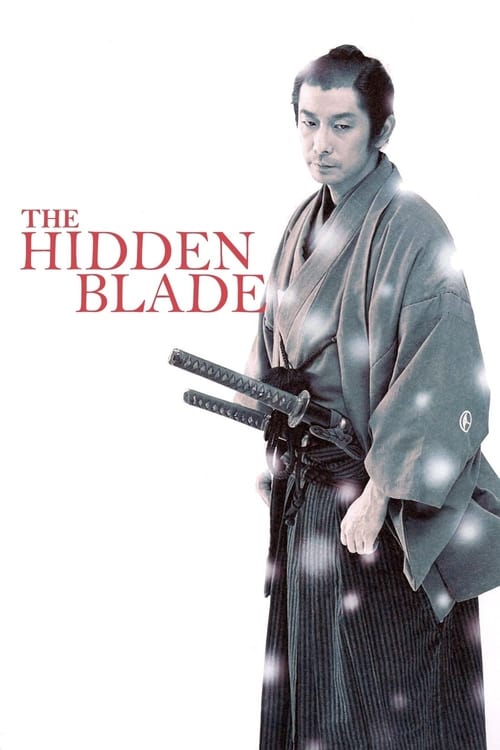
The Hidden Blade
2004 · Yoji Yamada
For a slow evening when you want something humane and old-fashioned — a love story and a code-of-honor story in one, more comfort than challenge until it tightens its grip in the final stretch.
What it's about
In the last decades of feudal Japan, a low-ranking samurai named Munezo Katagiri lives a modest, dutiful life in a northern castle town while Western rifles and cannon drills begin to unsettle the old order. He quietly loves Kie, a farm girl who once served his household — a match his caste makes impossible — and his loyalty is pushed to the breaking point when the clan orders him to kill a condemned traitor who happens to be his closest friend. It's a story about honor, class, and a sword technique kept secret for the day it's truly needed.
The experience
Patient, tender, and quietly devastating — long stretches of domestic warmth and dry humor punctuated by sudden, scrappy violence that feels dangerous precisely because it's so rare. It builds a slow ache rather than a rush.
Performances
Masatoshi Nagase plays Katagiri with a wonderful, weathered restraint — a decent man whose feelings surface in glances and hesitations rather than speeches, which makes the moments he finally acts land hard.
The craft
Yoji Yamada shoots the samurai world without gloss: muddy streets, cold rooms, clumsy rifle drills, swordplay that's desperate rather than balletic. The period detail is lived-in rather than decorative, and the film's realism about money, rank, and duty gives its romance real stakes. It rewards patience more than a big screen.
Why it matters
The middle film of Yamada's acclaimed late-career samurai trilogy, it helped cement a revisionist strain of jidaigeki that treats samurai as underpaid civil servants rather than superheroes — a quiet counterpoint to the era's wuxia spectacles.
Snapshot
The Hidden Blade (Kakushi-ken oni no tsume, literally "Hidden Blade: Demon's Claw") is the second installment in Yoji Yamada's late-career trilogy of films about low-ranking samurai in the twilight of the Tokugawa order, bracketed by The Twilight Samurai (2002) and Love and Honor (2006). Like its companions, it adapts the short fiction of Shuhei Fujisawa, whose stories of provincial retainers in a fictionalized northern domain furnished Yamada with a vision of the samurai not as a heroic swordsman but as a salaried civil servant snared in obligation, poverty, and class. The film follows Munezo Katagiri (Masatoshi Nagase), a middling samurai of the Unasaka clan, across roughly the 1860s — the Bakumatsu years when Western cannon and rifle drill were arriving in the castle towns of feudal Japan. Its twin engines are a forbidden tenderness, between Munezo and Kie (Takako Matsu), a farm girl who once served his household, and a wrenching ordeal of duty: ordered to hunt down and kill his closest friend and former classmate, branded a traitor. The "hidden blade" of the title is both a literal secret sword technique and a metaphor for the buried, unsanctioned forms of conscience and feeling the story prizes over feudal honor. It is a quiet, deliberate, deeply humanist period film — a jidaigeki drained of spectacle and refilled with domestic detail and moral discomfort.
Industry & production
The film was a production of Shochiku, the venerable studio with which Yamada had been associated for his entire directing career, and it arrived as the deliberate sequel-in-spirit to a major prestige success. The Twilight Samurai had been a critical and awards triumph two years earlier — a multiple Japan Academy Prize winner and a nominee for the Academy Award for Best Foreign Language Film — and The Hidden Blade extended that proven formula: Fujisawa source material, the same fictional Unasaka setting, the same register of restrained, period-accurate realism. For Yamada, by then in his early seventies and long defined by the gentle comedy of the decades-spanning Tora-san (Otoko wa Tsurai yo) series, the samurai cycle represented a significant act of late reinvention within the studio system that had employed him since the 1950s. The production drew on Shochiku's resources for meticulous period reconstruction — castle-town streets, farmhouse interiors, the apparatus of clan administration — and on location work in northern Japan consonant with Fujisawa's own Shonai-region roots. Beyond the broad strokes of studio backing and the trilogy's commercial logic, granular production records (budget figures, shooting schedule specifics) are not well documented in widely available English-language sources, and I won't invent them.
Technology
The Hidden Blade is a conventionally photographed early-2000s film rather than a technological showcase, and its interest in technology is thematic rather than formal. The narrative is set precisely at the moment when imported military technology was rendering the samurai obsolete: the film stages scenes of Western-style drill, artillery and firearms training, the clan struggling to absorb European martial methods that make the inherited sword arts decorative. This is the historical irony at the film's center — that Munezo masters a lethal traditional technique in a world that is about to have no use for swordsmen at all. As a piece of filmmaking it employs the standard photochemical and post-production tools of its era without ostentation; its craft lies in restraint, naturalistic light, and an almost documentary attention to material culture rather than in any innovation of cinema technology.
Technique
Cinematography
The photography, by cinematographer Mutsuo Naganuma, is composed, patient, and unshowy. It favors stable framing, natural and motivated light, and a muted, earthen palette appropriate to a story of provincial poverty and seasonal labor — the browns of farmhouse timber, the gray of overcast northern skies, the cold tones of snow. Interiors are frequently observed through the geometry of shoji screens, sliding doors, and the low horizontal sightlines of tatami-level living, lending the domestic scenes a measured, almost Ozu-like calm. When violence finally erupts in the duel sequences, the camera does not lunge for kineticism; it keeps its distance and its composure, so that the rare moments of swordplay register as ruptures in an otherwise still and ordered visual field.
Editing
The cutting matches the cinematography's deliberation. The Hidden Blade unfolds at an unhurried, accretive pace, allowing scenes to breathe and giving weight to small gestures, silences, and the passage of seasons. The film cross-cuts between its two main strands — the slow-burning love story and the gathering political crisis around the condemned friend — letting them accumulate emotional pressure in parallel before they finally converge. The duel and action passages are edited for clarity and impact rather than fragmentation, preserving spatial legibility. (Precise editorial credits for the film are not something I can confirm in detail from memory, and I'd rather flag that than misattribute the work.)
Mise-en-scène / staging
This is the film's richest dimension. Yamada and his collaborators reconstruct the texture of mid-nineteenth-century provincial life with ethnographic care: the rituals of clan hierarchy and etiquette, the labor of the farm, the cramped economy of a lesser samurai's household, the precise codes of bowing, seating, and speech that encode rank. Staging is frequently organized around thresholds and barriers — doorways, gates, the social distance between a samurai's rooms and a servant's quarters — that literalize the class divisions the story interrogates. The placement of bodies in domestic space carries enormous dramatic information: who may sit where, who may approach whom, what proximity is permitted between a samurai and a farm girl. The result is a mise-en-scène in which every spatial arrangement is also a statement about social order.
Sound
The score is credited to Isao Tomita, the composer and electronic-music pioneer, working here in a restrained orchestral and traditional idiom rather than the synthesizer experiments for which he was internationally famous. The music underscores the film's emotional currents — the tenderness of the central romance, the melancholy of a dying social order — without overwhelming them. Equally important is the film's use of ambient, naturalistic sound: the quiet of interiors, the sounds of weather and rural labor, the charged silences of scenes in which what cannot be said matters more than what is spoken. The soundscape reinforces the overall aesthetic of dignified understatement.
Performance
Performances are calibrated to the same key of suppression and interior life. Masatoshi Nagase plays Munezo with a watchful, contained decency, a man whose strongest feelings are precisely the ones his station forbids him to act on. Takako Matsu's Kie supplies the film's warmth and its moral clarity; the relationship between them is built less from declarations than from glances, small kindnesses, and the ache of class-enforced distance. The supporting ensemble — including the friend-turned-traitor whose fate forms the film's tragic spine, and the sword master who imparts the secret technique — sustains the same naturalism. Acting throughout privileges nuance over display, which is essential to a film whose subject is feeling held in check.
Narrative & dramatic mode
The film's dramatic mode is melodrama in the most serious, classical sense: a structure of obligation, sacrifice, and feeling thwarted by social law, played without irony and aimed squarely at the emotions. Two plots interlace. The first is a romance across a class boundary, in which Munezo's love for Kie is obstructed by the rigid distinction between samurai and peasant; the film treats this not as a private misfortune but as an indictment of the system that forbids it. The second is a tragedy of duty, in which Munezo is commanded by his clan to kill a man he loves as a brother — a friend imprisoned and condemned for involvement in political dissent. The collision of these strands forces the protagonist toward a reckoning with the difference between honor as the clan defines it and honor as conscience demands. The narrative builds slowly and resolves into choices that quietly repudiate the feudal order, ending on a note of cautious liberation rather than heroic affirmation.
Genre & cycle
The Hidden Blade belongs to the jidaigeki (period drama) and, more specifically, the chambara (swordfight) tradition, but it stands in pointed revision of that tradition. Where the classical samurai film of the 1950s and 60s — Kurosawa's action epics, the Zatoichi and Lone Wolf and Cub franchises — foregrounded martial prowess and stylized violence, Yamada's trilogy belongs to a humanist, anti-spectacular strain that treats the samurai as a working person and the sword as a tragic burden rather than a source of glamour. The film is best understood as the middle panel of Yamada's Fujisawa-derived samurai triptych, sharing with The Twilight Samurai and Love and Honor a common world, a common ethos, and a common interest in the obscure dignity of the lower-ranking retainer. Within the long history of the genre, these films constitute a late, elegiac, revisionist cycle — period filmmaking as critique of the very codes the genre once celebrated.
Authorship & method
The film is unmistakably a Yoji Yamada work, bearing the signature his decades of populist filmmaking had refined: sympathy for ordinary people, attentiveness to domestic and economic detail, gentle humor leavening serious feeling, and a fundamentally humane, anti-authoritarian moral outlook. Yamada co-wrote the screenplay (with Yoshitaka Asama), adapting Shuhei Fujisawa's short fiction — a body of work whose recurring fictional northern domain and focus on minor samurai gave Yamada the raw material for his late-period vision. The collaboration is deeply authorial in the sense that Yamada's adaptive method consistently translates Fujisawa's quiet stories into a cinema of restraint and accumulated detail. Key craft collaborators include cinematographer Mutsuo Naganuma, whose composed naturalism defines the film's look, and composer Isao Tomita, whose understated score supplies its emotional undercurrent. The ensemble of performers, led by Nagase and Matsu, executes Yamada's preference for nuance over demonstration. Together these collaborators realize a method whose governing principle is subtraction — of spectacle, of heroics, of melodramatic excess — in favor of texture, patience, and moral seriousness.
Movement / national cinema
The film is a landmark of early-2000s Japanese cinema and of a broader international revival of serious, art-house-inflected Japanese period filmmaking at that moment. Yamada's samurai trilogy, alongside other prestige productions of the era, helped reposition the jidaigeki for contemporary audiences at home and abroad as a vehicle for character drama and social critique rather than genre thrills. The films are also exemplary of Shochiku's house tradition of shomin-geki — dramas of ordinary lower-class life — transposed into period dress; Yamada effectively fuses the studio's long humanist lineage (a lineage that runs back through Ozu) with the samurai film. Within Japanese national cinema, The Hidden Blade represents the persistence and renewal of a deeply local storytelling tradition, rooted in regional history and Fujisawa's Shonai geography, carried by one of the industry's most enduring directors.
Era / period
The film is set in the Bakumatsu, the closing years of the Tokugawa shogunate around the 1860s, immediately before the Meiji Restoration of 1868 would abolish the samurai class altogether. This setting is not incidental but constitutive: the story takes place at the precise historical hinge when feudal Japan was being forced open to Western modernity, when clans were importing European artillery and drill, and when the entire social and martial order embodied by the samurai was sliding toward obsolescence. The drama of individual conscience versus feudal obligation is therefore doubled by a larger historical irony — the characters cling to, or struggle against, codes that history is about to render void. As a production, the film is a product of early-twenty-first-century Japanese prestige cinema, looking back across more than a century at a world on the brink of dissolution.
Themes
The film's central themes are interlocking. First, class and its cruelties: the love story dramatizes the injustice of a hierarchy that forbids union across the samurai-peasant line, and the film clearly sides with human feeling against social rank. Second, the conflict between duty and conscience: the order to kill a beloved friend stages the collision between clan loyalty (giri) and personal moral truth, and the narrative ultimately privileges the latter. Third, the obsolescence and hollowness of the samurai code: by setting honor against modernization and against decency, the film exposes bushido less as a noble ideal than as an instrument of an unjust and dying order. Fourth, the dignity of ordinary life — the recurring Yamada conviction that worth resides in kindness, labor, and integrity rather than in status or violence. Running beneath all of these is a quiet ethic of liberation: the film's emotional resolution lies in characters choosing love, conscience, and a freer future over inherited obligation.
Reception, canon & influence
Critically, The Hidden Blade was generally well received as a worthy, if slightly less heralded, companion to The Twilight Samurai, which remains the most celebrated and awarded entry in Yamada's trilogy. Reviewers praised the film's emotional richness, its meticulous period craft, its performances, and its humane reframing of the samurai genre, while some noted that it covers terrain very close to its predecessor. (I'm characterizing the broad shape of its reception rather than citing specific figures or awards, which I can't verify precisely here.)
Its influences flow backward from a clear lineage. Most directly, the film descends from Shuhei Fujisawa's short fiction, the wellspring of its world and ethos. More broadly it answers, and revises, the classical samurai cinema of the postwar masters — the moral seriousness of Akira Kurosawa, the everyday humanism of Yasujiro Ozu and the Shochiku shomin-geki tradition in which Yamada was formed, and the long chambara genre against which it defines its restraint. Yamada's own decades of populist filmmaking, above all the Tora-san series' affection for ordinary people, are the immediate authorial soil from which the trilogy grew.
Looking forward, The Hidden Blade's most concrete legacy is its place in cementing Yamada's late-career samurai trilogy as a coherent, internationally recognized body of work — completed by Love and Honor in 2006 — that demonstrated the continued artistic and commercial viability of the humanist, anti-spectacular period film. Together these films contributed to a wider re-legitimization of the jidaigeki as a vehicle for serious drama in twenty-first-century Japanese cinema, and they stand as an influential model of how a national genre can be reanimated through restraint, social critique, and sympathy for its least heroic figures. Within the larger map of cinema, the film is best located not as a fountainhead but as a distinguished node in a continuous tradition — receiving the postwar samurai film and the Shochiku humanist legacy, and passing them onward in chastened, elegiac form.
A Deleuzian reading
A man kneels at the edge of a room.
The full Deleuzian reading of The Hidden Blade →
Reception
On release it was warmly reviewed but dogged by the 'isn't this just The Twilight Samurai again?' shrug, arriving two years after that film's Oscar nomination. Two decades on, fans increasingly defend it as an equal — the quietly great middle chapter of Yamada's samurai trilogy rather than a retread.
How The Hidden Blade was received, from release to now →
Influences: the films it descends from and the films it influenced
- The Twilight Samurai (2002) — First panel of the same trilogy, establishing the Fujisawa-adaptation method of building a low-stipend samurai's interior life through domestic economic detail and a single reluctantly-drawn duel rather than serial swordplay.
- Tokyo Story (1953) — The Shochiku shomin-geki blueprint Yamada inherited — framing household life through shoji and corridor thresholds in low static compositions, with feeling withheld behind polite surfaces.
- Late Spring (1949) — Source of the shoji-partition framing and receding-plane household geometry, so that suppressed emotion is read in posture and silence rather than dialogue.
- Harakiri (1962) — Revisionist-samurai template of indicting feudal hierarchy from the viewpoint of an impoverished retainer, exposing the institutional cruelty beneath the bushido code.
- Samurai Rebellion (1967) — Duty-versus-conscience drama in which a dutiful vassal finally turns his blade against his own corrupt clan — the precise moral structure Hidden Blade reprises in chastened form.
- Seven Samurai (1954) — Established the samurai film as serious moral drama about class and the obsolescence of the warrior — the seriousness Yamada keeps while answering its kinetic combat with deliberate restraint.
- Yojimbo (1961) — The chambara virtuosity of the decisive, balletic kill against which Yamada defines his anti-spectacular single-strike duels and the secret 'hidden blade' technique.
- Red Beard (1965) — Humanist period drama that subordinates action to compassion and social injustice, modeling the chastened, anti-heroic jidaigeki register Yamada extends.
- It's Tough Being a Man (Tora-san) (1969) — Yamada's own populist soil — affection for humble working people and gentle humor leavening pathos, the authorial sympathy he transplants onto the minor samurai.
- Twenty-Four Eyes (1954) — Shochiku humanist melodrama of decent ordinary people crushed by historical forces, the studio's classical-melodrama emotional register in which Yamada was formed.
- Love and Honor (2006) — Closes the trilogy with the identical apparatus — Fujisawa source, Naganuma's composed naturalism, and a blind low-ranking retainer's climactic duel staged as moral necessity, not spectacle.
- Sword of Desperation (2010) — Directly extends the Fujisawa-adaptation craft — a restrained, melancholy northern-domain retainer's tale building to one fatal secret-technique duel.
- Hara-Kiri: Death of a Samurai (2011) — Reanimates the Kobayashi-derived revisionism Yamada renewed, foregrounding class injustice and the economic desperation beneath the warrior caste in slow, composed staging.
- Unforgiven (2013) — Elegiac late-jidaigeki of the samurai's obsolescence across the Meiji transition, extending Hidden Blade's bakumatsu theme of a vanishing class adapting to gunpowder and modernity.
- When the Last Sword Is Drawn (2003) — Contemporary humanist revisionist jidaigeki centering a poor provincial swordsman, sharing the same 2000s re-legitimization of the genre as earnest character drama over action.
- 13 Assassins (2010) — Belongs to the same 2000s jidaigeki revival and shares the late-feudal setting of clan rot and duty, but restores spectacle — defining itself against the very restraint Yamada championed.
Similar films
- The Twilight Samurai (2002) — influence & lineage · same viewing thread
- Harakiri (1962) — influence & lineage · same viewing thread
- Samurai Rebellion (1967) — influence & lineage · same viewing thread
- 13 Assassins (2010) — influence & lineage · same viewing thread
- Seven Samurai (1954) — influence & lineage
- Late Spring (1949) — influence & lineage
- Yojimbo (1961) — influence & lineage · same viewing thread
- The Sword of Doom (1966) — same viewing thread
All the films related to The Hidden Blade →
Watch it with: curated runs of related films
- The Samurai Code on Trial — A run of chanbara films that draw the sword only to turn it against the myth of honor itself — watch them together and the bushido ideal keeps curdling into cruelty, nihilism, and doubt.