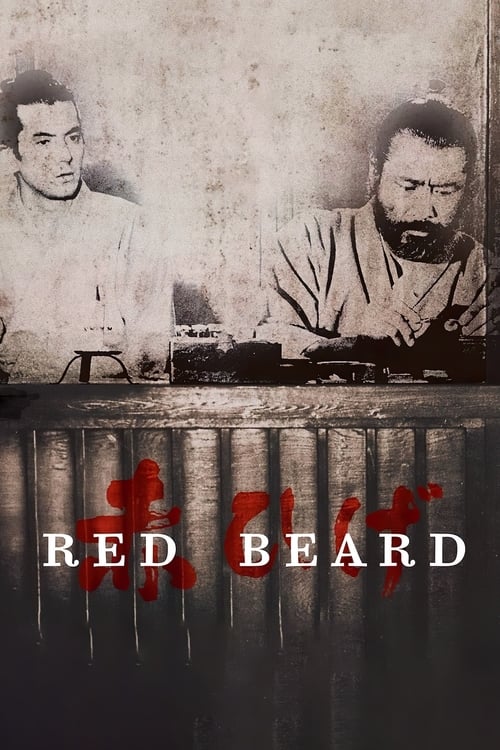
Red Beard
1965 · Akira Kurosawa
For when you want a film to live inside for an evening — something humane and restorative that takes its time and rewards it. Reach for it when you're ready to be patient and want to come out believing in people a little more.
What it's about
A cocky young doctor, fresh from elite Western-style medical training and expecting a cushy post with a wealthy family, is instead assigned to a charity clinic for the poor in early-1800s Japan — run by the gruff, immovable master physician everyone calls Red Beard. He rebels, sulks, and refuses to wear the uniform; his teacher simply waits, and case by case, patient by patient, remakes him into a doctor of conscience.
The experience
Long, patient, and deeply moving — it unfolds as a chain of patients' stories, each a small novel of poverty, cruelty, and grace, building an emotional weight that sneaks up on you. By the end it earns tears honestly, without a false note.
Performances
Toshiro Mifune, in his final collaboration with Kurosawa, plays Red Beard with a contained, gravitational authority — a performance of stillness and moral force that won him the Best Actor prize at Venice — opposite Yūzō Kayama's convincingly prideful, slowly softening intern.
The craft
Kurosawa's last black-and-white film and his last in the anamorphic widescreen format he'd mastered, and it shows: deep, meticulous compositions, a clinic built out in extraordinary detail, and episodes staged with novelistic care. Its images of weather, lamplight, and crowded sickrooms reward a big screen.
Why it matters
A hinge in Kurosawa's career — the end of his legendary partnership with Mifune and of his black-and-white period — and a summit of humanist filmmaking that later doctors and directors alike have cited as formative.
Snapshot
Red Beard (Akahige, 赤ひげ) is Akira Kurosawa's three-hour humanist epic set in an early-nineteenth-century Edo-period charity clinic, adapted principally from a story cycle by Shūgorō Yamamoto with a central strand borrowed from Dostoevsky. It follows Noboru Yasumoto (Yūzō Kayama), an arrogant young physician fresh from Dutch-influenced medical study in Nagasaki, who is posted against his wishes to the Koishikawa public infirmary run by the gruff, imposing Dr. Kyojō Niide — nicknamed "Akahige," Red Beard — played by Toshiro Mifune. Over the film's episodic length, Yasumoto is broken down and rebuilt into a doctor of conscience. The film is a hinge in Kurosawa's career: his last black-and-white feature, his last film shot in the anamorphic Tohoscope format he had mastered, and the final collaboration between Kurosawa and Mifune, a partnership of sixteen films that ended here for reasons still debated. It won Mifune the Volpi Cup for Best Actor at the 1965 Venice Film Festival, his second such prize. After it, Kurosawa entered the most troubled decade of his working life.
Industry & production
Red Beard was produced by Toho, Kurosawa's long-standing studio home, and by the director's own Kurosawa Production unit, and it was made on a scale that reflected his stature at the peak of the postwar Japanese studio system. The production was famously protracted — commonly reported as running roughly two years — a duration that reflected both Kurosawa's perfectionism and the elaborate reconstruction of an Edo-period clinic and surrounding town. Kurosawa built a large, detailed standing set and insisted on a level of physical authenticity — aged timber, functioning fittings, textures that would register even in objects the camera barely lingered on — consistent with his lifelong conviction that a set the actors believed in would produce truer performances.
That long schedule had industrial consequences. Mifune, contractually committed to wearing the beard and remaining in character's physical shape, was effectively prevented from taking other work for the duration, a strain on an actor who by this point ran his own production company. This is the most frequently cited proximate cause for the end of the Kurosawa–Mifune partnership, though the two men gave little on-the-record explanation and the deeper reasons — divergent ambitions, temperamental friction, the sheer accumulated weight of sixteen films — remain a matter of informed speculation rather than documented fact, and should be treated as such.
The film arrived at a moment when the Japanese studio system was contracting under television's pressure, and Kurosawa's expensive, unhurried methods were increasingly out of step with the industry's economics. Red Beard can be read, in hindsight, as the last work Kurosawa made comfortably inside that system. His subsequent projects — an aborted Hollywood venture and his removal from Tora! Tora! Tora! — would leave him, by the early 1970s, struggling to finance films at all.
Technology
Red Beard was photographed in black-and-white on the anamorphic Tohoscope system, Toho's widescreen format, yielding a roughly 2.35:1 frame. Kurosawa's decision to remain in monochrome for a mid-1960s prestige production was, by then, a deliberate aesthetic choice rather than a default; color had become standard for major features, and this would prove his final black-and-white film before he moved permanently to color with Dodesukaden (1970). The wide monochrome frame let him orchestrate deep, laterally extended compositions and exploit a broad tonal range — from the near-white of winter light to the dense blacks of the clinic interiors.
The production's technical ambition lay less in novel equipment than in Kurosawa's established multi-camera shooting method and his use of long lenses, both of which he had refined across the preceding decade. Beyond that, claims about specific gear or processes on this particular film are not strongly documented, and I will not manufacture them.
Technique
Cinematography
The photography is credited to Asakazu Nakai and Takao Saitō, both long-standing Kurosawa collaborators. The film's visual signature is its control of a very wide tonal scale within a widescreen monochrome frame: high-key winter exteriors set against the shadowed, lamp-lit clinic. Kurosawa's characteristic use of the anamorphic frame — arranging figures in depth and across the full breadth of the image so that hierarchy and relationship are legible in composition alone — is everywhere. Weather and season carry meaning: snow, wind, and the changing light of the clinic yard function as an emotional register. Certain set-pieces are built on strong graphic and acoustic ideas — most famously the sequence in which the clinic women call the recovering girl Otoyo's name down a well, the sound returning as a kind of communal summons back to life.
Editing
Kurosawa edited his own films, and Red Beard shows his habitual command of rhythm across a very long running time. The structure is episodic — a series of case histories and embedded flashbacks — and the cutting must sustain a three-hour arc without a conventional plot engine. Within scenes, Kurosawa's editing frequently exploits the coverage generated by his multi-camera method to produce fluid, unshowy continuity; between episodes, he uses tonal and seasonal contrast to mark passages of time and shifts of mood. Embedded stories — Sahachi's confession, the abused girl's history — are handled as flashbacks that deepen the film's moral argument rather than advance a mechanical narrative.
Mise-en-scène / staging
The clinic set is the film's controlling space, and Kurosawa stages the drama through the movement of characters within and between its rooms, corridors, and yard. Meaning is carried by blocking: Red Beard's physical mass and stillness against Yasumoto's restless resistance; the sick and the poor arranged so that their suffering is never merely decorative. Kurosawa's well-documented attention to authentic props and aged surfaces gives the space a lived density. The staging repeatedly frames medicine as manual, bodily labor — the film does not spare the "unglamorous side" of the profession that the synopsis names, and the mise-en-scène insists on it.
Sound
The score is by Masaru Satō, Kurosawa's regular composer of the period. Satō's music underscores the film's humanist warmth without swamping it, and Kurosawa — always attentive to the dramatic use of silence and single, isolated sounds — reserves music for emotional culmination. Kurosawa's fondness for Western classical motifs surfaces in the score's textures. Sound design carries several of the film's most memorable moments, the well sequence chief among them, where the human voice becomes the primary instrument.
Performance
The performances anchor the film's moral seriousness. Mifune's Red Beard is a study in restrained authority — a marked contrast to the volatile, kinetic roles (the bandit, the ronin) that had defined his earlier work with Kurosawa. Here his power is in stillness, gravity, and a banked ferocity that erupts only occasionally (a celebrated scene has the doctor dispatching a brothel's thugs, medicine and violence briefly colliding). Yūzō Kayama gives Yasumoto the necessary arrogance and its slow erosion. A gallery of supporting performances — including Kyōko Kagawa as a dangerously disturbed woman and Terumi Niki as the traumatized child Otoyo — supplies the case histories through which Yasumoto is educated. Mifune's Volpi Cup at Venice recognized a performance that is, unusually for him, almost entirely interior.
Narrative & dramatic mode
The film's dramatic mode is the moral education, or Bildungsroman, structured as a series of largely self-contained episodes bound by Yasumoto's developing conscience. There is no antagonist and no plot machine in the conventional sense; the drama is internal and cumulative, built from encounters with the dying, the mad, the abused, and the poor. Kurosawa uses embedded flashback narratives — patients' and characters' histories told within the frame — to widen the film's scope beyond the clinic and to argue, again and again, that poverty and ignorance are the true diseases Red Beard fights and cannot cure. The tone is earnest and unironic, and the film openly courts sentiment in its later movements, particularly the redemption of the child Otoyo. This directness is central to the film's meaning: Red Beard is a deliberate act of moral affirmation.
Genre & cycle
Nominally a period drama (jidaigeki), Red Beard belongs less to the samurai cycle for which Kurosawa was internationally known than to his strain of contemporary-minded humanist dramas — closer in spirit to Ikiru (1952) than to Yojimbo (1961). It is a medical drama and a mentor-and-pupil story, and it stands as a summa of the socially engaged, compassion-centered filmmaking Kurosawa had pursued since the immediate postwar years. Within his own filmography it forms a loose thematic cycle with Drunken Angel (1948) and Ikiru — works in which doctors, disease, and the confrontation with mortality become the ground for ethical inquiry.
Authorship & method
Red Beard is a fully authored Kurosawa work, and it gathers his major collaborators for what would be, for several of them, a culminating effort. The screenplay is credited to Kurosawa with Masato Ide, Hideo Oguni, and Ryūzō Kikushima — the writing-room method Kurosawa favored, in which multiple writers drafted in parallel to guard against any single voice's blind spots. The source is Shūgorō Yamamoto's story collection Akahige shinryōtan (Red Beard's Casebook), while the Otoyo strand adapts Dostoevsky's The Insulted and Injured — a characteristic instance of Kurosawa's lifelong engagement with the Russian novelist, whom he revered above nearly all other writers.
The key craft collaborators — cinematographers Nakai and Saitō, composer Satō — were long-term members of Kurosawa's stock company, and their fluency with his methods is audible and visible throughout. Above all, the film is inseparable from Mifune, whose sixteen-film partnership with Kurosawa reaches its end and its most reticent expression here. Kurosawa's method on Red Beard — total control of the physical environment, extended schedule, refusal to compromise on authenticity — is the same method that made the film so costly and, arguably, so hard to repeat.
Movement / national cinema
The film sits within the mature Japanese studio cinema of the mid-1960s, but Kurosawa's position in relation to Japanese national cinema was always singular. Prized abroad as Japan's most internationally legible director — and sometimes, at home, criticized as the most "Western" — Kurosawa fused Japanese period settings with Western literary and formal sources (here Dostoevsky, as elsewhere Shakespeare and Gorky). Red Beard appeared as the Japanese New Wave (Ōshima, Yoshida, Shinoda) was defining itself partly in opposition to the humanist, studio-anchored classicism Kurosawa represented. The film can thus be read as a high-water mark of an older mode of Japanese filmmaking at the very moment younger directors were repudiating it.
Era / period
Made in 1965, Red Beard is a product of the last flush of the Japanese studio system before its sharp decline. Its diegetic setting is the late Tokugawa (Edo) period, and its portrait of a public charity clinic for the poor evokes the historical Koishikawa infirmary tradition. The temporal gap is meaningful: Kurosawa uses a nineteenth-century setting to make an argument addressed to postwar Japan's present — about inequality, the duties of the educated, and the unfinished business of caring for the vulnerable. Coming twenty years after the war, the film's insistence on communal responsibility reads as a considered statement from a director who had spent his career examining what individuals owe one another.
Themes
The film's governing themes are compassion as an ethical discipline and the education of conscience. Medicine is its central metaphor: Red Beard repeatedly insists that the diseases he treats are, at root, poverty and ignorance, and that the physician's true adversary is a society that produces such suffering. The mentor–pupil relationship dramatizes moral formation — the idea that virtue is learned through service, humility, and exposure to others' pain, not through status or ambition. Redemption and the recovery of trust run through the Otoyo storyline, where a brutalized child is slowly returned to human connection. And beneath all of it lies Kurosawa's recurrent preoccupation with human dignity in the face of mortality — the conviction, shared with Ikiru, that a life's meaning is made by what one does for others before death.
Reception, canon & influence
Red Beard was well received on release and honored internationally, most conspicuously with Mifune's second Volpi Cup for Best Actor at the 1965 Venice Film Festival (his first came for Yojimbo in 1961). It has remained a respected entry in Kurosawa's canon, though its critical standing is more debated than that of his 1950s masterworks: admirers cite its emotional depth, moral seriousness, and formal command, while some critics find its length and its avowed sentimentality less bracing than the tighter, more ambivalent films that precede it. Its reputation has, if anything, grown as viewers have come to read it as a summation of Kurosawa's humanist project.
Looking backward, the film's influences are clear and well documented: Yamamoto's source stories, Dostoevsky's The Insulted and Injured, and Kurosawa's own earlier doctor-and-disease films (Drunken Angel, Ikiru). Its ethic of stoic service and craftsmanship also chimes with values Kurosawa articulated across his career and, by his own account, with the moral seriousness he found in nineteenth-century Russian literature.
Looking forward, Red Beard's legacy is bound up with its status as an ending. It closed the Kurosawa–Mifune partnership, and it marked the last time Kurosawa worked so freely within a supportive studio system; the difficult, financially precarious later career — Dodesukaden, the near-fatal crisis of the early 1970s, and the internationally financed epics Kagemusha and Ran — followed. Its archetype of the stern, wise mentor who breaks down a callow protégé's arrogance became a widely echoed figure, and the film is frequently invoked as a touchstone of humanist cinema and of the mentor-narrative more broadly. Precise, individually attributable lines of influence on specific later filmmakers are harder to document with certainty, and where the record is thin I will not overstate them; what is secure is the film's standing as the valedictory statement of Kurosawa's great classical period.
A Deleuzian reading
The women of the clinic gather at the well and call Otoyo's name down into it.
The full Deleuzian reading of Red Beard →
Reception
A huge hit in Japan in 1965 — it topped the Kinema Junpo poll and won Mifune the Best Actor prize at Venice — while Western critics long dismissed it as sentimental minor Kurosawa; it's since been reappraised as the emotional summit of his humanist period rather than a footnote to the samurai films.
How Red Beard was received, from release to now →
How to watch Red Beard: what to notice on a first viewing
- Notice how Kurosawa arranges people across the full width of the frame. The widescreen Tohoscope compositions place characters in depth and across the frame so status and relationship read from position alone. The room tells you who matters before anyone speaks.
- Watch Mifune stand still while other characters move around him. Red Beard's authority is built from stillness and mass rather than motion, a deliberate contrast to Mifune's more volatile earlier roles for Kurosawa. His power reads as something held in reserve, not on display.
- Notice the shift from bright snow to lamp-lit interiors. The black-and-white photography moves between near-white winter exteriors and dense shadow inside the clinic, marking the shift between outside and the sickroom. Light itself tells you when you have crossed into the clinic's world of suffering.
- Notice the film moving case by case, not plot to plot. Yasumoto's education proceeds through a series of largely self-contained encounters with patients rather than a single continuous story. The structure argues that character is built through accumulation, not through one decisive event.
- Watch how medicine is staged as physical, manual labor. The film repeatedly shows bodies handling bodies, cleaning wounds and restraining patients, refusing to prettify the clinic's daily work. Meaning here is carried by posture and labor, not by speeches.
The whole guide to watching Red Beard, with the keys for a rewatch →
Influences: the films it descends from and the films it influenced
- Sanshiro Sugata (1943) — Kurosawa's debut established the same bildungsroman engine Red Beard runs on — an arrogant youth broken down and remade by a stern master's discipline (judo dojo there, clinic here).
- Drunken Angel (1948) — First of Kurosawa's doctor-and-disease films, pairing a gruff, ethically absolute physician with Mifune in a squalid, authentically dressed clinic-and-slum environment that Red Beard's Koishikawa infirmary directly extends.
- The Quiet Duel (1949) — Casts Mifune as a doctor whose medical vocation demands private self-sacrifice, prefiguring Red Beard's fusion of clinical craft with compassion-as-ethical-discipline.
- Rashomon (1950) — Perfected the embedded-flashback architecture — a present-tense frame opening into characters' recounted pasts — that structures Otoyo's and the patients' interpolated backstories in Red Beard.
- The Idiot (1951) — Kurosawa's direct Dostoevsky adaptation, the same lifelong engagement with the Russian novelist that supplies Otoyo's strand (drawn from The Insulted and Injured).
- Ikiru (1952) — Its portrait of a dying bureaucrat achieving grace through service is the direct precursor of Red Beard's thesis that compassion is a disciplined moral labor, not sentiment.
- Seven Samurai (1954) — With cinematographer Asakazu Nakai, Kurosawa developed the multi-camera coverage plus long telephoto lenses that let actors perform continuously — the same shooting grammar deployed across Red Beard's ensemble scenes.
- Sansho the Bailiff (1954) — The founding statement of humanist jidaigeki — compassion asserted against feudal cruelty through austere deep-staged long takes — the studio-classicism tradition Red Beard consummates.
- The Hidden Fortress (1958) — Kurosawa's first Tohoscope film, where he learned to compose black-and-white anamorphic frames in receding depth — the deep-widescreen staging Red Beard refines to its peak.
- Yojimbo (1961) — Reunites the same stock company — Mifune, Nakai's telephoto Tohoscope, and Masaru Satō's muscular percussive scoring — that Red Beard redeploys in a minor, elegiac register.
- Dodesukaden (1970) — Kurosawa's next feature carries forward Red Beard's tender attention to the destitute poor, relocating the infirmary's compassion to a shantytown though abandoning its studio resources and monochrome scope.
- Dersu Uzala (1975) — Revives the Red Beard structure of a wise, self-disciplined elder schooling a callower man in humility and reverence for life, transposed from clinic to Siberian wilderness.
- Star Wars (1977) — Lucas, an avowed Kurosawa disciple, imported both the optical wipe transitions and the stern master-teaches-arrogant-apprentice figure — the mentor archetype Red Beard crystallized — into Obi-Wan and Luke.
- The Hidden Blade (2004) — Humanist period drama that subordinates action to compassion and social injustice, modeling the chastened, anti-heroic jidaigeki register Yamada extends.
- Harakiri (1962) — Contemporary black-and-white scope jidaigeki whose rigorously symmetrical deep-focus staging turns period drama into a humanist indictment of institutional cruelty, the same studio-classicist project as Red Beard.
- Sword of Doom (1966) — Toho black-and-white Tohoscope jidaigeki scored by Masaru Satō and starring Mifune as a stern master-swordsman, sharing Red Beard's exact craft ecosystem the year after its release.
- Samurai Rebellion (1967) — Gives Mifune another reticent, morally immovable patriarch in restrained interior register, extending the humanist-resistance jidaigeki into the same late-studio moment.
Similar films
- Drunken Angel (1948) — influence & lineage
- Ikiru (1952) — influence & lineage
- Rashomon (1950) — influence & lineage
- Seven Samurai (1954) — influence & lineage
- Yojimbo (1961) — influence & lineage
- Samurai Rebellion (1967) — influence & lineage
- Harakiri (1962) — influence & lineage
- Dersu Uzala (1975) — influence & lineage