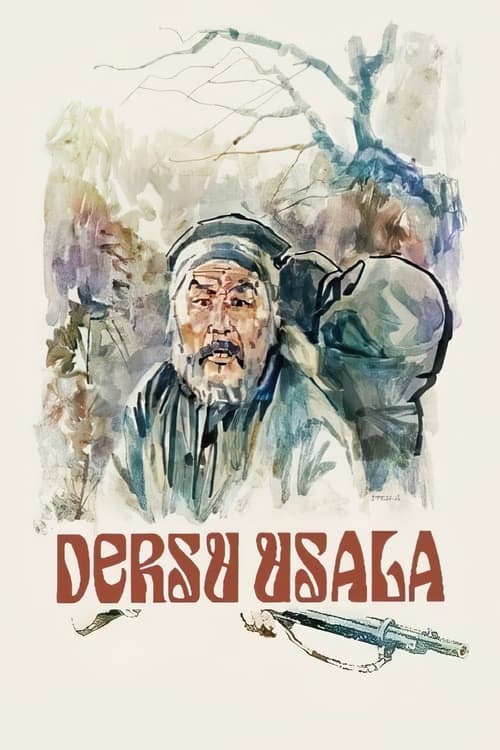
Dersu Uzala
1975 · Akira Kurosawa
When you want to be swallowed by wilderness and come out moved — a film for a long, unhurried evening when you're ready to sit with big landscapes and bigger feelings. More contemplative than thrilling, and richer for it.
What it's about
In the first years of the twentieth century, a Russian military surveyor leads mapping expeditions into the unmapped Siberian taiga, where he meets Dersu Uzala, a solitary Nanai hunter who reads the forest the way other men read books. Dersu becomes the party's guide and the captain's friend — a bond between a man of maps and a man of weather, tested by tigers, blizzards, and the slow advance of the world Dersu doesn't belong to.
The experience
Vast, patient, and quietly devastating — long stretches of wind, ice, and firelight punctuated by moments of real survival terror. It builds one of cinema's great friendships almost wordlessly, and the feeling it leaves is closer to mourning than adventure.
Performances
Maksim Munzuk makes Dersu one of the screen's most fully alive characters — funny, practical, superstitious, and profoundly decent — while Yuri Solomin's watchful warmth as the explorer gives the friendship its aching weight.
The craft
Kurosawa shot on location in the Soviet Far East and in 70mm, and it shows: horizons that swallow the frame, a frozen lake sequence of pure elemental dread, seasons that pass like tides. This is filmmaking that uses scale to make two small human figures matter more, not less. See it as big as you possibly can.
Why it matters
Made at the lowest point of Kurosawa's career and his only film shot outside Japan, it won the Academy Award for Best Foreign Language Film and proved the master had another act left in him.
Snapshot
Dersu Uzala is Akira Kurosawa's Soviet-Japanese epic of wilderness and friendship, adapted from the memoirs of the Russian explorer and surveyor Vladimir Arsenyev. Across two expeditions into the Ussuri taiga of the Russian Far East in the first decade of the twentieth century, a military topographer (Yuri Solomin, as Arsenyev) forms a deep bond with Dersu Uzala (Maksim Munzuk), a solitary Nanai — historically called Goldi — hunter whose animist reading of the forest keeps the mapping party alive. It is Kurosawa's only film made outside Japan and his only feature in a language other than Japanese, shot largely on location and in 70mm. Made at the lowest ebb of his career, it won the Academy Award for Best Foreign Language Film as the Soviet Union's entry and the Golden Prize at the Moscow International Film Festival, and it reopened the door to the international financing that would produce Kagemusha and Ran. Where his samurai films compress human conflict into violent motion, Dersu Uzala slows to the rhythm of weather, distance, and old age, staging the collision between an indigenous cosmology and the surveying instruments of an expanding empire.
Industry & production
The film was produced by the Soviet state studio Mosfilm in collaboration with Japanese partners, arising from an invitation extended to Kurosawa after the commercial failure of Dodesukaden (1970) and the collapse of his independent production venture, the Yonki no Kai ("Club of the Four Knights"). Kurosawa had long been drawn to Arsenyev's writings — he is generally reported to have contemplated the material for decades before circumstances allowed him to film it. The Soviet offer gave him a large studio apparatus, a substantial budget by the standards of his recent work, and access to remote locations that a Japanese production could not have reached.
Production was arduous and protracted. The unit filmed on location in the taiga of the Russian Far East and in Siberia, working through seasonal extremes to capture the region's snow, ice, flooding rivers, and dense forest across the calendar of the story. Shooting stretched across a long period — the sources consistently describe a demanding, multi-season campaign rather than a conventional schedule — and Kurosawa worked through a Russian-speaking crew with the aid of interpreters, directing in a language he did not speak. The screenplay was written by Kurosawa with the Soviet writer Yuri Nagibin. Beyond these broad contours, precise line-item budget figures and box-office returns are not securely documented in the accessible historical record, and I will not invent them; the film's significance was cultural and career-restorative rather than commercial in the manner of a studio blockbuster.
Technology
Dersu Uzala was photographed in 70mm, the large-format process giving Kurosawa the resolution and horizontal breadth to render the taiga as a vast, engulfing space rather than a backdrop. The wide gauge suits a film whose central drama is scale — the smallness of men against forest, sky, and frozen water — and it rewards the long, deep compositions Kurosawa favored. The production relied on natural light and available weather to an unusual degree; much of the film's power comes from real cold, real wind, and real low sun rather than studio simulation, which imposed the logistical burden of waiting on and chasing conditions in the field. This is a film in which the technology of capture (the large negative, location shooting) is inseparable from its subject (the surveyor's technology of measurement — the transit, the compass, the map). Kurosawa foregrounds Arsenyev's instruments as the visible tools of a civilization that catalogs the wild even as Dersu reads it by inherited attention.
Technique
Cinematography
The photography is credited to a team led by Asakazu Nakai — one of Kurosawa's most important collaborators, dating back to films including Ikiru and Seven Samurai — working with the Soviet cinematographers Yuri Gantman and Fyodor Dobronravov. The visual signature is patience: long-held wide shots in which figures cross the frame at a distance, the horizon low or high to emphasize the pressure of land or sky. Kurosawa's characteristic use of the telephoto lens flattens depth in certain passages, pressing men and forest into a single plane, while elsewhere deep staging sets the tiny expedition against receding ranks of trees. The film's most celebrated visual set piece unfolds at dusk on a wind-scoured frozen lake, where Dersu recognizes that the two men will freeze unless they build shelter, and the camera holds on their desperate labor cutting grass as the light dies and the wind rises — a sequence built almost entirely from landscape, weather, and physical action rather than dialogue. Throughout, weather is not atmosphere but event.
Editing
Kurosawa was, across his career, a director deeply involved in the cutting of his own films, and Dersu Uzala bears the marks of his editorial temperament: scenes are allowed to run to their natural length, and the film accepts long stretches of near-silence and slow traversal that a more conventional adventure picture would compress. The overall architecture is unhurried, organized around the seasons and the two expeditions rather than around plot beats. Where the samurai films cut on violent motion, here the rhythm is set by the pace of walking, waiting, and looking. (Precise editing credits and Kurosawa's exact hands-on role in the Mosfilm cutting room are less thoroughly documented than for his Japanese productions, and I flag that rather than assert specifics.)
Mise-en-scène / staging
The staging is governed by the relationship of human figures to environment. Kurosawa repeatedly places the two protagonists as small marks within enormous natural compositions, so that the drama of friendship is legible against, and dwarfed by, the indifferent scale of the taiga. The framing device — Arsenyev returning years later to a disturbed, unmarked grave where the forest is being cleared for construction — bookends the film and converts the whole narrative into an elegy staged in flashback. Interiors, when they come (the surveyor's home, the city to which Dersu is finally brought), are cramped and enclosing precisely to register how the wilderness man cannot breathe within walls. The contrast is spatial before it is verbal.
Sound
The score is by the Soviet composer Isaak Shvarts, deployed with restraint; long passages carry only the ambient sound of wind, water, fire, and footfall, which is central to the film's immersion in place. The soundscape is a character — the roar of the lake wind in the survival sequence, the silence of snow — and Kurosawa lets natural sound dominate where a more conventional epic would underscore. Dialogue is spare, and the film's meaning often resides in what is heard of the forest rather than what is said within it.
Performance
Maksim Munzuk's Dersu is the film's center of gravity: a performance of watchfulness and courtesy, physically expressive in the reading of tracks and weather, tender and stubborn, moving without sentimentality toward the tragedy of a man whose failing eyesight strips him of the very skill that defined him. Yuri Solomin's Arsenyev is the necessary counterweight — the educated, affectionate officer who comes to revere Dersu but can neither fully enter his world nor save him from the civilization the officer serves. The two performances are built around looking and listening rather than declaration, and the film's emotional arc depends on the growth of trust between them being shown in gesture and attention.
Narrative & dramatic mode
The film is structured as a framed remembrance. It opens with Arsenyev's later return to find Dersu's grave already erased by clearing, then moves back to the first expedition, in which the surveyor's party encounters the hunter; forward to the second expedition years later; and finally to Dersu's failing sight, his removal to the city, his inability to live within its rules, his return to the forest, and his death. The dramatic mode is elegiac and episodic rather than tightly plotted — a sequence of encounters with the wilderness (the frozen lake, a flooding river, a tiger, the changing seasons) that cumulatively dramatize Dersu's knowledge and, later, its loss. Tension arises from environment and mortality rather than from human antagonists; the "villain" is time, blindness, and the encroachment of civilization. The result is a bildungsroman in reverse, in which the "civilized" man is the pupil and the forest man the master, and the tragedy lies in the master's obsolescence.
Genre & cycle
Nominally an adventure-drama, Dersu Uzala sits within a small, distinguished tradition of wilderness-survival and ethnographic-encounter films, closer in spirit to a philosophical nature epic than to the action-adventure the label implies. It belongs, too, to the cycle of Kurosawa's "late" work — the reflective, mortality-haunted films that follow the kinetic samurai pictures — and it stands somewhat apart from any national genre because of its hybrid Soviet-Japanese origins. Within Kurosawa's own filmography it is the outlier: no swords, no feudal intrigue, a foreign language, a documentary attentiveness to landscape and indigenous craft.
Authorship & method
This is unmistakably a Kurosawa film — in its humanism, its moral seriousness, its treatment of nature as an active force, and its use of weather and scale as dramatic instruments — yet it was made through a wholly foreign apparatus. Screenplay: Kurosawa with Yuri Nagibin, adapting Arsenyev's memoirs (chiefly the volume centered on Dersu). Cinematography: Asakazu Nakai, Kurosawa's veteran collaborator, with Soviet cinematographers Yuri Gantman and Fyodor Dobronravov. Music: Isaak Shvarts. Lead performances: Maksim Munzuk and Yuri Solomin. Kurosawa's method here adapted his famous meticulousness to conditions he could not fully control: rather than compose the wild, he waited for and captured it, subordinating his perfectionism to weather and season. Directing in Russian through interpreters, he depended on his collaborators to a greater degree than on his home productions, making the film a genuine act of cross-cultural authorship in which his sensibility was realized by a Soviet crew.
Movement / national cinema
Dersu Uzala is a genuine hybrid that resists single-nation classification. Institutionally it is a Soviet film — a Mosfilm production that represented the USSR at the Academy Awards — but authorially it is Japanese, the work of the most internationally celebrated of Japanese directors. It thus stands at the intersection of two national cinemas: the Soviet tradition of the location epic and the literary adaptation, and Kurosawa's own humanist strain within postwar Japanese film. Because it fits neatly into neither a Soviet movement nor a Japanese one, it is best understood as a transnational, auteur-driven co-production of a kind that was still relatively rare in the mid-1970s, and as a bridge between the state-funded model that made it and the international art-cinema financing that would sustain Kurosawa's final major works.
Era / period
The film arrives at a pivotal moment in Kurosawa's life and in world cinema. After Dodesukaden failed commercially and Kurosawa endured a severe personal crisis in the early 1970s — a period widely documented as including a suicide attempt — his prospects in the Japanese industry had narrowed sharply. The Soviet invitation offered rescue, and Dersu Uzala (1975) marks the beginning of his late international phase. It sits at the tail of the era of state-sponsored epics and just before the rise of the prestige international co-production; its Oscar and festival success helped make possible the foreign backing (from figures and studios abroad) that financed Kagemusha (1980) and Ran (1985). Within the sweep of the decade, it is both a recovery and a turning point.
Themes
The film's governing theme is the relationship between humanity and nature, and the incommensurability of two ways of knowing the world. Dersu treats fire, water, and wind as living "people" to be respected and reasoned with; his animism is not superstition but a practical epistemology that repeatedly saves lives, set against Arsenyev's instruments of measurement and the imperial project of mapping the unmapped. From this flows a meditation on the destruction wrought by civilization: the very expansion Arsenyev serves — surveying, settlement, clearing — is what ultimately erases Dersu, both literally (his grave is disturbed by construction) and figuratively (his skills become useless once his eyes fail and he is transplanted to the city). Friendship across an unbridgeable cultural gulf is the film's emotional core, and mortality its final subject: the tragedy of a master rendered obsolete, the dignity and loneliness of old age, and the impossibility of the civilized man saving the wilderness man from the world that made their friendship possible. It is, in the end, an elegy for a way of life and a way of seeing.
Reception, canon & influence
Dersu Uzala was received as a major return to form and a significant international event. It won the Academy Award for Best Foreign Language Film as the Soviet Union's official entry and took the Golden Prize at the Moscow International Film Festival, and it drew serious critical attention as proof that Kurosawa's powers were intact after years of difficulty. Some Western critics, then and since, have found it slower and more contemplative than his celebrated action films, and reactions have accordingly ranged from reverence to a sense of stateliness; but its standing as a considerable late work is secure, and it is routinely counted among the essential films of Kurosawa's career.
Influences on the film (backward): The primary source is Vladimir Arsenyev's own memoirs of his Ussuri expeditions and his relationship with the historical Dersu Uzala, which supply the events, the ethnographic detail, and the elegiac frame. Behind that lies Kurosawa's lifelong humanism and his recurring fascination with nature as a moral and dramatic force, visible across his work from Rashomon onward, here given its fullest environmental expression.
Legacy (forward): The film's most consequential effect was on Kurosawa's own trajectory — its acclaim restored his international viability and helped make possible the foreign-financed epics Kagemusha and Ran, arguably the crowning works of his late period. More broadly, it stands as an enduring touchstone of the wilderness-and-friendship film and of ethnographically attentive cinema, admired by later filmmakers concerned with landscape, indigenous knowledge, and the human place within the natural world. Its influence is felt less through direct stylistic imitation than through its example: proof that a large-scale epic could be built entirely from weather, distance, patience, and the tragedy of a single irreplaceable man.
A Deleuzian reading
Dusk on a frozen lake, and the wind is getting up.
The full Deleuzian reading of Dersu Uzala →
Reception
Dismissed by some Western critics in 1975 as 'minor Kurosawa' — too slow, too simple — it's since been fully rehabilitated: now routinely called his most underrated film and a late-career masterpiece rather than a footnote between Red Beard and Kagemusha.
How Dersu Uzala was received, from release to now →
How to watch Dersu Uzala: what to notice on a first viewing
- Watch how small the two men look against the forest. Kurosawa holds long, patient wide shots in which figures cross the frame at a distance, the horizon pressed low or high to emphasize land or sky. The scale of the shot alone tells you these men are guests in a place that doesn't need them.
- Watch the forest flatten into one plane in certain shots. Kurosawa's telephoto lens presses men and trees together into a single surface, alternating with deep staging that lets the trees recede for miles. The switch between flat and deep space changes how trapped or exposed the wilderness feels from shot to shot.
- Listen for wind, water, and fire instead of a musical score. Long passages carry only ambient sound, with Isaak Shvarts's score used sparingly and dialogue kept spare throughout. Letting the forest's own sound carry a scene puts you inside the same attentiveness Dersu lives by.
- Watch Dersu read the ground and the wind before speaking. Munzuk builds the performance almost entirely out of looking and listening, courteous and physically expressive rather than declarative. His knowledge is shown entirely through attention, not through anything he explains in words.
- Watch the men cut grass on the lake as daylight fails. The camera holds on their labor as the wind rises, building the sequence almost entirely from physical action and weather rather than dialogue. Watching them race the light is more gripping than any line of dialogue could make it.
The whole guide to watching Dersu Uzala, with the keys for a rewatch →
Influences: the films it descends from and the films it influenced
- Nanook of the North (1922) — Establishes the ethnographic method Dersu extends — building a whole drama from a single indigenous hunter performing his own survival techniques against a hostile environment, with the camera in reverent observation rather than fictional control.
- Man of Aran (1934) — Models the staging of human figures as tiny specks against overwhelming sea and rock, with weather itself cast as the true antagonist — the figures-dwarfed-by-landscape grammar Kurosawa deploys on the taiga.
- Earth (1930) — Supplies the Soviet-lyrical template of an unhurried seasonal cycle and animist communion with the land, the agrarian rhythm Dersu inherits in its patient seasonal structure.
- Rashomon (1950) — Kurosawa's own precedent for the framed-flashback structure and for treating nature — forest, wind, camera pointed into the sun through telephoto foliage — as an active dramatic and moral force rather than backdrop.
- Ikiru (1952) — Provides the elegiac architecture organized around one irreplaceable man's mortality and obsolescence, the reverse-bildungsroman logic Dersu rebuilds around its trapper's decline.
- Seven Samurai (1954) — Pioneers the multi-camera telephoto coverage that captures uncontrollable action and weather — the rain-and-mud finale — turning meteorology into dramaturgy, the exact technique used on Dersu's storms and flooding grass.
- Andrei Rublev (1966) — A Soviet precedent Kurosawa admired for its long-take natural-light naturalism and figures dwarfed within landscape treated as spiritual epistemology, filmed through the same apparatus Dersu would later borrow.
- Red Beard (1965) — Revives the Red Beard structure of a wise, self-disciplined elder schooling a callower man in humility and reverence for life, transposed from clinic to Siberian wilderness.
- Kagemusha (1980) — Directly enabled by the international viability Dersu's acclaim restored, and extending its telephoto massed-figures-and-weather epic scale into color widescreen.
- Ran (1985) — The foreign-financed crowning work Dersu made possible, elaborating its natural-light spectacle and figures-dwarfed-by-landscape composition into vast battle tableaux governed by wind, cloud and fire.
- The Emerald Forest (1985) — Carries forward the nature-vs-civilization axis and the treatment of indigenous ecological knowledge as a superior epistemology, staging tribal fluency against Western blindness in the deep landscape.
- The Bear (1988) — Extends the waited-for-nature discipline — patient telephoto capture of real wildlife in genuine wilderness, animals granted the status of watchful characters rather than scenery.
- Dances with Wolves (1990) — Inherits the elegiac long-held wides and telephoto plains, framing indigenous knowledge as a superior reading of the land and ending in the tragedy of an obsolescent world — Dersu's structure transposed to the American frontier.
- The New World (2005) — Advances the natural-light, ambient-sound-dominant, gesture-based watchful performance and animism-as-epistemology, keeping figures small within a landscape treated as the film's real subject.
- Happy People: A Year in the Taiga (2010) — The most literal descendant — Siberian taiga trappers whose year is organized by the seasonal calendar, extending Dersu's ethnographic attention to indigenous survival craft in the same forest.
- Meek's Cutoff (2010) — Carries the unhurried survival-in-landscape mode where a frontier guide's contested ability to read terrain decides life and death, with figures dwarfed and natural ambient sound dominating over score.
- The Revenant (2015) — Consummates Dersu's example of a wilderness-survival epic shot entirely in natural light with wide-and-telephoto framing, subordinating the whole production to weather and season exactly as Kurosawa did on the Ussuri.
- Spring, Summer, Fall, Winter... and Spring (2003) — Narrative organized by the turning of seasons across one landscape, each season a discrete moral chapter — the seasonal-cyclical structuring principle named in Kim's title.
- The Velvet Queen (2021) — Composes wide frames that deliberately dwarf human figures against vast wilderness, the exact staging-of-human-humility-scale by which The Velvet Queen renders its searchers small before the Tibetan plateau.
- Walkabout (1971) — Shares the device of an indigenous guide whose fluent reading of the land exposes the incapacity of 'civilized' outsiders, rendered in telephoto, heat-hazed distance and figures small against emptiness.
- Aguirre, the Wrath of God (1972) — Subordinates staging to an environment the director cannot control — jungle as overwhelming force filmed in real conditions — the same surrender of perfectionism to weather and terrain that defines Dersu's method.
- Jeremiah Johnson (1972) — Wilderness-survival study built on man-dwarfed-by-taiga wide shots, a natural-ambient sound register, and reverence for the woodsman's hard-won craft — the same trust in landscape to carry meaning.
Similar films
- Rashomon (1950) — influence & lineage
- Seven Samurai (1954) — influence & lineage
- Dances with Wolves (1990) — influence & lineage
- Ran (1985) — influence & lineage
- Kagemusha (1980) — influence & lineage
- Ikiru (1952) — influence & lineage
- The Hidden Fortress (1958) — shared sensibility
- Stray Dog (1949) — shared sensibility