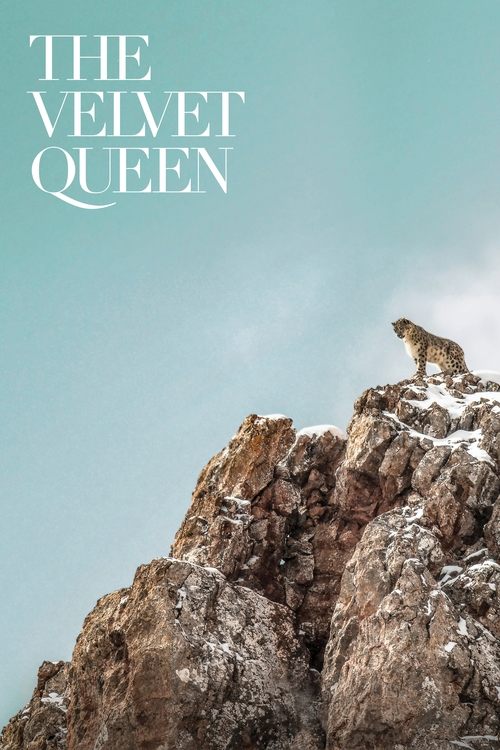
The Velvet Queen
2021 · Marie Amiguet
For when the world feels too loud and you want to be stilled — a contemplative evening, no plot machinery, just wonder. Deeply comforting, with a thread of genuine anticipation running through it.
What it's about
Wildlife photographer Vincent Munier takes writer-adventurer Sylvain Tesson into the high, frozen valleys of the Tibetan plateau in search of the snow leopard, one of the rarest and most elusive cats on earth. Mostly it means waiting: lying in blinds for days in brutal cold while yaks, foxes, falcons, and bears pass through the frame, hoping the mountain will decide to show them its ghost.
The experience
Meditative and hushed — a film about patience that teaches you patience as you watch. The suspense is real but slow-burning, and the landscapes are so vast and strange they induce a kind of awe-quiet; you come out breathing slower.
The craft
Marie Amiguet films the filmers, so you get both Munier's breathtaking wildlife imagery and the human story of two men freezing in a hide, threaded with Tesson's wry, searching commentary — it grew from his prize-winning book about the same expedition. Warren Ellis (with Nick Cave contributing) supplies a haunting score, and the widescreen plateau vistas beg for the biggest screen and best speakers you have.
Why it matters
A surprise arthouse hit that won France's César for best documentary, it helped push nature filmmaking toward the personal essay — less species catalog, more meditation on how we look at the wild.
Snapshot
The Velvet Queen (French: La Panthère des neiges) is a French wildlife documentary that follows the renowned nature photographer Vincent Munier and the writer-adventurer Sylvain Tesson across the high Tibetan plateau in search of the snow leopard, one of the most elusive large cats on earth. Directed by Marie Amiguet — with Munier credited as co-director on most releases, a point worth flagging since the film's authorship is genuinely shared between the filmmaker behind the camera and the photographer whose expedition it documents — the film is less a conventional natural-history program than a contemplative essay on patience, presence, and the ethics of looking. It grew directly out of Tesson's 2019 book of the same title, an account of the same expedition that won France's Prix Renaudot, and it carries a distinctive score by Warren Ellis and Nick Cave. The film premiered in 2021, circulated widely on the festival and arthouse circuit, and won the César Award for Best Documentary Film. Its reputation rests on the marriage of extraordinary telephoto imagery with a first-person, literary voice-over — a combination that pushes the wildlife documentary toward the register of the philosophical travelogue.
Industry & production
The film is a French production rooted in the ecosystem of European nature and adventure documentary, and its origins are unusually specific: it is the filmed record of a real expedition undertaken by Munier, who invited Tesson to accompany him, with Amiguet embedded to shoot. This tripartite arrangement — photographer, writer, filmmaker — defines the production's economy. Rather than a large crew with logistical infrastructure, the shoot was built around a very small team operating in extreme high-altitude conditions on the Tibetan plateau, where cold, thin air, and the need for stillness and concealment dictated everything. The film's release followed, and was closely linked to, the commercial and critical success of Tesson's book, which gave the project a ready-made literary profile and a built-in audience in France.
I should be candid that the granular production record — exact budget figures, precise shooting schedule, and distribution deal terms — is not something I can state with confidence, and I will not invent numbers. What is well established is the film's institutional standing on release: it was positioned as a prestige documentary, screened at major festivals in 2021, and was subsequently recognized by the César Awards (France's national film honors), where it took the prize for Best Documentary. That award, together with an international arthouse rollout under the English title The Velvet Queen, marks it as a commercially and critically significant entry in its category rather than a niche natural-history release.
Technology
Technologically, the film sits at the intersection of stills-photography practice and motion-picture capture. Its defining tools are long telephoto lenses and the discipline of the photographic hide — the concealed, static position from which wildlife is observed and shot over long durations. The imagery depends on modern digital cinema and long-lens systems capable of resolving distant animals in low light and against the muted palette of the plateau, but the film is not showy about its apparatus. There is little reliance on the drone-heavy, aerial-sweep grammar that dominates much contemporary blue-chip wildlife television; the emphasis is instead on ground-level observation, camouflage, and waiting.
Because Munier is fundamentally a stills photographer, the production folds photographic method into cinematographic practice: the same locations, blinds, and patience that yield his still images inform the moving-image capture. Where the record is thin — the specific camera bodies, lens inventory, and any remote or camera-trap rigs used — I will not speculate. The salient technological fact is philosophical as much as mechanical: the film's technique is organized around minimizing the human footprint and maximizing duration of observation, a choice that shapes every image.
Technique
Cinematography
The cinematography, credited to Munier and Amiguet, is the film's most celebrated element. It favors long-lens compositions that isolate animals — Tibetan foxes, wild yaks, antelope, birds of prey, and ultimately the snow leopard itself — within vast, austere landscapes. The palette is dominated by the ochres, slates, and bone-whites of the plateau, and the film repeatedly plays on camouflage: creatures emerging from, or dissolving back into, rock and snow. This is a visual argument about seeing, in which the audience is trained, alongside Tesson, to detect life that is initially invisible. The camera holds still and lets the frame do the work, so that the reveal of an animal reads as a reward for attention. The imagery has a painterly, almost still-photographic quality — unsurprising given Munier's background — with a preference for stillness over movement and for the decisive, held composition over the roving shot.
Editing
The editing serves the film's contemplative rhythm rather than working against it. Cutting is patient, giving shots room to breathe and allowing the passage of time and weather to register. The structure alternates between the men's search and the animals they encounter, and between exterior observation and interior reflection carried by voice-over. The result is a rhythm of waiting punctuated by revelation, which mirrors the experience of the hide. I can describe this shape with confidence from the film's construction; specific editorial credits and the fine detail of the cutting process are less securely documented, and I will not overstate them.
Mise-en-scène / staging
"Mise-en-scène" is a slightly awkward category for a documentary built on non-intervention, and that tension is itself instructive. The film does not stage its animals; its "staging" is the choice of position — where to place the hide, how to frame the emptiness so that the eventual arrival of a creature carries weight. What is composed is the relationship between the two human figures and the immensity around them: Munier and Tesson are frequently small within the frame, dwarfed by the plateau, which stages the film's central theme of human humility before the wild. The human presence is deliberately quiet and low, a compositional ethic of not disturbing.
Sound
Sound is central to the film's effect. The high plateau's sonic environment — wind, silence, the sparse calls of animals — is used as an expressive field rather than mere ambience, and the film's stillness makes every sound consequential. Layered over this is the original score by Warren Ellis and Nick Cave, whose spare, resonant textures give the images an elegiac, almost spiritual charge. The music is a defining collaborator here, not decoration: it lends the wildlife imagery an emotional register that pushes the film away from naturalist reportage toward meditation. Tesson's voice-over is the third sonic layer, and the interplay of wind, score, and narration constitutes much of the film's texture.
Performance
Performance in the conventional sense does not apply, but the film does depend on the presence of its two human subjects. Tesson functions as narrator and as an on-screen sensibility — restless, verbal, drawn to the metaphysics of the quest — while Munier embodies patience and expertise, the man who knows how to wait and where to look. Their temperamental contrast (the impatient writer, the disciplined photographer) supplies the film's human drama. This is "performance" only in the documentary sense of self-presentation, but the pairing is deliberate and productive.
Narrative & dramatic mode
The film's dramatic mode is the quest, framed as an essayistic meditation. Its ostensible narrative engine is simple and suspenseful: will they see the snow leopard? But the film continually subordinates that outcome to reflection, so that the search becomes an occasion for thinking about time, attention, extinction, and the human relationship to the non-human world. The through-line is carried by Tesson's first-person voice-over, which gives the film the shape of a literary travelogue — closer to the essay-film tradition than to the plotted natural-history special. Tension is generated by waiting and withholding rather than by event; the dramatic payoff, when the leopard appears, is treated as a near-mystical culmination rather than a mere sighting. This structure — quest as pretext for contemplation — is the film's defining formal choice.
Genre & cycle
Generically the film is a wildlife documentary, but it belongs to a more specific and prestigious cycle: the auteur nature film that treats the natural world through a personal, literary, or philosophical lens rather than as pedagogical spectacle. It stands apart from the blue-chip television tradition of large-scale, narrated natural-history series. Its closest generic kin are contemplative, essayistic nonfiction works that foreground the filmmaker's or subject's subjectivity. It also intersects the adventure-expedition genre, given the physical journey to a remote and hostile environment. The fusion of these strands — wildlife film, essay film, and expedition narrative — is what gives the film its distinctive place.
Authorship & method
The authorship is genuinely collaborative and is best understood through its key figures. Marie Amiguet, the credited director, is a French filmmaker who works within the wildlife and nature documentary field; her method here is one of embedding and self-effacement, shaping a film out of a real expedition rather than imposing a script upon it. Vincent Munier, co-director and co-cinematographer, is the project's originating consciousness — a celebrated wildlife photographer whose aesthetic of patience, concealment, and painterly stillness is effectively the film's visual philosophy. Sylvain Tesson, the writer whose book preceded and underwrites the film, supplies the voice-over and the reflective, literary intelligence; his authorship is textual and vocal rather than visual. The score by Warren Ellis and Nick Cave constitutes a fourth authorial layer, decisively coloring the film's emotional world. This distribution of authorship — visual (Munier/Amiguet), verbal (Tesson), musical (Ellis/Cave) — is the film's method: a layering of distinct sensibilities over shared material. Precise divisions of directorial labor between Amiguet and Munier are not something I can specify beyond the shared credit, and I will not invent that detail.
Movement / national cinema
The film is firmly a work of French cinema, and it draws on France's strong tradition of nature and adventure nonfiction as well as its essay-film heritage. It is not the product of a formal movement, but it participates in a contemporary current of contemplative, authored nature documentary in European filmmaking — work that treats landscape and animal life with an art-cinema sensibility. Its literary pedigree, via Tesson's award-winning book, ties it to a distinctly French intellectual culture in which the travel-and-nature essay is a respected literary form, and the film can be read as a cinematic extension of that tradition.
Era / period
As a film of the early 2020s, The Velvet Queen is legible within a period marked by acute environmental consciousness and a cultural appetite for slowness, presence, and connection to the non-human world. Its emphasis on patience and attention reads, in context, as a quiet counter-statement to an accelerated, screen-saturated culture. It also arrives within a broader contemporary flourishing of theatrical documentary that aspires to art-cinema status. Without over-reading the moment, it is fair to situate the film's themes of endangered fauna and human humility within the era's ecological anxieties.
Themes
The film's central themes cluster around attention and patience — the discipline of waiting and of learning to see what is hidden. Closely bound to this is humility before the wild: the repeated framing of small human figures within immense landscapes stages a decentering of the human. Presence and the metaphysics of encounter run throughout, especially in the treatment of the snow leopard as an almost sacred, barely glimpsed presence — the "velvet queen" of the title. There is a strong elegiac and ecological undercurrent concerning the fragility and disappearance of wild fauna. Finally, the film reflects on the relationship between seeing, knowing, and reverence — the idea that to observe the natural world properly is a spiritual as well as a technical act. These themes are carried as much by the score and the silences as by Tesson's words.
Reception, canon & influence
Critical reception was strongly favorable, with particular praise for the cinematography, the Ellis–Cave score, and the film's contemplative ambition; it was widely regarded as a standout in contemporary nature documentary and was honored with the César Award for Best Documentary Film, a significant marker of canonical standing within French cinema. I will not attribute specific review quotations or cite box-office figures I cannot verify, but the consensus of esteem and the César recognition are well established.
Looking backward, the film's influences are legible in several directions: Munier's own long-standing photographic practice and aesthetic; Tesson's literary source and the French nature-essay tradition; the broader lineage of contemplative and essayistic nonfiction that privileges reflection over exposition; and the elegiac musical sensibility that Ellis and Cave brought from their film-scoring partnership. Looking forward, the film's legacy is best understood as consolidating and elevating the model of the auteur wildlife film — demonstrating that patient, art-cinema treatment of the natural world can achieve both critical prestige and theatrical reach. Its most durable contribution may be to have shown that a wildlife documentary can succeed as a philosophical essay, foregrounding attention and reverence rather than spectacle, and thereby offering a template for a more contemplative strand of nature filmmaking. Precise claims about specific later films it directly inspired would be speculative, and I flag that the forward-influence record for so recent a film is necessarily still forming.
Reception
It arrived quietly — a Cannes 2021 premiere in the climate sidebar, then a César for Best Documentary — and has since settled into steady, word-of-mouth affection rather than any dramatic reappraisal: the nature doc people keep pressing on friends who 'don't watch nature docs.'
How The Velvet Queen was received, from release to now →
How to watch The Velvet Queen: what to notice on a first viewing
- Watch the frame hold still and let something take shape. The camera often holds a static shot of rock and snow with nothing visible, using stillness to let a camouflaged animal slowly emerge or dissolve back in. Seeing the animal becomes something you have earned through your own attention, not something handed to you.
- Notice the palette of ochre, slate, and bone-white. The plateau's colors are muted and consistent across the whole film, so animals and men alike blend into the same narrow range of tones. The landscape's color scheme is what makes an animal so hard to find, and so satisfying to spot.
- Watch the two men look tiny against the plateau. Munier and Tesson are repeatedly framed small within the frame, dwarfed by rock and sky, their presence kept quiet and low. Their smallness in the frame is the film's whole argument for humility before the wild.
- Listen to the wind and silence as much as the score. The plateau's own sound, wind, sparse calls, near silence, is treated as its own expressive layer, so every noise that breaks it becomes significant. The stillness of the soundtrack trains your ear the same way the stillness of the shot trains your eye.
- Notice how long each shot is given to simply sit. The cutting is patient throughout, letting shots run long enough for weather and time of day to visibly change within them. The pace of the edit is asking you to practice the same waiting the two men are doing.
The whole guide to watching The Velvet Queen, with the keys for a rewatch →
Influences: the films it descends from and the films it influenced
- Nanook of the North (1922) — Establishes the expedition-documentary method of embedding with a subject over long duration and building the film's dramatic arc from a real hunt/quest rather than a script — the same 'shape a film out of an expedition' method Amiguet uses.
- Le Monde du silence (1956) — Founds the French auteur-expedition nature film that fuses adventure-quest structure with patient immersive access to hidden animals, prizing revelation of the concealed creature over voiced explanation.
- Dersu Uzala (1975) — Composes wide frames that deliberately dwarf human figures against vast wilderness, the exact staging-of-human-humility-scale by which The Velvet Queen renders its searchers small before the Tibetan plateau.
- Sans Soleil (1983) — Canonizes the French essay-film device of a reflective, literary first-person voiceover laid over travel/observation footage — the Tesson narration's direct formal template of quest-as-contemplation.
- Microcosmos (1996) — French nature doc built almost wordlessly on patient long/macro-lens observation and painterly held frames, letting score and silence rather than commentary carry the contemplative register.
- The Thin Red Line (1998) — Models the painterly-stillness insert of natural-light flora/fauna cut against murmured philosophical voiceover, treating landscape footage as a contemplative essay rather than backdrop.
- Winged Migration (2001) — Consolidates the French art-cinema wildlife film that achieves extreme intimate proximity to animals with minimal narration and score-driven emotion, the prestige-auteur-wildlife model The Velvet Queen inherits.
- The Proposition (2005) — First fully realizes the Warren Ellis–Nick Cave scoring method — sparse drones, keening violin, and loops that score harsh landscape as mournful reverie — the sonic sensibility carried directly into this film.
- Grizzly Man (2005) — Imposes a first-person philosophical voiceover essay over raw wildlife footage, meditating on the human compulsion to enter and 'read' wild nature — the essayistic humility Tesson's narration reprises.
- March of the Penguins (2005) — Proves the French auteur-wildlife expedition can reach theatrical scale and top awards (Oscar/César prestige), establishing the canonical-prestige pathway The Velvet Queen's César win extends.
- The Assassination of Jesse James by the Coward Robert Ford (2007) — Pairs Ellis–Cave's elegiac minimalism with slow, painterly widescreen landscape and contemplative pacing — the precise marriage of score to held natural imagery that defines The Velvet Queen's emotional world.
- Gunda (2020) — Pushes the contemplative-pacing animal film to its limit — no narration, natural silence as field, painterly monochrome long takes — the slow-cinema wildlife strand The Velvet Queen helped legitimize for theatrical release.
- Fire of Love (2022) — Layers a literary, reflective voiceover over natural spectacle to build an elegiac essay-documentary of attention and mortality, adopting the same distribution of authorship (image / narration / mournful score) as The Velvet Queen.
- All That Breathes (2022) — Sustains painterly-still, patient observation of animals amid a broader ecological elegy, foregrounding attention and reverence over spectacle in the contemplative art-doc register The Velvet Queen consolidated.
- Nostalgia for the Light (2010) — Sustains the contemplative essay-documentary on cosmic/ecological humility, using long meditative takes and literary narration to frame human smallness against a vast indifferent nature.
- Aquarela (2018) — Advances the wordless slow-cinema nature film in which natural sound/silence functions as an immersive field and the elemental image itself, not commentary, sustains the contemplative arc.
- Honeyland (2019) — Extends observational auteur nature-documentary through patient long-lens embedding with a solitary figure in a remote landscape, letting an ecological elegy emerge without expository narration.
Similar films
- Microcosmos (1996) — influence & lineage
- Nanook of the North (1922) — influence & lineage
- Grizzly Man (2005) — influence & lineage
- The Summit of the Gods (2021) — shared sensibility
- The Assassin (2015) — shared sensibility
- The Ice Tower (2025) — shared sensibility
- Kaili Blues (2016) — shared sensibility
- Why Has Bodhi-Dharma Left for the East? (1989) — shared sensibility