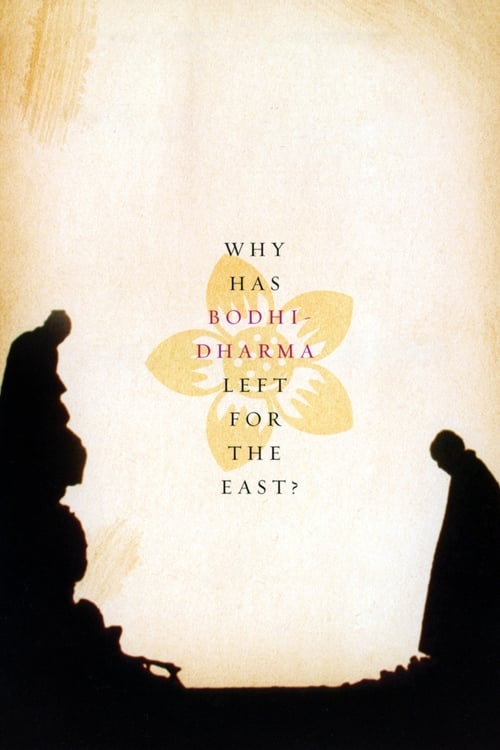
Why Has Bodhi-Dharma Left for the East?
1989 · Bae Yong-kyun
For when you want stillness — a film to quiet your mind rather than fill it, best when you can give it total attention and no phone. This is the challenging end of contemplative cinema, and a genuine reset if you meet it halfway.
What it's about
In a hermitage high in the Korean mountains, three lives share one season: an aged Zen master approaching death, a young monk who abandoned his city life and family obligations to seek enlightenment, and an orphaned boy the temple has taken in. Almost nothing happens in the conventional sense — the drama lives in small elemental incidents, a wounded bird, an ox, firewood, water — as each of the three confronts attachment, guilt, and mortality.
The experience
Slow, silent, and rigorously beautiful — a film that asks you to breathe at its pace and rewards you with images that feel carved rather than shot. It's demanding, then quietly overwhelming; less watched than sat with, like meditation.
The craft
Bae Yong-kyun made the film almost single-handedly over years — directing, shooting, and editing it himself — and every frame shows that obsessive care: mountain light, fire, water, and mist composed with a painter's patience. It rewards the biggest, darkest screen you can find and total silence around it.
Why it matters
A landmark of Buddhist cinema and one of the first Korean films to win major international recognition, it proved a rigorous art film could emerge from outside any industry system. It remains the touchstone for spiritually minded slow cinema from Korea.
Snapshot
Why Has Bodhi-Dharma Left for the East? (Korean: Dharmaga Dongjjogeuro Gan Kkadalgeun?) is a contemplative feature about three inhabitants of a remote mountain hermitage: Hyegok, an aged and dying Zen master; Kibong, a young monk who has abandoned urban life — and a dependent family — to seek enlightenment; and Haejin, an orphaned boy taken in by the temple. Almost nothing "happens" in the conventional sense. Over the course of a season the master approaches death, the young monk wrestles with the attachments he cannot sever, and the child confronts guilt and mortality through small, elemental incidents. The film is best known for two facts that are inseparable: it is among the most rigorously beautiful works of Buddhist cinema ever made, and it was created almost single-handedly by Bae Yong-kyun, a painter and university professor with no filmmaking background, over a period of years. Its title inverts a canonical Zen koan — "Why did Bodhidharma come from the West?" — signaling from the outset a film organized less as a story than as a question posed to the viewer's own perception. It won the Golden Leopard at the Locarno International Film Festival in 1989, the first major Western festival prize for a Korean film, and remains a touchstone of slow, meditative world cinema.
Industry & production
The production circumstances are the film's most extraordinary attribute and the ones most often recited in the literature — with good reason, because they are genuinely singular. Bae Yong-kyun was a professor of fine arts (painting) at Dongguk University in Seoul, a Buddhist-founded institution, when he undertook the project. He was not part of the Korean film industry, held no studio backing, and worked outside the commercial and quota-driven apparatus that governed Korean cinema in the 1980s. By the widely repeated account, he spent several years — figures on the order of seven to ten are commonly cited, though the exact timeline is not precisely documented — writing, shooting, and assembling the film largely by himself, financing it with his own resources and working with a tiny non-professional cast and crew.
This is worth situating. The late 1980s were a period of ferment in South Korean cinema: the loosening of authoritarian censorship after 1987, the emergence of the so-called Korean New Wave around directors such as Park Kwang-su and Jang Sun-woo, and a turn toward socially engaged realism. Bae's film stands almost entirely apart from that current. Where the New Wave was political, urban, and collective in spirit, Bodhi-Dharma was spiritual, rural, and radically solitary in its making — closer to the tradition of the artisanal auteur than to any industrial mode. Its international breakthrough at Locarno preceded and in some ways prefigured the later global attention to Korean cinema, but it did so as an outlier rather than a representative. Precise budget, financing, and release figures are not reliably part of the public record, and I will not invent them; what is securely established is that the film's economy was that of a self-funded artist's project rather than a studio production, and that its festival success gave it an arthouse afterlife in Europe and North America in the early 1990s.
Technology
The film was shot on 35mm celluloid using conventional photochemical technology of its era; there is nothing technologically novel about the apparatus. What is notable is the ascetic relationship Bae maintained with his tools. Working as his own cameraman with minimal equipment, he relied heavily on available and natural light, on long exposures of landscape and weather, and on a patient, largely tripod-bound stillness that the technology of the day rewarded. The absence of a large lighting package or elaborate rigging is not a limitation the film apologizes for but a discipline it converts into an aesthetic. Because production stretched across a long span and through changing seasons, the "technology" that matters most is really time and weather — the cinematic recording of light falling on stone, water, and skin across many days — rather than any device. Any claim to specific cameras, stocks, or laboratory processes beyond standard 35mm practice would be speculation, and the detailed technical record is thin.
Technique
Cinematography
The cinematography — Bae's own — is the film's signature and the clearest expression of his training as a painter. Compositions are built like ink-wash or oil canvases: deep, patient frames in which a small human figure is subordinated to mountain, mist, water, and rock. The camera favors stillness and long duration, letting an image ripen until the viewer's attention shifts from narrative anticipation to pure looking. Light is treated as subject rather than illumination — dawn haze, the glint on a stream, firelight on an aging face. There is a strong sense of the frame as a bounded field of contemplation, with negative space and horizon lines composed for balance rather than for dramatic emphasis. Color is muted and seasonal. This is landscape cinema in the most literal sense, and it aligns the film with a lineage of painterly, meditative image-making rather than with the coverage-driven grammar of narrative filmmaking.
Editing
Bae also edited, and the cutting is governed by duration and rhythm rather than by continuity or momentum. Shots are held far beyond the point at which a conventional edit would move on; transitions tend to breathe rather than to propel. The film's temporality is cyclical and elliptical — governed by the rhythms of nature, ritual, and the master's decline — so that the editing produces a sense of suspended, seasonal time rather than causal progression. Passages of pure landscape and near-abstract imagery are interleaved with the sparse human scenes, and the film trusts the viewer to hold meaning across these gaps. The result is closer to musical or meditative structure than to dramatic construction.
Mise-en-scène / staging
The staging is austere and elemental. The hermitage, the surrounding forest and mountains, a stream, an ox, a fire, a corpse — the film's world is reduced to a small vocabulary of objects and settings, each charged with symbolic and sensory weight. Human figures are placed within nature at a scale that constantly reminds the viewer of their smallness. Everyday monastic labor — drawing water, tending fire, preparing food, caring for the dying — is staged with documentary attentiveness and ritual gravity. The mise-en-scène draws directly on Zen aesthetics of emptiness, simplicity, and the significance of ordinary acts, so that a boy fetching water or an old man breathing carries the full dramatic freight the film allows.
Sound
The soundtrack is dominated by the natural world: wind, water, birdsong, fire, footsteps, the noises of animals and weather. Dialogue is sparse, often gnomic, and frequently gives way to silence, which the film uses as an active element rather than an absence. Buddhist chanting and the sounds of ritual appear, and there is spare use of music, but the film's default register is ambient and environmental — a sound design that reinforces stillness and presence. I am not able to confirm a specific composer or scoring credit with certainty, so I will not attribute the music; what is clear is that the aural design privileges silence and natural sound over conventional score.
Performance
The cast were non-professionals, and the performances are correspondingly restrained, physical, and unforced. The old master is played with a weathered stillness; the young monk's turmoil is conveyed through posture, labor, and gaze more than through speech; the child's presence is direct and unactorly. Bae directs bodies and faces as elements of composition, and the acting style suppresses psychological demonstration in favor of quiet being. This non-professional, anti-theatrical approach is consonant with the film's Buddhist ethos and with a broader tradition of contemplative cinema that treats the human face as landscape.
Narrative & dramatic mode
The film's dramatic mode is contemplative and parabolic rather than plot-driven. Its through-lines are three intertwined confrontations with attachment and impermanence: the master facing his own death, the young monk unable to release his guilt over the family — including, in the film's account, a blind, aged mother and a sister — he left behind in the city, and the orphan boy encountering death and remorse when he kills a small bird. These strands are not resolved through incident so much as deepened through repetition and image. Meaning is delivered obliquely, through koan-like exchanges, recurring symbols, and long stretches of wordless observation, so that the "drama" is finally internal and spiritual — a movement toward acceptance and release — asked of the characters and, pointedly, of the viewer. The title's inverted koan frames the entire film as an unanswerable question the audience is invited to sit with rather than to solve.
Genre & cycle
Nominally a drama, the film belongs more precisely to the small international category of Buddhist or Zen cinema and to the broader current of slow, contemplative art film. It has natural affinities with the spiritual cinema of directors concerned with transcendence and stillness, and it anticipates a later, globally recognized strand of "slow cinema." Within Korean cinema it does not sit comfortably in any commercial cycle; it is closer to a sui generis art-film event than to a genre production. Its clearest generic kin are other meditative religious films that use landscape, ritual, and duration to approach the ineffable.
Authorship & method
The authorship question is unusually simple and unusually total: Bae Yong-kyun is the film in a way few directors ever are of theirs. He wrote, directed, photographed, edited, and designed it, and financed and produced it himself, over a protracted period. This near-complete authorship is the film's defining fact and the reason it reads as a unified aesthetic object — a painter's sensibility extended into time and sound. There is, by design, no roster of the usual key collaborators to profile: no separate director of photography, no credited editor apart from Bae, no writer other than Bae. Where the record is thin — the identity of a music credit, the full crew — it is genuinely thin, and I will not manufacture names to fill it. What can be said with confidence is that his method was that of a fine artist working outside the industry, treating cinema as an extension of painting and Buddhist practice, and that the film's coherence flows directly from that single-authored, artisanal process. Bae made very few films afterward and is understood to have largely returned to painting and teaching; his filmography is exceptionally small, which only sharpens the sense of this work as a singular vocation rather than a career.
Movement / national cinema
The film is Korean, but it is an oblique member of its national cinema. It arrived during the Korean New Wave of the late 1980s yet shares little with that movement's realist, politically engaged program. Its lineage runs instead through Korea's Buddhist cultural heritage and through international contemplative and painterly cinema. In retrospect it functions as an early emissary of Korean film to the world stage — its Locarno victory a landmark preceding the broad international recognition Korean cinema would achieve in later decades — but it did so from outside any organized movement, as the isolated achievement of an artist-professor rather than a studio, collective, or school.
Era / period
It is a product of the very late 1980s, a hinge moment for South Korea: the transition from military authoritarianism toward democratization after 1987, and a corresponding opening of cultural and cinematic space. Yet the film is conspicuously outside its historical moment in subject and tone, turning away from the political and urban preoccupations of its period toward the timeless, seasonal world of the mountain hermitage. That deliberate withdrawal is itself a period gesture — a spiritual counter-statement made available precisely because the cultural loosening of the era created room for such personal, non-commercial work to be made and, crucially, to be seen abroad.
Themes
The central themes are impermanence, attachment, and enlightenment as understood through Zen Buddhism. Death is the film's gravitational center — the master's approaching end, the boy's encounter with the death he causes, the pull of dying obligations left behind in the city. Against death the film sets the discipline of release: the letting-go of desire, guilt, and worldly bond that Buddhist practice demands, dramatized through three characters at three stages of life. Nature is not backdrop but doctrine, embodying cycles of birth, decay, and renewal that mirror the human passage. Recurring symbols — water, fire, the ox (evoking the Zen ox-herding parables of the search for the self), the killed bird, the corpse — carry the film's meditation on life and death. Above all the film is about perception itself: the title's koan insists that the deepest questions have no discursive answer, and that the film's true subject is the quality of attention it asks its viewer to cultivate.
Reception, canon & influence
Critically, the film's decisive event was its Golden Leopard at Locarno in 1989, which brought it international visibility and framed it as a major discovery — a self-made masterwork of spiritual cinema. It circulated through festivals and arthouse venues in Europe and North America in the following years and was widely praised for the extraordinary beauty of its images and the purity of its conception, with the story of its lone-artist creation becoming inseparable from its reputation. It is now regarded as a canonical work of Korean art cinema and of Buddhist film more generally, and is frequently cited in discussions of contemplative or "slow" cinema.
Its backward-facing influences are the traditions Bae carried into the project: East Asian ink-wash and landscape painting, Zen Buddhist thought and aesthetics — including the koan tradition and the ox-herding imagery — and the broader lineage of transcendental, spiritually oriented filmmaking that treats stillness and duration as vehicles for the sacred. Its forward-facing legacy is subtler and harder to trace with precision, and honesty requires acknowledging that direct lines of influence are not heavily documented; but the film stands as an important early instance of the contemplative-cinema mode that later gained wide international currency, and as a demonstration — often invoked — that a single artist working outside the industry could produce world-class cinema. Within the story of Korean film it holds a place of honor as one of the works that first announced, at the highest level of international recognition, that Korean cinema was a force to be reckoned with.
Reception
It stunned everyone in 1989 by winning Locarno's Golden Leopard — a landmark first for Korean cinema on the international festival stage — then drifted into hard-to-see obscurity for years; it's since been reclaimed as the founding classic of Korean art cinema and a slow-cinema essential.
How Why Has Bodhi-Dharma Left for the East? was received, from release to now →
Influences: the films it descends from and the films it influenced
- Diary of a Country Priest (1951) — Establishes the transcendental use of a non-professional 'model' emptied of conventional performance so that spiritual interiority registers through gesture and stillness rather than expression — the same drained, undemonstrative acting Bae draws from his untrained monks.
- Late Spring (1949) — Codifies the 'pillow shot' — cutaways to static, unpeopled landscape and objects held past narrative need — as a way of building contemplative rhythm and Buddhist mu (emptiness), a device Bae extends into full elliptical passages.
- Ordet (1955) — Anchors Schrader's 'transcendental style': austere framing and withheld duration that accumulate toward an eruption of the sacred, the structural template for Bodhi-Dharma's stillness-as-vehicle-for-the-holy.
- Ugetsu (1953) — Models the long-take, scroll-like lateral composition of mist, water and mountain drawn straight from East Asian ink-wash painting — the painterly-landscape grammar Bae, himself a painter, inherits directly.
- Stalker (1979) — Demonstrates 'sculpting in time' — durational long takes threading figures through natural landscape as spiritual passage, treating the pace of nature itself as the film's metaphysical medium.
- Pather Panchali (1955) — Pioneers location shooting with an entirely non-professional cast under available natural light and ambient natural sound, proving a self-taught outsider could achieve world-class lyricism — the exact production model Bae adopts.
- L'Avventura (1960) — Introduces temps mort — 'dead time' that lingers after the dramatic event has passed, letting landscape absorb the characters — the dedramatized duration that lets Bae hold on rock, water and light.
- Spring, Summer, Fall, Winter... and Spring (2003) — The most direct heir within Korean Buddhist cinema: a lakeside hermitage across cyclical seasons staging a moral parable of attachment and release, translating Bae's ox-herding koan structure into a later Korean idiom.
- Uncle Boonmee Who Can Recall His Past Lives (2010) — Renders Buddhist reincarnation and impermanence through immersive ambient jungle sound and static durational takes, extending Bae's use of natural soundscape as the register in which the sacred becomes audible.
- Silent Light (2007) — Opens and closes on real-time magic-hour skies shot with available light and a non-professional cast, reviving Dreyer's transcendental miracle — a parallel painter's-eye pursuit of the sacred through natural illumination that Bae prefigures.
- Jauja (2014) — Uses static, painterly boxed frames of figures dwarfed by wilderness and a parabolic, near-mystical narrative drift, carrying forward Bae's koan-like refusal of clear causation within contemplative landscape.
- The Way Home (2002) — Korean precedent for near-wordless drama built from natural light, non-professional faces, and the domestic landscape treated as a patient spiritual motif.
- Goodbye, Dragon Inn (2003) — Pushes the fixed-frame long take and near-total absence of dialogue to a limit, using empty architectural duration as contemplative space — the same wager Bae makes that a held, silent image can carry a film.
- Sátántangó (1994) — Builds a metaphysics out of extended, choreographed long takes and elliptical repetition, sharing Bae's conviction that duration itself — not incident — is the film's true subject.
- The Tree of Life (2011) — Composes painterly landscape in restless available natural light (Lubezki) woven with whispered, non-narrative voiceover, chasing the same fusion of pictorial beauty and cosmic-spiritual contemplation as Bae's images.
- Once Upon a Time in Anatolia (2011) — Frames vast painterly landscape under natural and lamplight while telling its story through elliptical, dedramatized duration, extending Bae's marriage of fine-art composition to slow-cinema temporality.
- Honey (2010) — Immerses a near-wordless forest childhood in ambient natural sound and available light with minimal cutting, sharing Bae's method of letting the sensory texture of nature replace dialogue and score.
Similar films
- Spring, Summer, Fall, Winter... and Spring (2003) — influence & lineage
- Pather Panchali (1955) — influence & lineage
- Uncle Boonmee Who Can Recall His Past Lives (2010) — influence & lineage
- Satantango (1994) — influence & lineage
- Kaili Blues (2016) — shared sensibility
- Little Forest (2018) — shared sensibility
- The Burmese Harp (1956) — shared sensibility
- Burning (2018) — shared sensibility
All the films related to Why Has Bodhi-Dharma Left for the East? →