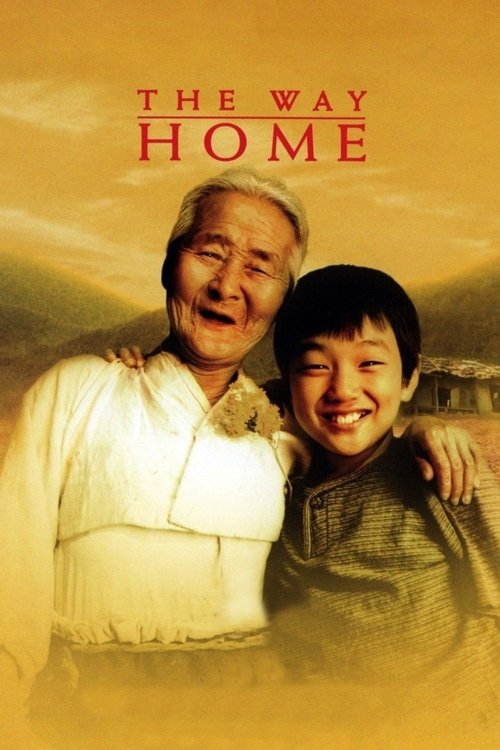
The Way Home
2002 · Lee Jeong-hyang
When you need a good cry of the cleansing kind, or you're missing a grandparent. A slow, tender comfort watch — bring tissues and call your family after.
What it's about
A bratty seven-year-old from Seoul — armed with a handheld game, roller blades, and a taste for fried chicken — is dropped off by his broke single mother at his grandmother's house in a remote mountain village for the summer. The grandmother is elderly, illiterate, and mute; she cannot argue with him, explain herself, or scold him. The film simply watches these two share a house across an enormous gap of language, generation, and habit, and lets a bond form in tiny increments.
The experience
Quiet, patient, and devastatingly gentle — the boy's cruelty stings, the grandmother's silent persistence works on you slowly, and by the end the smallest gestures carry enormous weight. It earns its tears honestly, without a drop of manipulation.
Performances
Kim Eul-boon, a woman in her seventies who had never acted — or even seen a film — before, plays the grandmother, and her stooped, wordless patience is the whole movie; young Yoo Seung-ho makes the boy's selfishness real enough that his thaw actually means something.
The craft
Lee Jeong-hyang directs with radical restraint: no score cues telling you what to feel, no dialogue crutch, just faces, weather, and the rhythms of rural labor observed at a child's eye level. The mountain village is shot plainly and beautifully, so the city-country divide is something you see and hear rather than something anyone explains.
Why it matters
A surprise box-office phenomenon in South Korea that outdrew blockbusters on word of mouth, and a landmark for quiet, humanist filmmaking — and for women directors — in Korean cinema's boom years.
Snapshot
The Way Home (Korean: 집으로…, Jibeuro…, literally "To the house…") is a South Korean family drama written and directed by Lee Jeong-hyang, her second feature after the romantic comedy Art Museum by the Zoo (1998). Its premise is disarmingly small: a spoiled seven-year-old boy from Seoul, Sang-woo, is deposited by his struggling single mother with his elderly, mute grandmother in a remote mountain village, and over a single summer the two find their way toward each other across a chasm of language, generation, and habit. The film's power lies almost entirely in the friction and eventual tenderness between these two figures — a child steeped in the disposable culture of the city (electronic games, Kentucky Fried Chicken, roller blades, battery-powered toys) and an illiterate old woman who cannot speak and lives without electricity or money. Made on a modest budget and cast around a non-professional lead in her late seventies, the film became one of the most beloved Korean releases of its year and a durable touchstone of the country's humanist cinema, dedicated by Lee to grandmothers everywhere.
Industry & production
The Way Home arrived at the height of the so-called Korean cinema renaissance of the late 1990s and early 2000s, a period when domestic films — buoyed by the screen-quota system, aggressive new financing, and the cultural liberalization of the Kim Dae-jung administration — were reclaiming their home market from Hollywood. In that landscape, the film was a deliberate counter-programming gesture: an intimate, low-budget drama with no stars, no genre hook, and a mute protagonist, released in a market increasingly defined by blockbusters like Shiri (1999) and Joint Security Area (2000).
Its commercial success was therefore genuinely surprising. It is widely reported to have been among the top-grossing Korean films of 2002, drawing on the order of four million admissions nationwide — an extraordinary figure for a film of its scale and subject. (Precise, verifiable admission totals for Korean films of this era vary between sources, so the exact number should be treated with caution.) The picture was distributed internationally to arthouse audiences and released theatrically in the United States by Paramount Classics, one of the relatively few Korean family dramas of the period to secure such a berth.
The production's defining decision was casting. The grandmother is played by Kim Eul-boon, a genuine rural resident with no acting experience, reportedly discovered in or near the shooting locale and, by widely repeated accounts, largely unfamiliar with cinema itself. The boy, Sang-woo, is played by Yoo Seung-ho in his screen debut; the film launched what became a substantial acting career. Shooting took place on location in a real mountain village, and the specific documentary texture of the place — the packed-earth house, the terraced fields, the long path over the hills that gives the film its title — is inseparable from the production's naturalist strategy. Where the record on individual below-the-line crew and financing partners is thin or inconsistently sourced, this dossier declines to guess.
Technology
Technologically the film is unremarkable by design, and that plainness is the point. It was made in the standard manner of a 2002 Korean theatrical feature — shot on 35mm film with conventional lenses and largely available or minimally augmented light — with none of the digital effects, elaborate rigs, or spectacle-oriented apparatus then being pioneered in Korean action and thriller production. There is no evident use of CGI, no showy camera machinery, and no reliance on post-production manipulation to generate its effects. The technological modesty aligns with the story's own thematic suspicion of gadgetry: the film that gently mocks Sang-woo's battery-dependent toys and electronic games is itself built from the oldest and simplest cinematic materials — a camera, faces, landscape, and light.
Technique
Cinematography
The visual approach is observational and patient, favoring the wide and medium shot over the close-up and letting the rural landscape carry emotional weight. The mountain village is rendered in deep, unhurried compositions — the winding path, the green hills, the small house dwarfed by its surroundings — that emphasize both the beauty and the isolating remoteness of the setting. Natural light and a muted, earthy palette dominate. The camera tends to hold and watch rather than chase, granting the non-professional grandmother the stillness she needs and letting behavior, not coverage, generate meaning. The recurring image of the path itself — traversed on foot, in rain, under load — is the film's central visual motif, literalizing the title's "way home."
Editing
Editing is elliptical and unhurried, structured around the rhythm of a rural summer rather than conventional dramatic escalation. Scenes are allowed to breathe; the cutting resists the impulse to punch up conflict or accelerate reconciliation. The film's few genuinely dramatic beats — the boy's tantrums, a night of illness, the wordless gestures of care — land precisely because the surrounding tempo is so calm. The overall shape is a slow, cumulative softening rather than a plotted arc, and the editing trusts the audience to register small shifts in the relationship without underlining.
Mise-en-scène / staging
The staging draws a stark, legible contrast between two material worlds. Sang-woo's belongings — the handheld game, robot toys, roller blades, packaged food, comic books — are bright, plastic, and self-contained, a portable bubble of urban consumerism. The grandmother's world is one of worn wood, cloth, earth, and hand labor: the hearth, the fields, the market stall, the needle and thread. The house, with no running conveniences, becomes a stage on which these two economies collide. Lee stages the pair's misunderstandings through this material vocabulary — most famously the boy's demand for "Kentucky" chicken answered by the grandmother's boiled hen (baeksuk), a gesture of love received as betrayal. The village and its inhabitants provide a lived-in supporting texture that reinforces the documentary feel.
Sound
Sound is arguably the film's most distinctive formal element. The grandmother is mute, and the film honors that silence: she communicates through breath, gesture, posture, and inarticulate sound rather than speech, and Lee refuses to sentimentalize this with voiceover or an explanatory score. The soundtrack leans on the ambient life of the countryside — wind, insects, birds, rain, the noise of the boy's electronic toys intruding on the quiet — so that the contrast between mechanical and natural sound becomes a thematic register in its own right. Musical scoring is used sparingly and unobtrusively; the film's emotional crescendos are more often carried by silence than by melody. (Specific attribution of the score's composer is not asserted here where the record is not firmly established.)
Performance
The performances are the film's foundation. Kim Eul-boon's grandmother is a study in non-professional authenticity: because she cannot rely on dialogue, everything registers through face, hands, gait, and the labor of the body, and the absence of "acting" in any conventional sense is precisely what makes her presence so affecting. Yoo Seung-ho, as the bratty and then chastened Sang-woo, delivers a remarkably unaffected child performance, moving from petulance to shame to inarticulate love without the precocious mugging that mars many child roles. The chemistry between a trained-by-instinct elder and a first-time child actor is the picture's central achievement, and Lee's direction — reportedly built around patience and observation — is oriented entirely toward protecting and capturing it.
Narrative & dramatic mode
The narrative mode is quiet, character-driven realism organized as a chamber drama between two people. There is almost no plot in the machined sense: a mother leaves her son with his grandmother, and the summer passes. The dramatic engine is entirely relational and moral — the gradual erosion of the boy's selfishness under the pressure of unconditional, uncomplaining love. Lee works in a register of understatement and restraint, withholding melodramatic release even where the material invites it. Conflict is domestic and small-scale (a demand for batteries, a rainstorm, a lost hairpin, a request for chicken), yet each incident is calibrated to reveal character and to advance the boy's slow moral education. The climactic gesture is characteristically muted: Sang-woo, unable to bear that his illiterate grandmother will have no way to reach him, teaches her to write and leaves her a stack of pre-addressed, pre-stamped postcards, some already marked with simple messages — a device that converts the film's theme of communication-beyond-words into a single, quietly devastating image.
Genre & cycle
The film sits within the family drama and the specifically Korean lineage of intergenerational and rural films — works concerned with the countryside, tradition, and the moral debts between generations. It belongs to a recognizable cycle of "grandmother" and rural-nostalgia narratives that recur across Korean and East Asian cinema, in which the depopulated village becomes a repository of vanishing values against which urban modernity is measured. It can also be read within the broader regional tradition of the humanist family film, and it anticipates the later Korean commercial vogue for "healing" (hilling) narratives of emotional restoration. What distinguishes The Way Home within these cycles is its refusal of overt sentimentality and its casting of authenticity over polish.
Authorship & method
The film is above all Lee Jeong-hyang's, and it is unusual as a major Korean commercial success authored by a woman writer-director in a heavily male industry. Having debuted with the urbane romantic comedy Art Museum by the Zoo, Lee pivoted radically here to rural realism and near-wordless drama, and both films share an interest in how people who cannot easily communicate nonetheless reach one another. Her method on The Way Home is defined by three choices that function together: writing a screenplay built around silence and gesture rather than dialogue; casting a genuine non-professional in the pivotal role; and directing with the patience required to let untrained performers and a child behave rather than perform. The result reads less as a script executed than as a situation observed. On the other principal collaborators — cinematographer, editor, composer — the publicly reliable record is thinner and inconsistently reported, and rather than attach names uncertainly, this dossier notes only that the film's craft is uniformly subordinated to Lee's naturalist program.
Movement / national cinema
The Way Home is a product of the Korean cinema renaissance, but it stands somewhat apart from the two dominant strands of that boom. It is neither a high-concept commercial blockbuster (Shiri, Joint Security Area) nor a festival-oriented auteur provocation of the kind associated with Park Chan-wook, Kim Ki-duk, Hong Sang-soo, or Lee Chang-dong. Instead it represents a third current: mainstream humanist realism that could be both commercially popular and artistically serious. Its rural subject connects it thematically to the older tradition of Korean films about the countryside and modernization — a tradition running back through directors such as Im Kwon-taek — while its clean, restrained style and mass appeal mark it as fully of its early-2000s moment. Its international arthouse circulation, including US distribution, made it one of the era's ambassadors for a gentler face of Korean cinema abroad.
Era / period
The film is precisely of its early-2000s moment in a way that is central to its meaning. It captures a South Korea caught between a rapidly modernizing, consumerist urban present — embodied by Sang-woo's Seoul and his portable technology — and a rural, pre-industrial past that is visibly depopulating and aging, embodied by the grandmother and her nearly empty village. The economic anxiety framing the story (a single mother forced by hardship to farm out her child) reflects the aftershocks of the 1997 Asian financial crisis and the era's dislocations. The film thus doubles as a snapshot of a specific historical transition: the moment when Korea's postwar rural civilization was passing out of living memory, surviving mainly in the bodies of its oldest citizens.
Themes
The film's governing theme is unconditional love and its expression across an unbridgeable gap of language and generation. Around it cluster several others: filial piety and the Confucian ethic of hyo (devotion to elders), here dramatized as a value the city has forgotten and must relearn; communication beyond and without words, staged through the grandmother's muteness and the boy's gradual attunement to gesture; the collision of consumerist modernity with subsistence tradition; the depopulation and aging of the countryside; childhood, moral formation, and the transmission of care between generations. Underlying all of these is a meditation on silence itself — as absence, as patience, and finally as a fuller form of speech than words allow.
Reception, canon & influence
Critically and popularly, The Way Home was received as a small miracle — praised for its restraint, its refusal of manipulation, and the astonishing authenticity of Kim Eul-boon's performance, and it was widely embraced by Korean audiences as one of the most affecting domestic films of its year. It was honored at home during a strong period for Korean cinema and traveled the international arthouse circuit, where its universal, near-wordless story translated readily across cultures. (Specific award citations from this period are inconsistently recorded, so individual wins are best verified against primary sources rather than asserted here.)
Looking backward, the film draws on the deep Korean and East Asian traditions of the rural humanist drama and the intergenerational family story, and on a documentary-inflected naturalism that privileges real places and real faces. Looking forward, its influence is felt in several registers. It helped confirm that quiet, low-budget humanist dramas could be major commercial successes in Korea, reinforcing a "well-made drama" tributary alongside the country's blockbuster and auteur cinemas, and it prefigured the later popularity of emotionally restorative "healing" films. It launched Yoo Seung-ho's career and stands as a landmark for women directors in Korean cinema. Perhaps most enduringly, it became a canonical family film — the kind repeatedly invoked in Korea as proof that the era's cinema could be both massively popular and deeply, unsentimentally humane. Its closing image of a grandmother's postcards remains one of the most quietly resonant endings in early-2000s Korean film.
Reception
A tiny, quiet film with no stars that became one of 2002's biggest sleeper hits in Korea, out-drawing Hollywood blockbusters on pure word of mouth. Two decades on it's settled in as Korean cinema's definitive grandmother tearjerker — the film people cite when they say 'I don't cry at movies, except…'
How The Way Home was received, from release to now →
How to watch The Way Home: what to notice on a first viewing
- Watch how often the film returns to the same dirt path. Lee repeatedly shoots the winding mountain path, on foot, in rain, under load, letting the road itself carry meaning rather than dialogue. The path is the title made visible, every trip up or down it a step toward or away from home.
- Watch the plastic toys against the grandmother's wood and cloth. Sang-woo's handheld games, robot toys, and packaged snacks are bright and self-contained; the grandmother's house is worn wood, cloth, and hand tools, and the two worlds collide in one small house. Two economies share one roof, and the friction between them carries the story instead of dialogue.
- Listen for how the grandmother never once speaks. She is mute throughout and communicates only through breath, gesture, and posture; the film supplies no voiceover or score to explain her, leaving the silence to carry its own weight. Her silence is not an absence of communication, it is a different, fuller language he has to learn to read.
- Watch Sang-woo's face for the very moment shame arrives. Yoo Seung-ho plays the boy's shift from petulant tantrums to embarrassment without precocious mugging, his face doing the moral work the script leaves unspoken. You can watch a child's selfishness erode in real time, one small unrewarded gesture at a time.
- Notice how calmly the film paces even its biggest arguments. The editing resists punching up conflict; scenes run at the unhurried rhythm of a rural summer, so the few dramatic beats land precisely because everything around them stays so calm. The quiet pace makes any small gesture register far more than it would in a louder film.
The whole guide to watching The Way Home, with the keys for a rewatch →
Influences: the films it descends from and the films it influenced
- Tokyo Story (1953) — Establishes the intergenerational drama built on ellipsis and static, eye-level observational framing, letting family tension register in gesture and absence rather than plotted melodrama.
- Umberto D. (1952) — Neorealist casting of a non-professional elderly lead whose small, undramatic routines become the drama itself — the model for observing an old person rather than scripting them.
- Pather Panchali (1955) — The grandmother/child rural dyad anchored by a non-professional elderly woman, shot in available light with ambient rural sound as humanist texture.
- Mouchette (1967) — The 'model' method — directing non-actors to behave rather than perform, subordinating dialogue to gesture and silence so the frame reads as observed, not executed.
- A Summer at Grandpa's (1984) — City child deposited with rural grandparents, told in distant static wide shots and ambient naturalism, with the year's events left narratively elliptical.
- Where Is the Friend's House? (1987) — A non-professional child crossing real landscape on a moral errand, filmed in observational wides with an event-thin, elliptical structure carrying the ethical weight.
- Why Has Bodhi-Dharma Left for the East? (1989) — Korean precedent for near-wordless drama built from natural light, non-professional faces, and the domestic landscape treated as a patient spiritual motif.
- Treeless Mountain (2008) — Children left with a rural grandmother, their non-professional performances captured in the same intimate, dialogue-sparse observational realism.
- A Brand New Life (2009) — Child's-eye understated realism carried by a non-professional child debut and elliptical restraint, extending the withhold-the-melodrama method (produced by Lee Chang-dong).
- Poetry (2010) — An elderly woman's interior life rendered through restrained naturalist performance and communication-beyond-words, echoing the writing/postcard motif as emotional closure.
- Little Forest (2018) — Directly extends the 'healing' rural tributary The Way Home legitimized — natural light, seasonal landscape-as-motif, and a restorative slow rhythm over incident.
- House of Hummingbird (2018) — Landmark woman-directed Korean coming-of-age realism descending from the renaissance's quiet 'well-made drama' tributary, built on observational stillness and understatement.
- Take Care of My Cat (2001) — Contemporaneous Korean-renaissance debut by a woman director working in understated realism about bonds too inarticulate to be spoken aloud.
- Oasis (2002) — Same-year renaissance work that replaces expository dialogue with un-actorly, naturalistically directed performance to dramatize communication across a barrier.
- Spring, Summer, Fall, Winter... and Spring (2003) — Near-wordless moral-education parable set within a single seasonal landscape, where gesture, weather, and place carry meaning in place of speech.
- Nobody Knows (2004) — Observational patience with non-professional children, letting kids simply behave on camera under ambient naturalism rather than hit performed beats.
- Kolya (1996) — Reconciliation across a generational and literal language divide (a mute grandmother and a city boy) achieved through near-wordless observational framing — Kolya's language-barrier-as-structure in another key.
Similar films
- Little Forest (2018) — influence & lineage
- Poetry (2010) — influence & lineage
- Nobody Knows (2004) — influence & lineage
- Spring, Summer, Fall, Winter... and Spring (2003) — influence & lineage
- House of Hummingbird (2019) — shared sensibility
- Miracle in Cell No. 7 (2013) — shared sensibility
- How to Make Millions Before Grandma Dies (2024) — shared sensibility
- Tae Guk Gi: The Brotherhood of War (2004) — shared sensibility