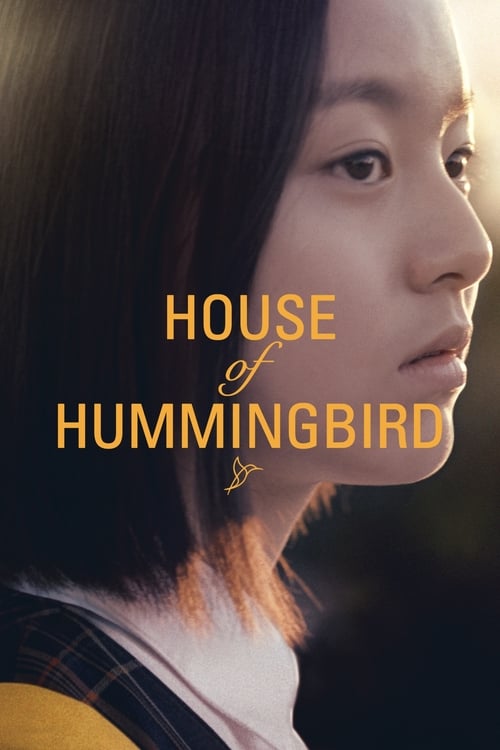
House of Hummingbird
2019 · Kim Bora
For when you want a film to sit with — slow, tender, and true — the kind you reach for when you're feeling reflective about your own growing up. A challenge in pace, a comfort in spirit.
What it's about
Seoul, 1994. Eun-hee is fourteen: her parents run a rice-cake shop and barely see her, her brother hits her, her friends come and go, and she moves through the city collecting small sweetnesses where she can — a best friend, first loves of more than one kind, and a night-school teacher who is the first adult to really look at her. Around the edges, a national tragedy is quietly gathering, felt the way a child feels such things: through overheard news and a changed sky.
The experience
Quiet, patient, and cumulative — it works by accumulation rather than incident, and the emotional weight sneaks up on you until small gestures of kindness land like thunderclaps. Expect stillness, and expect to be moved.
The craft
Kim Bora keeps her camera at a patient middle distance, trusting silence and duration over drama, so that a whole inner life assembles from glances and pauses. History enters the frame obliquely, the way it enters a child's day — a masterclass in scale, telling a national story at eye level.
Why it matters
Kim Bora's semi-autobiographical debut swept prizes from Berlin to Tribeca and became a touchstone of the late-2010s wave of Korean women filmmakers — a quiet counter-history to the country's male-dominated genre boom.
Seoul, 1994: the year of the Seongsu Bridge collapse, experienced at the eye level of Eun-hee, a fourteen-year-old girl adrift between an exhausted rice-cake-shop family, a violent brother, unreliable friends, and first loves of more than one kind. Kim Bora's semi-autobiographical debut — expanded from her acclaimed short The Recorder Exam — swept prizes from Berlin to Tribeca and became a touchstone of the remarkable wave of Korean women filmmakers who emerged in the late 2010s, offering a counter-history to the country's male-dominated genre boom: not spectacle but accumulation, the slow sediment of slights and small mercies that forms a self. Kim's camera keeps a patient middle distance, trusting silence and duration; national trauma enters the film the way it enters a child's life, obliquely, through overheard news and a changed skyline. At its center is a calligraphy teacher who offers the film's quiet thesis — that being truly seen, even once, can reorganize a life. Few films have caught so precisely the loneliness of adolescence in a family too tired to notice it.
Reception
A festival juggernaut from the start — it swept nearly 60 awards worldwide, including Berlinale's Generation 14plus Grand Prix and Tribeca's Best International Narrative Feature — but landed abroad in the shadow of Parasite's 2019-20 moment, and has since been steadily reclaimed by cinephiles as the other essential Korean film of that year.
How House of Hummingbird was received, from release to now →
Influences: the films it descends from and the films it influenced
- The 400 Blows (1959) — Establishes the semi-autobiographical adolescent portrait built from episodic accumulation and a naturalistic non-actor child lead observed without moralizing, the template Kim Bora follows for Eun-hee.
- The Spirit of the Beehive (1973) — National trauma (Francoism) is filtered entirely through a child's uncomprehending eye-level perception, the same displacement Kim uses to render the Seongsu Bridge collapse as overheard adult noise.
- A Time to Live and a Time to Die (1985) — Semi-autobiographical family memory told in static long takes at middle distance, letting meaning gather across undramatic domestic moments rather than plot beats.
- Good Morning (1959) — The low, child-height tatami-level camera that stages the adult world from a kid's sightline is the direct precedent for Kim's child-eye-level framing.
- A Brighter Summer Day (1991) — Anchors adolescent interiority to a specific fraught national-historical moment through patient long-take duration and period-precise mise-en-scène.
- Jeanne Dielman (1975) — Fixed middle-distance framing that dignifies domestic routine through real-time duration underwrites Kim's editing rhythm of held, undramatized household space.
- Yi Yi (2000) — Uses composed middle-distance domestic tableaux and a child observer to map an entire family's emotional life through accumulated small incidents.
- Peppermint Candy (1999) — Pioneers the Korean counter-history mode that reads national trauma through one ordinary interior life, the tradition Kim's 1994-set film extends toward the domestic and female.
- The Way Home (2002) — Landmark woman-directed Korean coming-of-age realism descending from the renaissance's quiet 'well-made drama' tributary, built on observational stillness and understatement.
- The World of Us (2016) — Extends the seed's class-mapped interiors and hagwon-as-social-infrastructure staging into adolescence, building scenes around a girl's micro-reactions to half-heard family speech rather than around events; the two are now programd as a matched pair.
- Minari (2020) — Semi-autobiographical family drama narrated from a child's sightline, letting historical and economic pressure surface through overheard adult tension rather than exposition.
- Petite Maman (2021) — Reduces coming-of-age to hushed child-scale observation and duration, trusting stillness and gesture over plot to carry emotional weight.
- Aftersun (2022) — Reconstructs semi-autobiographical memory as an accumulation of fragmentary, middle-distance moments in which adult pain is felt by the child only in retrospect.
- Ratcatcher (1999) — Builds a child's-perspective drama out of sensory, elliptical fragments and a naturalistic young lead rather than causal narrative, mirroring Kim's accumulation structure.
- Summer 1993 (2017) — Semi-autobiographical childhood shot at child eye-level with a naturalistic young lead, where grief and family strain register only obliquely through overheard adult exchanges.
- Moonlight (2016) — Chapters a life through quiet accumulated episodes centered on the ache of being truly seen, the same emotional through-line as Eun-hee's bond with her teacher Young-ji.
- The Florida Project (2017) — Sustains a child's-eye-level vantage and a naturalistic child performance while adult catastrophe unfolds at the blurred margins of the frame.
- Lady Bird (2017) — Semi-autobiographical coming-of-age anchored in a prickly mother-daughter relationship and a precisely dated milieu, told through small accreting scenes.
- Moving On (2019) — Contemporaneous Korean-women's domestic drama using held middle-distance long takes and a quiet adolescent observer of intergenerational family life.
- Roma (2018) — Recreates a personal 1970s domestic past with national upheaval kept to the background, staged in patient, observational wide compositions.
- Microhabitat (2018) — A female-authored Korean-independent debut of the same moment that builds meaning through accumulated quiet character-portrait episodes and generational disillusionment, sharing Microhabitat's staging of interior lives over plot.
- Kim Ji-young: Born 1982 (2019) — Reconstructs a girl's coming-of-age through braided, accretive vignettes and observational domestic framing that surface inherited women's history within an ordinary family, a near-simultaneous debut sharing Kim Ji-young's structural DNA.
Similar films
- Summer 1993 (2017) — influence & lineage
- Burning (2018) — same viewing thread
- Dreams (2024) — same viewing thread
- Past Lives (2023) — same viewing thread
- The World of Us (2016) — shared sensibility
- Little Forest (2018) — shared sensibility
- Mother (2009) — shared sensibility
- 20,000 Species of Bees (2023) — shared sensibility
All the films related to House of Hummingbird →
Watch it with: curated runs of related films
- The Ache of Almost — Watch these together for the way each circles a love that time, distance, or duty keeps just out of reach — long looks, feelings left unsent, and the life that gets lived instead.