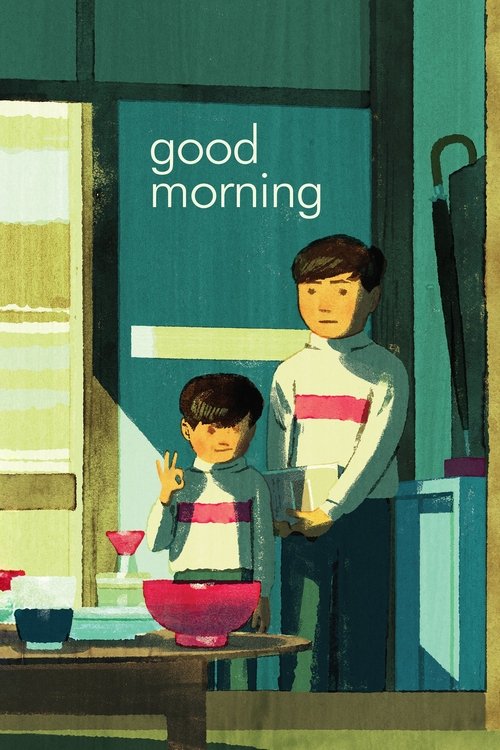
Good Morning
1959 · Yasujirō Ozu
For a cozy, low-stakes evening when you want to smile for ninety minutes — perfect when you're tired of noise and want charm, wit, and gentleness instead. Comfort viewing of the highest order.
What it's about
In a tight-knit Tokyo suburb, two young brothers demand a television set, and when their parents refuse, they take a vow of total silence — against parents, teachers, everyone. Around their pint-sized strike swirls the whole neighborhood: gossip about missing association dues, a washing machine that's causing envy, a door-to-door salesman down on his luck, and endless polite chatter the boys have decided is meaningless anyway.
The experience
Light, warm, and quietly hilarious — a comedy of small embarrassments and running gags (including a surprisingly philosophical one about farts) that sneaks real observations about family and community under the laughter. It's the definition of a film that leaves you feeling better.
Performances
The two boys are wonderful — their deadpan solidarity is the comic engine — and Ozu's regular ensemble gives the adult world a lived-in warmth.
The craft
Ozu's famous precision — low camera height, meticulous framing, gorgeous late-1950s color — is here tuned entirely for comedy, with gags rhyming across households like musical phrases. The film argues, elegantly, that small talk is the glue of social life, and its structure proves the point.
Why it matters
A beloved entry point to one of cinema's most revered directors, and a sly time capsule of postwar Japan's consumer boom — the moment the television entered the home.
Snapshot
Good Morning (Ohayō) is Yasujirō Ozu's twin-track comedy of manners and consumer desire, in which two suburban brothers, Minoru and Isamu Hayashi, launch a vow of silence to extort a television set from their parents. Around this pint-sized rebellion Ozu arranges a full chorus of adult anxieties — a neighborhood women's association fretting over missing dues, an unemployed husband reduced to hawking door-to-door, gossip about who has bought a washing machine — and threads the whole with a running gag about flatulence that doubles as the film's thesis. The boys' complaint that grown-ups say only meaningless things ("Good morning," "Nice weather," "Where are you off to?") is the picture's philosophical engine: Ozu proposes that empty pleasantries and the boys' fart games are the same lubricating social nonsense, both necessary, both faintly ridiculous. It is Ozu's second color film and one of his warmest and most immediately likable works — a reworking, by the director's own acknowledgment, of his 1932 silent I Was Born, But… Beneath the low-camera serenity and pastel houses lies a precise, gently satiric account of Japan at the moment of its postwar consumer takeoff.
Industry & production
Good Morning was produced and distributed by Shochiku, the studio to which Ozu was bound for essentially his entire career and whose Ōfuna studio house style — domestic, middle-class, sentimental-but-restrained (the so-called shomin-geki, or drama of ordinary people) — Ozu both epitomized and refined past all others. By 1959 Ozu was the senior prestige director on the lot, working with a settled repertory company of actors and technicians and enjoying the latitude to make films slowly and exactly to his specifications. The film was written, as almost all his late work was, in collaboration with Kōgo Noda, the two men composing at Ozu's mountain retreat.
The precise commercial performance of Good Morning is one of the areas where the readily available record is thin; reliable period box-office figures for individual Shochiku releases of this era are not something I can cite with confidence, and I will not invent them. What is clear is the film's institutional context: it belongs to the last, color-era phase of Ozu's output, a period in which he continued to command resources and top-billed stars while the Japanese studio system was still robust but beginning to feel the very pressures — television above all — that the film itself dramatizes. There is a self-aware irony in a major studio financing a comedy whose plot turns on the domestic arrival of the medium that would, within a few years, badly wound theatrical attendance.
Technology
Good Morning is Ozu's second film in color, following Equinox Flower (1958). Ozu came to color late and cautiously, and — as is well attested — he favored Agfa-derived stock for its rendering of reds, a hue he prized and deployed as a recurring accent (kettles, sweaters, household objects that punctuate his muted domestic palettes). The move to color did not loosen his method; if anything it intensified his control, since color gave him another calibrated variable to fix within the frame.
More pointedly, Good Morning is a film about a piece of consumer technology. The coveted television set, the neighbor's washing machine, the transistor radio and the electric appliances that mark status among the housewives — these are the plot's true motive forces. The film catches, and quietly editorializes on, the arrival of the "electrification" of the Japanese home during the late-1950s economic boom, the era when television ownership was spreading and durable goods were becoming the vocabulary of suburban belonging. Ozu's own attitude registers as ambivalent rather than scolding: the father grumbles that television will produce "a hundred million idiots," yet the film neither condemns the boys' longing nor pretends the modern conveniences are anything but seductive.
Technique
Cinematography
The film was shot by Yūharu Atsuta, Ozu's longtime camera operator and cinematographer, executing the director's famously rigid system. The camera sits low — the "tatami-level" vantage, roughly the eye-height of a person kneeling on the floor — and stays there. It does not pan, track, tilt, or crane; by this period Ozu had all but eliminated camera movement from his grammar. Compositions are built with near-architectural symmetry, frequently frontal, with figures addressing the lens along the axis of view so that characters seem to look almost directly at us. Ozu habitually violated the conventional 180-degree rule, shooting conversations from positions that reverse screen direction, and organized his interiors around a distinctive geometry of doorways, corridors, and receding planes. The color cinematography preserves this rigor while adding Ozu's chromatic punctuation — the recurrent reds among the pale walls and the row of near-identical houses.
Editing
Cut by Yoshiyasu Hamamura, another regular collaborator, the film is assembled from straight cuts alone — no dissolves, no fades, no wipes. Transitions between scenes are managed by Ozu's signature "pillow shots" (also called intermediate or cutaway shots): brief, unpeopled views of the exterior world — laundry on lines, the embankment, the corridor of houses, power pylons against the sky — that punctuate the narrative rhythmically rather than advancing it. Ozu edits for graphic and tonal continuity between shots, matching compositions across cuts, so that the film advances in measured, almost musical increments. The effect is a serenity of pace that runs counter to the comic material and gives the gags their deadpan poise.
Mise-en-scène / staging
Ozu's control extends to every object in the frame. The suburban tract — a line of small, look-alike houses along an embankment, thoroughly modern rather than traditional — is staged as a stage: neighbors' doorways face one another, and Ozu choreographs entrances, gossip, and passages between homes with theatrical precision. Props recur as motifs (the pumice stone the grandmother mutters over, the red kettle, the appliances). Actors are frequently posed in balanced, static groupings, and Ozu's blocking tends toward the flattened, frontal tableau. The famous flatulence sub-game — boys pressing one another's foreheads to produce a fart on cue, one hapless friend repeatedly soiling himself when the trick misfires — is staged with the same unruffled formality as everything else, which is precisely what makes it funny.
Sound
The score is by Toshirō Mayuzumi — a striking choice, since Mayuzumi was one of Japan's leading modernist and avant-garde composers of the period. For Ozu he supplied a light, jaunty, faintly Western-inflected theme that recurs like a bright refrain, its bounciness underscoring the comedy and setting the film apart in tone from the elegiac scores of Ozu's dramas. Sound design also carries the picture's central conceit: the litany of murmured greetings, the door-to-door salesman's patter, the television's imagined chatter, and — inevitably — the percussive punchlines of the fart routine all belong to a soundscape in which noise and speech are being weighed against one another. The recurring English phrases ("I love you," "Good morning") that the little boy parrots foreground language itself as sound, as social ritual emptied of and refilled with meaning.
Performance
Performances come from Ozu's stock company, tuned to his understated register. Chishū Ryū — the actor most identified with Ozu — plays the father, Keitarō Hayashi, with his characteristic mild, unemphatic gravity. Kuniko Miyake plays the mother. Yoshiko Kuga is the young aunt, Setsuko, and Keiji Sada the English teacher, Heichirō Fukui, whose halting non-courtship supplies the adult mirror to the children's plot. The two boys — Kōji Shitara as the elder Minoru and, especially, Masahiko Shimazu as the tiny, irrepressible Isamu — give the film its motor; Shimazu's "I love you" refrain is among the most quoted images in all of Ozu. The adult playing is deliberately even and reactive, a calm surface against which the children's stubbornness and the neighborhood's petty frictions play out.
Narrative & dramatic mode
The film runs on parallel plots knit by a single theme: communication. In the foreground, the children's silence strike — comic civil disobedience — escalates as the boys refuse to speak, refuse even to greet their teachers, until the vow snowballs into a minor neighborhood crisis. In the background, the adults conduct their lives almost entirely through formulaic speech: the women's association gossip and suspicion over the collective dues, the salesman-husband's decline, and the tender, tongue-tied exchanges between the aunt and the teacher, who can only circle their feelings through remarks about the weather. The boys' accusation — that adults' talk is meaningless — is thus both refuted and confirmed: the pleasantries are hollow, yet they are the very medium through which affection, reconciliation, and community are transacted. The dramatic mode is episodic and choral rather than tightly plotted, a mosaic of small domestic incidents resolving in the softest of accommodations (a television is bought; the strike ends; the shy adults exchange another weather report that now clearly means more).
Genre & cycle
Good Morning sits at the intersection of comedy, family drama, and the shomin-geki — the lower-middle-class domestic film that Shochiku's Ōfuna studio cultivated and that Ozu perfected. Within Ozu's own oeuvre it belongs to a small cycle of comedies and lighter works, and specifically to the lineage of his films about and from the perspective of children, of which I Was Born, But… (1932) is the fountainhead and Good Morning the color-era reprise. It is frequently paired, across national cinemas, with Jacques Tati's near-contemporary Mon Oncle (1958) as a companion satire of gadget-happy modern domesticity, though the two directors' methods could hardly be more different.
Authorship & method
Good Morning is a paradigm of Ozu's authorship because so little in it is accidental. The script was co-written with Kōgo Noda, Ozu's essential writing partner from the 1930s and again throughout the postwar masterpieces; the two built their screenplays through long, methodical collaboration, and the film's structure of interlocking domestic vignettes bears their joint signature. Yūharu Atsuta executed the cinematography under Ozu's exacting constraints — fixed low camera, no movement, frontal geometry. Yoshiyasu Hamamura edited in the cut-only, pillow-shot idiom. Toshirō Mayuzumi composed the buoyant score. And the acting ensemble, led by Chishū Ryū and Kuniko Miyake, embodies the repertory-company continuity that let Ozu treat his films almost as variations within a single lifelong project. Ozu's method — the systematized visual grammar, the refusal of conventional coverage, the patient accretion of everyday detail — is not decoration here but the very means by which comedy is kept dry and feeling kept from sentimentality.
Movement / national cinema
The film is a keystone of classical Japanese studio cinema and of Ozu's status, alongside Kenji Mizoguchi and Akira Kurosawa, as one of the pillars of the national tradition. Ozu is often characterized — a formulation associated above all with the critic Donald Richie, and much debated since — as the "most Japanese" of directors, an artist whose formal restraint and attention to domestic ritual were read (rightly or too neatly) as expressions of a Japanese aesthetic sensibility. Good Morning is at once thoroughly of that tradition and pointedly engaged with the Americanizing, consumerist modernity reshaping late-1950s Japan, making it a useful text for anyone tracing how the national cinema registered the country's postwar transformation.
Era / period
The film is a document of Japan's high-growth years, the late 1950s, when rising incomes, suburban tract housing, and the spread of household appliances were remaking daily life. Its very furniture — the new television, the neighbor's washing machine, the electric fittings that confer status — dates it precisely to the moment when durable consumer goods became the emblems of middle-class arrival. The unemployment sub-strand (the husband forced into door-to-door sales) and the anxious accounting of the women's association dues locate the comedy within real economic pressures, so that the boom is shown from below, at the level of family budgets and neighborly envy, rather than as triumphal progress.
Themes
The governing theme is the paradox of social communication: the tension between meaningful and meaningless speech, and the discovery that "empty" pleasantries are the indispensable connective tissue of community. Radiating from this are consumerism and status envy (the television as object of desire and instrument of conformity); the generation gap and children's-eye critique of adult hypocrisy; conformity and neighborly surveillance in the tightly packed suburb; and the encroachment of media and modernity on domestic life. The scatological gag is not a digression but the film's cleverest thematic move — by equating the boys' farts with the adults' greetings, Ozu insists that the bodily and the social forms of "just noise" are alike both trivial and, in their way, expressions of connection.
Reception, canon & influence
Good Morning has come to be regarded as one of Ozu's most accessible and beloved films — the easiest point of entry into a body of work that can otherwise seem austere — and its reputation has been secured in the West largely through retrospective rediscovery and home-video canonization (notably its Criterion Collection release) rather than through its original international run; like most of Ozu's films it was little seen abroad on first release, his Western reputation having grown substantially only after his death in 1963. Precise contemporary Japanese critical notices are not something I can quote reliably here, and I will not fabricate them; the film's standing today, however, is not in doubt.
Looking backward, the decisive influence on the film is Ozu's own: it openly refashions I Was Born, But… (1932), transposing that silent film's tale of two boys who mount a hunger-and-silence strike after seeing their father humbled before his boss into a lighter, color-era key. Where the 1932 film carried a sharp edge of class critique — the disillusionment of children discovering their father's social subordination — Good Morning softens the wound into a comedy of consumer desire, trading the salaryman's humiliation for the purchase of a TV, while preserving the core structure of childish rebellion, silence as protest, and the ironic education of children into the compromises of adult life.
Looking forward, the film's legacy is twofold. As part of the Ozu canon it contributed to the enormous posthumous influence the director exerted on filmmakers who absorbed his low camera, static framing, elliptical editing, and attention to domestic minutiae — an influence widely traced in figures such as Wim Wenders (whose 1985 documentary Tokyo-Ga is an explicit homage to Ozu), Hou Hsiao-hsien, Abbas Kiarostami, Jim Jarmusch, and Kore-eda Hirokazu, among others. More specifically, Good Morning's particular fusion of deadpan formal control with children's-perspective comedy and its satire of gadget-driven modern life have made it a touchstone for the tradition of quiet, observational domestic comedy. It endures as proof that Ozu's rigorous system was as capable of generating a fart joke as an elegy — and that, in his hands, the two were closer than anyone had supposed.
A Deleuzian reading
A boy presses his thumb into his friend's forehead.
The full Deleuzian reading of Good Morning →
Reception
Long filed under 'minor Ozu' — a lightweight comedy next to Tokyo Story — it's since been reclaimed as one of his most purely enjoyable films, and for many people the friendliest door into his work.
How Good Morning was received, from release to now →
How to watch Good Morning: what to notice on a first viewing
- Watch the camera stay fixed at a low, seated height. Ozu keeps the camera at roughly the eye level of someone kneeling on a tatami mat and never pans, tracks, tilts, or cranes. The stillness turns every room into a fixed stage, so what changes inside it is what you're meant to watch.
- Notice the shots of nobody: laundry, pylons, an empty street. Between scenes Ozu cuts to brief, unpeopled views that don't establish where we're going next or whose memory they belong to. These empty shots aren't filler between scenes. They're where the film lets time simply pass.
- Listen for how many times someone says 'good morning' or 'nice weather.' The greetings repeat almost identically across every neighborly encounter, a ritual exchanged rather than actually meant. The film keeps insisting these empty pleasantries are what actually hold a neighborhood together.
- Watch the boys' fart trick: forehead pressed, sound on cue. Two boys perform the same forehead-and-fart routine repeatedly, staged with the same unhurried formality as everything else in the film. Ozu treats bodily noise and adult small talk as the same kind of social nonsense, both trivial and both necessary.
- Notice the row of near-identical houses the family lives among. Ozu returns often to the same suburban embankment and doorways facing one another, staging the neighborhood like a theater set. The sameness of the houses lets you see who's actually pulling toward or away from the community inside them.
The whole guide to watching Good Morning, with the keys for a rewatch →
Influences: the films it descends from and the films it influenced
- I Was Born, But… (1932) — Good Morning openly refashions its two-boys hunger-and-silence-strike structure — childish rebellion as protest against a father's social humiliation — transposing the same plot skeleton into color and consumer comedy.
- Passing Fancy (1933) — Established Ozu's shomin-geki register of working-class row-house domestic comedy built on the father-and-child dynamic and the patient accretion of household minutiae that Good Morning inherits wholesale.
- A Story of Floating Weeds (1934) — Silent-era proving ground for the fixed low camera and the frontal shot/reverse that violates the 180-degree line, addressing characters nearly head-on rather than in conventional over-the-shoulder coverage.
- The Marriage Circle (1924) — A film Ozu repeatedly cited; its elliptical 'touch' — advancing story through objects, gestures and offscreen implication rather than exposition — models the dry, object-driven comedy of Good Morning's TV and fart gags.
- Late Spring (1949) — With co-writer Kōgo Noda, codified the mature grammar Good Morning runs on — tatami-eye camera height, pillow-shot transitions, straight cuts only, and refusal of the dissolve or camera move.
- Tokyo Story (1953) — Perfected the frontal-tableau staging and eyeline-matched near-to-camera address, plus the Ryū–Miyake repertory ensemble, that Good Morning redeploys six years later in a comic key.
- Playtime (1967) — Extends the consumer-modernity satire into rigorously frontal, static wide compositions where mass-produced objects and glass-box modernity generate the gags, echoing Good Morning's device-driven social comedy.
- Tokyo-Ga (1985) — An explicit filmed homage that seeks out Ozu's collaborators (including Chishū Ryū and cameraman Yūharu Atsuta) and reconstructs the low fixed-camera aesthetic as documentary tribute.
- Stranger Than Paradise (1984) — Locked-off frontal tableaux, deadpan minimalist performance, and blackout straight cuts between static scenes translate Ozu's cut-only, movement-averse grammar into American independent comedy.
- A Time to Live and a Time to Die (1985) — Fixed low-height long takes that observe domestic thresholds and courtyards, with landscape and object inserts functioning as pillow shots to mark elliptical time.
- Where Is the Friend's House? (1987) — Sustains a child's-eye moral drama through patient static observation and adult incomprehension of childhood logic, extending Ozu's children-versus-the-compromised-adult-world perspective.
- The Match Factory Girl (1990) — Terse cut-only editing and frontal, static tableaux of banal domestic routine push Ozu's deadpan formal restraint and everyday-detail accretion to a minimalist extreme.
- What Time Is It There? (2001) — Static long-take framing of apartments and family meals, with objects (a clock, a fish) held in fixed compositions, descends directly from Ozu's immobile-camera domestic observation.
- The Royal Tenenbaums (2001) — Planimetric frontal symmetry, direct near-to-camera address, and graphic-match cutting between geometrically balanced set-ups extend Ozu's frontal-tableau and graphic-match devices into deadpan family comedy.
- Still Walking (2008) — Rebuilds the Ozu family-gathering ensemble film — low static framing of the house, meals and corridors, feeling withheld through mundane detail — as a conscious continuation of the shomin-geki lineage.
- After the Storm (2016) — The suburban Japanese housing row — paper-thin walls, shared corridors, neighbor surveillance through windows — deployed as a social pressure-cooker registering class embarrassment through proximity; the direct architectural and staging precedent for Kore-eda's use of danchi as a character encoding thwarted aspiration.
- Kikujiro (1999) — Ozu's comic register staged around children, with repeated gags built in static frontal compositions, models how Kitano runs deadpan humor through rigid, tatami-level framing.
- House of Hummingbird (2019) — The low, child-height tatami-level camera that stages the adult world from a kid's sightline is the direct precedent for Kim's child-eye-level framing.
- Mon Oncle (1958) — A near-contemporary deadpan satire of gadget-driven consumer modernity in which comedy arises from architecture, appliances and near-wordless choreography rather than dialogue — Ozu's TV-envy plot's Western twin.
Similar films
- Tokyo Story (1953) — influence & lineage
- Late Spring (1949) — influence & lineage
- Mon Oncle (1958) — influence & lineage
- An Autumn Afternoon (1962) — shared sensibility
- Tokyo Twilight (1957) — shared sensibility
- Early Summer (1951) — shared sensibility
- Perfect Days (2023) — shared sensibility
- My Neighbor Totoro (1988) — shared sensibility