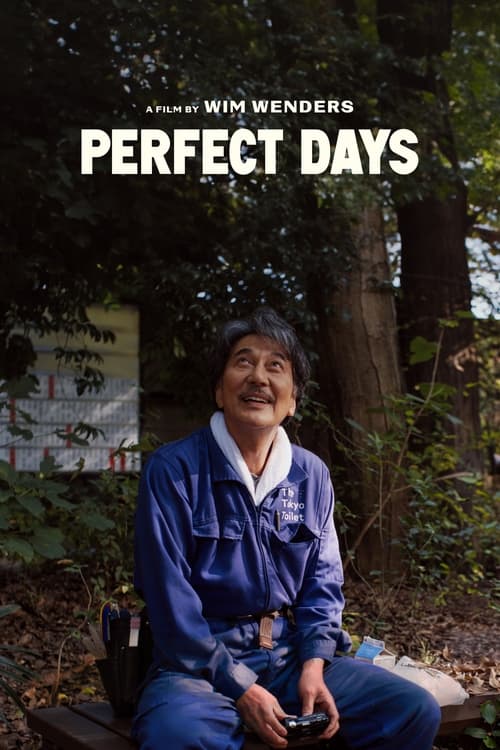
Perfect Days
2023 · Wim Wenders
For when the world feels too loud and you want a film that slows your pulse instead of raising it — a comfort watch that's also a gentle nudge to pay more attention to your own ordinary days.
What it's about
Hirayama cleans Tokyo's designer public toilets, and he does it with care. His days repeat in ritual: the folded mattress, vending-machine coffee, cassette tapes in the van, a film camera pointed at sunlight through leaves, a paperback before sleep. Small encounters — a colleague's drama, a niece's unannounced visit — ripple through the routine and hint at the life he left behind.
The experience
Serene, unhurried, and quietly absorbing — almost nothing 'happens,' and yet you lean in, because the film trains you to notice tiny variations the way Hirayama does. It leaves you calm and strangely grateful, with Lou Reed and Nina Simone stuck in your head.
Performances
Koji Yakusho won Best Actor at Cannes for a performance built almost entirely without dialogue — decades of backstory carried in a glance, a routine, and one extraordinary final close-up of a face in motion.
The craft
Wim Wenders shot it in seventeen days in a boxy 4:3 frame that turns each day into a portrait, building the whole film from variation within repetition. The cassette-tape soundtrack — Lou Reed, Patti Smith, Nina Simone — does the emotional talking, so good speakers genuinely matter.
Why it matters
A late-career high for Wenders, widely called his best fiction film in decades, and Japan's Oscar submission — a rare case of a European master making a Tokyo film that Japanese audiences embraced as their own.
Wim Wenders, the New German Cinema wanderer whose Tokyo-Ga once went searching for the ghost of Ozu, finally made his own Tokyo film — and it turned out to be his finest fiction in decades. Hirayama cleans the city's designer public toilets (the film grew from a commission around the real Tokyo Toilet project), and his days unfold in ritual repetition: the folded mattress, the vending-machine coffee, the analog camera aimed at sunlight through leaves. Shot in seventeen days in the boxy 4:3 frame, the film builds its drama entirely from variation within routine, trusting that repetition, closely watched, becomes revelation. Koji Yakusho, a titan of Japanese cinema since the Imamura years, won Best Actor at Cannes for a performance conducted largely in silence; his cassette deck supplies the voice — Lou Reed, Patti Smith, Nina Simone — a jukebox autobiography of Wenders's own generation. The Japanese have a word for the flicker of light through foliage, komorebi, and the film ends on the thing itself: a face in morning traffic, holding joy and sorrow in the same long take.
A Deleuzian reading
He folds the mattress.
The full Deleuzian reading of Perfect Days →
Reception
Premiered at Cannes 2023 to warm reviews and a Best Actor prize for Koji Yakusho, it was instantly hailed as Wenders's best fiction film in decades after a long run of shrugged-at features. It has since settled in not as a comeback curiosity but as a genuine late-career peak — the Wenders film people now recommend first.
How Perfect Days was received, from release to now →
Influences: the films it descends from and the films it influenced
- Departures (2008) — Ennobles menial, stigmatized labor by filming its repeated daily gestures as ritual choreography with hand-discipline rhyme, extending Departures' central move of finding grace in socially-looked-down-upon work.
- Early Summer (1951) — Wenders returns to Ozu's ethic directly: a restrained daily-ritual structure, komorebi as modern pillow shots, and quiet domestic framing built to let time and small change accumulate.
- Tokyo Story (1953) — Perfect Days quotes Ozu's tatami-level static camera and 'pillow shots' — cutaways to empty rooms, treetops and objects that carry emotion between scenes, restaged as Hirayama's lingering inserts of komorebi and toilets.
- Late Spring (1949) — Ozu builds mono-no-aware from repeated domestic rituals and transferred-emotion gestures; Hirayama's identical wake–fold-futon–water-plants morning is the same accumulation of everyday habit into feeling.
- An Autumn Afternoon (1962) — Ozu's final film renders an aging solitary man's melancholy through routine and near-frontal, restrained performance — the affective register Wenders hands to Yakusho.
- Tokyo-Ga (1985) — Wenders' own documentary pilgrimage retracing Ozu's Tokyo and interviewing Ryū and Atsuta; Perfect Days is the fiction-film culmination of that decades-long study of Ozu's grammar.
- Paris, Texas (1984) — With Robby Müller, Wenders builds a near-silent protagonist whose interior life is read through gesture and landscape rather than speech — the wordless-acting template reused for Hirayama.
- Wings of Desire (1987) — Wenders' observational, angel's-eye drift that dignifies small anonymous urban lives; the same compassionate, eavesdropping attention to strangers organizes Hirayama's city.
- Alice in the Cities (1974) — Wenders' formative New German Cinema road film of patient observation and grainy 16mm texture — the slice-of-life, drift-and-watch grammar he later refines into ritual.
- Jeanne Dielman, 23 quai du Commerce, 1080 Bruxelles (1975) — Akerman films repeated domestic chores in near-real time so meaning accrues through tiny day-to-day variations — the repetition-as-revelation structure Wenders borrows for Hirayama's cycling days.
- Five Dedicated to Ozu (2003) — Five long static takes of nature explicitly dedicated to Ozu, treating durational contemplation of light and water as narrative — kin to Perfect Days' long-take komorebi dreams.
- Café Lumière (2003) — An Ozu-centennial commission that renders Tokyo through train lines and elliptical everyday routine; the same reverent, contemporary transposition of Ozu into modern Tokyo.
- The Tree of Life (2011) — Malick's handheld, sun-through-leaves cinematography and whispered interior monologue codify the dappled-light (komorebi) contemplative mode Franz Lustig's camera echoes.
- The Eel (1997) — Kōji Yakusho as a quiet man rebuilding a life through modest routine — the minimalist, interiorized everyman performance Wenders casts him to reprise.
Similar films
- Tokyo Story (1953) — influence & lineage · same viewing thread
- An Autumn Afternoon (1962) — influence & lineage · same viewing thread
- Drive My Car (2021) — influence & lineage
- Late Spring (1949) — influence & lineage
- Still Walking (2008) — influence & lineage · same viewing thread
- After Life (1999) — same viewing thread
- Nobody Knows (2004) — same viewing thread
- Shoplifters (2018) — same viewing thread
All the films related to Perfect Days →
Watch it with: curated runs of related films
- The Weight of the Unspoken — A run of quietly shattering films where the largest feelings never get said aloud — love that outlasts reason, grief that gathers over a single family dinner, a long marriage cracked open by one old letter.