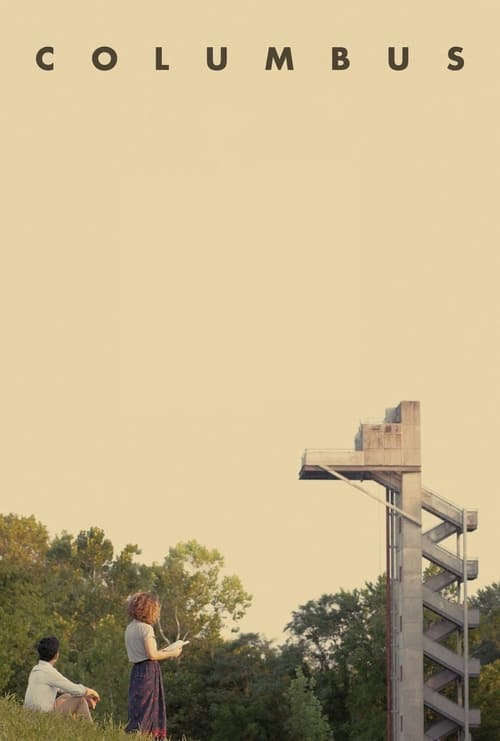
Columbus
2017 · Kogonada
For when you're feeling contemplative and want a film that lowers your pulse instead of raising it — a meditative, healing watch for a quiet evening, especially if you're at a crossroads yourself.
What it's about
When a renowned architecture scholar collapses on a speaking tour, his estranged son Jin is stranded in Columbus, Indiana — a small Midwestern city improbably filled with modernist landmarks. Waiting out his father's coma, he falls into a friendship with Casey, a young local who works at the library and loves the town's buildings, but has shelved her own future to care for her recovering mother. Walking and talking among glass banks and floating staircases, two stalled people help each other see their lives clearly.
The experience
Hushed, precise, and quietly moving — long, composed shots invite you to slow your breathing and actually look. It's a talky film where the silences say as much as the dialogue, and its calm sneaks up on you until a small emotional beat lands with surprising force.
Performances
Haley Lu Richardson is the revelation — warm, funny, and heartbreaking as a young woman arguing herself out of her own ambitions — and John Cho brings a wry, guarded gravity that makes their mismatched friendship feel real.
The craft
Kogonada, who came to filmmaking through the video essay, frames Columbus's modernist buildings with exacting symmetry, letting architecture carry the emotion the characters can't voice — thresholds, glass, and negative space become a second script. It's a debut of remarkable visual discipline that rewards a big screen and full attention.
Why it matters
It announced Kogonada as a significant new American filmmaker and became a touchstone for a strand of contemplative indie cinema where place and feeling are inseparable.
Snapshot
Columbus is the feature debut of Kogonada, a filmmaker who arrived in narrative cinema by way of the video essay. A two-hander of quiet intensity, it strands Jin (John Cho), the estranged son of a dying architecture scholar, in Columbus, Indiana — an unlikely mecca of American modernist building — where he forms a tentative bond with Casey (Haley Lu Richardson), a recent high-school graduate who has deferred her own future to care for a mother in recovery from addiction. The film uses the town's celebrated architecture not as backdrop but as a second language: a vocabulary of thresholds, symmetries, and negative space through which two people who cannot quite say what they feel arrive at understanding. It is a film about attention itself — about looking closely at things until they yield meaning — and it announced Kogonada as one of the most formally disciplined American directors of his generation.
Industry & production
Columbus is an independent production, made outside the studio system and financed by a small consortium of independent companies; among the entities credited are Superlative Films and Depth of Field, with producers including Danielle Renfrew Behrens, Aaron Boyd, Giulia Caruso, Ki Jin Kim, Andrew Miano, and Chris Weitz. The film premiered at the Sundance Film Festival in January 2017 and received a theatrical release later that year through Superlative Films / Depth of Field. Its commercial footprint was modest — this was an arthouse title playing to specialty audiences — and I will not cite precise grosses, as I cannot verify specific figures.
Two facts of production shape the film decisively. First, it was shot entirely on location in Columbus, Indiana, giving Kogonada access to the actual landmark buildings rather than sets or substitutes. Second, it was made quickly and economically, on a compressed shooting schedule (widely reported as roughly two and a half weeks; I flag that the exact day count is not something I can state with certainty). That efficiency is inseparable from the film's aesthetic: the long, locked-off takes and pre-planned symmetrical framings are, among other things, a way of extracting maximum expressive value from limited resources.
Technology
Columbus was captured digitally. The clarity, depth of field, and controlled tonal range of its images reflect contemporary digital cinematography rather than photochemical film; I will not name a specific camera or sensor, since I cannot confirm the exact package used. What matters technologically is how the tools serve a rigorously classical approach: the film largely eschews the handheld immediacy and shallow-focus intimacy that digital cameras made cheap and ubiquitous in low-budget American independent film of the 2010s. Instead it uses the medium's precision to hold deep, geometrically exact compositions steady, so that architecture reads with the crisp legibility of an architectural photograph. The score, by the ambient duo Hammock, likewise belongs to a contemporary digital soundworld of layered synthesis and processed guitar — texture and drone rather than melody-forward orchestration.
Technique
Cinematography
Shot by Elisha Christian, Columbus is built on a foundation of static frames, precise horizontal and vertical alignment, and a patient, contemplative distance. The camera rarely moves; when it does, it does so with deliberate, motivated slowness. Christian and Kogonada compose for symmetry and for the architectural frame-within-a-frame — doorways, windows, colonnades, and glass curtain-walls that bracket the human figures and often reduce them to small, precisely placed elements within a larger designed order. Characters are frequently seen through panes of glass, across reflective surfaces, or divided by structural columns, so that the buildings both connect and separate them. The lighting favors natural, even, unsentimental illumination that lets the modernist surfaces — brick, glass, concrete, steel — register their true materiality. The result is a cinematography that is genuinely architectural: it treats the shot as a designed space and the act of looking as a moral and emotional discipline.
Editing
Kogonada edited the film himself, and the cutting is of a piece with the shooting: unhurried, rhythmically exact, willing to let a shot breathe long past the point where a conventional drama would cut. The editing withholds coverage — scenes are often built from few setups, sometimes a single sustained frame — which forces the viewer to attend to composition, to duration, and to the small shifts in performance that occur within a take. This restraint is not inertia; it is a controlled tempo that mirrors the film's themes of patience and care. The measured pace also allows the buildings their own screen time, treating them as presences to be contemplated rather than merely establishing shots to be gotten through.
Mise-en-scène / staging
Staging is the film's signature. Kogonada blocks his actors within real architectural spaces so that the geometry of a building expresses the emotional geometry of a scene: two characters placed at opposite ends of a modernist bank lobby, or framed on either side of a structural axis, or standing before the vast glass wall of a church. Distance, proximity, and the barriers between figures are choreographed with a precision that reads meaning into physical placement. The town's landmarks are not decorative — the film moves through the real Columbus, including works associated with Eliel Saarinen, Eero Saarinen, and I.M. Pei (the Cleo Rogers Memorial Library, with Henry Moore's Large Arch out front, is Casey's workplace and a recurring site). The mise-en-scène insists that where people stand, and what stands between them, is the drama.
Sound
The soundscape is spare and attentive: ambient environmental sound, the acoustics of open modernist interiors, and long passages of near-silence in which dialogue lands with weight. Hammock's score works in washes of ambient texture — sustained, atmospheric, emotionally reticent rather than manipulative — underscoring reflection without dictating feeling. The restraint of the sound design is continuous with the visual restraint: it clears space for looking and listening.
Performance
The film rests on two calibrated, interior performances. Haley Lu Richardson's Casey is its emotional center — bright, guarded, tethered to her mother by love and fear, and quietly aflame with an intellectual passion for the buildings she has grown up among. Richardson gives Casey both curiosity and a carefully managed sadness. John Cho's Jin is her counterweight: cerebral, wounded, ambivalent toward the celebrated father whose deathbed he cannot bring himself to want to attend. Cho plays reticence and buried grief with unusual delicacy, in a role that pointedly cast an Asian-American actor typically confined to genre and comedy in a lead dramatic part. The supporting cast — including Parker Posey as Eleanor, the father's colleague; Rory Culkin as Casey's library co-worker; and Michelle Forbes as Casey's mother — fills out the emotional field with economy.
Narrative & dramatic mode
Columbus operates in the mode of the contemplative, dialogue-driven relationship drama: it is a film of conversations, walks, and looks rather than plot mechanics. Its dramatic engine is a pair of parallel, inverted predicaments — Jin resents a revered father he does not wish to save; Casey has sacrificed her own escape to save a mother she cannot leave — and the film draws its tension from the way each character's situation illuminates and gently challenges the other's. There is no melodramatic crisis, no romance consummated on schedule; the arc is one of small recognitions and released fears. The structure is patient and accretive, closer to the tradition of the "conversation film" and the European art film than to the American three-act script. Casey's growing ability to articulate why a building moves her — famously staged in a scene where the camera holds on her face from outside a glass wall while her spoken explanation is muted — is itself the drama.
Genre & cycle
Nominally a drama, Columbus sits within the strain of American independent cinema sometimes described as "slow cinema" or contemplative cinema, and within the intimate, place-rooted two-hander lineage. It belongs to a 2010s cycle of formally rigorous, festival-launched debuts by directors with backgrounds in criticism, video, or the art world, in which style is foregrounded as a mode of thought. Its kinship is less with plot-driven indie dramedy than with the walking-and-talking relationship films of Richard Linklater and the austere humanism of European masters — a hybrid of American independent subject matter and an art-cinema grammar.
Authorship & method
Kogonada — a pseudonym adopted in homage to Kōgo Noda, Yasujirō Ozu's longtime screenwriter — built his reputation before Columbus as a maker of video essays commissioned by outlets including Sight & Sound, the Criterion Collection, and the BFI. Those supercut studies dissected the formal signatures of Ozu, Bresson, Hitchcock, Kubrick, Wes Anderson, Malick, and Linklater — symmetry, the eyeline, the pillow shot, the hands, one-point perspective. Columbus is, in a real sense, the practical thesis of that criticism: a film that enacts, rather than merely analyzes, the compositional ethics he had spent years studying. He wrote, directed, and edited it — an unusually complete authorship for a debut.
His key collaborators translated that vision into practice. Cinematographer Elisha Christian realized the static, architecturally exact framing. The ambient duo Hammock (Marc Byrd and Andrew Thompson) supplied a score of atmospheric restraint. As his own editor and writer, Kogonada controlled the film's rhythm and its reticent, precise dialogue directly. The through-line is a method of subtraction: withhold camera movement, withhold cutting, withhold scoring and exposition, until what remains — a face, a wall, a silence — carries the full charge.
Movement / national cinema
Columbus is an American independent film, but its sensibility is transnational. Kogonada is a Korean-American artist whose formative influences are heavily East Asian and European — Ozu above all, alongside the European art film. The result is a distinctly hyphenated cinema: American in setting, subject, and casting (its foregrounding of Asian-American leads is itself a quiet intervention in a national cinema that has marginalized them), yet grafted onto the contemplative aesthetic lineage of postwar Japanese and European filmmaking. It exemplifies a globalized art cinema in which a filmmaker's "national" identity is a synthesis of inherited traditions rather than a single origin.
Era / period
The film is a product of the mid-2010s independent scene, and it bears that era's marks: the maturation of affordable digital production; the festival-and-specialty-distribution ecosystem (Sundance to arthouse release) as the primary path for such work; and the video essay's rise as a legitimate critical form and, in Kogonada's case, a pipeline into filmmaking. It also participates in a period conversation about representation in American film, arriving amid growing scrutiny of Hollywood's treatment of Asian-American performers. Set and released in the same present, it is a contemporary story with no period reconstruction — its "period" is the reflective, design-conscious sensibility of its moment.
Themes
The film's governing subject is attention — the discipline of looking closely, whether at a building, a parent, or another person, as an act of care. Architecture is its central metaphor and its literal material: the modernist idea that designed space can heal, order, or elevate human life is tested against characters whose inner lives are anything but ordered. Parents and children form the emotional spine — two inverted studies of obligation, resentment, and love, in which each protagonist must decide how much of their own life to surrender to a failing parent. Related threads run throughout: place and rootedness versus escape; care as both burden and vocation; the gap between feeling and articulation (the recurring struggle to say what a thing means to you); and the possibility of healing through encounter with another person and with beauty. Underlying all of it is a nearly moral proposition that the film shares with Ozu and Bresson — that how we look at the world is inseparable from how we live in it.
Reception, canon & influence
Columbus was warmly, in places rapturously, received by critics, who singled out its compositional rigor, its emotional delicacy, and the breakthrough performances of Richardson and Cho; it featured on numerous year-end best-of lists and is frequently cited as one of the strongest American debuts of its decade. (I describe the critical consensus in qualitative terms rather than citing specific aggregate scores or awards tallies, which I cannot verify precisely.)
Influences on the film (backward): The dominant lineage is Yasujirō Ozu — visible in the low, static camera, the symmetrical framing, the "pillow shots" of architecture and empty space, and the patient domestic humanism — a debt encoded in the very pseudonym Kogonada. Robert Bresson's austere attention and the contemplative European art film inform its restraint; Richard Linklater's conversation-driven films inform its structure of walking, talking, and gradual recognition. The film also draws on the real cultural history of Columbus, Indiana itself — a genuine landmark of American modernist architecture — and on the tradition of architectural photography.
Legacy / what it shaped (forward): Columbus established Kogonada as a major filmmaker and served as a template for his subsequent, larger-canvas work — the science-fiction chamber piece After Yang (2021) and his prestige television, including the series Pachinko — extending his signature of stillness, symmetry, and quiet feeling into new registers. More broadly, the film became a touchstone example of the video-essayist-turned-director path and a case study, taught and written about, in how architectural space can carry dramatic meaning. Its championing of Asian-American actors in interior, non-genre lead roles has been repeatedly noted as part of a wider shift in American independent casting. Precisely because it is recent, its long-term influence is still being written; but within a decade of release it had already become a reference point for a certain kind of contemplative, design-literate American independent cinema.
A Deleuzian reading
A young woman stands outside a building at night and finally says what it does to her.
The full Deleuzian reading of Columbus →
Reception
A quiet Sundance 2017 debut that made barely a ripple at the box office, it has steadily climbed into modern-indie-canon status — and Kogonada's later work (After Yang, Pachinko) keeps sending new viewers back to it.
How Columbus was received, from release to now →
Influences: the films it descends from and the films it influenced
- Late Spring (1949) — The tatami-level static camera and the tranquil 'pillow shots' of empty rooms and objects between scenes are the exact grammar Kogonada transposes onto Columbus's modernist facades.
- Tokyo Story (1953) — Ozu's frontal, eyeline-matched two-shots of seated figures conversing across a low symmetrical axis supply the reticent staging Kogonada uses for Casey and Jin.
- An Autumn Afternoon (1962) — Its geometric color compositions built on receding doorframes and corridors are the direct source of Columbus's frame-within-a-frame architectural blocking.
- Pickpocket (1959) — Bresson's ethic of subtraction — flat affect from 'models,' isolated shots of hands, withheld emotion — underwrites Columbus's method of restraint until a face or wall carries the charge.
- Diary of a Country Priest (1951) — Its austere, near-silent contemplation of interior spiritual states models the interior performance restraint Kogonada asks of Haley Lu Richardson.
- Before Sunrise (1995) — The peripatetic two-hander structure — a film built entirely from walking, talking, and gradual mutual recognition between two near-strangers — is Columbus's narrative spine.
- L'Eclisse (1962) — Antonioni's use of modernist architecture and hard geometry to dwarf and emotionally isolate figures is the antecedent for Columbus's dramaturgy of buildings as psychological space.
- Playtime (1967) — Tati's rigorous one-point-perspective compositions that treat glass-and-steel modernist architecture as the film's true subject prefigure Kogonada's architectural framing.
- Lost in Translation (2003) — Coppola's platonic two-hander of quiet mutual recognition, carried by ambient scoring and performances of withheld interiority, prefigures Columbus's emotional key.
- 35 Shots of Rum (2009) — An avowed Ozu scholar, Kogonada builds a parent-child drama from architectural stillness, patient framing and emotional restraint — the same loving translation of Ozu's observational ethos into a contemporary idiom.
- After Yang (2021) — Kogonada's own follow-up extends the identical signature — static symmetry, ambient score, near-silence, emotional subtraction — into a science-fiction chamber register.
- Pachinko (2022) — His prestige-television work carries the compositional rigor, stillness, and quiet interior performance of Columbus into long-form serial drama.
- Aftersun (2022) — Wells extends the mid-2010s digital-indie mode of restraint — a two-hander about attention between generations told through elliptical stillness and near-silence — that Columbus helped canonize.
- Certified Copy (2010) — A walking two-hander in which art and architecture become the medium of an evolving relationship, staged in long, patient takes with static framing — a contemporary parallel to Columbus's form.
- A Ghost Story (2017) — A contemporaneous American indie built on locked-off long takes, ambient drone score, and durational stillness — the same slow-cinema patience applied to domestic space.
- Paterson (2016) — Jarmusch's attention-as-care aesthetic — finding drama in repetition, quiet routine, and gentle observation rather than plot — shares Columbus's contemplative restraint.
- Certain Women (2016) — Reichardt's American slow cinema — patient wide compositions, sparse dialogue, ambient sound design, emotion held below the surface — is Columbus's closest domestic peer.
- Past Lives (2023) — Parallel A24-era restraint two-hander built on architectural negative space and precise static composition, where two people circle an unspoken attraction through conversation framed against buildings, emotion staged spatially.
- Dreams (2024) — Composes quiet intellectual exchanges in carefully framed static two-shots under available light, the precise cinematographic register of Dreams' talk scenes.
- Before Sunset (2004) — Builds its drama from two people walking and talking through a city's architecture in long composed takes, extending the same location-anchored dialogue craft into an elegiac register.
- The Farewell (2019) — Kogonada's rigorously symmetrical, frontal placement of figures inside architecture — bodies formally framed and centered within static compositions — is the same portrait-framing grammar Wang uses for her group shots.
- Perfect Days (2023) — Kogonada, an Ozu video-essayist, applies Ozu's geometric static framing and architecture-as-feeling; a direct formal descendant of the same contemplative compositional lineage.
- Minari (2021) — Korean-American quiet cinema that stages emotion through thresholds, doorways, and architectural enclosure, holding composed observational frames and trusting stillness over dialogue.
Similar films
- Certain Women (2016) — influence & lineage
- Before Sunrise (1995) — influence & lineage · same viewing thread
- Lost in Translation (2003) — influence & lineage · same viewing thread
- Tokyo Story (1953) — influence & lineage · often watched together
- Synecdoche, New York (2008) — often watched together
- The Rider (2018) — shared sensibility
- Searching (2018) — shared sensibility
- Little Forest (2018) — shared sensibility
All the films related to Columbus →
Watch it with: curated runs of related films
- Strangers Who Walk and Talk — Watch these back to back for the particular magic of two people, a city, and a few borrowed hours of talk that may not outlast the night.