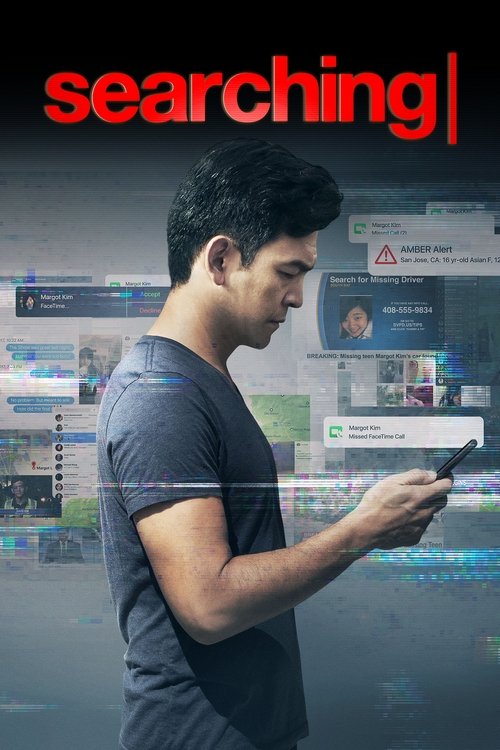
Searching
2018 · Aneesh Chaganty
For when you want to be hooked hard — a one-sitting, edge-of-the-couch mystery that also sneaks up on your feelings. Great with someone who likes guessing the ending out loud (they probably won't).
What it's about
A widowed Silicon Valley father's sixteen-year-old daughter vanishes, and when the police investigation stalls he opens the one place no one has searched: her laptop. Cracking her accounts and reading her messages, he discovers he barely knew the girl he raised — and every window he opens deepens both the mystery and his grief. The entire film unfolds on screens: video calls, browser tabs, texts, news feeds.
The experience
A tight, propulsive thriller that keeps twisting, with an undertow of real sadness — the tension of a whodunit fused to the ache of a father realizing how much distance grew in his own house. You end up scanning every corner of the screen like a detective yourself.
Performances
John Cho holds the whole film in webcam close-up, playing panic, guilt and dawning obsession mostly to a camera lens — a genuinely difficult acting job that never shows the strain.
The craft
Aneesh Chaganty's debut turns the computer-screen gimmick into real cinema: cursor hesitations, typed-and-deleted messages, and browser history all become characterization, and the editing hides its clues in plain sight. It's the rare high-concept thriller where the form is the story.
Why it matters
A breakout hit from Sundance, it proved the screen-bound thriller could carry mainstream emotional weight — and was a landmark as a Hollywood thriller led by an Asian American family without comment.
Snapshot
Searching is a missing-person thriller told entirely through the glowing rectangles of consumer computing: desktop windows, video calls, security-camera feeds, news streams, text threads. A widowed Silicon Valley father, David Kim (John Cho), discovers that his sixteen-year-old daughter Margot (Michelle La) has vanished, and — finding the police investigation stalled — begins excavating her laptop, cracking her accounts, reading her messages, watching her livestreams. The formal conceit is total: we never leave the screen. What makes the film more than a stunt is that the conceit and the theme are the same object. A father who has not spoken to his daughter about her mother's death tries to reconstruct her interior life from metadata, and the film's central irony is that the archive is complete and he still doesn't know her.
Made for a reported budget well under a million dollars on a shooting schedule of roughly two weeks, assembled over a far longer post-production, and released by Sony's Screen Gems in the late summer of 2018, it became one of the most profitable American releases of its year and the film that moved the "screenlife" format from horror novelty to mainstream dramatic instrument.
Industry & production
Searching originates less in the American indie system than in the production laboratory of Timur Bekmambetov, the Kazakh-Russian director-producer (Night Watch, Wanted) whose company Bazelevs had been developing the desktop-film format as a proprietary house style. Bekmambetov produced Levan Gabriadze's Unfriended (2014), the Blumhouse-distributed teen horror film staged entirely in a Skype call, and has since evangelized "Screenlife" as a codified form with its own rules and, eventually, its own software pipeline. Unfriended's commercial success on a microbudget established the economics; Searching was the attempt to prove the form could carry a non-horror, adult, emotionally serious story.
Aneesh Chaganty came to the project by an unusual route. A USC School of Cinematic Arts graduate, he worked at Google's Creative Lab, where he directed the 2014 short Seeds, shot entirely on Google Glass — a piece that circulated widely and functioned as his calling card. Bekmambetov's company approached him about the format; Chaganty, by his own account, was initially resistant to the gimmick, and it was the search for a story that required the screen rather than merely tolerated it that produced the script, co-written with his USC contemporary Sev Ohanian (a producer on Fruitvale Station). Ohanian and Natalie Qasabian produced alongside Bekmambetov and Adam Sidman.
The film premiered in the NEXT section at Sundance in January 2018, where it took both the NEXT Audience Award and the Alfred P. Sloan Feature Film Prize — the latter awarded for films engaging with science and technology, a fitting institutional recognition of the picture's subject. Sony acquired it and released it through Stage 6 / Screen Gems in late August 2018, expanding from a platform opening to wide release on the strength of exit reactions. Against a reported budget in the neighborhood of $880,000, it grossed on the order of $75 million worldwide — a return ratio that made it, in pure multiples, among the year's most successful releases and that decisively validated the format as a business.
Its release also landed inside what was widely dubbed "Asian August": Crazy Rich Asians and Netflix's To All the Boys I've Loved Before arrived within the same two weeks. Cho's casting carried its own charge. He had been the subject of the 2016 #StarringJohnCho campaign, William Yu's viral project photoshopping Cho onto major studio one-sheets to dramatize the absence of Asian American leading men. Two years later he was actually carrying a wide-release studio thriller. Chaganty has been consistent that the Kim family's Korean American specificity is present in the film's texture — the family archive, the language of grief, the relatives — without being the subject of the plot, a choice that was itself read as a statement.
Technology
The film is a document of a particular technological moment and a product of a particular technological pipeline, and the two are worth separating.
As document: Searching opens with a Windows XP boot screen and walks its family history forward through roughly a decade of interface design — desktop wallpapers, calendar apps, webcam resolutions, chat clients — before settling into the film's present of macOS, FaceTime, iMessage, Gmail, YouTube, Instagram, Tumblr, Venmo, and a fictionalized livestreaming service, YouCast. Interface obsolescence does the work that costume and production design do in a period film. The visual grammar of a 2006 webcam capture — low frame rate, muddy compression, 4:3 — reads instantly as the past, and the film uses that legibility for emotional shorthand.
As pipeline: nothing in Searching is screen-captured live. The human performance was shot conventionally with digital cameras standing in for webcams and phone lenses, at the correct eyeline and height for a laptop, with lighting calibrated to look like the flat, top-lit, screen-bounced illumination of a person sitting at a desk. That footage was then composited into screen environments built as motion-graphics projects — every window, cursor movement, notification, scroll, and typing action animated as a discrete asset. The reported production shape is a shoot of about thirteen days followed by a post-production stretching across roughly two years, with a small team of editors and animators effectively directing the film a second time in the timeline. This inverts the normal ratio of production to post and is the single most important production fact about the picture: the mise-en-scène was authored in After Effects.
Technique
Cinematography
Juan Sebastián Baron's camerawork is constrained to plausibility: fixed lenses at fixed heights, no camera moves that a laptop lid or a phone held in a hand could not produce. The expressive burden therefore shifts to lighting and to the physics of consumer optics. Baron and Chaganty differentiate the film's many "cameras" by their defects — the wide-angle barrel distortion and rolling-shutter smear of a phone, the noise floor of a laptop cam in a dim room, the color cast of a fluorescent-lit police station's security feed, the crushed blacks of a night exterior on a news chopper's long lens. Compression artifacts function as grain. When David's face fills a FaceTime window, the softness is not incidental; it is the film's equivalent of a diffusion filter.
There is one further layer: the frame is not the screen. The film performs slow push-ins and repositions within the desktop image, effectively cropping and scaling to isolate a window or a face. This is a rule-break — a virtual camera looking at the screen — but it is deployed sparingly enough to read as emphasis rather than cheat. The finale, which leans on broadcast-news and aerial imagery, loosens the rules further; critics noticed, and the loosening is defensible on the grounds that by that point the story has genuinely escaped David's laptop into public media.
Editing
Nick Johnson and Will Merrick's cutting is where the film actually lives, and it is the most inventive editing of any mainstream American film of its year. Three techniques recur.
First, the cursor as camera. Mouse movement supplies the eyeline, the pan, and the hesitation. When the cursor drifts toward a folder and stops, we experience it as a look held too long. Second, the typed-and-deleted line as interior monologue: David composes a message, backspaces it, composes something safer. The gap between the two drafts is the entire characterological distance the film needs, and it is expressed without a word spoken. Third, window layering as depth staging — a video call foregrounded over a browser search over a spreadsheet, with the eye's attention managed by focus, opacity, and motion rather than by cutting.
The opening montage, which compresses years of the Kim family's life into a wordless sequence of photos, videos, calendar entries, and one devastating recurring reminder about a mother's scheduled return home that is postponed and finally deleted, is openly modeled on the "Married Life" prologue of Pixar's Up (2009) — an antecedent Chaganty has acknowledged. It is the film's proof of concept: seven minutes establishing that an operating system can hold grief.
Mise-en-scène / staging
The desktop is the set. Icon arrangement, wallpaper choice, the contents of a downloads folder, the naming of files — these are production design, and they carry characterization that would otherwise require dialogue. Margot's browser history is her bedroom. The film also stages absence spatially: the empty seat in a video call, the greyed-out contact, the account with no recent activity. And it uses the ecology of platforms as social geography — the difference between what Margot posts publicly, what she says in a private message, and what she streams to strangers on YouCast maps the concentric rings of a teenager's self-presentation with real precision.
Sound
The sound design is the film's most underrated element. Its vocabulary is almost entirely diegetic UI: keystrokes, trackpad clicks, notification chimes, the FaceTime ring, the hollow room tone of a laptop microphone, the swallowed low end of a phone speaker. Each device has an acoustic signature, and the film uses codec quality as a distance cue — the worse the audio, the further the person. Torin Borrowdale's score is the deliberate exception to the purity of the scheme, a string-and-pulse underlay that supplies suspense the interface cannot. Screenlife hardliners regard non-diegetic music as a violation; Searching treats it as a necessary concession to make a two-hour thriller sustainable.
Performance
John Cho gives a performance built almost entirely from reaction, shot alone into a lens with scene partners off-camera. Denied the ordinary actor's resources of movement through space and physical proximity, he works in micro-adjustments: the eyes tracking text, the jaw setting, the breath caught before a call connects. Two registers dominate — the composed voice he uses for others and the unguarded face he doesn't know is visible. It is a continuation of the dramatic seriousness Cho had shown a year earlier in Kogonada's Columbus (2017), and it anchors the film's credibility. Debra Messing, cast against her comic persona as Detective Rosemary Vick, carries the film's mechanism of misdirection, playing procedural warmth in video calls. Michelle La, in her first feature role, must build Margot almost entirely out of archived footage — she exists only as recording — and Joseph Lee, as David's brother Peter, supplies the film's most textured secondary relationship.
Narrative & dramatic mode
The film is a classical mystery in an unclassical container. Its dramatic engine is the investigation procedural: a ticking clock, a widening pool of suspects, a sequence of leads that resolve into dead ends. But the epistemology is specifically digital. Evidence arrives as records rather than testimony, and the film's suspense derives from interpretation — of a Venmo transaction, a photo's background, a stranger's account. It is a paranoid text in the tradition of films about re-examined recordings, where meaning is not observed but extracted by replay.
Structurally, Searching is built as a series of false bottoms. Each revelation reframes what preceded it, and the final reversal — that the officer who volunteered for the case has been shaping it to protect her own son — retroactively converts every procedural courtesy into misdirection. This is the film's most contested element. Detractors reasonably argue that the climax abandons the rigor of the premise for a conventional twist and a somewhat melodramatic resolution; defenders note that the twist is thematically exact, since it makes the film's subject another parent's catastrophic misreading of a child. The film also runs a sharp secondary thread on the public performance of grief: comment sections that pivot from sympathy to accusation, acquaintances who claim intimacy with Margot on camera, a disappearance metabolized as content.
Genre & cycle
Searching sits in the desktop-film or "screenlife" cycle, whose immediate ancestry is legible: the Canadian short Noah (2013, Walter Woodman and Patrick Cederberg), which staged a teenage relationship's collapse entirely on a laptop; The Den (2013); Nacho Vigalondo's Open Windows (2014); Unfriended (2014) and its 2018 sequel Dark Web; the "Connection Lost" episode of Modern Family (2015). Beyond that lies the found-footage tradition — The Blair Witch Project, Paranormal Activity — and beyond that, the epistolary novel.
What distinguishes Searching within the cycle is genre migration. Every significant predecessor was horror or thriller with a supernatural or sadistic engine; Searching is a domestic drama with a mystery structure, and it demonstrated that the form could sustain sentiment, family history, and a protagonist over forty. It is also the cycle's most technically ambitious entry, treating the desktop as a composed image rather than a captured one.
Authorship & method
Chaganty's method, visible across this film and his subsequent Run (2020), is high-concept constraint married to unfashionably sincere family melodrama. He is a formalist whose formalism serves emotional legibility: the rules exist to make feeling land harder, not to alienate. His Google Creative Lab background is not incidental — the sensibility of Seeds (a story told through a wearable interface) is the sensibility of Searching.
The collaboration is unusually distributed for a debut. Sev Ohanian, co-writer and producer, has been Chaganty's constant partner. Cinematographer Juan Sebastián Baron solved the problem of making artificial webcam footage look authentically bad. Editors Will Merrick and Nick Johnson functioned as something closer to co-directors given post's dominance in the schedule — a claim supported by the fact that Sony subsequently handed them the follow-up to direct. Composer Torin Borrowdale supplied the film's one wholly non-diegetic layer. Bekmambetov, as producer, provided the format, the pipeline, and the commercial thesis.
Movement / national cinema
Searching is American independent cinema in its financing shape and Silicon Valley in its setting and sensibility — the film is located in San Jose, and its texture is that of a Bay Area tech-adjacent middle class. But its formal lineage is transnational: the screenlife project is Bekmambetov's, developed out of Russian-language production, and it belongs to a broader post-2010 international turn toward films made of found and mediated images.
Within American cinema, the film also belongs to the 2018 moment of Asian American visibility in studio filmmaking, alongside Crazy Rich Asians and To All the Boys I've Loved Before. Its approach differs from both: rather than centering cultural specificity as subject, it casts an Asian American family in a genre role historically reserved for white protagonists and lets specificity live in the details of the family archive.
Era / period
The film is set in and thoroughly of the mid-2010s: post-smartphone saturation, pre-TikTok, at the moment when livestreaming had become ambient and when the social contract around data — that your children's lives are recoverable, and that recoverability is both comfort and violation — had not yet been widely examined in mainstream narrative film. It arrives after the Snowden disclosures made surveillance a general anxiety and during the period when true-crime podcasting and amateur online sleuthing were becoming mass pastimes; the film's depiction of internet crowds convicting an innocent man is directly legible against that. Watched now, its interfaces have already aged into period detail, which — as with any technology-forward film — has only sharpened its function as a record.
Themes
The governing theme is the gap between information and knowledge. David has near-total access to his daughter's data and no access to her grief; every password he cracks deepens the evidence that he never asked her a question. The film's most quietly brutal running motif is the unspoken subject of Pamela's death, encoded in the deleted calendar reminder of the prologue and in a father and daughter who have jointly agreed not to mention her.
Secondary threads: parental surveillance as love's degraded substitute; the performance of intimacy and mourning in public networks; the unreliability of the digital self-portrait; and — through the Vick reversal — the recognition that a parent's protective instinct is continuous with the crime. There is also a persistent thread about the labor of self-representation, in which Margot's loneliness is invisible precisely because she is so thoroughly documented.
Reception, canon & influence
Critical reception was strongly positive, and unusually so for a high-concept debut. The dominant critical move was to note that the gimmick recedes — that within twenty minutes the viewer stops registering the format and simply watches a thriller — and to credit Cho's performance and the editing with achieving that. The most common reservation concerned the third act: a twist some found ingenious and others found a retreat into contrivance, with a resolution more sentimental than the film's cool surface had promised. The Sundance NEXT Audience Award and Sloan Prize marked it early as both a crowd film and a technology-minded one, and it maintained a strong critical standing through its wide release.
Looking backward, the film's influences are: the screenlife lineage above; Rear Window (1954) for the immobilized watcher who assembles a crime from partial views; Blow-Up (1966) and The Conversation (1974) for the obsessive re-scanning of a recording; the found-footage horror tradition for the ethics of the mediated image; and, explicitly, the montage grammar of Up (2009).
Looking forward, its influence is unusually concrete for a film of its size. Commercially, its return ratio made screenlife a durable studio proposition rather than a one-off, and Bekmambetov's Screenlife operation expanded on the back of it. Formally, it moved the desktop film out of horror; the COVID-era wave — most prominently Rob Savage's Host (2020), a Zoom-set horror short feature made in lockdown — inherited both its technical vocabulary and the audience literacy it had built. Chaganty and Ohanian went on to Run (2020). Most directly, editors Will Merrick and Nick Johnson graduated to directing Missing (2023), a standalone follow-up starring Storm Reid built from a Chaganty–Ohanian story, which performed strongly and effectively turned Searching into a franchise premise: not recurring characters, but a recurring interface.
Its longer-term canonical position is likely as the form's proof text — the film cited whenever the question is whether a purely mediated image can sustain feature-length drama. That it did so while putting an Asian American actor at the center of a mainstream studio thriller, in a summer when that was still remarkable, gives it a second claim on the record.
Reception
It arrived at Sundance 2018 sounding like a gimmick — 'the whole movie is on screens' — and left with the NEXT Audience Award and a $5M Sony deal; it's since settled in as the film that proved screenlife could carry a real mainstream thriller, not just a horror stunt.
How Searching was received, from release to now →
How to watch Searching: what to notice on a first viewing
- Watch where the cursor pauses before it clicks. Chaganty's editors use mouse movement as eyeline and hesitation. A cursor drifting toward a folder and stopping reads as a look held too long. The interface stands in for glance and gesture, so the film's grammar of looking lives inside a mouse.
- Listen for how muddy or clear each voice sounds. Each device carries its own acoustic signature. The film uses audio degradation as a distance cue, so the worse the sound, the further away the speaker. Sound quality quietly tells you who is close and who is far, without a single establishing shot.
- Notice the empty chair in every video call. The film stages absence spatially: an empty seat, a greyed-out contact, an account gone quiet. These voids carry as much information as any full window. Absence becomes visible space, letting the film show loss without ever leaving a screen.
- Watch Cho's eyes track text before he answers. Cho performs almost entirely in reaction, alone into a lens with scene partners off-camera. He works in eye movement, a set jaw, a caught breath. The performance proves feeling can read clearly even when an actor has no physical scene partner.
The whole guide to watching Searching, with the keys for a rewatch →
Influences: the films it descends from and the films it influenced
- Lady in the Lake (1947) — Sustains a single mediating apparatus — the camera as Marlowe's eyes — across a whole feature, including the trick of showing the protagonist only in mirrors, the same bet Searching makes with the cursor and the archival-only glimpse.
- Rear Window (1954) — The immobilized watcher reconstructing a crime from partial framed views; the courtyard's grid of lit windows is the desktop's tiled application windows, with suspense generated by what the frame excludes.
- Blow-Up (1966) — Enlarging an image until grain replaces information — Searching's repeated zoom-and-hold on low-res webcam and CCTV stills makes compression artifacts the literal limit of what can be known.
- The Conversation (1974) — Scrub-and-replay of a recording whose meaning inverts on the nth pass; Searching re-cues the same clips and voicemails so that emphasis, not new footage, produces the reversal.
- The Blair Witch Project (1999) — Codifies consumer-camera defects — autofocus hunting, blown highlights, clipped mic — as authenticity markers, the exact artifact set Juan Sebastián Baron had to synthesize to make clean footage look convincingly bad.
- Up (2009) — Explicitly cited template for the wordless opening montage that compresses a marriage and a loss into minutes; Searching transposes its beat structure onto folder dates, calendar entries and OS-version drift.
- Locke (2013) — Builds a full ensemble out of voices on a phone line, making off-screen characters dramatically present — the absence-as-space staging Searching uses for the missing daughter and the phone-only relatives.
- Noah (2013) — The short that invented the grammar: cursor drift and hesitation as a camera move and a mind, and the typed-then-deleted message as the most legible available unit of interiority.
- Unfriended (2014) — The Bekmambetov Screenlife template Searching inherits wholesale — one unbroken screen, diegetic UI sounds carrying the score's function, chat-window stacking as blocking — which Searching then lifts out of horror and out of real time.
- Open Windows (2014) — Pushes the desktop into compositing spectacle, using window layering and virtual push-ins on nested video players to manufacture depth on a flat plane — the device Searching disciplines into invisible coverage.
- Luther: The Fallen Sun (2023) — Carries the digital-exposure/online-blackmail thriller forward, building the manhunt entirely out of screen-life surveillance and the threat of internet revelation.
- All About Lily Chou-Chou (2001) — Pushes the floating on-screen-text device to its endpoint, telling the entire story through interfaces and message threads as the primary narrative surface.
- Host (2020) — Inherits the videocall vocabulary and, decisively, the audience literacy Searching built: filters, screen-share and dropped frames function as the entire scare mechanism with no explanatory scaffolding.
- Dashcam (2021) — Moves the interface to livestream, using a scrolling viewer-comment overlay as a running chorus and stream lag as dramatic latency — Searching's diegetic-UI sound design turned aggressive.
- We're All Going to the World's Fair (2021) — Adopts compression-as-grain as an expressive register rather than a realism tax, using upload artifacts, webcam low-light noise and autoplay framing to render dissociation.
- Missing (2023) — Made by Searching's own editors as a sequel-in-form: identical desktop grammar updated to cloud and mobile UI, establishing that the recurring franchise element is the interface, not the characters.
- Profile (2018) — Same producer and post pipeline, released the same year: Skype-window layering plus deliberate codec degradation used to meter emotional and geographic distance between two faces on one screen.
- Cam (2018) — Streaming interface as set — performer acting to a laptop lens while a chat sidebar runs a competing text track — and a doppelgänger false-bottom reveal executed entirely through UI state rather than staging.
- Run (2020) — The same director–writer–editor unit reapplying the method: a hard physical constraint wired to sincere family melodrama, with the withheld information staged as what the frame refuses to show.
- Kimi (2022) — Extends the audio-forensics scene into the streaming era — an agoraphobe scrubbing a compressed voice-assistant clip where bitrate, room tone and clipping are themselves the evidence.
- The Guilty (2018) — The contemporaneous counterpart within technologically mediated cinema: where The Guilty constructs its offscreen world acoustically through telephone, Searching does so visually through screen interfaces — both films' entire dramatic reality is composed of mediated rather than direct experience, and both premiered at Sundance 2018.
- Blue Film (2026) — Pushes screenlife to full mise-en-scène — cursor movement as blocking, window layering as depth, webcam resolution shifts as lens changes — the vocabulary Blue Film sets against its inset feed.
Similar films
- Gone Girl (2014) — shared sensibility
- Columbus (2017) — shared sensibility
- Forgotten (2017) — shared sensibility
- Left-Handed Girl (2025) — shared sensibility
- Changeling (2008) — shared sensibility
- Chithha (2023) — shared sensibility
- The Guilty (2018) — shared sensibility
- Stoker (2013) — shared sensibility