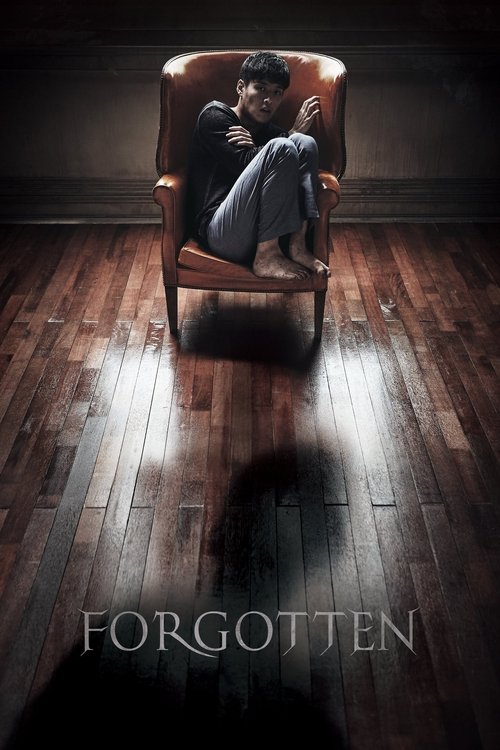
Forgotten
2017 · Chang Hang-jun
For when you're craving a twisty midnight thriller that keeps you guessing — the kind you finish in one sitting and immediately want to argue about. More adrenaline than comfort.
What it's about
Jin-seok is twenty-one, newly moved into a house with his family, managing a mild mental illness under their warm care — and quietly in awe of his older brother Yu-seok, the family's golden boy. Then one rainy night Yu-seok is dragged into a van by men whose faces Jin-seok never sees. Nineteen days later his brother comes home with no memory of what happened, and Jin-seok starts noticing small things about him that don't add up. The question of who to trust — including himself — becomes the whole film.
The experience
It plays like a slow tightening of a wire: paranoid, clammy, and increasingly desperate, with reveals that keep yanking the floor out from under you. Once it starts moving it barely lets you breathe.
Performances
Kang Ha-neul carries the film almost single-handedly, sliding from boyish devotion into raw, frantic panic, while Kim Mu-yeol makes the returned brother's warmth feel just slightly, unbearably wrong.
The craft
This is polished Korean genre filmmaking at its most disciplined — dread built out of ordinary domestic spaces, a locked door, rain on windows — with a structure engineered so each answer opens a worse question. It rewards close attention; the details are load-bearing. Watch it at night with no distractions.
Why it matters
Picked up internationally by Netflix, it became one of the Korean thrillers that traveled — a calling card for how rigorously that industry constructs the rug-pull suspense film.
Snapshot
A tightly wound psychological thriller from South Korea, Forgotten (기억의 밤) works through the oldest trick in unreliable-narrator cinema — it makes its audience trust the wrong eyes — and then detonates that trust with methodical precision. Released in November 2017 and later distributed internationally through Netflix, the film stars Kang Ha-neul as Jin-seok, a mildly schizophrenic young man whose older brother Yu-seok (Kim Mu-yeol) returns from a 19-day unexplained disappearance as something subtly, disturbingly wrong. The film belongs to a mature phase of Korean genre cinema: technically polished, dramaturgically rigorous, and philosophically curious about the vulnerability of memory as the foundation of self. It is not a horror film about monsters but about the horror of suspecting that the person closest to you has been replaced — and, deeper still, about the horror of not trusting your own cognition to confirm it.
Industry & production
Forgotten arrived during a period of confident commercial consolidation in the Korean film industry. The mid-2010s saw Korean thrillers routinely crossing domestic revenue benchmarks that would have been unthinkable a decade earlier, propelled by the global prestige infrastructure built by directors such as Bong Joon-ho, Park Chan-wook, and Kim Jee-woon. Chang Hang-jun, working at a smaller scale of ambition than those auteurs, nonetheless benefited from industrial conditions — a deep pool of trained genre craftspeople, distribution partnerships with streaming platforms hungry for premium Asian content — that allowed a taut, mid-budget psychological thriller to reach audiences well beyond Korea. Netflix's acquisition of international rights placed the film in a curatorial company that included Bong's Okja (2017) in the same year, marking a moment when Korean cinema was becoming a prestige brand for global platforms rather than a niche art-cinema commodity. Specific production budget figures for Forgotten are not a matter of the public record I can reliably cite; what is evident from the finished film is that its resources were concentrated on performance and script rather than spectacle.
Technology
The film does not announce itself as a showcase for any particular technological innovation. It was shot digitally, as is standard for Korean commercial cinema of the period, and deploys a controlled, desaturated color palette — grays and cold blues dominating the new family home's interiors — that is less a technological statement than a tonal one. The suburban house itself functions as the film's primary set, and the production design channels resources into the geometry and lighting of domestic space rather than into exterior location work or visual effects. Post-production color grading reinforces the sense of ambient unease: the world of the film looks as though someone has slightly drained it of warmth, which literalizes the protagonist's psychological experience before the narrative has explained why it should feel that way.
Technique
Cinematography
The cinematography of Forgotten is disciplined rather than expressive in any showboating sense. Compositions favor enclosed framings — doorways, window panes, stairwells — that transform the domestic interior into a set of thresholds the protagonist cannot safely read. The camera frequently adopts Jin-seok's point-of-view without fully committing to it: we are placed close to his perspective but held at a slight remove, a formal choice that prepares us, in retrospect, to question what exactly we have been seeing. Shallow depth-of-field during scenes of intense suspicion blurs background figures into an ambient threat, consistent with the film's interest in perceptual unreliability. The specific cinematographer's body of work beyond this film is not part of the record I can draw upon with confidence, and I will not fabricate a name or attribute specific influences to a cinematographer I cannot verify.
Editing
The editing is the film's sharpest technical instrument. Forgotten is constructed around a structural irony that requires the editor to maintain two coherent temporal logics simultaneously: the logic Jin-seok believes he is inhabiting, and the logic the audience will retroactively reconstruct once the twist is delivered. This is demanding work — the kind of editing that must be right twice, once on first viewing and once on second — and the film largely succeeds. Pacing in the first act is deliberately measured, allowing domestic rhythms to establish a false normality; the middle section tightens as Jin-seok's suspicions mount; the finale accelerates with a confidence that suggests the filmmakers were not uncertain about their ending. The management of information — what the audience is shown, what it is permitted to infer, what it is actively misled about — is the film's central editorial project.
Mise-en-scène / staging
Chang Hang-jun's most consistent staging decision is to place Jin-seok in spatial relationships that emphasize his perceptual marginality. He watches from doorways; he stands slightly outside the social geometry of the family dinner table; he observes through glass. The blocking of scenes between him and the returned Yu-seok is particularly careful: physical proximity between the brothers is staged to look like warmth while being available for a retrospective reading as surveillance or control. The suburban house — new, clean, anonymous in the way Korean high-density suburban housing of the 2010s tends toward — is staged not as cozy domesticity but as a stage set whose normalcy cannot be trusted. This is a consistent move in Korean domestic horror and thriller: the new house as a space that has not yet been inhabited truthfully, that conceals rather than shelters.
Sound
The sound design and score deploy familiar psychological-thriller registers — low drones, sudden silences, strategic sound drops to accompany Jin-seok's dissociative episodes — but the film's most interesting sonic choice is restraint. Dialogue-heavy scenes between Jin-seok and Yu-seok are often mixed with ambient house sound at a slightly heightened level: the refrigerator hum, the street outside, the small mechanical sounds of an occupied building. This atmospheric realism makes the occasional intrusion of scored music more destabilizing than it would be in a film that relied on score throughout. The precise composer credits for Forgotten are not ones I can confirm with scholarly certainty, and I decline to invent them.
Performance
The film's chief strength as execution is the dual performance challenge it sets its leads. Kang Ha-neul, by 2017 a firmly established figure in Korean film and television (known for emotionally demanding roles in projects including Twenty and various prestige dramas), carries the extraordinary difficulty of playing a character whose interiority the audience cannot fully trust. He must be sympathetic enough to anchor our identification while planting, in retrospect, the micro-expressions and hesitations that make a second viewing coherent. It is a performance that works in two registers simultaneously, and Kang manages it through a quality of deliberate stillness: Jin-seok does not perform his distress loudly, which is both psychologically credible for a character managing schizophrenia and strategically useful for a film that needs to keep its secrets. Kim Mu-yeol as Yu-seok (the brother) is required to be warm and then wrong and then something more complicated than either: his performance in the film's second half navigates the uncanny valley between recognizable person and unsettling stranger with care.
Narrative & dramatic mode
Forgotten operates squarely in the tradition of the twist-architecture thriller: a film that constructs an apparent reality in order to dismantle it, and whose real subject is the epistemological fragility of that apparent reality. The clinical detail in the premise — Jin-seok's schizophrenia is established early — is not decorative. It serves the film's structural logic by providing the audience with a ready explanation for Jin-seok's perceptual errors, an explanation the film will later reveal to be partially true in a way that is worse than simply being false. The narrative mode is closer to paranoid fiction in the Paul Auster or Patricia Highsmith lineage than to the supernatural horror cycle: the dread here is rational, not spectral. Something has happened that can be explained; the problem is that the explanation is more disturbing than the mystery.
The film's dramatic engine runs on a question it withholds for most of its length: not "what happened to Yu-seok during the 19 days" but "who is Jin-seok, really?" The structural revelation recontextualizes the entire preceding film in the manner perfected by twist thrillers since at least the 1990s, but Forgotten earns its reversal more than most because it does not simply add a plot layer — it adds a moral and psychological layer. The twist changes not just what happened but what the protagonist's suffering means and who deserves our sympathy.
Genre & cycle
Forgotten belongs to a specific and productive cycle in Korean cinema: the domestic psychological thriller inflected by questions of identity, family loyalty, and the possibility that the people who know you best may be the ones most capable of deceiving you. This cycle includes A Tale of Two Sisters (Kim Jee-woon, 2003), which established many of its formal and thematic templates; The Wailing (Na Hong-jin, 2016), which pushed the paranoia into folkloric territory; and the extensive tradition of Korean family-secret melodramas that have been a staple of Korean narrative in both film and television since the 1980s. The specific shade of Forgotten — identity substitution, memory manipulation, the uncanny double — also connects to a global art-cinema current running from Hitchcock's Vertigo through Michael Haneke's Caché and into the contemporary South Korean thriller. The film is not indebted to J-horror or the supernatural-horror cycle that dominated East Asian genre cinema in the late 1990s and early 2000s; its atmosphere is colder, more forensic. It asks psychological and even quasi-legal questions more than it asks supernatural ones.
Authorship & method
Chang Hang-jun is primarily known in Korean entertainment as a writer-director with a background in commercial genre work. He is also known publicly in Korea for his marriage to actress Kim Hye-soo, a figure of considerable cultural prominence, though this biographical detail has no bearing on Forgotten's formal character. His approach to the material here is that of a craftsman interested in mechanism: the film's script is its most impressive component, constructed with care for the retroactive coherence that twist thrillers demand. Chang wrote the screenplay himself, which is consequential — the film's specific combination of clinical psychological detail and structural manipulation has the feel of a single authorial intelligence rather than a committee. His style as a director is not visually flamboyant; he seems more interested in performance and script architecture than in establishing a distinctive cinematographic signature. This is consistent with a writer-director tradition that prizes narrative reliability over visual expressiveness. The result is a film that will be remembered for what it does to its audience's understanding rather than for any particular image.
Key collaborators beyond Chang himself are not part of the record I can verify with sufficient confidence to name in this account.
Movement / national cinema
Forgotten is a product of the mature, commercially confident phase of the Korean New Wave, a movement that consolidated in the 2000s under the pressures of the Korean government's cultural industry investment policies (the screen quota system, the Korean Film Council's development programs) and international festival attention. By 2017, the "Korean wave" (hallyu) had normalized international consumption of Korean popular culture, and Korean cinema occupied a peculiar position: simultaneously a prestige art cinema (Cannes-friendly Bong and Park) and a highly functional commercial genre industry capable of producing polished thrillers, action films, and horror with craft comparable to Hollywood output. Forgotten operates in the latter current without aspiring to the former, though its psychological ambition places it closer to the art-cinema end of the commercial spectrum than to the pure multiplex entertainment. The film inherits from Korean cinema a specific set of genre permissions: graphic emotional honesty about family dysfunction, willingness to make all characters morally complex, and a structural fatalism that allows tragedies to be complete rather than resolved.
Era / period
2017 was a productive moment for Korean genre cinema. Alongside Forgotten, the year included significant work in adjacent registers: A Taxi Driver (Jang Hoon) addressed the Gwangju Uprising through the action-drama form; The Merciless (Byun Sung-hyun) revisited the undercover-cop thriller; and international attention to Korean cinema was reaching a pre-Parasite peak that would accelerate dramatically in 2019. The film appeared at a moment when Korean thrillers had absorbed and metabolized their Hollywood genre influences (the high-concept twist thriller, the Hitchcock legacy, the procedural) and were producing work that felt confident and local rather than derivative. It also appeared at the beginning of the global streaming platform era's intensive acquisition of Korean content, placing it at a historical inflection point for Korean cinema's international circulation.
Themes
Forgotten is thematically organized around the vulnerability of memory as the only foundation we have for identity, relationship, and moral accountability. Jin-seok's schizophrenia is the film's opening gambit: it introduces the question of whether subjective experience can be trusted before the plot has given us any reason to doubt it. The film then systematically expands that question outward — from "can Jin-seok trust his own perceptions?" to "can he trust the people who interpret his perceptions for him?" to the larger question of whether the family, the institution supposedly most invested in knowing who you are, might be precisely the institution most capable of exploiting that investment.
The motif of the imposter or the stranger-who-wears-a-familiar-face is one of the oldest in narrative literature, but Forgotten gives it a specifically contemporary psychological inflection: the replacement is not supernatural but engineered, the work of human manipulation rather than magical transformation. This makes it more disturbing in a particular way — it asks what it would mean for identity to be a social construction that can be constructed falsely, for "being someone" to be a performance that another person might replicate. The film's interest in surveillance — Jin-seok's constant watching, the monitoring of his behavior by others — connects these themes to a broader Korean cinema concern with the mechanisms of social control operating through the family unit.
Reception, canon & influence
Forgotten received generally positive reviews on its Korean theatrical release, with particular praise directed at Kang Ha-neul's performance and the script's structural integrity. Critical response outside Korea was largely generated by Netflix viewers after the film's streaming availability, and it developed a healthy reputation in the international online film community as a well-constructed example of the Korean psychological thriller. It did not achieve the canonical status of the major Korean thrillers of its era — it was not a Parasite, not a The Wailing, not a I Saw the Devil — but it occupies a solid position in the secondary tier of Korean genre cinema, the kind of film cited by enthusiasts as evidence of the depth of the Korean thriller tradition rather than merely its peaks.
As a film that influenced Forgotten backward, the lineage is clearly legible: Hitchcock's use of the unreliable point-of-view and particularly the double (Vertigo, Psycho) are foundational; Kim Jee-woon's A Tale of Two Sisters established the template for Korean domestic psychological horror with a revelation structure; the broader tradition of twist thrillers running through Bryan Singer's The Usual Suspects (1995) and Christopher Nolan's Memento (2000) provided the dramaturgy of managed audience deception. Korean television drama's long tradition of family-secret revelation plots, which Chang likely internalized as a working professional in Korean entertainment, is also a plausible influence on the film's emotional register, though this is a structural inference rather than a documented attribution.
The film's forward influence is harder to trace with certainty at this point in the record. It did not catalyze a visible cycle of imitators in the way that Oldboy or Train to Busan did. Its significance is more as a confident, well-executed example of a mature genre form than as a formal innovation that opened new possibilities. That is an honorable position: Korean cinema in the 2010s produced a large body of technically accomplished, thematically serious genre work that is only now beginning to receive the kind of systematic critical attention it warrants, and Forgotten is a creditable representative of that body.
A Deleuzian reading
Start with the one thing Jin-seok cannot stop seeing: a string of numbers.
The full Deleuzian reading of Forgotten →
Reception
A solid but unremarkable performer in Korean theaters in late 2017, it found its real audience when Netflix picked it up globally — becoming one of those word-of-mouth 'Korean thriller on Netflix' discoveries that international viewers passed around in the pre-Parasite years.
How Forgotten was received, from release to now →
Influences: the films it descends from and the films it influenced
- Vertigo (1958) — Invented the identity-substitution plot engine in which a male protagonist's obsessive reconstruction of a lost persona becomes the mechanism for his own undoing — the direct structural template for Forgotten's brother-as-impostor revelation.
- Psycho (1960) — Established dual-register performance as a genre norm: the actor who appears to be one coherent person while secretly embodying another, performed without telegraphing the concealed identity until the film demands it.
- The Tenant (1976) — Cinematizes paranoid domestic fiction through enclosed framing — doorways, corridor bottlenecks, and window sightlines used as threshold geometry that makes the residential interior itself feel like a trap closing.
- The Usual Suspects (1995) — Codified retroactive coherence as a dramaturgy: the retrospective narrator's fabrication requires every prior scene to be mentally re-edited by the audience simultaneously at the moment of revelation, a structural expectation Forgotten's script was written to satisfy.
- Memento (2000) — Demonstrated that dual temporal logic — two timelines moving at different speeds toward a convergence point — can function as the primary formal architecture of a psychological thriller rather than merely a stylistic flourish.
- A Tale of Two Sisters (2003) — Established the Korean domestic psychological thriller template: shallow depth of field isolating figures within enclosed family space, a revelation structure that retroactively reframes every prior family interaction, and the home as a site of identity dissolution rather than safety.
- Oldboy (2003) — Set the precedent in Korean genre cinema for the annihilating identity revelation — a protagonist systematically deceived about his own history, with the truth delivered not as a plot twist but as a structural collapse that forces the audience to reprocess the entire film.
- Secret Sunshine (2007) — Normalized deliberate stillness in performance and a desaturated, affectively muted palette as the registers of psychological interiority in Korean domestic drama — a tonal inheritance Forgotten draws on to keep its thriller mechanics from becoming melodramatic.
- The Call (2020) — Builds directly on the Korean domestic thriller's dual temporal logic by making the two timelines simultaneous rather than retrospective, with retroactive coherence as the payoff — the formal architecture Forgotten helped consolidate in the genre now becomes the premise.
- Recalled (2021) — Inherits memory vulnerability as narrative mechanism — the protagonist's inability to verify her own recall drives both the thriller plot and the formal strategy of controlled ambiguity — extending the post-Forgotten Korean psychological thriller's interest in traumatic amnesia as an unreliable-narrator device.
- Caché (2005) — Develops paranoid fiction through ambient heightening: the domestic interior filmed as if under surveillance, with a sound design that generates pressure exceeding any visible source and refuses to deliver the explanatory revelation the genre conventionally provides.
- The Others (2001) — Deploys threshold geometry systematically — doors, windows, and corridors as contested boundaries between competing versions of reality — and uses retroactive coherence to transform the entire preceding film into evidence of an identity state the audience did not recognize.
- Shutter Island (2010) — Extends dual-register performance across a full feature: DiCaprio's character performs functional competence over a fractured identity history, with performance cues calibrated so the enacted normalcy is plausible on first viewing and legible as performance on second.
- Gone Girl (2014) — Structures dual temporal logic in the domestic thriller by running two irreconcilable first-person accounts of the same marriage, engineering systematic allegiance transfer in the audience through controlled information release rather than revelatory shock.
- The Wailing (2016) — Operates paranoid fiction at the community scale: ambient sound heightening makes the village environment feel self-menacing, and narrative authority is so systematically withheld that the audience's interpretive instinct is the film's primary formal subject — a destabilization Forgotten applies to the domestic unit.
Similar films
- A Tale of Two Sisters (2003) — influence & lineage
- Memento (2000) — influence & lineage
- Gone Girl (2014) — influence & lineage
- Memoir of a Murderer (2017) — shared sensibility
- Even If This Love Disappears Tonight (2025) — shared sensibility
- Steel Rain (2017) — shared sensibility
- Burning (2018) — shared sensibility
- Miracle in Cell No. 7 (2013) — shared sensibility