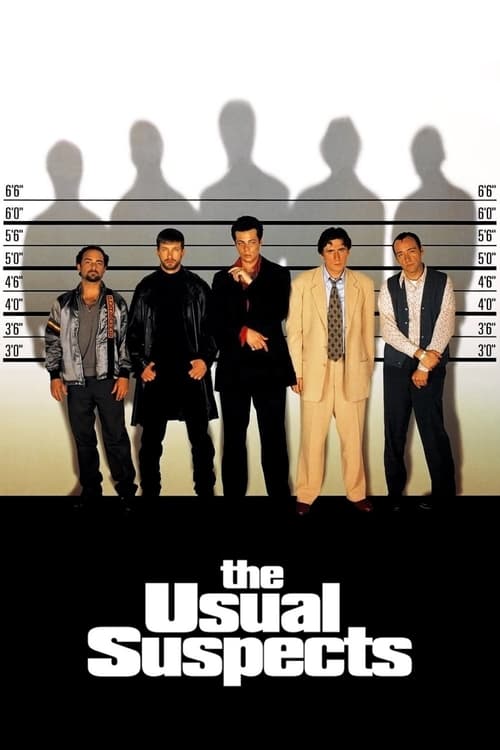
The Usual Suspects
1995 · Bryan Singer
For when you want to play detective — a give-it-your-full-attention thriller for a night when being outsmarted is the fun. Ideal for watching with someone so you can compare theories after.
What it's about
A crippled small-time con man named Verbal Kint sits in an L.A. interrogation room, the near-lone survivor of a massacre on a ship in San Pedro harbor, and tells the story of how he got there: five career criminals thrown together in a police lineup, a string of escalating jobs, and a shadowy crime lord called Keyser Söze whose name makes hardened men go quiet. The cop across the table wants the truth. What he gets is a story.
The experience
A coiled, talky puzzle-box that keeps you leaning forward, sifting every detail for what's real. It's twisty, mordantly funny in flashes, and builds to a finish that rearranges everything you thought you were watching.
Performances
Kevin Spacey won an Oscar as Verbal, a performance of meek, chattering misdirection, and the ensemble around him — Gabriel Byrne's weary ex-cop-turned-crook chief among them — crackles in every lineup and argument.
The craft
Christopher McQuarrie's Oscar-winning screenplay is built with watchmaker precision, nesting the whole film inside one man's testimony, and the editing keeps the flashbacks and the interrogation in constant, sly conversation. It's a masterclass in how structure alone can generate suspense.
Why it matters
A low-budget independent that became one of the defining crime films of the 1990s; its ending entered the canon of great movie reveals and made 'Keyser Söze' cultural shorthand for the boogeyman.
Snapshot
A low-budget American neo-noir crime thriller that became one of the defining films of its decade, The Usual Suspects is constructed around an unreliable narrator whose fabricated testimony constitutes nearly the entire film. Its central question — "Who is Keyser Söze?" — generated cultural afterlife far exceeding its modest origins. Anchored by Kevin Spacey's Oscar-winning performance as Verbal Kint and written by Christopher McQuarrie with geometric precision, the film is equally a confidence trick played on its audience and a sustained meditation on how narrative itself can be weaponized. Its twist ending entered the canon of cinema's great reveals, reshaping audience expectations for the crime thriller for years afterward.
Industry & production
The Usual Suspects emerged from the independent margin of mid-1990s American cinema, produced by PolyGram Filmed Entertainment and Singer's own Bad Hat Harry Productions on a budget of approximately six million dollars. Bryan Singer had made only one prior feature, the little-seen Public Access (1993), and Christopher McQuarrie had no produced screenplay credits. The project existed almost entirely on the strength of McQuarrie's script, which circulated with the kind of word-of-mouth heat unusual for a debut writer. The two had known each other since high school, and Singer was attached as director from the script's inception rather than brought in afterward.
Casting assembled an ensemble of actors at early or inflection points in their careers: Gabriel Byrne, Kevin Spacey, Kevin Pollak, Stephen Baldwin, and Benicio del Toro as the five criminals corralled into the police lineup that opens the story, with Chazz Palminteri as the federal agent conducting the interrogation and Pete Postlethwaite in the pivotal supporting role of Kobayashi. The film's production was concentrated and efficient, consistent with its budget constraints, and principal photography took place in Los Angeles and at various industrial locations meant to evoke the harbor docks where the inciting massacre occurs.
The now-famous lineup scene, in which the five suspects are made to read the same line into a camera, reportedly generated genuine laughter on set — particularly attributed to Benicio del Toro's comic behavior — requiring numerous takes and giving the sequence the looseness that distinguishes it from the procedural formality the scene is nominally meant to depict.
Technology
The Usual Suspects was shot on 35mm film by cinematographer Newton Thomas Sigel, working in the conventional photochemical mode standard for the period. There is no significant deployment of emerging digital technology in the film's production or post-production; it belongs firmly to the analog era, and its visual texture reflects this. The film predates the widespread adoption of digital intermediate color grading, meaning Sigel's choices were committed at the stage of negative exposure and photochemical printing.
Sigel and Singer maintained a collaboration across subsequent work, and the visual language established here — a preference for low-key, high-contrast lighting inflected by noir tradition — was already identifiable as a set of deliberate choices rather than incidental results.
Technique
Cinematography
Newton Thomas Sigel's work on the film is purposefully unglamorous: the palette runs toward desaturated grays, institutional fluorescents, and the smoky half-light of urban interiors. The interrogation room in which Verbal Kint narrates is rendered as a kind of neutral, bureaucratic white-box — deliberately stripped of atmosphere so that the baroque flashback sequences Verbal conjures can carry the film's expressionist weight. Sigel frames the flashback reconstructions with slightly more theatrical intent, shadows deepening, compositions tightening around faces, lending Verbal's fabrications the aesthetic credibility of memory even as the film undermines them. The harbor massacre that bookends the film is lit with a cold, procedural clarity that makes it harder to trust than the warmer, more narratively legible flashbacks — a subtle inversion of the expected relationship between spectacle and truth.
Editing
John Ottman served as both editor and composer — an unusual dual function that gave him rare control over the film's temporal architecture, cutting picture to rhythms he was devising simultaneously. The editing strategy is built around accumulation and misdirection: Verbal's testimony advances through associative flashbacks that feel causally linked until the film's final minutes, when the camera crawls across the interrogation room's bulletin board and reveals that the named details — Kobayashi, Quartet Coffee, Redfoot — are transcriptions of objects visible in Kujan's office. The editorial reveal is a retroactive re-cutting performed in the viewer's mind: every prior cut now requires reassessment. Ottman achieves this without obvious formal telegraphing, maintaining a pace that feels naturalistic rather than deliberately withholding.
Mise-en-scène / staging
Singer's staging throughout relies on the traditional grammar of the police procedural — two-shots, shot-reverse-shot in interrogation, actors placed across institutional furniture — which serves as a container whose very familiarity functions as misdirection. The criminal ensemble sequences, by contrast, employ more ensemble-oriented framings that give the five suspects a collective geometry: they are shot as a group, as a unit of criminal possibility, before individual interests fragment them. The recurring use of the police lineup as a visual motif — a row of bodies, a row of faces, a row of suspects — literalizes the film's thematic preoccupation with the legibility of identity. Postlethwaite's Kobayashi is staged with a particular stillness and controlled elegance that codes him as a representative of something larger than himself.
Sound
Ottman's score is the audio counterpart to his editorial strategy — lyrical, slightly melancholic, built around a main theme that carries the weight of myth-making rather than menace. It functions to make Verbal's story emotionally credible: the music endorses the emotional logic of the narrative even when the narrative is revealed to be fraudulent. The absence of an overtly sinister score for what is ostensibly a film about one of cinema's most formidable villains is a deliberate compositional choice; Söze's music is hushed, even regretful. Sound design in the harbor sequences is rawer and more abrasive, anchoring those scenes in physical contingency the rest of the film deliberately avoids.
Performance
Kevin Spacey's performance as Verbal Kint is the film's central technical achievement and the mechanism on which the entire narrative depends. The character presents as physically diminished — Verbal has a congenital palsy affecting one hand and his gait — and emotionally submissive, seemingly eager to please his interrogators. Spacey calibrates the performance to suggest a man talking too much because he is frightened rather than because he is constructing something. The final shot, in which Spacey's body language and physical bearing visibly transform as Verbal walks out of the police station, recontextualizes everything the viewer has seen without a single line of dialogue. It remains one of cinema's most studied actor-to-camera reveals. Benicio del Toro's near-unintelligible turn as Fenster — reportedly the result of creative choices made during filming about how the character should speak — became a signature of the ensemble and contributed to del Toro's profile as an actor willing to subordinate legibility to character truth.
Narrative & dramatic mode
The film operates as a frame narrative of radical unreliability. Everything after the initial harbor scene is testimony — Verbal's account of events leading to the explosion, delivered to Agent Kujan in an interrogation room and reconstructed by the film in full dramatic flashback as though it were fact. The classical unreliable narrator, in literature, is a technique that places interpretive uncertainty in the reader; Singer and McQuarrie apply it cinematically by fully dramatizing fabricated events, granting them the authority of visual actuality. The audience watches events that never happened as though they happened.
The film's dramatic mode is fundamentally the classic confidence trick structure: trust is established, investment made, and then the ground is pulled. The "long con" narrative — characters deceiving other characters while the audience occupies a privileged position — is here inverted: the audience and Agent Kujan are deceived together, and the revelation lands on both simultaneously. This alignment between Kujan's experience and the viewer's is carefully constructed. We are not shown anything Kujan is not shown; we are, like him, entirely dependent on the narrator's goodwill.
Genre & cycle
The Usual Suspects is neo-noir by design and temperament. It inherits from classic Hollywood noir the foundational elements: the criminal world as moral labyrinth, a protagonist whose reliability is compromised from the start, a narrative assembled from retrospection and incomplete knowledge, and an atmosphere of fatalism that makes individual agency seem illusory. The figure of Keyser Söze — a criminal so mythologized that his actual existence is uncertain — amplifies the noir tradition of the unseen, structuring absence: the Chinatown water conspiracy, the Touch of Evil border corruption, the organizing crime that exceeds any single frame.
The film also participates in the 1990s heist film revival, a cycle that included Reservoir Dogs (1992), Heat (1995), and various international productions; it shares with this cycle an interest in criminal ensemble dynamics, professional codes of conduct, and the catastrophic failure of collaborative criminal enterprises. Within this cycle, The Usual Suspects distinguishes itself by subordinating the heist mechanics to epistemological uncertainty: the audience is ultimately more interested in whether the events occurred than in how the robbery was executed.
Authorship & method
Bryan Singer brought to the film a visual sobriety that resisted stylistic self-assertion, channeling his energy into structural and performance choices rather than cinematographic flourish. His instinct to cast against the mythology he was constructing — to make Keyser Söze's front man look like a timid bureaucrat, to make Söze's instrument look like a limping, frightened witness — reflects a directorial confidence in the script's architecture.
Christopher McQuarrie's screenplay is the film's primary authorial document. Written with a formal elegance that conceals its own tricks, it plants all of its deceptions in plain sight: the names on the bulletin board are visible throughout the interrogation scenes; the script makes no claims about what actually occurred. McQuarrie received the Academy Award for Best Original Screenplay and the film effectively launched his career as a writer of elaborate, structurally sophisticated genre films, a trajectory that eventually led to the Mission: Impossible franchise.
John Ottman's contribution, spanning both editorial structure and musical underscoring, is unusually integrated. Composers typically work from a cut picture; Ottman worked from his own cut, giving the film's rhythm and its emotional color a coherence that a divided collaboration might have disrupted.
Newton Thomas Sigel has spoken in interviews about the deliberate choice to avoid stylization in the interrogation sequences — to deny those scenes the glamour the flashback material might have invited — though the specific details of those conversations are not reliably documented in published sources.
Movement / national cinema
The film is solidly American and operates within a specifically Hollywood independent mode — not the coastal art cinema of Cassavetes or the studio system, but the mid-budget, genre-inflected independent sector that flourished in the aftermath of sex, lies, and videotape and Reservoir Dogs. It has no meaningful engagement with national themes or American cultural mythology beyond the ambient noir inheritance; its criminals are stateless types, its locations functional rather than expressive of place. Keyser Söze is constructed as deliberately un-American, his background vaguely Eastern European, his methods described as belonging to a tradition of violence foreign to the domestic criminal imagination — a deliberate distancing that gives the mythologizing room to operate.
Era / period
The Usual Suspects is a product of the mid-1990s moment in American independent cinema, a period of unusual density in crime filmmaking. Quentin Tarantino had redrawn the genre's possibilities in 1992 and 1994; Michael Mann's Heat appeared the same year; Se7en was released in the same autumn of 1995. The period licensed genre formalism — intricate plotting, ensemble dynamics, self-conscious genre intelligence — in ways that the decade's subsequent years would normalize and eventually exhaust. Singer's film arrived at the precise moment of maximum appetite for this mode.
Themes
Identity is the film's central concern — specifically, the capacity of identity to be performed, sustained, and finally abandoned. Verbal Kint's disability, his apparent weakness, his verbal compliance with Kujan's narrative about Dean Keaton all constitute an identity constructed for the occasion of the interrogation. The film asks how we read identity and what visual and behavioral cues we trust, and answers by demonstrating that trained investigators are no more reliable readers than civilians.
The nature of evil as legend — evil that becomes more potent the less it can be verified — runs through the film's conception of Söze. The film's most quoted line, concerning the devil's greatest achievement being convincing the world he does not exist, articulates a theory of power through obscurity that the film dramatizes structurally: the less Söze is shown, the more credible and terrible he becomes. The phrase itself has antecedents in nineteenth-century literary tradition, and McQuarrie's deployment of it gives the film a slightly archaic, fable-like register.
Narrative complicity — the audience's investment in a storyteller who is lying to them — is simultaneously a formal strategy and a theme. The film is about how willingly we participate in stories we want to be true.
Reception, canon & influence
The Usual Suspects premiered at the Sundance Film Festival in January 1995, where it attracted significant attention, and opened to strong critical reception on its theatrical release in August of the same year. Reviews emphasized the screenplay's structural ingenuity and Spacey's performance. The film's commercial performance substantially exceeded expectations given its budget, and its cultural presence — particularly the Söze mythology and the twist ending — extended well past its theatrical run.
At the 68th Academy Awards, the film won two Oscars: Best Original Screenplay for McQuarrie and Best Supporting Actor for Spacey. These recognitions cemented its status as a significant achievement rather than a clever novelty.
The film's precursors include the noir tradition broadly and Rashomon (1950) in particular as a precedent for cinema organized around unreliable retrospective testimony. Agatha Christie's closed-system mystery structure — a fixed number of suspects, an investigator who is also deceived — is a clear ancestor, as is the hard-boiled tradition's fascination with the criminal mastermind who exists more as rumor than person. The Sting (1973) supplies the con-film template.
Its forward influence is substantial. The twist-ending crime film became a genre unto itself in the late 1990s, with The Sixth Sense (1999) and Fight Club (1999) among its most prominent successors; both films are unimaginable without The Usual Suspects having established audience appetite and narrative permission for the mode. The film launched Bryan Singer toward X-Men (2000) and a sustained studio career; it established McQuarrie as a writer of reliable genre sophistication; it contributed materially to the trajectories of del Toro, Spacey, and Palminteri. The figure of Keyser Söze entered the broader culture as shorthand for the absent, structuring criminal — a villain whose power derives from his unverifiability. Whether any single film can be said to have inaugurated the late-1990s twist-film cycle is an overstatement, but The Usual Suspects sits at its origin with unambiguous centrality.
A Deleuzian reading
Watch the feet.
The full Deleuzian reading of The Usual Suspects →
Reception
A low-budget sleeper that built word-of-mouth through 1995 into Oscar wins for Kevin Spacey and screenwriter Christopher McQuarrie, it spent two decades as a canonical 'greatest twist ever' pick — before the allegations against Spacey and Singer made it one of the era's most awkward rewatches.
How The Usual Suspects was received, from release to now →
Influences: the films it descends from and the films it influenced
- Double Indemnity (1944) — The retrospective voiceover confession narrated to an authority figure who doesn't yet know the truth—Neff talking into a dictaphone for Keyes—is the direct structural blueprint Singer adopts: Verbal's entire testimony is a confessional performance delivered to an investigator who systematically misreads its evidence.
- Rashomon (1950) — Kurosawa renders each witness's self-serving testimony as fully visualized flashback sequences given equal photographic authority to contradictory accounts, establishing the cinematic grammar that shown images can be lies—the precise device Singer weaponizes when Verbal's fabrications materialize as trustworthy film.
- Stage Fright (1950) — The first major deployment of the false flashback—a narrator's deliberate lie rendered as a fully realized film sequence—establishes the precedent Singer exploits: flashback imagery conventionally encodes truth, making Verbal's fabricated reconstructions visually indistinguishable from fact.
- The Killing (1956) — Kubrick's heist ensemble is fragmented across interlocking non-linear time slices and reassembled by editing into criminal causality, establishing the multi-strand ensemble-as-mechanism structure McQuarrie inherits for distributing and strategically withholding narrative information.
- Chinatown (1974) — Polanski deploys procedural investigation grammar—interrogation two-shots across institutional furniture, the detective accumulating misleading evidence—as total misdirection toward a hidden criminal sovereign, the exact staging-as-structural-deception Singer systematizes with Verbal's testimony.
- The Sting (1973) — Hill engineers a confidence-trick structure where the film's audience is the final mark alongside the in-film target, with every prior narrative beat retroactively revealed as strategic misdirection—the architectural model McQuarrie replicates for Verbal's bulletboard-sourced fiction.
- Angel Heart (1987) — Parker stages a neo-noir private investigator as unreliable narrator of his own hidden identity, using expressionist flashback lighting to visualize a protagonist whose embodied performance conceals his true nature from himself—the identity-as-performance-reveal template Singer adapts for Verbal's physical transformation.
- House of Games (1987) — Mamet's procedural dialogue architecture performs information exchange while concealing its real function, constructing a confidence-trick structure in which the film's audience is the mark—the tonal and dramaturgical register McQuarrie inherits for Verbal's total control of his interrogator.
- Reservoir Dogs (1992) — Singer lifts Reservoir Dogs' structural architecture wholesale — the absent crime reconstructed through fragmented retrospective testimony, a hidden informant within an ensemble of named criminals — and extends the 'who is the traitor?' engine into an unreliable narrator framework that makes the narrative's own reconstruction its subject.
- The Crying Game (1992) — Runs the prestige-twist economy Jordan licensed: an entire film built as withheld information whose last-reel reframe retroactively rewrites every prior scene, distributed on the secrecy-based campaign model Miramax developed here.
- L.A. Confidential (1997) — Hanson directly extends Singer's procedural-grammar-as-misdirection: the neo-noir ensemble navigates an investigation whose institutional staging systematically misleads toward a hidden criminal sovereign revealed through a final-act retroactive recontextualization of every prior scene's trusted authority figure.
- Fight Club (1999) — Fincher scales Singer's unreliable-embodiment device to a structural condition: the narrator's split identity requires full retroactive mental re-editing of every prior scene, extending the retroactive-recontextualization mechanism from a final-minutes bulletin-board crawl to a film-length premise.
- The Sixth Sense (1999) — Shyamalan inherits Singer's retroactive-recontextualization architecture as the film's primary structural mechanism—the reveal forces a complete mental re-cut of every prior scene—extending the Usual Suspects' final-minutes re-editing into a design premise engineered from the first shot.
- Memento (2000) — Nolan externalizes Singer's unreliable-narrator device through structural editing inversion—running time fragments backwards to place the viewer inside a compromised POV—making explicit what Singer keeps implicit: that narrative constructed from testimony is always an act of misplaced trust.
- Oldboy (2003) — Park deploys a confidence-trick structure orchestrated by an off-screen mastermind whose revealed plan forces total retroactive recontextualization, extending Singer's hidden-sovereign architecture to a more formally extreme register where the mark's every action was engineered by the antagonist from the start.
- Inside Man (2006) — Singer's dual-timeframe architecture — post-event interrogation intercut with dramatized flashback, the detective as audience surrogate whose access to information is structurally withheld through a puzzle-box design that recontextualizes prior footage at the final reveal — is the direct formal model for Inside Man's interview/crisis intercutting and Barry Alexander Brown's third-act convergence editing.
- The Prestige (2006) — Singer's retrospective unreliable narrator — whose testimony is revealed as constructed fiction, forcing the audience to reread all prior imagery as fabrication — is the specific mechanism The Prestige inherits; the device of a character narrating documents while dramatized events unfold that may be entirely false is structurally identical.
- Memoir of a Murderer (2017) — Pioneers retrospective unreliable first-person narration in which the entire film functions as fabricated testimony, demanding complete retroactive rereading once the narrator's identity is disclosed — the structural grammar Memoir's voiceover-as-confessional directly inherits.
- Forgotten (2017) — Codified retroactive coherence as a dramaturgy: the retrospective narrator's fabrication requires every prior scene to be mentally re-edited by the audience simultaneously at the moment of revelation, a structural expectation Forgotten's script was written to satisfy.
- The Outfit (2022) — Singer's disclosure-motivated editing architecture retroactively recontextualizes the entire narrative through a single withheld identity revelation; the strategic misdirection of audience perception across the full film's duration is the structural template Moore most precisely inherits for his final act.
- Jack Reacher (2012) — McQuarrie's own Oscar-winning screenplay; its architecture of strategically withheld and re-sequenced information is the narrative-engineering signature he brings to Reacher's deduction reveals.
- The Illusionist (2006) — Frames its story as testimony to an investigator and detonates a climactic retrospective montage that re-reads every prior scene as staged—the Inspector Uhl framing device's blueprint.
- The Last Seduction (1994) — Dahl's neo-noir deploys a protagonist whose entire performance is a confidence-trick identity construction, working within the same Hollywood-independent, Sundance-adjacent production context and hard-edged procedural staging that defines the mid-1990s crime renaissance Singer inhabits.
- Heat (1995) — Mann deploys a desaturated blue-gray LA industrial palette and procedural ensemble staging simultaneously with Singer, sharing the same mid-1990s crime-renaissance commitment to treating criminal organization with the visual authority of the police procedural.
- Se7en (1995) — Fincher constructs an invisible criminal mastermind through mythological absence—John Doe accumulates terror before appearing—using the same desaturated neo-noir palette and procedural-grammar-as-misdirection as Singer within the same production window; both films aestheticize criminal intelligence as an organizing force above the frame.
- Following (1999) — Constructs an entire plot as a con narrated by an unreliable witness whose retrospective account is revealed as a fabricated frame — the same patsy-built-from-fragments reveal Following deploys.
- The Invisible Guest (2017) — Perfects the interrogation-frame twist where a narrator spins an elaborate false account and the listener's revealed identity collapses it, the structural rug-pull Paulo copies wholesale.
- Iron Man 3 (2013) — The villain-identity twist — a theatrical decoy concealing the true mastermind — is the exact narrative device Iron Man 3 deploys with Trevor Slattery fronting for Killian.
Similar films
- L.A. Confidential (1997) — influence & lineage
- Memento (2000) — influence & lineage
- Heat (1995) — influence & lineage
- Se7en (1995) — influence & lineage
- Inception (2010) — shared sensibility
- The Mastermind (2025) — shared sensibility
- Sicario (2015) — shared sensibility
- Tenet (2020) — shared sensibility
All the films related to The Usual Suspects →