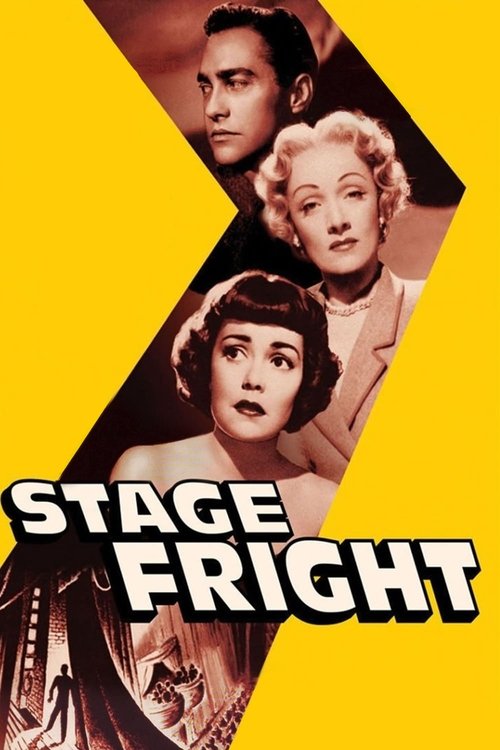
Stage Fright
1950 · Alfred Hitchcock
For a rainy-evening classic-mystery mood — when you want charm, disguises, and a whodunit that toys with you rather than terrifies you.
What it's about
Eve Gill, a drama student in London, hides a friend who's on the run — he swears he's been framed for murdering the husband of Charlotte Inwood, a glamorous West End singer he's been involved with. To dig out the truth, Eve does what an actress does: she invents a role, disguising herself as Charlotte's maid and working her way inside the star's household. Complicating everything, she's falling for the detective on the case.
The experience
Lighter on its feet than Hitchcock's darkest work — witty, theatrical, and playfully devious, with the suspense coming from watching an amateur keep a dangerous performance going one improvised line at a time. It builds to a genuinely tense finish while keeping a twinkle in its eye.
Performances
Marlene Dietrich is the show as Charlotte Inwood — imperious, funny, and impossible to read — while Jane Wyman makes Eve's amateur sleuthing both comic and quietly brave. Alastair Sim steals scenes as Eve's roguish father.
The craft
Hitchcock returned to England for this one and steeped it in the world he knew — drama schools, dressing rooms, the West End — so the whole film is about performance, on stage and off. It's also famous among film lovers for one daring storytelling gambit that quietly breaks a rule thrillers were assumed to follow; best discovered cold.
Why it matters
Long treated as minor Hitchcock, it's been reappraised for that audacious narrative trick — a device so controversial at the time that filmmakers argued about whether a movie was allowed to do it.
Snapshot
Stage Fright is the film Alfred Hitchcock made on his return to England at the end of the 1940s — a backstage thriller set in the overlapping worlds of the Royal Academy of Dramatic Art and the West End stage, in which an aspiring actress turns her training to the most dangerous role of her life. Eve Gill (Jane Wyman) shelters a friend, Jonathan Cooper (Richard Todd), who claims to be the framed lover of the glamorous singer-actress Charlotte Inwood (Marlene Dietrich), accused of murdering her husband. To clear him, Eve disguises herself as a maid and infiltrates Charlotte's household, even as she falls for the detective investigating the case. The picture is best remembered today for a single audacious gambit — an opening flashback that the film later reveals to be a lie — and for the way it folds Hitchcock's lifelong fascination with performance, impersonation, and the unreliability of appearances into its very form. Made between the commercial disappointment of Under Capricorn (1949) and the triumphant Strangers on a Train (1951), it is a transitional, uneven, but unusually self-aware entry in his catalog.
Industry & production
Stage Fright was produced for Warner Bros. and shot at Associated British's Elstree Studios outside London, the studio where Hitchcock had begun his directing career in the silent era. It belongs to the contractual phase that bound Hitchcock to Warner Bros. and to the producer's role he had taken on through Transatlantic Pictures, the independent venture he had formed with Sidney Bernstein (the company behind Rope and Under Capricorn). The English setting allowed Hitchcock to work close to home and to draw on a deep bench of British stage talent — Alastair Sim, Sybil Thorndike, Kay Walsh, Joyce Grenfell in a memorable comic cameo at the garden fête — while the casting of two transatlantic stars, the American Jane Wyman (then newly an Academy Award winner for Johnny Belinda) and the German-born, internationally branded Marlene Dietrich, served the box-office logic of an Anglo-American co-production.
The source was Selwyn Jepson's novel Man Running (published in the United States as Outrun the Constable). The film is also notable as the screen debut of Hitchcock's daughter, Patricia Hitchcock, who plays Eve's wry friend "Chubby" Bannister. Dietrich, by all accounts, exerted considerable control over her own presentation — her gowns were by Christian Dior, and she is reported to have been exacting about her lighting, drawing on decades of experience in how she should be photographed. Precise budget and box-office figures for the production are not something I can state reliably, and contemporary accounts generally place the film as a modest performer rather than a hit; I won't invent numbers to fill that gap.
Technology
Technologically Stage Fright is a conventional black-and-white, Academy-ratio studio production of its moment, with optical printing used for its most discussed effect — the dramatized flashback. It carries no innovation comparable to the long-take experiments of Rope. Its interest lies less in apparatus than in the manipulation of standard tools of continuity cinema, and especially in the way image and sound are deployed to deceive. The film's most "technological" idea is conceptual rather than mechanical: the recognition that the photographic image, conventionally trusted as objective testimony, can be made to lie as fluently as a spoken sentence.
Technique
Cinematography
The cinematography is by Wilkie Cooper, a British cameraman who would later be associated with Ray Harryhausen's fantasy films. His work here is functional and polished in the studio idiom, ranging from the bright artifice of the theatrical garden fête to the shadowed interiors of Charlotte's dressing room and the Gill household. The visual signature of the film, however, is dictated by Dietrich, who is lit and framed throughout as a self-consciously glamorous object — a star photographed as a star — in pointed contrast to Wyman's deliberately dowdied-down "Doris," the plain lady's maid Eve pretends to be. That contrast is itself thematic: the film makes its lighting and framing carry the difference between performance and concealment.
Editing
Edited by Edward B. Jarvis, the film's cutting is most consequential in its opening. Stage Fright begins with a safety curtain rising on London and moves immediately into Jonathan's account of the murder, rendered as a fully dramatized flashback complete with the authority of objective continuity editing. Only later does the film disclose that this sequence was a fabrication — Jonathan's self-serving story. The editing thus does not merely arrange events; it is complicit in the deception, presenting a falsehood with the same grammar of cuts and eyelines that audiences had been trained to read as truth. The remainder of the film is cut in a more standard suspense register, building toward the garden-party climax.
Mise-en-scène / staging
The mise-en-scène is saturated with theater. The film moves through RADA classrooms, theatrical digs, dressing rooms, a charity garden fête staged like a piece of pageantry, and finally the literal machinery of a stage — culminating in the descent of an iron safety curtain. Hitchcock organizes the world so that nearly every space is a stage and nearly every character is, at some level, performing: Eve performs Doris; Charlotte performs grief and innocence; Jonathan performs the wronged man; even Eve's father, Commodore Gill (Alastair Sim), stage-manages a small piece of theater to expose the truth, contriving a bloodstained doll to crack Charlotte's composure in public. The staging consistently dramatizes the idea that identity is a role assumed for an audience.
Sound
Sound is integral to the film's reflexive design. Music by Leighton Lucas underscores the action, but the film's most memorable aural element is Dietrich's performance of "The Laziest Gal in Town," written by Cole Porter — a musical number that doubles as a portrait of Charlotte's languid, self-dramatizing persona. Dietrich also performs "La Vie en Rose." The use of song is not decorative: it locates Charlotte firmly in the world of the staged performance, where seduction and artifice are her professional métier, and lets the film comment on her character through the medium she commands.
Performance
Performance is the film's subject and its medium, and the acting is correspondingly layered with self-reference. Jane Wyman carries the picture as Eve, an actress playing an actress playing a maid; the central conceit asks the audience to watch a performer perform poor disguise. (Wyman is sometimes reported to have resisted the plainness the role required, an instinct at odds with the part's logic.) Dietrich gives one of her definitive late-career star turns as Charlotte Inwood, essentially deploying the Dietrich myth as a character — imperious, glamorous, opaque. Richard Todd plays the febrile, increasingly unstable Jonathan; Michael Wilding is the easygoing detective "Ordinary" Smith; and the supporting ensemble — Sim's mischievous Commodore, Thorndike as Eve's mother, Walsh as Charlotte's maid Nellie — supplies the seasoned British character work that gives the film its texture.
Narrative & dramatic mode
The narrative mode is the most historically significant thing about Stage Fright. It is built on what has come to be called the "lying flashback": the film opens by dramatizing, in good faith and with full cinematic authority, an account that is subsequently revealed to be false. This breaks an implicit contract of classical cinema — that while characters may lie in dialogue, the objective image does not. Hitchcock himself came to regard the device as a misjudgment; in his interviews with François Truffaut he acknowledged that audiences felt cheated, reasoning that viewers will accept a verbal lie but resist a visual one. Whether mistake or experiment, the gambit makes Stage Fright an unusually pure study in unreliable narration, and it knits formally with the film's content, which is everywhere concerned with feigning, impersonation, and the impossibility of trusting surfaces. Around this conceit the film runs a fairly conventional amateur-detective plot in the Hitchcock "innocent investigator" mold, leavened with romantic comedy.
Genre & cycle
Stage Fright sits within Hitchcock's long cycle of wrong-man and amateur-sleuth thrillers, but it leans markedly toward comedy and the backstage picture. It is less a taut suspense machine than a hybrid: part romantic comedy of disguise, part whodunit, part theatrical milieu study. Within the broader 1950 landscape it stands somewhat apart from the American film noir cycle then at its height; though it shares noir's interest in deception and a fatale figure in Charlotte, its tone is lighter, its setting more genteel-theatrical, and its sensibility more English drawing-room than American mean street. It belongs, finally, to the small Hitchcock sub-tradition of films set explicitly in the theater, looking back to Murder! (1930).
Authorship & method
The film is unmistakably Hitchcock's in its preoccupations — performance, guilt, the transfer of suspicion, the ordinary person drawn into deception — but it is also a collaboration that reaches into his innermost circle. The screenplay is credited to Whitfield Cook, with adaptation by Alma Reville, Hitchcock's wife and a long-standing creative partner whose contributions across his career were substantial, and additional dialogue by the Scottish playwright James Bridie. The cinematographer was Wilkie Cooper; the composer Leighton Lucas; the editor Edward B. Jarvis. Dietrich functioned as something close to a co-author of her own image, shaping costume and lighting to her established persona. Hitchcock's method here — building the film around a structural trick and a milieu he knew intimately from his theatrical interests — is characteristic of his fascination with the mechanics of audience belief, even when, by his own later judgment, the experiment did not entirely land.
Movement / national cinema
The film is a hinge between Hitchcock's American studio period and the British cinema of his origins. Shot in England with a largely British cast and crew, it draws on the country's rich theatrical tradition and the talent pool of its stage. Yet it was made for a Hollywood studio and headlined by stars with American and international profiles, so it cannot be claimed simply for British national cinema; it is best understood as a transatlantic production reflecting Hitchcock's own divided professional geography at mid-century. Its theatrical Englishness — RADA, the garden fête, the West End — gives it a distinct national texture rare in his American-period work.
Era / period
Released in 1950, Stage Fright belongs to the immediate postwar moment and to a particular crossroads in Hitchcock's career. It follows two films that had tested his independence and his audience's patience (Rope and Under Capricorn) and immediately precedes the run of acclaimed thrillers — beginning with Strangers on a Train — that would define his 1950s. Viewed in period, it reads as a consolidating, somewhat tentative work: a return to familiar ground after experiment, in which Hitchcock regroups around genre and milieu before the great commercial-critical successes to come.
Themes
The governing theme is performance and its dangers — the proximity of acting to lying, of the stage to the courtroom, of role-play to deceit. Eve, an actress, discovers that life off the stage demands the same skills and exacts higher stakes; her disguise as Doris is her finest role and very nearly her undoing. Allied to this is the theme of the unreliable surface: the film distrusts appearances so thoroughly that it extends that distrust to its own images, implicating the viewer's faith in what the camera shows. Guilt and innocence circulate freely, attaching to the wrong people, in the Hitchcockian pattern of transferred and misread culpability. And beneath the comedy runs a darker observation about glamour and predation — Charlotte's staged femininity as a weapon, and the fatal cost of believing a beautiful story.
Reception, canon & influence
Contemporary reception was lukewarm, and Stage Fright has generally been regarded as minor or transitional Hitchcock — a film of fine parts (Dietrich's number, Sim's comedy, the reflexive wit) that does not cohere with the force of his best work. Hitchcock's own dissatisfaction with the lying flashback, voiced to Truffaut, has shaped that critical consensus, and the film is often introduced precisely through that "mistake." Detailed contemporary box-office figures are not something I can verify, and I will not supply them; the safe statement is that the film made comparatively little lasting noise on release.
Its influences run backward into Hitchcock's own career — the theatrical setting of Murder!, the wrong-man and transferred-guilt structures recurring across his British and American thrillers, and his abiding interest in the audience as the true subject of suspense. Looking forward, the film's significance has grown precisely around the device its director regretted. The "lying flashback" has become a standard reference point in discussions of cinematic narration and the ethics of the image, repeatedly invoked when later films deploy deceptive visual storytelling — the unreliable flashback of The Usual Suspects (1995) being the most frequently cited descendant. In this sense Stage Fright enjoys a second life as a theoretical case study: the picture that broke the image's promise of truth, and so opened a question that modern film has never stopped exploring. Patricia Hitchcock's debut here also marks the start of her intermittent presence in her father's films. The legacy, then, is paradoxical — a film judged a lesser work whose boldest miscalculation proved one of its director's most generative bequests.
A Deleuzian reading
The film opens with an iron safety curtain rising on a painted London, and within a minute you are inside another man's story.
The full Deleuzian reading of Stage Fright →
Reception
Dismissed on release as minor Hitchcock — a talky British misfire between his Hollywood peaks — it's been quietly upgraded by fans of its theatrical wit and Marlene Dietrich's imperious turn, with its once-derided narrative gambit now defended as decades ahead of its time.
How Stage Fright was received, from release to now →
Influences: the films it descends from and the films it influenced
- Murder! (1930) — Establishes Hitchcock's backstage-theater milieu with an actor-detective who penetrates a theatrical company to solve a killing, the template Stage Fright reworks around RADA students and the stage world.
- Blackmail (1929) — Pioneers Hitchcock's transferred-guilt mechanism — a woman shielding a killer while audience sympathy is steered toward the complicit — which Stage Fright inherits in Eve's protection of a man she believes innocent.
- The Lodger (1927) — Engineers wrong-man suspicion purely through framing and editing, training the audience to misread an innocent — the same visual rhetoric of misdirection Stage Fright turns into its central trick.
- The 39 Steps (1935) — Frames the wrong-man chase inside music-hall performance (the Mr. Memory bookends), fusing showmanship with suspense exactly as Stage Fright nests its thriller inside a theatrical world.
- The Cabinet of Dr. Caligari (1920) — The founding instance of an entire narrative delivered as an unreliable subjective account whose images are retroactively exposed as a deranged narrator's construction — the deep precedent for the lying flashback.
- The Blue Angel (1930) — Forges Dietrich's co-authored star image around a diegetic cabaret number and self-shaped costume, the persona-as-performance she imports wholesale into Stage Fright's 'La Vie en Rose' set piece.
- Shanghai Express (1932) — Codifies the von Sternberg/Dietrich glamour-lighting grammar — veiling and key light sculpting her face — which Dietrich effectively dictated for her own scenes in Stage Fright.
- The Woman in the Window (1944) — Its notorious lying flashback — the film's images deceiving the viewer outright — belongs to the same lineage of trick, unreliable framing that Lang's dream-cheat ending provoked.
- The Usual Suspects (1995) — The explicit heir to the lying flashback: a narrator's fabricated story is dramatized as truthful image and only retroactively exposed, the most-cited descendant of Stage Fright's device.
- Fight Club (1999) — Uses deceptive continuity to conceal the narrator's true identity, withholding the key fact through the image exactly as Stage Fright's flashback hides the real killer.
- Hero (2002) — Builds competing color-coded flashbacks, several knowingly false, around recollection that lies — a stylized elaboration of Stage Fright's premise that a flashback can deceive.
- Gone Girl (2014) — Dramatizes Amy's fabricated diary as flashback that the film later exposes as invention, a direct modern deployment of the lying-flashback ethics Stage Fright opened.
- Atonement (2007) — Reveals its dramatized account to be a guilty fabrication, weaponizing the lying flashback as a confession about the image's broken promise of truth.
- Witness for the Prosecution (1957) — Hitchcock embeds a false flashback — visualized testimony shown as objective fact — establishing the principle that expressionist reconstruction can itself be the lie; this direct precursor to Christine Vole's flashback sequences makes the audience's visual evidence unreliable by design.
- Glass Onion: A Knives Out Mystery (2022) — Hitchcock presents a character's fabricated account as objective-reality footage, establishing the formal device of lying visual presentation — the camera as active deceiver rather than neutral observer — that Glass Onion's mid-film rewind weaponizes against the audience.
- Rashomon (1950) — The same year's parallel experiment in mutually contradictory eyewitness flashbacks, where the dramatized image itself cannot be trusted as testimony.
- All About Eve (1950) — Sets performance-as-deception inside a backstage-theater milieu, with an ingénue's self-fashioning operating as a sustained con — the contemporaneous prestige version of Stage Fright's theatrical masquerade.
- Sunset Boulevard (1950) — Meta-casts a faded star (Swanson) performing a version of herself and destabilizes its narration's reliability, twinning Stage Fright's Dietrich star-persona play and its untrustworthy storytelling.
- Vertigo (1958) — Hitchcock himself extends performance-as-deception — a woman knowingly playing a fabricated role while the audience's belief is the true subject — the mature flowering of Stage Fright's concerns.
- The Invisible Guest (2017) — Pioneers the lying flashback — visualizing a character's spoken account as if it were true, then detonating it — the specific betrayal-of-the-image trick Paulo builds his whole confession around.
Similar films
- The 39 Steps (1935) — influence & lineage
- Vertigo (1958) — influence & lineage
- The Cabinet of Dr. Caligari (1920) — influence & lineage
- All About Eve (1950) — influence & lineage
- Sunset Boulevard (1950) — influence & lineage
- Gone Girl (2014) — influence & lineage
- The Lady Vanishes (1938) — shared sensibility
- Rebecca (1940) — shared sensibility
All the films related to Stage Fright →