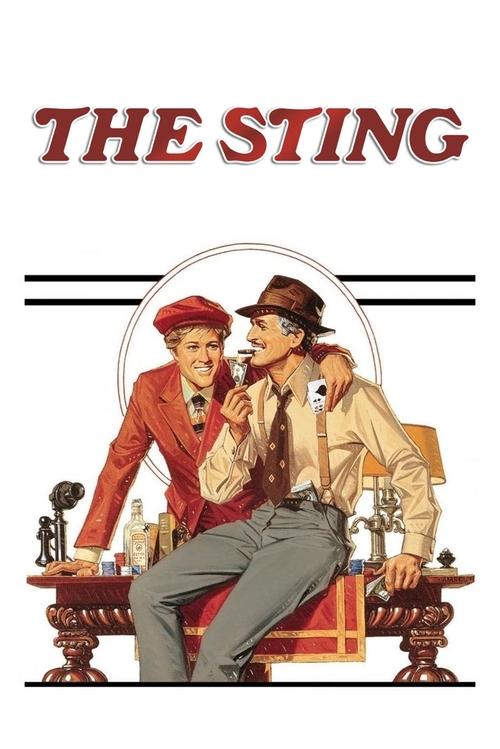
The Sting
1973 · George Roy Hill
For a night when you want to be entertained, full stop — clever without being demanding, stylish without being cold. This is comfort cinema with a wicked streak; great with company.
What it's about
Depression-era Chicago: a small-time grifter watches his mentor get murdered by a mob boss and decides the only revenge worth having is an expensive one. He teams up with a legendary con man gone to seed, and together they assemble a crew to run the 'big con' — a fake betting parlor built from scratch — against a man who kills people for far less. Every piece of the scheme has to land perfectly, and the mark can never know he was played.
The experience
Pure pleasure — playful, twisty, and immaculately paced, with a grin under every scene. Part of the fun is that the film cons you too: it hides its own machinery until the last possible second.
Performances
Paul Newman and Robert Redford are effortless together — Newman all rumpled, boozy charm as the old master, Redford quick and eager as the apprentice — and Robert Shaw makes the mob boss genuinely menacing, so the game feels like it has real stakes.
The craft
George Roy Hill structures the film like a storybook, with chapter titles borrowed from con-man slang, and the period Chicago production design is a joy to look at. The ragtime piano score became instantly iconic and gives the whole caper its jaunty, wind-up-toy bounce.
Why it matters
It swept the Oscars, including Best Picture, and remains the movie every con-artist and heist film gets measured against — the definitive screen treatment of the long con.
Snapshot
A Depression-era Chicago con-man procedural in which small-time grifter Johnny Hooker (Robert Redford) enlists veteran operator Henry Gondorff (Paul Newman) to avenge the murder of their mutual friend Luther Coleman by running a long con—a fake off-track betting parlor—against Irish mob boss Doyle Lonnegan (Robert Shaw). Structured as a chapter-play with intertitles borrowed from the argot of professional swindlers, the film withholds the full architecture of its deception from the audience as well as the mark, delivering a final reversal that implicates the viewer in the pleasure of being fooled. Winner of seven Academy Awards including Best Picture, Best Director, and Best Original Screenplay, it remains the definitive Hollywood treatment of the confidence racket and one of the most commercially successful films of the 1970s.
Industry & production
Universal Pictures backed the project through Zanuck/Brown Productions, the independent unit Richard D. Zanuck and David Brown had formed after leaving Fox. The script by David S. Ward, a then-unknown writer, circulated Hollywood for some time before reaching the Zanuck/Brown desk; its elaborate con architecture and sheer length posed obvious production risks. The decisive factor was the availability of Paul Newman and Robert Redford, whose teaming in George Roy Hill's Butch Cassidy and the Sundance Kid (1969) had been one of the great commercial successes of the era. Reassembling Hill, Newman, and Redford four years later was an explicit industry strategy—a pre-sold combination at a moment when studios were still learning to work within and around New Hollywood's auteurist energies.
The film was shot largely in southern California, with Universal backlot facilities and period locations standing in for 1930s Joliet and Chicago. Production designer Henry Bumstead, a veteran of Hitchcock's collaborations with him (Vertigo, The Man Who Knew Too Much), supervised the meticulous recreation of Depression-era urban interiors—betting parlors, rooming houses, pool halls—that give the film its material density. Bumstead and set decorator James Payne won the Academy Award for Best Art Direction. The budget was substantial but not extravagant by major-studio standards of the period; Universal had confidence in the commercial formula and gave Hill relatively unconstrained control.
David S. Ward won the Academy Award for Best Original Screenplay, though the film's debt to David Maurer's 1940 non-fiction study The Big Con: The Story of the Confidence Man and Confidence Game is well documented. Maurer's taxonomy of the "big con"—its stages, its vocabulary, its social psychology—provided the operational spine of Ward's script. Universal subsequently settled a dispute with Maurer's estate over the screenplay's relationship to the book, though the exact terms were not made public.
Technology
The Sting presents no special case in the history of filmmaking technology; Hill and cinematographer Robert Surtees worked within the established practices of major American studio production in the early 1970s. Surtees's approach was largely invisible and classical—controlled, motivated lighting that reinforced period plausibility without drawing attention to itself. The sepia-inflected palette that characterizes the film's look was achieved through careful choices in stock, processing, and post-production timing rather than any novel technique, designed to evoke the warm tones of period photography and early color newsprint illustration. The production's contribution to technical craft is primarily in the application of conventional tools to an unusually precise period-recreation task.
Marvin Hamlisch's musical supervision similarly relied on standard recording practice, though his editorial decisions in presenting Scott Joplin's compositions had enormous cultural consequences.
Technique
Cinematography
Robert Surtees, a three-time Academy Award winner (King Solomon's Mines, The Bad and the Beautiful, Ben-Hur), brought an old-Hollywood fluency to The Sting that is both its strength and its invisible architecture. The cinematography is fundamentally classical: motivated source lighting, a controlled palette, camera movement in service of performance rather than commentary. Surtees calibrates the light to differentiate spaces meaningfully—the dank, cash-green interiors of Lonnegan's world against the burnished amber of Gondorff's Chicago operation—but never imposes a visual signature that would compete with the intricate plotting. The decision to warm and slightly desaturate the image, giving it the quality of old photographs or hand-tinted film stills, is a consistent and carefully maintained choice that places the film at one remove from the present, reinforcing its appeal as a nostalgic fantasy.
Editing
William Reynolds, who had edited The Sound of Music (1965) and Butch Cassidy and the Sundance Kid, won the Academy Award for Best Film Editing on The Sting, and the honor was well earned. The film's structural complexity—interweaving multiple con-man operations, introducing secondary characters whose loyalties are ambiguous, and withholding information that will be retroactively revealed—demands an editor who can maintain narrative clarity without sacrificing surprise. Reynolds achieves this through rigorous control of spatial and temporal orientation. He also deploys period-appropriate transitional devices: iris wipes, freeze frames styled as photographic stills, and the intertitle chapter breaks that punctuate and reframe the action. These devices are not merely decorative; they invoke the silent-serial and early talkie tradition, embedding the film in a cinematic past that mirrors its historical setting.
Mise-en-scène / staging
Hill's theatrical background—he had directed for both Broadway and television before moving into features—manifests in The Sting as a preference for ensemble blocking and the management of information within the frame. The film's great set pieces are not action sequences but scenes of performance within performance: Gondorff playing drunk on the train to Lonnegan while signaling his complete control of the situation; the climactic fake FBI raid in which every participant must sustain a role while appearing to break from another. Hill stages these recursively deceptive scenes with clear spatial grammar, ensuring the audience can follow the choreography of who knows what and when. The production design collaborates directly with the staging: Bumstead's fake betting parlor, the "shop," is constructed to operate as a theatrical set—a space designed to be performed in by people who are performing.
Sound
The soundtrack is defined by Marvin Hamlisch's adaptation of Scott Joplin's ragtime compositions, principally "The Entertainer" (1902), which Hamlisch re-arranged for the film with infectious lightness. The choice is technically anachronistic—ragtime's commercial peak was roughly 1897–1917, and a 1936 setting would more plausibly feature swing—but the anachronism was either overlooked or forgiven in the film's enormous success. Hamlisch won the Academy Award for Best Scoring: Adaptation and Original Song Score. The cultural effect was significant and durable: The Sting triggered a mainstream Joplin revival and substantially contributed to the posthumous canonization of Joplin as a major American composer, a recognition that culminated in the award of a posthumous Pulitzer Prize to Joplin in 1976. On the level of narrative sound, the dialogue mix is conventional; the film's sound design does not depart from studio norms of the period.
Performance
The Newman/Redford pairing is the film's primary performative event, and Hill orchestrates it with the practiced skill of a director who understands star chemistry as a formal resource. Redford's Hooker is impulsive, eager, slightly overwhelmed—the audience surrogate whose incomplete knowledge mirrors our own. Newman's Gondorff is all containment and timing: a man performing incompetence (the drunken card game with Lonnegan) who reveals mastery only in retrospect. The contrast maps directly onto the film's epistemological game. Robert Shaw as Lonnegan plays against type in a different direction—his physical authority and barely suppressed Irish fury create a credible threat that the film needs to earn its stakes. The supporting ensemble, including Charles Durning, Harold Gould, and Ray Walston, contributes the texture of a world rather than a series of functional roles. Edith Head's costume design—her record eighth Academy Award—functions as a performative element in itself, the careful tailoring of each character's sartorial register signaling status, aspiration, and disguise.
Narrative & dramatic mode
The Sting is formally organized around the stages of what Maurer called the "big con," and the film announces this openly: its chapter intertitles—"The Setup," "The Hook," "The Tale," "The Wire," "The Shut-Out," "The Sting"—are drawn directly from the vocabulary of professional confidence operators. This structural transparency is itself a narrative strategy. By naming the stages of the deception, the film invites the audience to believe they understand the game being played, which is precisely the condition of the mark inside the diegesis. The final reversal—in which the apparent deaths of Gondorff and Hooker are revealed as the last layer of the operation, and the entire supporting cast is unmasked as fellow conspirators including a figure presented as a federal agent—works because the audience has been managed with the same care as Lonnegan.
The dramatic mode is simultaneously comic and procedural. There is genuine menace (Lonnegan's enforcer Floyd kills Luther; Hooker is stalked by a hitman throughout the film), but the tonal register is fundamentally light, its pleasures those of watching skilled craftsmen at work. The film belongs to what might be called the "competence porn" tradition—narratives whose primary satisfaction is the detailed observation of expertise—though it complicates this by withholding the evidence of that expertise until the final sequence.
Genre & cycle
The Sting participates in and substantially defines the heist/caper subgenre, which was finding renewed energy in Hollywood in the late 1960s and early 1970s. It is distinguished from the contemporaneous heist film, however, by substituting the con for physical theft: there is no vault, no guard to overpower, no getaway. The violence that does occur—Luther's murder, the threat hanging over Hooker—is external to the central mechanism of the story, which unfolds entirely in the psychological register. This places the film closer to literary confidence-trick narratives (Patricia Highsmith, not John Huston) than to The Italian Job or Ocean's 11.
The film also belongs to the early-1970s nostalgia cycle, a loosely coherent tendency in American cinema that included Chinatown (1974), The Way We Were (1973), and Paper Moon (1973), among others—films that turned to the 1930s and Depression-era America as a setting at a moment of significant cultural anxiety. The appeal of the period is complex: partly escapism, partly a myth of American resilience, partly an implicit critique of the present through the past. The Sting's con men operating against a corrupt mob boss carry a faint populist charge that the Depression backdrop amplifies without making explicit.
Authorship & method
George Roy Hill (1921–2002) is a director whose reputation has been shaped more by the commercial success of individual films than by sustained auteurist recognition, a fact that may reflect critical discomfort with his chameleonic genre facility as much as any absence of authorial signature. A graduate of Trinity College Dublin and Yale School of Drama, trained as a musician, Hill brought genuine technical range to projects as varied as Toys in the Attic (1963), Hawaii (1966), Butch Cassidy and the Sundance Kid (1969), Slaughterhouse-Five (1972), and The World According to Garp (1982). What links these is less a visual signature than a consistent interest in elegiac male friendship, tonal instability (comedy shading into violence or loss), and the architecture of performance—characters who sustain poses for audiences within the diegesis.
On The Sting, Hill's collaboration with Ward, Surtees, Reynolds, Bumstead, Hamlisch, Head, and the Newman/Redford pairing represents the classical Hollywood model of authorship-as-orchestration. Hill trusted his department heads and his stars; he was known on set for directorial efficiency and clear communication of intention rather than autocratic control. His musical training informed his understanding of narrative rhythm and his rapport with Hamlisch on the score. The film is best understood as a collaborative artifact whose coherence derives from Hill's tonal management rather than from any single strong personal signature.
Movement / national cinema
The Sting occupies a paradoxical position within New Hollywood. It was produced and released at the height of the movement's influence—the same year as The Exorcist, Serpico, Mean Streets, and Badlands—but its relationship to the New Hollywood aesthetic is more tangential than immersive. Where canonical New Hollywood films foregrounded formal self-consciousness, moral ambiguity without resolution, and the deconstruction of genre, The Sting embraces genre, delivers resolution, and courts pleasure without irony. It is classical in form while contemporary in its commercial self-awareness.
Some film historians classify it as a transitional work that anticipates the blockbuster era's reassertion of classical narrative satisfaction—a line of development that would culminate in Jaws (1975) and Star Wars (1977). The argument has merit: The Sting's enormous commercial success demonstrated that audiences in the early 1970s had appetites the New Hollywood's more abrasive tendencies did not fully address, and that a well-crafted genre film with major stars could outperform the art-cinema inflected works the period is now most associated with.
Era / period
The film was released in December 1973 and became the highest-grossing film of that year in North America, a commercial achievement that registered against a broader context of American cultural crisis—Watergate, the Vietnam withdrawal, the oil embargo, sustained social fragmentation. The paradox of The Sting's period is that its Depression-era setting, populated by charming criminals operating against corrupt power, resonated in a political environment saturated with official dishonesty. The con men are not heroes in any conventional sense, but their competence and loyalty to one another offer satisfactions that the political present conspicuously withheld.
Themes
The film's most persistent theme is the ethics and aesthetics of deception—not deception as moral failing but as craft, as a form of labor that demands intelligence, coordination, and nerve. Gondorff and Hooker are not critiqued for what they do; the film is wholly aligned with their project. What grounds this alignment is the target: Lonnegan is not merely corrupt but murderous, and the con is explicitly framed as justice that the legitimate legal system cannot deliver. The revenge plot provides moral permission for the audience to enjoy the spectacle of swindling.
Beneath the genre machinery, the film is a study in trust and apprenticeship. Hooker must take Gondorff's competence on faith through most of the operation; the audience is in the same position. This epistemological structure—knowledge withheld, trust extended, understanding retroactively conferred—mirrors the social dynamics of the confidence game itself, which depends on the mark's willingness to believe. The film turns this into a form of pleasure rather than critique.
The Depression setting introduces, without belaboring, a context of systemic economic failure that makes individual fraud feel like a minor infraction beside the larger frauds of capitalism. This is sketched lightly; The Sting is not a political film in any programmatic sense, but the period setting carries ideological content that inflects the moral valence of its protagonists.
Reception, canon & influence
Backward influences: David Maurer's The Big Con (1940) is the foundational source, providing both the operational vocabulary and the sociological framework for Ward's script. The film draws on the tradition of the American trickster narrative—a lineage extending from frontier tall tales through O. Henry's short fiction to Damon Runyon's Broadway world. Cinematically, the chapter-play structure invokes the serial tradition of early Hollywood, and the Newman/Redford pairing builds directly on the chemistry established in Butch Cassidy and the Sundance Kid (1969). The Depression-era nostalgia aesthetic connects to a strain of American cinema interested in the period as a site of populist mythology, from Bonnie and Clyde (1967) onward.
Critical reception: Initial reviews were strongly positive, if sometimes cautious about the film's cheerful amorality. Critics recognized the craftsmanship of the production and the pleasures of the Newman/Redford dynamic. The film's seven Oscar wins—including Best Picture over American Graffiti, The Exorcist, A Touch of Class, and Cries and Whispers—confirmed its standing with the industry, though the Best Picture win has been revisited by critics who find the choice conservative given the competition. Vincent Canby's New York Times review praised the film's polish and star performances while acknowledging its fundamental commitment to entertainment over ambition. Over time, critical consensus has settled on The Sting as a consummate genre exercise rather than a major artistic statement—praised for what it is rather than for what it aspires to be.
Forward legacy: The most immediately measurable cultural consequence of The Sting is the Joplin revival. The film introduced Scott Joplin's music to an audience that had no prior relationship to ragtime, generating a wave of recordings, performances, and scholarly attention that substantially altered Joplin's posthumous reputation. The 1976 Pulitzer Prize is directly connected to this renewed visibility.
Within film history, The Sting established formal conventions for the con-film subgenre that subsequent productions have consistently engaged with, whether directly or in reaction. The principle that the audience should be conned alongside the mark—and that this should be pleasurable rather than alienating—is now genre orthodoxy, evident in films from House of Games (1987) to The Spanish Prisoner (1997) to Steven Soderbergh's Ocean's Eleven (2001) and its sequels. The chapter-title device has been widely borrowed as a marker of genre self-consciousness. More broadly, the film demonstrated the commercial viability of the nostalgia cycle and contributed to a studio appetite for period genre films that would shape American cinema through the 1970s and into the 1980s.
A Deleuzian reading
Start on the floor of the fake betting parlor.
The full Deleuzian reading of The Sting →
Reception
A massive hit on release — it won seven Oscars including Best Picture and out-grossed nearly everything in 1973-74 — and unlike many Best Picture winners it never suffered a backlash: it's aged into a beloved, endlessly rewatchable comfort classic.
How The Sting was received, from release to now →
Influences: the films it descends from and the films it influenced
- Butch Cassidy and the Sundance Kid (1969) — Hill and Newman/Redford first established the casual-rivalry two-hander as dramatic architecture here; The Sting explicitly reassembled this trio and replicated their improvisatory banter structure and Hill's theatrical staging of their scenes as competitive performance duels.
- The Hustler (1961) — Newman's Fast Eddie codified the charming-rogue whose compulsion overrides skill as a screen persona that Redford's Hooker directly inherits; Rossen's pool hall also established the deception-as-spectator-sport staging—a performance space watched by an audience within the film—that The Sting's betting parlor replicates.
- The Lady Eve (1941) — Sturges established the confidence trick as sustained comedic engine in which the audience watches the mark being manipulated while the grifter improvises within the scheme; The Sting's audience-as-mark structure and its protagonist maintaining a false persona across the film's full length both derive from this model.
- Tom Jones (1963) — Richardson's period comedy deployed silent-era formal devices—iris wipes, freeze frames, direct-to-camera address—as theatrical self-consciousness within a historical setting; The Sting's adoption of precisely these transitional devices (iris wipes, freeze-frame stills, chapter intertitles) in a 1930s context follows Richardson's precedent of using archaic film grammar as period-appropriate artifice.
- Bonnie and Clyde (1967) — Penn established the Depression-era outlaw as folk-hero subject of New Hollywood nostalgia and used anachronistic bluegrass (Flatt and Scruggs, a sound from thirty years later) to give 1930s criminals a populist acoustic signature; The Sting extends both the retrospective nostalgia framing and the anachronistic-score strategy with Joplin's 1900s ragtime placed in a 1936 setting.
- The Asphalt Jungle (1950) — Huston's heist film established the ensemble competence-procedural as genre template, structuring audience pleasure around watching each specialist's discrete skill displayed before the caper executes; The Sting adapts this architecture wholesale for the confidence trick, with Gondorff's crew demonstrating each role in the long con as a sequential show of professional mastery.
- Some Like It Hot (1959) — Wilder demonstrated that sustaining elaborate false-identity performances across an entire film's length could function as both comic engine and formal architecture; The Sting's chapter-organized deception, requiring protagonists to maintain personas for the duration, inherits this structural commitment to the performance-within-performance as organizing principle.
- Charade (1963) — An elaborate multi-persona con game in which every character's identity is progressively revealed as false—Charade's villain-ensemble mechanism applied at full feature length—with Scott Joplin's ragtime score functioning analogously to Mancini's jazz underscore as a bright, propulsive tonal counterpoint to genuine mortal danger.
- Dirty Rotten Scoundrels (1988) — Oz inherits The Sting's performance-within-performance architecture, in which rivals sustain competing false identities that generate comic escalation; the theatrical ensemble staging of confidence routines as set pieces—each con requiring the protagonist to improvise within a maintained persona before a live audience of marks—descends directly from Hill's method.
- House of Games (1987) — Mamet draws explicitly on David Maurer's con-man taxonomy (the same non-fiction source as Ward's Sting script) and replicates The Sting's structural device of withholding the con's full architecture from the audience, then revealing it retroactively; the film is simultaneously homage and formal analysis of The Sting's method of making the audience the ultimate mark.
- The Spanish Prisoner (1997) — Mamet formalizes The Sting's audience-as-mark device into pure cinematic method: the film systematically engineers viewer inference toward the wrong conclusion through motivated misdirection, treating the spectator as the target of a confidence trick whose mechanics are concealed until the reveal.
- The Grifters (1990) — Frears inherits The Sting's long-con procedural template and its investment in competence-as-character-revelation—watching professionals execute technique is the film's dramatic core—while replacing Hill's comic register with noir fatalism; the ensemble of operators displaying discrete skills in a Depression-adjacent underworld traces the same genre lineage.
- Ocean's Eleven (2001) — Soderbergh directly inherits The Sting's defining structural innovation: withholding the full architecture of the long con from the audience and delivering a retroactive reveal that recontextualizes what was observed; the ensemble of specialists each displaying a discrete skill, the warm palette, and the chapter-like setup segments all reproduce The Sting's genre grammar.
- American Hustle (2013) — Russell directly inherits The Sting's visual grammar—warm, desaturated period palette evoking degraded documentary photography, ensemble long-con narrative, chapter-organizational structure—and replicates its audience-as-mark final-act revelation; the film's retrospective nostalgia strategy mirrors The Sting's own use of period setting as a distancing device.
- Catch Me If You Can (2002) — Spielberg applies The Sting's formula of the charming-rogue confidence narrative paired with a warm nostalgic palette and period-specific score (John Williams in early-1960s lounge-jazz mode) to produce retrospective distance; the period-set con-man as folk hero who outsmarts institutional authority through performance skill rather than violence descends from The Sting's populist-deception template.
- Ocean's Thirteen (2007) — Encodes loyalty-as-revenge-motive as the caper's structural engine (the mark killed Hooker's friend Luther), uses parallel-action editing to choreograph simultaneous con operations toward a single climax, and deploys period score (Joplin ragtime) as tonal register rather than dramatic underscore.
- The Usual Suspects (1995) — Hill engineers a confidence-trick structure where the film's audience is the final mark alongside the in-film target, with every prior narrative beat retroactively revealed as strategic misdirection—the architectural model McQuarrie replicates for Verbal's bulletboard-sourced fiction.
- Operation Mincemeat (2022) — Models the caper architecture in which an elaborate staged con is the engine, withholding the mechanics of the fabrication to engineer a delayed-payoff reveal.
- The Illusionist (2006) — Period con-narrative whose true mechanism is concealed from the audience and sprung as a retrospective reveal, the structural sleight-of-hand the Illusionist's plot inherits.
- Nine Queens (2000) — Supplies the long-con blueprint in which the mechanics are choreographed as spectacle and a final reversal reveals the whole operation was a staged performance run on a mark who—like the audience—never saw the frame.
- Paper Moon (1973) — Released the same year, Bogdanovich used high-contrast photography deliberately evoking period still photography and newsprint illustration to construct Depression-era nostalgia through visual texture—a parallel strategy to The Sting's sepia-warmed palette; both films belong to the same 1972–74 Hollywood Depression-nostalgia wave and use the period grifter as folk-hero protagonist.
- Ocean's Twelve (2004) — Ancestor of the meta-con structured to deceive the audience itself, withholding the real grift until a chaptered reveal — Twelve's misdirection-con architecture.
Similar films
- Butch Cassidy and the Sundance Kid (1969) — influence & lineage
- American Hustle (2013) — influence & lineage
- The Asphalt Jungle (1950) — influence & lineage
- Paper Moon (1973) — influence & lineage
- GoodFellas (1990) — same viewing thread
- Pulp Fiction (1994) — same viewing thread
- The Magnificent Seven (1960) — shared sensibility
- The Maltese Falcon (1941) — shared sensibility
All the films related to The Sting →
Watch it with: curated runs of related films
- The Great American Crime Film — A run through the seductions and wreckage of American crime — mob epics that span a whole life beside capers that unravel over a weekend, all told with the same eye for how ordinary greed curdles into violence.