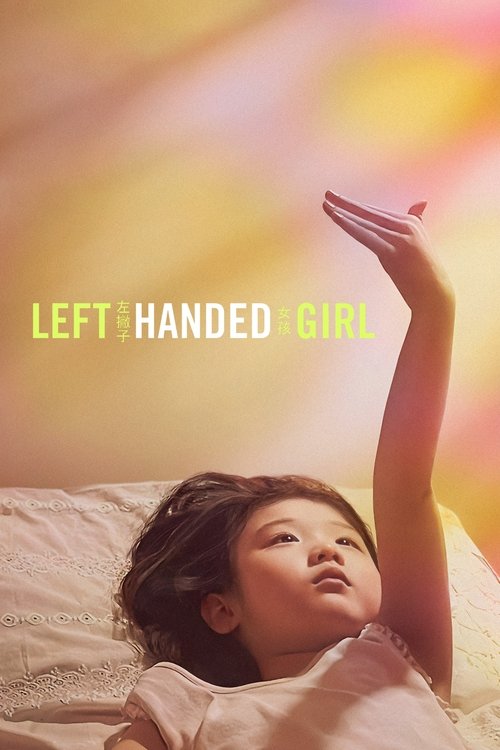
Left-Handed Girl
2025 · Tsou Shih-ching
For when you want a humane, textured family drama that transports you somewhere specific — engaging and emotionally direct, more bittersweet than bleak.
What it's about
A single mother and her two daughters arrive in Taipei to open a noodle stand in a crowded night market, chasing a fresh start that family secrets and old traditions keep undermining. At the story's center is the youngest, a small left-handed girl whose traditionalist grandfather calls her left hand the 'devil's hand' — a superstition she takes to heart and starts using as an alibi for her small transgressions.
The experience
Immersive and alive, it plunges you into the neon crush of the night market and stays close to its three women through both tenderness and friction. It's warm without being soft — the family tensions have real teeth.
The craft
Shot entirely on iPhone in the working chaos of Taipei's night markets, it turns that limitation into intimacy — the camera slips through crowds and cramped apartments with documentary immediacy. Director Tsou Shih-ching, a longtime producing partner of Sean Baker, brings that school's street-level realism and saturated color to her solo debut.
Why it matters
Premiering in Critics' Week at Cannes in 2025, it marked Tsou's emergence as a director in her own right after two decades behind the scenes of American independent film.
Snapshot
Left-Handed Girl is the solo feature-directing debut of Tsou Shih-ching (Shih-Ching Tsou), a Taiwanese-American filmmaker best known, until now, as the co-director of Sean Baker's 2004 debut Take Out and as a producing partner across two decades of Baker's career. Premiered in the Critics' Week (La Semaine de la Critique) sidebar at the 2025 Cannes Film Festival on 15 May, the film is a contemporary Taipei family drama built around a mother and her two daughters who arrive in the capital to run a noodle stand in a night market. Its title refers to the youngest child, a small left-handed girl whose traditionalist grandfather tells her the left is her "devil's hand" — a superstition the child internalizes and weaponizes, using the "evil" hand as an alibi for small transgressions. Shot entirely on iPhone in the crush of real Taipei night markets, co-written and edited by Baker, the picture arrived as one of the most warmly received Asian debuts of the 2025 festival circuit, drawing near-unanimous critical praise and a Netflix acquisition for much of the world. It sits at an unusual intersection: a distinctly Taiwanese story of women, debt, and inherited shame, made with the guerrilla iPhone aesthetic and improvisatory realism that Baker's American independent cinema made famous.
Industry & production
The film is a Taiwan–France–UK co-production, credited to Good Chaos, Cre Film, and Le Pacte, and produced by Tsou, Baker, and Mike Goodridge (of Good Chaos). Its runtime is 109 minutes, in Mandarin and Taiwanese Hokkien. The production model is essentially the Baker template scaled to Taipei: small crews, available and practical light, real locations rather than sets, and non-professional or lightly experienced performers folded in among trained actors. The night markets — dense, commercial, unpermitted-feeling spaces — were used as live environments, with the camera's small footprint enabling clandestine shooting amid actual crowds.
Commercially, the film followed a festival-to-streamer path characteristic of mid-budget international art cinema in the mid-2020s. After its Cannes Critics' Week premiere it traveled the major fall festivals (Toronto, and a competition berth at Rome, among others), and Netflix acquired distribution across a large share of territories, opening the film theatrically in select markets in November 2025 ahead of streaming. That trajectory — Cannes launch, strong reviews, streamer pickup — is now the dominant survival route for exactly this kind of subtitled auteur debut, and Left-Handed Girl is a clean example of it.
Technology
The defining technical fact of Left-Handed Girl is that it was captured on iPhone. This is not a gimmick imported from nowhere: it is the direct descendant of Baker's Tangerine (2015), the breakout film shot on iPhone 5S, and it reflects a two-decade working relationship in which Tsou and Baker have repeatedly chosen consumer and prosumer tools to shoot in places where a full cinema rig would be impossible or would destroy the reality they're chasing. The phone's tiny profile is what makes the night-market photography possible — the crew could work inside genuine commercial chaos, close to strangers, without the apparatus that announces "a film is being made here."
I should flag the limits of the public record: reporting consistently confirms iPhone capture and the use of stealth shooting, natural light, and minimal crew, but the granular technical specification — exact handset model, lens adapters, stabilization rigs, capture apps, and grading pipeline — is not reliably documented in the sources available to me, and I will not invent those particulars. What is clear is that the film belongs to the now-mature tradition of "phone cinema" as a deliberate aesthetic and logistical choice rather than a budget accident, and that it was finished to a theatrical standard capable of playing Cannes and winning a competition prize at Rome.
Technique
Cinematography
Cinematography is credited to Ko-Chin Chen and Tzu-Hao Kao. Their work is the film's most-discussed craft element: they capture Taipei's night markets — the neon, the steam, the food stalls, the churn of bodies — with an intimacy and chromatic richness that reviewers repeatedly found startling for phone-shot material, one critic going so far as to call it among the best-looking iPhone movies yet made. The method reportedly leaned on stealth, natural and practical light, and small footprints, letting the camera move at a child's-eye level through crowds. The visual grammar prizes proximity and texture over classical composition: close, mobile, reactive framing that keeps pace with performers rather than pre-blocking them into a static image. This is the Tangerine lineage — vivid, saturated, street-level realism — transposed to a specifically Taiwanese sensory world.
Editing
The film was edited by Sean Baker, who in the same period was cementing a reputation as one of American independent cinema's most acclaimed editor-directors (his editing on Anora was part of that film's 2024–25 awards sweep). Baker's cutting sensibility — propulsive, comedic in its timing, willing to hold on faces and let scenes breathe before snapping forward — is a structural authorial presence here even though he did not direct. Reviewers noted a percussive rhythm to the film, and the interweaving of three women's parallel storylines into a single kaleidoscopic portrait of the city is fundamentally an editorial achievement as much as a written one.
Mise-en-scène / staging
The staging is documentary-adjacent: the mise-en-scène is largely found rather than constructed, organized around the noodle stand and the surrounding market as a recurring stage. Blocking appears keyed to real space and real crowds, with the family's cramped domestic and working environments emphasizing financial precarity through sheer density of objects and people. The child's low vantage — moving through forests of adult legs and stall counters — is a recurring spatial motif that ties the staging to her point of view.
Sound
Sound is built from the market itself: the ambient roar of commerce, sizzling food, competing vendors, and two languages (Mandarin and Hokkien) braided together as a marker of generational and regional identity. Several reviews single out a percussive score that gives the film an "infectious" forward rhythm, though I have not been able to confirm the credited composer from reliable sources and so will not attribute the music to a specific author. The bilingual texture is itself dramatically meaningful, coding the grandfather's traditionalism and the younger generation's mobility.
Performance
The ensemble pairs trained actors with fresh faces. Janel Tsai plays the mother, Shu-Fen; Ma Shih-Yuan plays the surly, university-aged elder daughter, I-Ann; and newcomer Nina Ye plays the young left-handed I-Jing. Supporting roles include Brando Huang, Akio Chen (as the traditionalist grandfather figure), and Xin-Yan Chao. The performances drew strong notices and hardware: Ma Shih-Yuan won Best New Performer at the Golden Horse Awards and a Best Actress prize at Stockholm, while Nina Ye was recognized as a rising star on the festival circuit. The acting register is naturalistic and reactive — consistent with a production designed to catch behavior in real environments rather than to deliver polished, pre-rehearsed line readings.
Narrative & dramatic mode
The film operates in the mode of the ensemble domestic realist drama — a "dramedy," in several critics' framing — that tracks three generations of women contending with family, tradition, and money. Its architecture is braided rather than linear: the mother struggling with debt as the estranged, gravely ill father's situation drains their finances; the elder daughter drifting into an affair with a married man; and the youngest processing the world through the frightening idea that one of her own hands is evil. Family secrets surface gradually and detonate late, giving the otherwise observational film a melodramatic spine. The dramatic engine is shame and its inheritance — how a superstition handed down by an elder becomes, in a child, both a wound and a tool. Tonally it balances warmth and comedy against genuine hardship, refusing both misery and sentimentality.
Genre & cycle
Generically the film is a family drama with strong social-realist coloring, and it belongs to a recognizable contemporary cycle: the international festival debut that renders a specific working-class urban milieu through handheld, quasi-documentary immediacy. It converses with two lineages at once — the Taiwanese tradition of intimate family and city portraiture, and the American indie realism of Baker's Tangerine/The Florida Project/Red Rocket run, which foregrounds people on the economic margins with vivid, empathetic energy. The night-market setting also places it within a broader wave of films that use street food and market economies as both stage and metaphor for precarity.
Authorship & method
The authorship question here is genuinely interesting, because Left-Handed Girl is a debut that arrives with an established collaborative signature already attached. Tsou Shih-ching is the director and co-writer, and this is her first solo feature — the culmination of a career that began co-directing Take Out with Baker in 2004 and continued as a producer and creative partner on his subsequent films. The Taipei material, the linguistic texture, and the specifically Taiwanese observation of tradition and womanhood are hers. Sean Baker is co-writer, editor, and producer, and his imprint — the iPhone capture strategy, the propulsive cut, the marginal-lives realism — is pervasive; it would be inaccurate to describe the film as purely Baker's or purely Tsou's, and the two have publicly framed it as a shared, long-gestating collaboration. The cinematographers Ko-Chin Chen and Tzu-Hao Kao are essential co-authors of its look, translating the phone's constraints into a genuinely beautiful nocturnal palette. Producing was shared by Tsou, Baker, and Mike Goodridge. On the score and any single credited composer, the reliable public record is thin, and I decline to assign authorship I cannot verify.
Movement / national cinema
The film sits within Taiwanese cinema while being, by production and method, transnational. Taiwan's art-cinema prestige rests heavily on the New Taiwan Cinema of the 1980s–90s — Hou Hsiao-hsien, Edward Yang, Tsai Ming-liang — whose patient, socially attentive family and city films form the deep background against which any serious contemporary Taipei drama is read. Left-Handed Girl does not adopt that movement's long-take stillness; if anything it inverts it with restless, close, mobile shooting. But it shares its subject — the family as the site where tradition, money, and modern Taipei collide — and its interest in the ordinary textures of the city. The film's other "national" allegiance is to a stateless festival-and-streamer international art cinema, financed across Taiwan, France, and the UK, that increasingly defines how films like this are made and seen.
Era / period
Left-Handed Girl is a work of the mid-2020s and legible as such on several axes. Technologically, it is a product of the moment when phone-shot filmmaking had fully matured from novelty (Tangerine, 2015) into a legitimate, award-caliber option. Industrially, it embodies the Cannes-to-Netflix pipeline that had by 2025 become a primary distribution reality for subtitled auteur work. And it arrives on the immediate updraft of Baker's Anora (2024), whose Palme d'Or and Academy Awards raised the visibility of everything in his orbit — making a long-planned collaboration with his oldest creative partner both possible and highly anticipated at exactly this moment.
Themes
The film's central theme is inherited shame: the way a superstition — that the left hand is a "devil's hand" — passes from grandfather to granddaughter and reorganizes a child's sense of herself. From that seed radiate the film's larger concerns: tradition versus modernity in a rapidly changing Taipei; the specific pressures on women across three generations; financial precarity and debt as forces that deform family life; and the persistence of secrets, which the narrative treats as a kind of familial inheritance no less real than a name or a habit. The left hand functions as the organizing metaphor — a natural part of the self reframed by others as wrong, and then reclaimed. Reviewers also emphasized the film's warmth: its insistence that these women's resilience and affection coexist with the hardship, so that the picture reads finally as generous rather than bleak.
Reception, canon & influence
Critical reception was strongly positive. The film emerged from Cannes Critics' Week as a sidebar highlight — festival reporting credits it with Critics' Week honors including the Gan Foundation prize and the Rail d'Or — and went on to win Best Film in competition at the Rome Film Festival, with Ma Shih-Yuan taking acting prizes at Stockholm and the Golden Horse Awards and Nina Ye recognized as a rising talent. Aggregators reflected the enthusiasm, with an exceptionally high critics' score and a strong Metacritic average. Reviewers repeatedly praised the vividness of the iPhone night-market photography, the naturalism of the young ensemble, and the film's balance of comedy and social feeling.
On influences flowing into the film (backward): the clearest lineage is Sean Baker's own body of work, above all Tangerine, whose iPhone strategy and marginal-lives realism are the direct methodological ancestors; behind that stands the broader tradition of handheld social realism, and, on the Taiwanese side, the family-and-city preoccupations of New Taiwan Cinema. On what it may shape (forward): it is too early, and I will not overstate a legacy that does not yet exist. Its most plausible influence is as a high-profile proof of concept — a phone-shot, non-Western-language debut that reached Cannes, won a European competition, and secured global streaming distribution — which strengthens the case for other filmmakers pursuing intimate, location-driven stories with minimal apparatus. As a debut it also repositions Tsou from "Sean Baker's collaborator" to a director in her own right, and any future work of hers will be read partly through this film. Those are reasoned projections, not established facts; the film's durable place in the canon remains to be written.
Reception
It premiered in Cannes Critics' Week in May 2025 as a warm-hearted sleeper, then snowballed: Taiwan's official Oscar entry, a Best International Feature shortlist spot, and a Netflix release that turned a tiny night-market indie into a global watch.
How Left-Handed Girl was received, from release to now →
How to watch Left-Handed Girl: what to notice on a first viewing
- Watch the camera move at the child's eye level. Shot on iPhone through crowded night markets, the camera stays close and mobile, low enough to travel through forests of adult legs and stall counters. You see the market the way the youngest daughter does, from underneath everyone else.
- Watch for the neon and steam of the night market. The cinematographers shoot real Taipei markets with vivid color and texture, the noodle stand recurring as the family's stage inside the crowd. The market is not backdrop. It is the family's whole economy, visible in every frame.
- Listen for Mandarin and Hokkien switching within one scene. The two languages are braided together throughout, a marker of who in the family belongs to which generation and which part of Taiwan. You can hear the family's generational split before anyone explains it in words.
- Watch the girl favor her left hand, then hide it. Her grandfather calls the left hand her devil's hand, and the film keeps returning to small moments where she catches herself using it around adults. A single habit becomes the film's way of showing a child learning to police herself.
- Notice how fast the film moves between three women's days. Baker's editing interweaves the mother, the elder daughter, and the youngest into one braided, percussive rhythm rather than following one story at a time. The cutting itself argues that these three lives are one continuous pressure, not three separate plots.
The whole guide to watching Left-Handed Girl, with the keys for a rewatch →
Influences: the films it descends from and the films it influenced
- Tangerine (2015) — The direct methodological template: shooting a feature entirely on iPhone (5s with an anamorphic adapter) to move invisibly through real streets, the exact capture strategy Baker carries into this film's night market.
- Take Out (2004) — Tsou's own co-directed debut established the grammar reused here — cheap prosumer-camera handheld tracking an immigrant laborer across a single compressed day in a real working environment.
- The Florida Project (2017) — Sets the camera low at a child's eye-line and lets nonprofessional kids improvise against found, unglamorized mise-en-scene, the same childs-eye vantage organizing this film.
- Prince of Broadway (2008) — Roaming, semi-improvised handheld built around a marginal street-vendor ensemble shot inside real storefronts — the loose docu-fiction staging method behind the night-market scenes.
- Yi Yi (2000) — New Taiwan Cinema's braided family-and-city ensemble partly refracted through a child's literal act of observing/photographing what adults miss.
- Rebels of the Neon God (1992) — Turns Taipei's neon arcades and rain-slicked night streets into expressive social texture, the nocturnal urban palette this film inherits for its market.
- Millennium Mambo (2001) — Luminous handheld neon-nightlife cinematography (with Mark Lee Ping-bing) trailing a young woman through the after-dark city as sensory environment.
- Dust in the Wind (1986) — New Taiwan Cinema's foundational treatment of tradition-versus-modernity and inherited familial obligation dragging on the young, the thematic substrate here.
- Bicycle Thieves (1948) — The neorealist bedrock: nonprofessional actors and real locations structured as a parent-child street odyssey through economic precarity.
- Rosetta (1999) — Pins a restless handheld camera to the back of a young working-class girl in near-real-time, the propulsive body-following handheld style echoed here.
- Red Rocket (2021) — Shares Baker-as-editor's percussive, momentum-driven cutting rhythm keyed to a hustler protagonist's relentless forward motion.
- Anora (2024) — Same authorial fingerprint of a braided marginal-lives ensemble that pivots late from comic energy into raw melodrama, mirroring this film's late melodramatic reveal.
- Fish Tank (2009) — Anchors handheld social realism to an adolescent girl's volatile point of view built around a first-time nonprofessional lead.
- American Honey (2016) — Immersive handheld coverage of a nonprofessional youth ensemble hustling at society's economic margins, shot for texture over plot.
- The Rider (2017) — Docu-fiction naturalism casting nonprofessionals to play lightly fictionalized versions of themselves inside their real milieu.
- Unsane (2018) — A parallel proof-of-concept that iPhone capture can be a deliberate feature-length aesthetic rather than a gimmick, validating the same low-apparatus method.
Similar films
- The Little Sister (2025) — same viewing thread
- The Mysterious Gaze of the Flamingo (2025) — same viewing thread
- Sound of Falling (2025) — same viewing thread
- Young Mothers (2025) — shared sensibility
- Shoplifters (2018) — shared sensibility
- Her Story (2024) — shared sensibility
- Little Amélie or the Character of Rain (2025) — shared sensibility
- Hard Truths (2024) — shared sensibility
All the films related to Left-Handed Girl →
Watch it with: curated runs of related films
- What the Mothers Left — A run of daughters and young women — grieving lost mothers, wary of surrogate ones, unearthing the family's secrets — where a house or a legacy keeps shaping who a girl becomes.