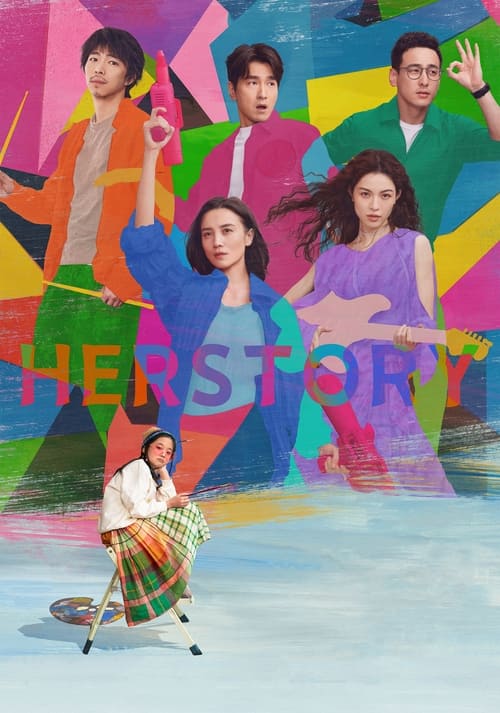
Her Story
2024 · Shao Yihui
For when you want a smart, big-hearted comedy about friendship and getting back on your feet — something that makes you laugh and leaves you a little lighter. Comfort viewing with a real brain.
What it's about
A single mother in Shanghai — a former investigative journalist now piecing together freelance work — loses her job, moves to a new apartment with her school-age daughter, and strikes up an intense friendship with her downstairs neighbor, a young singer whose cheerfulness hides real depression. Around these three orbit a set of well-meaning, hapless men, including an ex-husband who keeps making trouble, but the heart of the film is the women holding each other up.
The experience
Warm, talky, and genuinely funny — the humor comes fast and conversational, and then a line lands that's suddenly tender or sharp about how women get judged. It feels like spending time with people you'd want as neighbors.
Performances
Song Jia grounds the film as Tiemei, playing competence and exhaustion at once — a mother who's funny, flinty, and visibly tired of being everyone's safety net.
The craft
Shao Yihui's script is the star: dense, quotable dialogue that turns everyday arguments — about chores, dating, parenting, work — into comedy with a point. The film's structure gives the men the supporting-foil roles women usually get, and the flip is done with wit rather than lecture.
Why it matters
A major word-of-mouth hit in China and a landmark for mainstream feminist comedy there, confirming Shao Yihui as one of the most distinctive new voices in Chinese film.
Snapshot
Her Story (Chinese title 好东西, literally "Good Things") is the second feature written and directed by Shao Yihui, released in mainland China in November 2024. A dialogue-driven urban comedy-drama set in Shanghai, it follows Wang Tiemei — a former investigative journalist and single mother now scraping together freelance work — as she settles into a new apartment with her school-age daughter and forms an intense, often comic friendship with her downstairs neighbor Xiaoye, a young singer whose bright surface hides depression and low self-worth. Around this female trio orbit a set of hapless, well-meaning men: Tiemei's estranged ex-husband, a drummer, and other suitors who become the film's foils rather than its engines. The English release title, punning on "history/herstory," announces the picture's explicit feminist framing. Where a conventional romance would center coupling, Her Story keeps its attention on the household of women and treats heterosexual romance as raw material for satire and conversation. It became one of the most acclaimed and widely discussed Chinese releases of its year, prized for verbal wit, its refusal of melodrama, and its willingness to stage contemporary gender debate as living-room comedy.
Industry & production
Her Story belongs to a strand of mid-budget, star-driven, city-set commercial cinema that mainland studios have increasingly leaned on as an alternative to spectacle blockbusters and patriotic tentpoles. It arrived as the follow-up to Shao Yihui's well-received debut B for Busy (爱情神话, 2021), and it carried forward that film's model: a modestly scaled, talk-heavy Shanghai comedy sold on script, performances, and word of mouth rather than IP or scale. The picture opened in the crowded late-autumn 2024 window and became a genuine sleeper success, building through strong reviews and social-media enthusiasm into one of the notable domestic hits of the season. I will not cite a precise gross, as I cannot verify a specific figure; the reliable point is that it substantially outperformed expectations for a film of its size and register.
The production reunited elements of the creative team and milieu behind B for Busy, and it was positioned as a showcase for Shao as an emerging auteur-brand. Detailed international-language documentation of the full financing and distribution chain is thin, and I will not invent production-company attributions. What is clear is the industrial significance of the release: it demonstrated, alongside Jia Ling's YOLO the same year, that a female-authored, women-centered picture could anchor a commercial run, and it did so while foregrounding rather than softening its feminist content — a notable commercial gamble in a market where gender discourse is both intensely popular online and politically sensitive.
Technology
Her Story is not a technology-forward film in the sense of visual-effects or format innovation; like most contemporary mainland productions it was shot and finished digitally, and its craft is deliberately subordinated to performance and language. Precise camera and post-production toolchain credits are not something I can confirm, and I will not fabricate them. The one genuinely conspicuous "technological" set piece is aural rather than visual: a sequence built around recorded domestic sound. Xiaoye plays back a tape of ordinary household noises — cooking, cleaning, rain on a window, the small percussion of chores — and Tiemei's daughter, listening blind, reinterprets them as majestic natural phenomena (thunder, a stampede, the sea). The scene is a foley and sound-mixing showcase that turns the audio post-production process into an emotional and thematic device: the "invisible" labor of domestic life is re-heard as something sublime. It is the film's most self-conscious use of the apparatus, and it is characteristic that the apparatus in question is sound design, not image manufacture.
Technique
Cinematography
The camerawork is naturalistic and intimate, keyed to lived-in Shanghai interiors: cluttered apartments, kitchens, indie music venues, cafés, and streets. The palette runs warm and domestic, favoring the texture of a real home over designed prettiness. Coverage privileges faces and conversation — the film is composed to let dialogue land — with an unfussy mix of steadier composed frames and looser handheld intimacy in the more emotionally charged exchanges. I cannot reliably attribute the cinematography to a named director of photography from the English-language record, so I flag that credit as one I am not confirming; the visible style, however, is legible: unshowy, actor-centered, and rooted in a recognizable contemporary urban China.
Editing
Editing is where the comedy actually lives. The film cuts for verbal timing — the rhythm of a good talk comedy — trimming exchanges to their sharpest beats and letting reaction and pause do comic work. Structurally it is episodic and additive rather than tightly plotted, assembling incidents, arguments, and encounters into a cumulative portrait. The already-noted domestic-sounds montage is the standout edited passage, an audio-led sequence that briefly lifts the film out of its naturalism into something lyrical before returning it to the everyday.
Mise-en-scène / staging
The governing space is the female household: a warm, crowded, feminine domestic interior that the film treats as a self-sufficient world. Men enter it as visitors and disruptors rather than residents. Staging repeatedly arranges the three principals — mother, daughter, neighbor — as a unit, and blocks the male characters at the margins or in postures of apology and explanation. The production design of the apartment does real characterizing work: this is the home of a woman who reads, argues, and gets by, and the objects around her signal a specific class and cultural position — educated, urban, precarious-professional.
Sound
Sound is arguably the film's signature technical dimension. Beyond the domestic-sounds set piece, music is woven diegetically through Xiaoye's identity as a performer, tying indie/rock textures to her arc of shaky self-esteem and tentative self-assertion. The soundtrack functions as characterization and as mood, and the film's willingness to build an entire emotional sequence out of foley signals a director thinking seriously about the ear as well as the eye.
Performance
Performance carries the picture. Song Jia's Wang Tiemei is the anchor — dry, intelligent, quick-tongued, worn but not defeated — a portrait of maternal authority without martyrdom. Zhong Chuxi plays Xiaoye's brittle vulnerability against her outward brightness, giving the friendship its emotional stakes. The young performer playing Tiemei's daughter supplies a precocious counter-voice, delivering some of the film's most disarming lines; I will not risk a wrong name for the child actress, but the role is central to the film's tone. The supporting men are played broadly enough to satirize but humanely enough to avoid caricature, which is essential to the film's comic ethics.
Narrative & dramatic mode
Her Story works in a low-stakes, slice-of-life register — a "conversation film" in which argument, banter, and confession replace plot machinery. There is no thriller engine and little melodrama; the drama is generated by relationships shifting incrementally over a stretch of everyday time. Its most distinctive formal choice is essayistic: the film repeatedly embeds explicit gender-political argument into naturalistic dialogue, so that feminist ideas are debated aloud by characters rather than merely implied. The most-cited example is a scene of men performing elaborate, self-flagellating acknowledgments of male privilege — a set piece that is simultaneously sincere and satirical, letting the film critique performative allyship while still valuing the attempt. This blend of comedy, sincerity, and near-lecture is the film's defining dramatic mode, and part of why it provoked debate: it wears its thesis openly.
Genre & cycle
The film sits at the crossroads of romantic comedy, urban dramedy, and something closer to a feminist "talk comedy." It belongs to a 2020s cycle of women-centered Chinese commercial films that found large audiences by dramatizing contemporary female experience — a cycle whose other tentpole in 2024 was Jia Ling's YOLO. Within Shao Yihui's own work it extends the "Shanghai talk comedy" she inaugurated with B for Busy: ensemble-driven, dialogue-forward, class- and city-specific, romantically skeptical. It also converses, at a distance, with the international lineage of dialogue-driven independent comedies about young women in cities — a resonance critics repeatedly drew — while remaining firmly grounded in mainland social texture.
Authorship & method
Shao Yihui is the film's clear author: sole credited writer-director, and the source of its most identifiable trait — a dense, quick, allusive verbal style that treats conversation as the primary event. Coming to directing from screenwriting, she foregrounds language, and her method appears to be to build films outward from talk and character rather than from incident, letting a loose structure accommodate set-piece arguments and comic riffs. Her sensibility is explicitly feminist and generationally contemporary, alert to online gender discourse and willing to put it on screen. Her Story confirms the authorial identity that B for Busy announced: a director of urban women's lives working in comedy with an essayist's appetite for ideas.
On key collaborators, the reliable English-language record is thin, and I will not manufacture credits. The lead performances — Song Jia and Zhong Chuxi in particular — function as genuine co-authors of the film's tone, and the sound work stands out as a defining craft contribution even where I cannot confidently name the individual technicians. Where you need definitive cinematographer, composer, and editor attributions, they should be confirmed against the film's own credits rather than taken from this account.
Movement / national cinema
Her Story is a product of contemporary mainland Chinese commercial cinema's art-house crossover zone, and specifically of two overlapping currents: the recent visibility of women directors making bankable, women-centered films, and a lineage of Shanghai-set urban cinema attentive to the city's particular middle-class texture. Shao's work participates in a long Chinese fascination with Shanghai as a cinematic locale while updating it for a post-pandemic, digitally mediated present. The film is not avant-garde or festival-oppositional; its "movement," to the extent it has one, is this emergent mainstream feminist comedy — populist in form, pointed in politics.
Era / period
The film is thoroughly of its moment: China in the early-to-mid 2020s, after the pandemic years, in a consumer, professionally precarious urban milieu. Its concerns — single motherhood, freelance instability, dating fatigue, online feminist argument, therapy-adjacent language about depression and self-worth — are period-specific markers of that world. It arrives amid an intense, contested popular feminism in Chinese social media, and the film's reception cannot be separated from that climate: it both drew energy from and became a flashpoint within ongoing public arguments about gender. It is, in that sense, a document of its exact cultural instant.
Themes
The film's central subject is the sustaining power of relationships between women — the friendship between Tiemei and Xiaoye, and the mother-daughter bond — set against the disappointments and comedy of heterosexual romance. Around this it develops several linked themes: single motherhood as ordinary competence rather than tragedy; the recuperation of invisible domestic labor (literalized in the sound montage) as something valuable and even beautiful; depression and self-worth, dramatized through Xiaoye; male privilege and the pitfalls of performative allyship, satirized through the men; and the project of raising a daughter into a different relationship with gender than her mother inherited. Underlying all of it is a deconstruction of romance itself: the film systematically declines to let coupling be the answer, redistributing the emotional weight to female solidarity and self-possession.
Reception, canon & influence
Critically and popularly, Her Story was a standout of its year. It drew strong reviews and unusually warm audience response, and it registered as one of the highest-rated Chinese theatrical releases of recent years on domestic platforms — I recall its Douban score opening around the low 9s, though I flag that specific number as something to confirm rather than take on my word. Much of the praise centered on the script's wit, the performances, and the film's rare willingness to argue its feminist case in public and in comedy; it also, predictably, became a target within polarized online gender debate, which amplified its visibility. It featured prominently in year-end critical conversations about the best Chinese films of 2024. I will not claim specific award wins I cannot verify.
Reading its influences backward, the clearest is Shao's own B for Busy, which established the template; beyond that, critics repeatedly connected it to the international tradition of dialogue-driven, city-set independent comedies about women's lives, and more broadly to a conversation-cinema mode in which talk is the principal action. Looking forward, the film is too recent for a settled legacy, and honesty requires saying so. Its most plausible near-term influence is industrial and cultural: as a demonstrated commercial success, it strengthens the case for female-authored, openly feminist mainstream comedies in China and consolidates Shao Yihui as a leading voice of that emergent cycle. Whether it becomes a canonical reference point or a marker of a particular 2020s moment will depend on what the films after it choose to build on.
Reception
Released with modest expectations in November 2024, it became China's sleeper phenomenon of the year — grossing over 680 million yuan and landing a 9.1 on Douban, the highest-rated domestic Chinese film of 2024. Less a reappraisal arc than an instant coronation, with the discourse still raging.
How Her Story was received, from release to now →
Influences: the films it descends from and the films it influenced
- B for Busy (2021) — Shao's own debut established the exact engine she reuses here: a Shanghai apartment-and-dinner-table ensemble whose dialect-inflected, rapid-fire banter is the dramatic event, which Her Story simply re-tools around a female household.
- My Night at Maud's (1969) — Rohmer's 'moral tale' method — staging an entire film as an extended verbal debate where a philosophical/romantic argument, not incident, carries the drama — is the template for treating talk itself as the principal action.
- Annie Hall (1977) — Deconstructs romance through digressive, essayistic dialogue and direct-address asides, turning a love story into an argument about love — the same rhetorical comedy Her Story aims at gender discourse.
- Jeanne Dielman, 23 quai du Commerce, 1080 Bruxelles (1975) — Pioneers making invisible domestic labor the film's foregrounded material through the sound and gesture of housework — the direct precedent for Her Story's foley showcase that renders chores as audible, guessable events.
- One Sings, the Other Doesn't (1977) — Builds an essayistic feminist film around female solidarity across a decades-long friendship, mixing song and warm direct argument to make a political case without abandoning pleasure.
- Metropolitan (1990) — A witty drawing-room ensemble in which dialogue about class, sex and manners IS the plot, structuring the film as a chain of verbal set-pieces rather than incident.
- Before Sunrise (1995) — Establishes the near-real-time walk-and-talk where sustained, naturalistic conversation between characters is the entire architecture of the film.
- On the Beach at Night Alone (2017) — Conversation cinema built from episodic drink-table debates shot in unforced handheld long takes, using structural repetition and talk as the sole engine.
- Frances Ha (2012) — Naturalistic handheld portrait of urban female friendship assembled from light, episodic vignettes with a quick comic rhythm — the tonal and shooting-style model.
- The Worst Person in the World (2021) — Chapters a young woman's romantic and working life into essayistic vignettes that argue about desire and autonomy, sharing Her Story's episodic, deconstruct-romance-by-talking structure.
- Lady Bird (2017) — Female-authored comedy whose emotional truth lives in quick, overlapping naturalistic dialogue and precise comic timing between women rather than in plot mechanics.
- Barbie (2023) — A mainstream commercial blockbuster that delivers its feminist argument openly through monologue set-pieces — the same willingness to make the case in public comedy that defines Her Story.
- Booksmart (2019) — Ensemble female-friendship comedy driven by rapid overlapping banter, prioritizing performance chemistry and comic-timing edits over incident.
- YOLO (2024) — A same-year Chinese female-authored box-office phenomenon that proves women's-lives comedy can be a mainstream commercial force, consolidating the very cycle Her Story extends.
- Send Me to the Clouds (2019) — An earlier Chinese female-directed comedy-drama centering female desire and bodily autonomy, an immediate domestic forerunner of the openly feminist mainland comic voice.
- Someone Great (2019) — Structures a breakup as an episodic day among a female trio whose talk-through-grief conversations, not events, deconstruct a romance — a close structural cousin to the female-solidarity conversation film.
Similar films
- Barbie (2023) — influence & lineage
- Lady Bird (2017) — influence & lineage
- So Long, My Son (2019) — shared sensibility
- Soulmate (2023) — shared sensibility
- Love in the Big City (2024) — shared sensibility
- Saving Face (2004) — shared sensibility
- Kim Ji-young: Born 1982 (2019) — shared sensibility
- Taipei Story (1985) — shared sensibility
All the films related to Her Story →
Watch it with: curated runs of related films
- Women Refusing to Disappear — Watch these together for one steady study of women taking back the space a violent husband, a famous man, a marriage, or a curated public image has boxed them into.