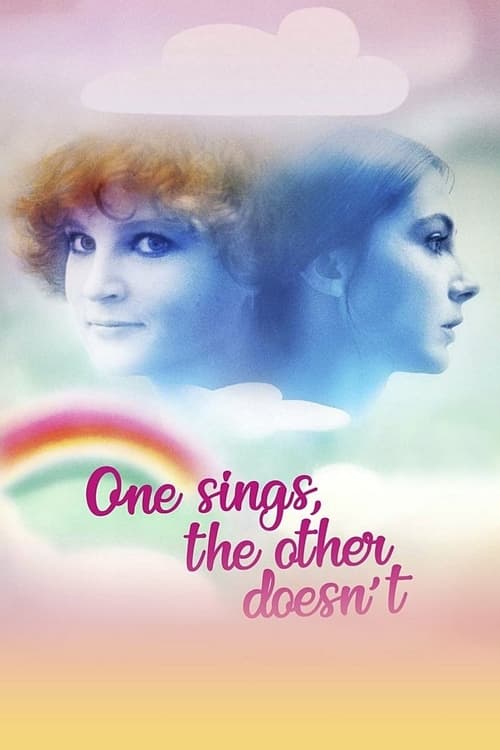
One Sings, the Other Doesn't
1977 · Agnès Varda
For when you want to feel hopeful about people — sisterhood, second acts, lives choosing themselves. A comfort film with a spine.
What it's about
Two young women meet in early-1960s Paris when one helps the other pay for an illegal abortion, then lose touch — and find each other again as the French women's movement remakes the world around them. Over fifteen years, Pomme becomes a traveling singer performing joyous, defiant songs about women's lives, while Suzanne builds herself into a community worker; the film follows their friendship, sustained mostly by postcards, through love, work, motherhood, and change.
The experience
Warm, buoyant, and quietly radical — a film about a political era that feels like catching up with old friends. The songs are funny and disarming, and the whole thing leaves you lighter than its subject matter has any right to.
Performances
Valérie Mairesse's Pomme is pure appetite for life, and Thérèse Liotard gives Suzanne a hard-won steadiness; the film lives in the contrast between them.
The craft
Varda wrote the lyrics to Pomme's songs herself — sung from flatbed trucks and country stages — and folds real history into fiction, including a restaging of the 1972 trial that helped change France's abortion law, which she had campaigned around in real life. It moves with the ease of a musical and the honesty of a diary.
Why it matters
Made by a filmmaker who was inside the movement she was filming, it stands as one of the defining feminist films of the 1970s and one of Varda's most beloved works.
Agnès Varda's feminist musical — and it is, unashamedly, both of those things — follows two friends, the irrepressible Pomme and the graver Suzanne, from a Paris photographer's studio in 1962 through the tumult of the French women's movement, meeting and parting across fifteen years. Varda was no observer of that history: she had signed the Manifesto of the 343 admitting to an illegal abortion, and the film restages the 1972 Bobigny trial that helped force the law's change. Yet nothing here is a tract. Varda wrote the lyrics to Pomme's songs herself — buoyant, funny declarations of bodily self-possession delivered from flatbed trucks and country stages — and lets a whole political era pass through the medium of a friendship sustained mostly by postcards. Where her Left Bank contemporaries theorized, Varda embodied; the film's radicalism is its warmth, its conviction that liberation might look like sunlight, pregnancy chosen freely, and two women waving across a crowd. It remains the New Wave's fullest answer to the question of what a woman's life is for.
A Deleuzian reading
A truck pulls into a field, a woman climbs onto the flatbed, and she sings.
The full Deleuzian reading of One Sings, the Other Doesn't →
Reception
Divisive in 1977 — plenty of critics (and even some feminists) found its sunny, song-filled militancy too soft or too sentimental — it spent decades in the shadow of Cléo and Vagabond before the 2010s Varda revival and restoration made it a beloved feminist landmark.
How One Sings, the Other Doesn't was received, from release to now →
Influences: the films it descends from and the films it influenced
- La Pointe Courte (1955) — Establishes Varda's docudrama braid — intercutting documentary observation of a real community with a scripted couple's story — the two-strand method she reprises by threading Pauline and Suzanne's fiction through footage of real 1970s abortion-rights protest.
- Cléo from 5 to 7 (1962) — Varda's diegetic song as interior rupture: Cléo's studio performance of 'Sans toi' halts the narrative to render a woman's fear from inside, the device expanded here into Pomme's stage anthems that voice the film's politics.
- The Umbrellas of Cherbourg (1964) — Demy's method of setting the unglamorous facts of women's lives — unplanned pregnancy, separation, waiting — to purpose-written melody, which Varda borrows by scoring feminist consciousness through the Orchidée band's original songs.
- Lola (1961) — The decades-spanning chance-reunion architecture built around a performer heroine; Varda adopts Demy's structure of two women's paths crossing, diverging, and re-meeting across years.
- Hiroshima mon amour (1959) — The Left Bank interweaving of intimate voiceover with documentary-political imagery; Varda's postcard narration braiding private correspondence into the public abortion struggle descends from Resnais's essayistic voice.
- Le Bonheur (1965) — The deliberately pretty pastel palette and classical scoring deployed against a story about women's interchangeability and constrained choice — the ironic sunlit color design carried into Pomme's iconography.
- Salt of the Earth (1954) — Blacklist-era docudrama casting real strikers and centering women's collective political awakening — the model of using non-actors and an activist real event as the dramatic spine.
- Born in Flames (1983) — Feminist agitprop docudrama driven by radio and original protest music; Borden extends Varda's sung feminist slogans ('my body is mine') into a punk collective soundtrack fused with pseudo-documentary.
- Story of Women (1988) — Dramatizes a real abortion-law martyr with docudrama sobriety, extending Varda's fusion of a woman's private reproductive choice with a specific, historically named legal case.
- 4 Months, 3 Weeks and 2 Days (2007) — Renders an illegal abortion through the loyalty of two women, one aiding the other, inheriting Varda's insistence that bodily autonomy is lived through female friendship rather than in solitude.
- Portrait of a Lady on Fire (2019) — Stages an abortion collectively and matter-of-factly among women, then has it re-enacted and painted; Sciamma's solidarity-and-art-as-testimony directly answers Varda's warmth-as-radicalism.
- Happening (2021) — First-person procedural focus on a woman claiming her body under a criminalizing law, pushing the docudrama urgency of Varda's Bobigny-trial thread toward visceral subjectivity.
- Never Rarely Sometimes Always (2020) — A two-woman journey to obtain an abortion whose cousins' near-wordless solidarity extends Varda's model of friendship as the vehicle of reproductive self-determination.
- Her Story (2024) — Builds an essayistic feminist film around female solidarity across a decades-long friendship, mixing song and warm direct argument to make a political case without abandoning pleasure.
- Jeanne Dielman, 23 quai du Commerce, 1080 Bruxelles (1975) — The same mid-1970s feminist project of making women's unshown labor and bodily life the entire subject, though Akerman's durational stasis is the formal inverse of Varda's mobile, song-punctuated lyricism.
- News from Home (1977) — The epistolary voice: Akerman reads her mother's letters over city footage the same year Varda structures her film around postcards exchanged between the two friends, both turning correspondence into narrative armature.
- Daisies (1966) — Anarchic feminist play with song, costume, and collage as political refusal; the kinship lies in treating female friendship as joyous, formally disruptive rebellion rather than melodrama.
- Girlfriends (1978) — A low-budget chronicle of two women's friendship straining as their life choices — marriage versus independent work — diverge, Varda's Pauline/Suzanne dyad rendered in an American vérité key.
- Sing, Lola, Sing! (2023) — A feminist musical whose original songs voice women's emotional lives across life-stages, the same sung-testimony device deployed for solidarity and grief.
Similar films
- Happiness (1965) — influence & lineage · same viewing thread
- Cléo from 5 to 7 (1962) — influence & lineage
- Story of Women (1988) — influence & lineage
- Daisies (1966) — influence & lineage
- Born in Flames (1983) — influence & lineage
- Love Letters (2025) — same viewing thread
- 20th Century Women (2016) — same viewing thread
- Varda by Agnès (2019) — shared sensibility
All the films related to One Sings, the Other Doesn't →
Watch it with: curated runs of related films
- Families Made and Unmade — A run of intimate domestic portraits — watch these together and feel marriages dissolve, mothers improvise, and love keep redrawing the shape of a family across sixty years.