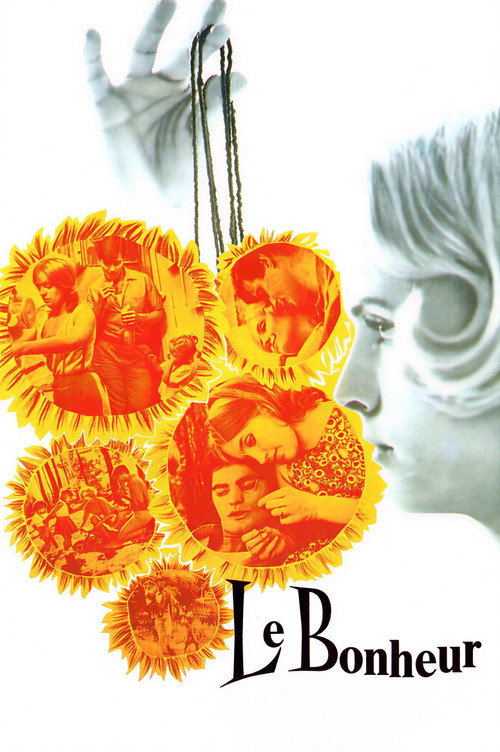
Happiness
1965 · Agnès Varda
For when you want something beautiful that bites — a short, sunny film that turns out to be one you chew on for days. Comfort viewing on the surface, a genuine challenge underneath.
What it's about
A young carpenter named François has, by every visible measure, a perfect life: a beautiful, loving wife, two small children, and Sunday picnics in the sunlit woods outside Paris. Then he drifts into an affair with a postal worker — and instead of guilt, he feels only more joy, reasoning that happiness simply adds up. The film watches, without ever raising its voice, what that arithmetic does to a marriage.
The experience
Deceptively gentle and gorgeous — all summer light, flowers, and Mozart — with a chill underneath that builds so quietly you may not notice until it has you. It leaves you unsettled in the best way, arguing with the film and with yourself on the way out.
Performances
Jean-Claude Drouot plays François opposite his real-life wife and children, and that casting gives his easy, untroubled warmth an uncanny edge — the affection is real, which is exactly what makes it disturbing.
The craft
Jean Rabier's Eastmancolor photography is ravishing — sunflower yellows and picnic greens used like weapons — and Varda fades scenes into washes of pure red and blue where other films would cut to black. The Mozart score keeps everything buoyant while the story curdles, a tension the film sustains from first frame to last. It rewards a big screen, where the color does its quiet indicting.
Why it matters
Scandalous on release in 1965 and still argued over now, it cemented Agnès Varda as the conscience of the French New Wave — proof that a film could look like a postcard and cut like a scalpel.
The most quietly lethal film of Agnès Varda's career opens like an Impressionist picnic — sunflowers, Mozart, a handsome carpenter adoring his wife and children in the woods outside Paris — and never once drops the smile as it slides a blade between the ribs of the whole arrangement. François loves Thérèse; he comes to love another woman too, and sees no contradiction, because happiness, he reasons, simply adds up. Varda, the lone woman at the heart of the New Wave and its Left Bank conscience, refuses to editorialize: she lets the summer light and Jean Rabier's ravishing Eastmancolor do the indicting, fading scenes into washes of pure red and blue where other films fade to black. The casting is its own provocation — Jean-Claude Drouot plays the husband opposite his actual wife and children. Scandalous in 1965 and still argued over now, it remains cinema's most beautiful film about male self-regard, a poisoned bouquet whose colors have not faded an ounce.
A Deleuzian reading
A scene ends, and the screen doesn't go black.
The full Deleuzian reading of Happiness →
Reception
In 1965 it scandalized French audiences, who couldn't decide if Varda was endorsing or indicting her sunny adulterer — it won Berlin's Silver Bear anyway. Today it's canonized as one of the most quietly savage feminist films of the New Wave, its prettiness read as the trap.
How Happiness was received, from release to now →
Influences: the films it descends from and the films it influenced
- Une partie de campagne (1936) — Its dappled, sun-dazzled riverside picnic staged as a living Auguste Renoir canvas is the direct model for Varda's Impressionist family-outing tableaux lit by natural light.
- All That Heaven Allows (1955) — Establishes the melodrama tactic of turning hyper-saturated domestic prettiness ironically against the emotional cruelty inside it — the exact gap between surface beauty and cold content that Varda exploits.
- La Pointe Courte (1955) — Her own Left Bank debut invents the juxtapositional montage of documentary texture against a stylized couple's drama that Le Bonheur refines into painterly blocks.
- Hiroshima mon amour (1959) — Left Bank editing that fuses image, music, and memory into associative movements rather than continuity — the associative logic behind Varda's Mozart-scored color sequences.
- Lola (1961) — Demy's non-judgmental, enchanted romantic fatalism gives Varda the fairy-tale register she inverts into ironic domestic arithmetic.
- Cléo de 5 à 7 (1962) — Her prior film with cinematographer Jean Rabier, working out the observational, near-real-time following of a protagonist that carries into Le Bonheur's watchful eye on the husband.
- Jeanne Dielman (1975) — Inherits the durational, refuses-to-judge camera on domestic ritual, letting composed everyday tableaux carry the emotional charge instead of dialogue.
- Far from Heaven (2002) — Reclaims the Sirkian saturated-melodrama surface that Varda ironized, again using immaculate color beauty to frame a marriage's quiet devastation.
- Marie Antoinette (2006) — Impressionist pastel tableaux and a female gaze on pleasure that withholds moral verdict — a direct heir to Le Bonheur's non-editorializing surface of prettiness.
- Portrait of a Lady on Fire (2019) — Composes natural-light, painterly tableaux where the frame is treated as a canvas, extending Varda's practice of building shots from Impressionist painting.
- The Souvenir (2019) — Observes a relationship's self-deception with the same cool, non-editorializing distance and real-texture domestic staging, refusing to editorialize the emotional harm on screen.
- One Sings, the Other Doesn't (1977) — The deliberately pretty pastel palette and classical scoring deployed against a story about women's interchangeability and constrained choice — the ironic sunlit color design carried into Pomme's iconography.
- Le Mépris (1963) — Deploys flat primary-color fields (red/blue/white) as emotional punctuation over a dissolving marriage — the same use of saturated color-field fades Varda times as editing beats.
- Les Parapluies de Cherbourg (1964) — Shares Jean Rabier's Eastmancolor palette in which saturated hues code feeling, wrapping a bittersweet domestic melodrama in candy-colored surfaces.
- Il deserto rosso (1964) — Painted sets and expressive color as externalized psychology — color treated as the film's true subject, parallel to Varda's chromatic dramaturgy.
- La Collectionneuse (1967) — Natural-light, non-editorializing observation of a man rationalizing his own desire, letting male self-regard indict itself without directorial comment.
- Model Shop (1969) — Rabier-shot, sun-flooded study of aimless male desire that extends the same natural-light, non-moralizing gaze on a man drifting between women.
- Chronicle of a Summer (1961) — Shares Morin's sociological inquiry into happiness in modern France using non-professional presence and available-light location shooting in the New Wave register Chronicle helped seed.
Similar films
- Cléo from 5 to 7 (1962) — influence & lineage
- Contempt (1963) — influence & lineage
- Red Desert (1964) — influence & lineage
- The Umbrellas of Cherbourg (1964) — influence & lineage
- One Sings, the Other Doesn't (1977) — same viewing thread
- Jules and Jim (1962) — shared sensibility
- A Man and a Woman (1966) — shared sensibility
- Belle de Jour (1967) — shared sensibility
All the films related to Happiness →
Watch it with: curated runs of related films
- Families Made and Unmade — A run of intimate domestic portraits — watch these together and feel marriages dissolve, mothers improvise, and love keep redrawing the shape of a family across sixty years.