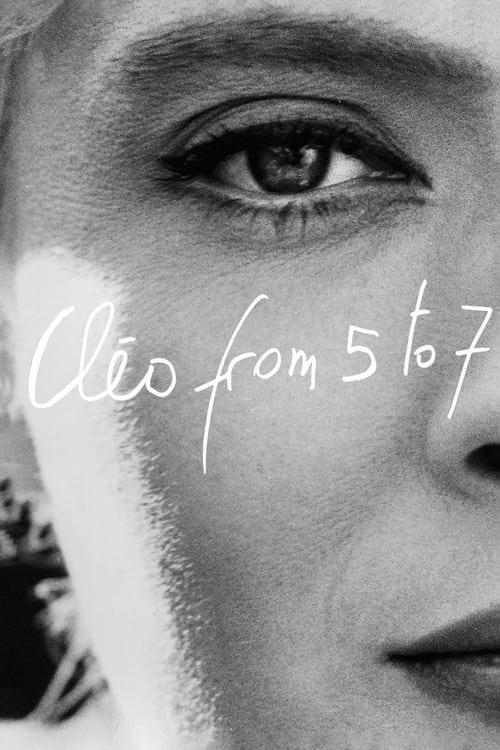
Cléo from 5 to 7
1962 · Agnès Varda
When you want to wander — a film to sink into like a walk through a city, contemplative but never heavy, perfect for a reflective evening alone. It's a challenge only in the sense that it asks you to slow down.
What it's about
A glamorous Paris pop singer has two hours to kill before learning the results of a medical test that could mean cancer. Told nearly in real time across the city on a single summer evening in 1961, the film follows Cléo — a woman accustomed to being looked at — as she drifts through cafés, taxis, and parks, and slowly starts truly looking at the world around her.
The experience
Buoyant and melancholy at once — it moves with the rhythm of a real afternoon, alive with street noise and chance encounters, while dread ticks quietly underneath. It's the rare film about mortality that feels light on its feet.
Performances
Corinne Marchand carries nearly every frame as Cléo, tracing a woman's shift from performing herself to inhabiting herself with remarkable subtlety — vain and childish at first, then startlingly open.
The craft
Agnès Varda structures the film in timestamped chapters that make ninety minutes of a life feel both documentary-real and formally daring, filling the frame with mirrors that gradually give way to unguarded views of Paris. Michel Legrand's score threads through it, and the black-and-white street photography captures the city with a photographer's eye.
Why it matters
A cornerstone of the French New Wave and of Varda's career, it proved a woman's interior life could carry an entire film's architecture — and generations of walking-and-talking city films owe it a debt.
Ninety minutes in the life of a pampered pop singer, told in something very close to real time: Agnès Varda's second feature follows Cléo across Paris on the summer solstice of 1961 as she awaits the results of a medical test, watching a woman accustomed to being looked at learn, chapter by timestamped chapter, how to look. Varda — the Left Bank photographer whose La Pointe Courte had anticipated the New Wave by half a decade — stages a quiet formal drama of mirrors: the film brims with them until, at its turning point, Cléo tears off her wig and Paris stops reflecting her and starts existing. Michel Legrand, who wrote the score, appears as her songwriter; Godard and Anna Karina turn up in a silent-film burlesque screened within the film. Only the opening tarot reading is in color — the cards, after all, claim to see the future; the rest unfolds in luminous black and white, which cannot.
A Deleuzian reading
She keeps checking her face.
The full Deleuzian reading of Cléo from 5 to 7 →
Reception
Admired on release as a highlight of the New Wave but long filed behind the films of Godard and Truffaut, it has climbed steadily as Varda's reputation soared — by the 2022 Sight & Sound poll it sat in the critics' top 20, now routinely called one of the movement's defining films.
How Cléo from 5 to 7 was received, from release to now →
Influences: the films it descends from and the films it influenced
- La Pointe Courte (1955) — Varda's own debut established her contrapuntal editing (cut by Alain Resnais) that alternates a documentary-real location with a scripted couple — the same braiding of documented street and staged interiority Cléo runs in real time.
- Hiroshima mon amour (1959) — The Left Bank model of subjective duration and interior monologue laid over city walking that Varda inherits, treating clock time as psychological time rather than plot time.
- Rope (1948) — Hitchcock's experiment in collapsing screen time onto story time in near-continuous takes is the formal precedent for Cléo's insistence that the film's runtime equal the heroine's lived interval.
- The Set-Up (1949) — Wise's strict real-time construction, with visible clocks marking every passing minute of the story, is the discipline Varda adopts and chapters explicitly with title cards.
- High Noon (1952) — Zinnemann's synchronization of narrative duration to a ticking clock and recurring shots of timepieces prefigures Cléo's countdown structure toward a dreaded verdict.
- Bicycle Thieves (1948) — The neorealist practice of building a film from a person's real-time search across genuine city streets and crowds is the documentary substrate Varda grafts onto a New Wave character study.
- Cléo's mirror lineage — The Lady from Shanghai (1947) — Welles's mirror-hall staging that fractures and interrogates a woman's image anticipates Varda's recurring mirror motif, in which Cléo's compulsive self-reflection is progressively dismantled as vanity gives way to sight.
- Wild Strawberries (1957) — Varda applied Bergman's road-film-as-elegy format — a protagonist's journey through space as real-time interior reckoning with mortality — to urban, feminist, and strictly real-time terms, retaining the introspective journey's structure while transforming its social and temporal coordinates.
- Forever a Woman (1955) — A near real-time portrait of a woman awaiting a cancer verdict, extending Tanaka's female-gaze framing of a body under medical threat rather than male desire.
- Jeanne Dielman, 23 Commerce Quay (1975) — Akerman extends Cléo's real-time female duration into rigorous domestic observation, letting elapsed time and a woman's ordinary tasks carry the drama through a frankly female gaze.
- Wanda (1970) — Loden inherits the drifting, aimless female protagonist observed in near-documentary real space, decentering plot in favor of a woman's moment-to-moment perception.
- Vagabond (1985) — Varda herself extends the craft: a wandering woman traversed in quasi-real episodes structured toward mortality, again fusing documentary encounter with a formal countdown.
- Before Sunset (2004) — Linklater revives Cléo's real-time-equals-runtime conceit as two people walk a European city continuously, the film's duration matching the story's ticking window.
- Russian Ark (2002) — Sokurov pushes the real-time premise to its limit in a single unbroken take, the ultimate purification of the temporal contract Varda made with the viewer.
- Victoria (2015) — Schipper's one-take real-time night across a city, anchored to a young woman's continuous experience, is a direct descendant of Cléo's synchronized-clock walking film.
- Frances Ha (2012) — Baumbach openly homages the New Wave — black-and-white photography and a young woman ambling through the city set to buoyant music — reviving Cléo's tonal blend of melancholy and lightness.
- Portrait of a Lady on Fire (2019) — Varda establishes the grammatical distinction between being-looked-at and looking, tracking the moment when a woman turns the camera's moral authority back on the world that objectifies her — the precise 'ethics of looking' and 'female gaze' problem Sciamma inherits and resolves through Mathon's shared-gaze construction.
- Poor Things (2023) — Varda's method of holding the female body as cinematic subject from within rather than surveilling it from without — the camera attending to a woman's interiority as she moves through social space — is the foundational formal commitment *Poor Things* inherits for its approach to Bella's developing selfhood.
- Anora (2024) — A female protagonist whose social existence is conditioned by others' projections onto her; Varda uses real Paris locations and non-professional encounters to anatomize the fairy-tale female role from the inside, providing a template for Baker's Cinderella critique through inhabitation rather than external commentary.
- Locke (2014) — Models the real-time portrait of a single protagonist moving through a city in unbroken present tense, anchoring narrative to lived duration rather than plot events.
- The Currents (2025) — Uses mirror and reflection framing to track a woman's interior crisis across a city in near-real time, externalizing psychological state through reflective surfaces.
- Breathless (1960) — Godard (who cameos in Cléo) pioneered the New Wave method of shooting handheld in real Paris streets with natural light and non-professional bystanders that Varda deploys for Cléo's cab and café wanderings.
- The 400 Blows (1959) — Truffaut's roving location camera tracking a solitary figure through actual Parisian exteriors shares Cléo's ambulatory grammar of following a protagonist through documented city space.
- Elephant (2003) — Van Sant's Steadicam trailing of characters through real corridors in overlapping continuous time echoes Cléo's method of binding the camera to a body moving through space in the present tense.
- La Jetée (1962) — Contemporaneous Left Bank work that builds its drama on a rigorous temporal armature and documentary location-shooting of real Paris streets rather than studio sets.
- Vivre Sa Vie (1962) — A chaptered, near-real-time portrait of a Parisian woman, structured by titled time-segments and lateral tracking through the city's streets.
- Muriel, or the Time of Return (1963) — Left Bank near-real-time portrait of a woman moving through an everyday Paris shadowed by the Algerian War, a contemporaneous formal answer to the same milieu.
- Tatami (2024) — Traces a woman's existential crisis in near-real-time over a compressed span in the city — the female-centered real-time structure Tatami reframes as a fighter's single decisive day.
- The Fire Within (1963) — Shares the last-days-countdown clock and the peripatetic wandering through real Paris while awaiting a verdict of death, treating time itself as the film's structuring principle.
- Boyfriends and Girlfriends (1987) — A New Wave sibling in walking a woman through real Paris in near-real time, letting the city's streets and architecture function as co-subject rather than backdrop.
- Lola (1961) — Varda applies the same method Demy uses — a rigid geometric scheme (real-time chapters, mirror motifs) laid over documentary street footage — and hires the same composer, with Legrand appearing on screen at the piano, making the score's artifice visible inside the location reality.
Similar films
- Vagabond (1985) — influence & lineage
- Breathless (1960) — influence & lineage
- Hiroshima Mon Amour (1959) — influence & lineage
- Vivre Sa Vie (1962) — same viewing thread
- L'Eclisse (1962) — same viewing thread
- The Green Ray (1986) — same viewing thread
- Nouvelle Vague (2025) — same viewing thread
- Pierrot le Fou (1965) — same viewing thread
All the films related to Cléo from 5 to 7 →
Watch it with: curated runs of related films
- Adrift in the Modern World — Watch these when you want to drift through postwar Rome and Paris alongside people who have everything and feel nothing — they rhyme on beautiful boredom, aimless days, and a search for meaning that modern comfort keeps failing to supply.