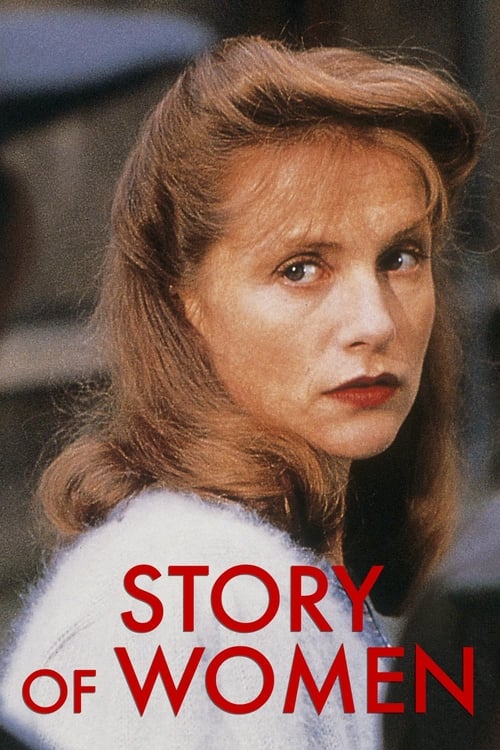
Story of Women
1988 · Claude Chabrol
For when you want a serious, morally thorny drama that treats you like an adult — no comfort viewing, but deeply absorbing. Reach for it when you're in the mood to argue with a film afterward.
What it's about
In a coastal town in Nazi-occupied France, Marie Latour is a working-class mother of two scraping by while her husband returns from the war injured and diminished. Almost by accident she begins performing clandestine abortions — first as a favor, then as a trade — and rents a room to a prostitute friend, building a small illicit economy that buys her independence, pleasure, and a young lover. It's drawn from the real case of a woman prosecuted by the Vichy regime, told without either sainthood or condemnation.
The experience
Cool, precise, and quietly damning — Chabrol keeps his distance and lets the moral temperature drop scene by scene. It doesn't tell you what to feel about Marie, which is exactly what makes it linger; the unease builds toward a genuine weight.
Performances
Isabelle Huppert is extraordinary as Marie: selfish, vital, opaque, and sympathetic all at once, refusing to soften the character into a heroine or harden her into a villain. It's one of the great demonstrations of her ability to hold contradictions on screen without explaining them.
The craft
Chabrol directs with surgical restraint — no melodrama, no editorializing, just accumulating detail about money, hunger, and hypocrisy in an occupied town. The period reconstruction serves the argument: the film indicts a state's moral posturing simply by showing how things worked.
Why it matters
One of the peaks of Chabrol's late career and of his long collaboration with Huppert, it remains a touchstone for films about abortion, wartime collaboration, and the way states punish women — a historical drama that keeps re-entering current debates.
Snapshot
Story of Women (French: Une affaire de femmes, literally "A Woman's Affair" or "An Affair of Women") is Claude Chabrol's clear-eyed reconstruction of the case of Marie-Louise Giraud, a working-class Frenchwoman who performed clandestine abortions in Occupied France and became one of the last women guillotined in the country, executed in 1943 under the Vichy regime. Renamed Marie Latour and embodied by Isabelle Huppert, she is a mother of two in a coastal town whose casual, almost accidental drift into abortion — first a favor, then a trade — coincides with the taking of a young lover and the humiliation of a war-damaged husband who ultimately denounces her. Chabrol films this not as martyrology but as a cold moral autopsy: Marie is neither heroine nor monster, and the state that kills her is exposed as a hypocrite dressing patriarchal panic as national virtue. It stands among the most respected works of Chabrol's late career and a summit of the Chabrol–Huppert partnership.
Industry & production
The film was produced by Marin Karmitz through MK2, the production-and-distribution house that became Chabrol's principal industrial home in this period and would back several of his subsequent films. It adapts Francis Szpiner's nonfiction account Une affaire de femmes (published in the mid-1980s), which reopened the Giraud case; the screenplay was written by Chabrol with Colo Tavernier O'Hagan. Made on the moderate budget typical of French auteur production of the era, the picture reflects Chabrol's famously economical working method — a small, loyal, long-standing crew and efficient shooting rather than spectacle. Its international profile was secured at the 1988 Venice Film Festival, where Huppert won the Volpi Cup for Best Actress; that prize drove the film's foreign distribution, including a well-received U.S. release the following year. Precise budget and box-office figures are not something I can state reliably here, and I won't invent them.
Technology
This is a conventionally photographed 35mm film of the late 1980s, and its technology is deliberately unobtrusive: Chabrol was never a technical experimentalist. The interest lies in the refusal of period-picture gloss. Available and motivated light, practical interiors, and a restricted, wintry color range substitute for the burnished textures typical of Occupation dramas. There is no reliance on optical showmanship, elaborate camera rigging, or the era's emerging effects. If there is a "technology" story, it is one of classical craft used to strip away artifice — the machinery kept invisible so that the human transaction stays foregrounded.
Technique
Cinematography
The photography is by Jean Rabier, Chabrol's cinematographer since the early 1960s and one of the defining hands of the director's visual style. Rabier gives Story of Women a muted, chilled palette appropriate to wartime scarcity — grays, browns, weak daylight through modest windows — and a composed, watchful camera that observes Marie without editorializing. The framing is precise and often frontal, holding characters at a slight remove so that the viewer is invited to judge, then denied the comfort of a clear verdict. Cramped domestic interiors express poverty and entrapment; the camera rarely indulges in movement for its own sake, favoring stable setups that let performance and blocking carry meaning. This restraint is itself the argument: the abortions and the executions are shown with the same even, unsentimental attention.
Editing
Editing is by Monique Fardoulis, another core member of Chabrol's long-term collaborative "family." The cutting is classical and unhurried, building the narrative through accumulation of ordinary incident rather than dramatic acceleration. Scenes are allowed to breathe; the rhythm mirrors the way Marie's fate creeps up on her through small, self-interested choices. The film withholds the melodramatic montage a more conventional treatment would use at the arrest and trial, keeping the tempo level so that the shift from private life to state machinery lands with procedural coldness rather than crescendo.
Mise-en-scène / staging
Chabrol's staging is where his method is most legible. The film is organized around thresholds and rooms — the family apartment, the rented room let to a prostitute friend, the kitchens and corridors where the abortions happen — so that domestic space and clandestine trade occupy the same frame. Marie is repeatedly staged in relation to her children, her husband, her clients, and her lover, the choreography making visible how she treats each as an obstacle or an opportunity. Period detail is present but never fetishized; the Occupation is rendered through shortage, opportunism, and the quiet ubiquity of collaboration rather than through iconography. The staging insists on the continuity between the everyday and the atrocious.
Sound
The score is by Matthieu Chabrol, the director's son and his regular composer from the 1980s onward. In keeping with the film's restraint, music is used sparingly and pointedly rather than to underscore emotion continuously. Diegetic sound — a song Marie sings or teaches, the noises of a crowded flat, the sounds of the tribunal — grounds the film in lived texture. The soundtrack avoids the swelling orchestration that would sentimentalize Marie or heroize her death; the aural world stays as measured and cool as the images.
Performance
The film is a performance showcase in the most disciplined sense. Isabelle Huppert plays Marie without seeking sympathy: she is vain, ambitious, careless with her children, alive to pleasure, and largely oblivious to the moral and political weight of what she does. Huppert refuses to soften her, which is precisely what makes the eventual execution damning — the state kills an ordinary, flawed woman, not a saint. François Cluzet plays her husband Paul as a wounded, emasculated returned soldier whose resentment curdles into the denunciation that destroys her; his performance supplies the film's other tragedy, that of impotent male grievance weaponized by an authoritarian order. The supporting playing — the prostitute friend, the young lover, the children — is kept in the same unforced register.
Narrative & dramatic mode
The dramatic mode is Chabrol's characteristic ironic realism: a slow, observational chronicle that declines to guide the audience's moral response. The narrative is essentially a downward trajectory told without moralizing voice-over or special pleading — Marie's rise into modest prosperity and self-assertion is inseparable from the acts that will condemn her. Chabrol builds dramatic irony from the audience's foreknowledge (this is a true story of an execution) set against Marie's obliviousness. The trial and its aftermath introduce a colder, more procedural mode, and the film closes on the machinery of state punishment with a documentary flatness, reportedly framed by a closing text tied to her son — a detail readers should verify against the print, as I'd rather flag it than overstate its exact wording. The overall effect is tragedy stripped of catharsis.
Genre & cycle
Formally the film is a period drama and a true-crime biography, but it belongs to two more specific cycles. First, the strand of Chabrol's own work built from real criminal cases and the moral opacity of women who transgress — most directly recalling Violette Nozière (1978), his earlier Huppert collaboration about a young murderess. Second, and more broadly, it sits within the French cinema of reckoning with the Vichy years and the Occupation, a body of work that includes Marcel Ophüls's documentary The Sorrow and the Pity (1969), Louis Malle's Lacombe, Lucien (1974) and Au revoir les enfants (1987), and François Truffaut's The Last Metro (1980). Against those films' concern with collaboration and resistance, Chabrol adds a feminist and class dimension: the war seen from the kitchen, and the citizen destroyed not for treason but for controlling women's bodies.
Authorship & method
Story of Women is a near-textbook example of Chabrol's authorship and working method. A first-generation figure of the French New Wave — co-author, with Éric Rohmer, of an early critical study of Hitchcock, and a lifelong ironist of bourgeois manners — Chabrol worked by the 1980s as a classical craftsman surrounded by a stable creative "family." That collaborative core is fully present here: cinematographer Jean Rabier, editor Monique Fardoulis, and composer Matthieu Chabrol, with the screenplay co-written by Colo Tavernier O'Hagan and the production overseen by Marin Karmitz. Chabrol's method favored trust in actors, economical shooting, and a refusal of directorial editorializing — he famously observed his characters, especially transgressive women, without condemning or absolving them. The result is authorship as controlled withholding: the "point of view" is the very evenness with which cruelty and ordinariness are given equal weight.
Movement / national cinema
Chabrol was one of the founders of the Nouvelle Vague, his Le Beau Serge (1958) and Les Cousins (1959) among its earliest features. By 1988, however, he was no longer making "New Wave" films in any formal sense; Story of Women belongs to the mature, classically constructed auteur cinema that the New Wave generation settled into. Within French national cinema of the 1980s it exemplifies the prestige auteur drama — literary or historical source, star actress, mid-scale MK2-style production — that coexisted with the glossier cinéma du look of younger directors. The film's French specificity is essential: it interrogates a national trauma (Vichy) and a national institution (the guillotine, still in use into the early 1980s) with a directness aimed squarely at French historical memory.
Era / period
The film was made and released in 1988 but set in roughly 1941–1943, in Occupied France under the Vichy government. That period setting is not backdrop but subject. Vichy's official ideology — "Travail, Famille, Patrie" (Work, Family, Fatherland) — elevated motherhood and the family as pillars of national regeneration, and it recategorized abortion as a crime against the state, punishable by death. Marie's execution is thus historically precise: she is killed less for individual acts than as an exemplary sacrifice to a regime's demographic and moral panic, at the very moment that same regime was collaborating in far greater crimes. The 1988 vantage point matters too — the film arrived amid a broader French cultural willingness, through the 1970s–80s, to confront the compromises of the Occupation rather than mythologize universal resistance.
Themes
The governing theme is the female body as political territory: reproduction, sexuality, and survival made into matters of state, and a poor woman punished for asserting autonomy over all three. Around it cluster several others. Hypocrisy and complicity — a collaborationist regime moralizing about virtue while Marie's clients, neighbors, and the tribunal all participate in the ordinary economy of the Occupation. Poverty and opportunism — abortion enters Marie's life as economic necessity and then aspiration, class shaping every "choice" she makes. Emasculation and denunciation — Paul's wounded masculinity, and the way private resentment is enlisted by authoritarian power, so that the personal betrayal and the state execution become one act. The withholding of judgment — Chabrol's refusal to make Marie sympathetic forces the audience to confront capital punishment and patriarchal law without the alibi of admiring the victim. It is, finally, a film about how societies choose whom to sacrifice.
Reception, canon & influence
Story of Women was received as a major work and a high point of Chabrol's late period. Its most concrete honor was Isabelle Huppert's Volpi Cup for Best Actress at Venice in 1988, and the film went on to a strong critical reception internationally, including an admired U.S. release; it was widely cited as one of the best foreign-language films of its release year, though I would not attach specific critics'-group prizes to it without confirmation, and readers should verify any such attributions. Backward, its influences run through Chabrol's own lineage — his Hitchcock-schooled interest in guilt and moral ambiguity, his recurring fascination with real female criminals (Violette Nozière), and the New Wave's founding impulse to observe rather than instruct — grafted onto Szpiner's documentary source and the French tradition of Occupation reckoning. Forward, the film's most durable legacy is twofold. It consolidated the Chabrol–Huppert collaboration as one of the great director–actor partnerships of modern European cinema, leading to Madame Bovary (1991), La Cérémonie (1995), and further films, and it became a touchstone in feminist film discussion and in the cultural history of abortion rights, repeatedly invoked whenever cinema is asked to depict the criminalization of reproductive care. Its influence is less a matter of stylistic imitation than of moral example: proof that a film can indict a system most powerfully by refusing to flatter its victim.
Reception
Acclaimed from the start — Venice loved it in 1988 and it's long been ranked among Chabrol's very best — but it was also genuinely controversial in France, drawing protests from Catholic groups over its abortion subject; post-2022, Letterboxd reviewers keep rediscovering it as suddenly, uncomfortably current.
How Story of Women was received, from release to now →
Influences: the films it descends from and the films it influenced
- Shadow of a Doubt (1943) — The Hitchcock study Chabrol co-wrote with Rohmer is applied directly here: lodge murder inside sunlit domestic ordinariness and let the camera watch guilt accrue without underlining it — the withholding point of view of Story of Women.
- Le Boucher (1970) — Establishes Chabrol's frontal, observational provincial framing and his refusal to condemn a killer, the exact evenness of gaze later trained on Marie.
- Violette Nozière (1978) — The first Chabrol–Huppert true-crime portrait of a real female criminal observed without absolution — the collaborative method and unsympathetic-heroine register Story of Women perfects.
- Les Bonnes Femmes (1960) — New Wave location realism and unsentimental, near-documentary attention to ordinary women's constrained provincial lives — the observe-don't-instruct impulse at Chabrol's origin.
- The Sorrow and the Pity (1969) — Dismantled the resistance myth by cataloging everyday Vichy complicity, supplying the moral reckoning about ordinary collaboration that Story of Women dramatizes.
- Lacombe, Lucien (1974) — Portrays a collaborator with cold evenness, granting cruelty and banality equal weight without moral instruction — the same non-editorializing treatment of Occupation-era transgression.
- La Vérité (1960) — French true-crime built as a trial of a transgressive woman judged by a hypocritical society — the trial-as-social-indictment structure that frames Marie's execution.
- One Sings, the Other Doesn't (1977) — Dramatizes a real abortion-law martyr with docudrama sobriety, extending Varda's fusion of a woman's private reproductive choice with a specific, historically named legal case.
- Madame Bovary (1991) — Immediately extends the partnership with the same muted wintry palette, classical unhurried editing, and Huppert's cool opacity refusing audience identification.
- La Cérémonie (1995) — Huppert as an unlikable working-class figure, staged through frontal compositions across domestic thresholds where class resentment curdles into violence — the mature form of this method.
- The Piano Teacher (2001) — Extends the Chabrol-forged 'unsympathetic Huppert,' pairing her opacity with clinical frontal framing and withheld judgment of a self-destructive transgressive woman.
- Elle (2016) — Trades on the same actress's refusal to solicit sympathy — the flat, unreadable Huppert performance whose grammar Story of Women codified.
- Happening (2021) — A French illegal-abortion drama that treats the female body as political territory through clinical, close, unsentimental framing directly descended from Chabrol's refusal to aestheticize suffering.
- Never Rarely Sometimes Always (2020) — Restrained observational framing of abortion access, letting dramatic irony and procedural detail carry the indictment in place of sentiment.
- Vera Drake (2004) — Renders an ordinary backstreet abortionist through domestic-threshold staging and moral evenness rather than melodrama, indicting the system by refusing to flatter or vilify its agent.
- 4 Months, 3 Weeks and 2 Days (2007) — Observational long takes and sparing diegetic sound render criminalized abortion without a musical cue or editorial comment — the same discipline of unhurried, unsentimental proximity.
- Au revoir les enfants (1987) — A contemporaneous entry in the Vichy-reckoning cycle that stages everyday complicity and betrayal without accusation, sharing the evenhanded gaze on Occupation moral failure.
Similar films
- La Cérémonie (1995) — influence & lineage
- 4 Months, 3 Weeks and 2 Days (2007) — influence & lineage
- Happening (2021) — influence & lineage
- The Butcher (1970) — influence & lineage
- The Piano Teacher (2001) — influence & lineage
- Au Revoir les Enfants (1987) — influence & lineage
- Diary of a Chambermaid (1964) — shared sensibility
- Belle de Jour (1967) — shared sensibility