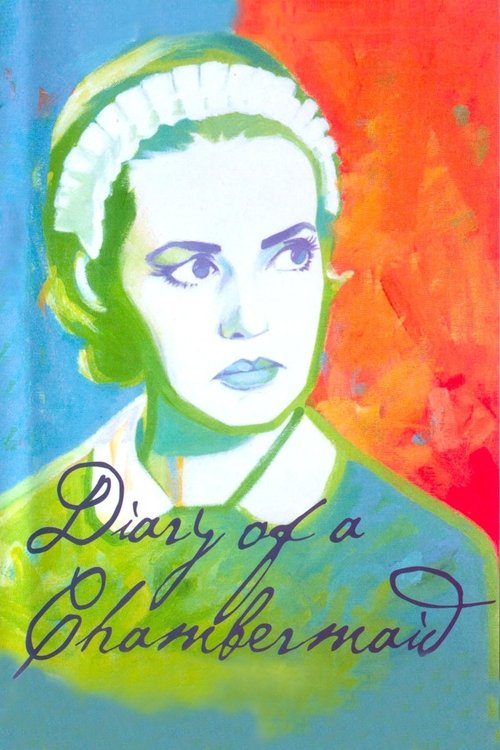
Diary of a Chambermaid
1964 · Luis Buñuel
For when you're in the mood for something wicked and grown-up — a film that skewers polite society and trusts you to keep up. Definitely a challenge pick: it rewards attention and a taste for dark irony over comfort.
What it's about
Célestine, a sharp Parisian chambermaid played by Jeanne Moreau, takes a post with a bourgeois family on a provincial Normandy estate in the late 1920s, where she's immediately surrounded by the household's kinks, repressions, and petty tyrannies — a boot-fetishist old patriarch, a frigid mistress, a lecherous master. When a young girl is raped and murdered, Célestine becomes convinced the culprit is Joseph, the brutish, far-right groundskeeper, and stays on, using her own allure as bait to draw out a confession.
The experience
Cool, dry, and quietly vicious — a comedy of manners where the laughs catch in your throat. Buñuel keeps the surface elegant and matter-of-fact while the rot underneath gets steadily uglier, and the film's deadpan refusal to moralize is exactly what makes it unsettling.
Performances
Jeanne Moreau is the whole engine — watchful, unreadable, ironic, letting you see Célestine calculate without ever telling you what she's concluded. It's a masterclass in playing intelligence.
The craft
Shot in austere widescreen black and white, with Buñuel's first script written with Jean-Claude Carrière — the partnership that would define his late masterpieces. The surrealism here is subtle, tucked into fetish objects and loaded glances rather than dream sequences, and the restraint gives every perverse detail more charge.
Why it matters
The film opened the great final chapter of Buñuel's career — the run of French satires that made him the cinema's supreme mocker of the bourgeoisie — and its linking of private perversion to rising fascism has only grown sharper with time.
Snapshot
Le Journal d'une femme de chambre is Luis Buñuel's first French production after his long Mexican period and his Spanish detour with Viridiana (1961), and it marks the opening of the most consequential partnership of his late career: his first screenplay co-written with Jean-Claude Carrière, who would collaborate on every Buñuel film through That Obscure Object of Desire (1977). Adapted from Octave Mirbeau's 1900 novel — already filmed by Jean Renoir in Hollywood in 1946 — the picture transplants the story's events to provincial Normandy in the late 1920s, where Célestine (Jeanne Moreau), a Parisian chambermaid arriving to serve a bourgeois household, becomes entangled in fetishism, repression, and a child's rape and murder she comes to pin on the brutish, fascist-leaning groundskeeper Joseph. Shot in austere black-and-white widescreen with no musical score, it is a cold, controlled film, less overtly Surrealist than Buñuel's earlier work but saturated with his lifelong contempt for the comfortable cruelties of the bourgeoisie and the church. The transposition forward in time lets Buñuel end the film on the rise of French reaction — a chillingly modern note that distinguishes his version sharply from Renoir's.
Industry & production
The film was a French-Italian co-production, mounted by producer Serge Silberman — beginning another long-running Buñuel association — in collaboration with Michel Safra, through the companies Speva Films, Ciné-Alliance and Filmsonor on the French side and Dear Film on the Italian. Buñuel had returned to Europe and, after the Spanish authorities' suppression of Viridiana, was effectively working in exile from Spain; France offered both capital and the relative artistic freedom of its postwar industry. The project reunited him with a property he reportedly had long wanted to adapt: Mirbeau's anticlerical, anti-bourgeois novel was congenial material, and the decision to relocate its action from the turn of the century to roughly 1928 was a deliberate authorial intervention rather than a production constraint. Jeanne Moreau, then at the height of her international standing after Jules et Jim (1962) and her work with Antonioni, anchored the film commercially and gave Buñuel a star of cool intelligence well suited to Célestine's watchfulness. The supporting cast drew on established French players — Michel Piccoli (here beginning his own important relationship with the director), Georges Géret, Françoise Lugagne, Jean Ozenne, and Daniel Ivernel. The detailed financial record is thin in English-language sources, and I will not invent box-office figures; the film is generally understood to have been a respectable art-house release rather than a major commercial event, valued more for re-establishing Buñuel in the French industry than for its returns.
Technology
The film was made with the standard professional apparatus of mid-1960s French cinema: 35mm black-and-white photography in an anamorphic widescreen process (Franscope, the French CinemaScope-type system), with direct synchronous and post-synchronized French dialogue. There is nothing technologically experimental here, and that restraint is itself meaningful. Buñuel, who had begun in the silent and early sound eras, was famously indifferent to technical novelty for its own sake; he used the tools that served the story and no more. The choice of black-and-white in 1964, when color was increasingly the commercial default, was an aesthetic and tonal decision rather than a limitation — it suits the film's wintry Norman setting and its morally desaturated world. The anamorphic frame, likewise, is deployed not for spectacle but to organize social space within rooms and across the manor's grounds.
Technique
Cinematography
The photography is by Roger Fellous, who renders the household and its surroundings in a flat, even, undramatized gray. Buñuel's late style is characterized by an almost classical sobriety of camerawork — eye-level framing, unobtrusive setups, a refusal of expressive distortion — and Fellous's images serve that program. The widescreen compositions tend to place figures within the architecture of the bourgeois interior or the bare winter landscape, observing rather than editorializing. Where many directors would underline the film's perverse and violent material with lighting or angle, Buñuel and Fellous keep the camera level and the lighting plain, so that fetishism, cruelty, and murder are presented with the same matter-of-fact lucidity as a meal or a conversation. This deadpan neutrality is central to the film's disturbing effect.
Editing
The cutting (the editorial work is generally credited to Louisette Hautecœur) follows Buñuel's characteristic economy. His late films are notable for their lack of ostentatious montage; scenes are constructed in clear, legible spatial terms and joined without flourish. The film moves through its episodic incidents — Célestine's arrival, the old fetishist M. Rabour and his ritual with her boots, the father's death, the child's murder, the investigation, the ambiguous resolution — with a steady, unhurried rhythm. Buñuel reserves his disruptions for content rather than form: it is the abrupt eruption of the murdered girl into the narrative, and the elliptical handling of guilt and complicity, that unsettle, not any virtuoso editing.
Mise-en-scène / staging
This is where the film is richest. Buñuel stages the bourgeois household as a closed ecosystem of repression and appetite: M. Monteil (Piccoli) a frustrated, predatory husband; his frigid, money-counting wife (Lugagne); her father M. Rabour (Ozenne), whose courtly fetish for women's feet and fine boots is one of the film's most celebrated images; and the menacing Joseph (Géret) below stairs. Objects carry enormous weight in Buñuel's staging — boots, a slug on a leaf, snails crawling over a dead child's legs, hunting and slaughter — and the manor's rooms and grounds become a map of class and desire. The famous shot of Rabour's death, his body discovered still clutching one of Célestine's buttoned boots, fuses eros and mortality in a single Surrealist-inflected tableau. Buñuel's staging consistently links the polite surfaces of the household to the violence and perversity it contains.
Sound
Most distinctive is the near-total absence of non-diegetic music. Buñuel had a well-documented aversion to scoring in his mature work, distrusting music as emotional manipulation, and Diary of a Chambermaid proceeds almost entirely on natural sound — footsteps, wind, the noise of the countryside, dialogue. This silence intensifies the film's coldness and its observational stance; without a score to cue feeling, the spectator is left alone with the events and their implications. The soundscape of the rural manor — animals, weather, the report of a gun — does much of the atmospheric work that music would conventionally carry.
Performance
Jeanne Moreau gives a performance of guarded, ironic intelligence as Célestine, a servant who watches her employers with a knowing detachment and who pursues her own ambiguous course — neither innocent victim nor simple avenger. Her Célestine uses sexuality strategically, and Moreau plays the character's calculation and self-possession without softening them. Georges Géret makes Joseph a genuinely frightening figure of inarticulate brutality and reactionary politics. Michel Piccoli's Monteil is a study in bourgeois sexual frustration, and Jean Ozenne's elderly fetishist is rendered with a courtly delicacy that makes the perversion both comic and poignant. The ensemble plays in the restrained, unmelodramatic register Buñuel favored, which keeps the film's extremity grounded in social observation.
Narrative & dramatic mode
The film is episodic and ironic rather than tightly plotted, structured around Célestine's progress through the household and its scandals. Its dramatic mode mixes drama with mordant black comedy, a tonal blend characteristic of Buñuel: the fetishism is treated with dry humor, the bourgeois marriage with satire, and the murder with a chilling refusal of catharsis. Crucially, Buñuel withholds moral resolution. Joseph is strongly implicated in the child's murder but is never definitively convicted within the story's terms; Célestine's pursuit of justice is entangled with her own ambitions and ends compromised — she marries up and out of service, while Joseph prospers and the social order absorbs the crime. The film denies the audience the satisfaction of guilt assigned and punished, and that denial is the point: justice is shown to be subordinate to class.
Genre & cycle
Nominally a literary costume drama and a tale of crime, the film belongs more truly to Buñuel's ongoing cycle of bourgeois critiques — the loose, lifelong project that runs from L'Âge d'Or (1930) through The Exterminating Angel (1962) and forward to The Discreet Charm of the Bourgeoisie (1972). Within his French period it stands as the first of a trio of major adaptations of French and Spanish literary sources made with Carrière and built around scrutiny of bourgeois mores, alongside Belle de Jour (1967) and Tristana (1970), the latter also pairing a watchful woman with an older man's desire and a fetishized lower body. It is less a genre film than an entry in an authorial cycle.
Authorship & method
Diary of a Chambermaid is, above all, a Buñuel film, and it inaugurates the working method that would define his last great phase. The screenplay, written with Jean-Claude Carrière, established a collaboration of remarkable durability and intellectual sympathy; Carrière's literary precision and structural sense meshed with Buñuel's imagistic and satirical instincts. The decisive authorial move — shifting Mirbeau's fin-de-siècle story forward to the late 1920s so that it could climax with a fascist street demonstration — is pure Buñuel, converting a period drama into a political prophecy and settling old scores: the reactionary crowd's cry of "Vive Chiappe!" invokes Jean Chiappe, the Paris police prefect associated with the banning of L'Âge d'Or, a pointed personal allusion. Roger Fellous (cinematography) supplied the cool gray surface; Louisette Hautecœur the unobtrusive cutting; and the absence of a composer is itself an authorial signature. Buñuel's method here is one of restraint and displacement — letting objects, gestures, and tone carry meaning that the camera declines to underline.
Movement / national cinema
The film occupies an unusual position in French cinema of the 1960s. Made at the height of the Nouvelle Vague, it is emphatically not a New Wave film: Buñuel, a generation older and rooted in 1920s Surrealism, worked in a classical, controlled style that has little to do with the handheld spontaneity of Godard or Truffaut, even as he shared the New Wave's taste for Moreau and its appetite for transgression. He is better understood as a returning master of the international art cinema, a Surrealist elder whose French production drew on French capital, stars, and literary heritage while remaining stylistically and thematically his own. The film thus belongs to French national cinema institutionally and to the transnational, exilic lineage of Buñuel artistically.
Era / period
Released in 1964, the film registers its moment obliquely. Its setting in the late 1920s and its closing vision of organized far-right reaction were, for a postwar European audience, unavoidably colored by the memory of fascism and occupation — Buñuel makes the bourgeois household's casual cruelties and the groundskeeper's brutality continuous with the political violence gathering outside. Made by a director who had lived through the Spanish Civil War and decades of exile, the film carries the weight of that history into a deceptively quiet country-house story, using the past to speak to the persistence of authoritarian sentiment.
Themes
The governing themes are Buñuel's perennial ones, here distilled with unusual coldness: the hypocrisy and repression of the bourgeoisie; the entanglement of desire with cruelty and death (the boot fetish, the slaughter and hunting motifs, the eroticized violence against the child); the impotence of justice before class power; and the political undertow of bourgeois respectability, which the film links explicitly to fascism. Sexuality is presented as transactional and strategic — Célestine deploys hers to extract a confession and to secure her own advancement — and religion and propriety appear as thin coverings over appetite. The recurrent Buñuelian fascination with feet, footwear, and the body's lower registers finds one of its fullest expressions in Rabour's fetish, an image at once tender, absurd, and morbid.
Reception, canon & influence
Critically, the film has long been regarded as a significant work of Buñuel's transitional French period — the bridge between the scandal of Viridiana and the celebrated late masterpieces — and especially as the threshold of the Carrière partnership. It is frequently noted that Buñuel's version stands in deliberate contrast to Jean Renoir's more romantic 1946 Hollywood adaptation of the same Mirbeau novel; comparison between the two is a standard critical lens, with Buñuel's colder, more political reading generally taken as the more characteristic and incisive. Detailed contemporary box-office and award records are thin in accessible English-language sources, and I will not fabricate them; the film's standing rests on its place in Buñuel's auteur canon rather than on prizes or grosses.
Looking backward, the film draws on Mirbeau's anticlerical, socially indignant novel, on Buñuel's own Surrealist formation and his decades-long anatomizing of the bourgeoisie, and implicitly on the Renoir precedent it revises. Looking forward, it shaped the trajectory of Buñuel's final decade: the Carrière collaboration it launched produced Belle de Jour, The Milky Way, Tristana, The Discreet Charm of the Bourgeoisie, The Phantom of Liberty, and That Obscure Object of Desire, and several of this film's preoccupations — the strategic sexuality of a watchful woman, the fetishized older man's desire, the deadpan presentation of perversity — recur and deepen across that body of work, with Tristana in particular reading as a near-companion piece. Its influence is felt less in direct imitation than in its contribution to the mature Buñuel mode of cool, satirical, image-driven bourgeois critique that became one of the defining strains of European art cinema.
A Deleuzian reading
A man dies in a chair, holding a woman's boot.
The full Deleuzian reading of Diary of a Chambermaid →
Reception
Landing between the scandal-makers, it was received in 1964 as oddly restrained, 'realist' Buñuel — barely a dream sequence in sight. Now it's read as the launchpad of his great late French period: the first Jean-Claude Carrière collaboration, and one of his most quietly furious political films.
How Diary of a Chambermaid was received, from release to now →
Influences: the films it descends from and the films it influenced
- Un Chien Andalou (1929) — Establishes Buñuel's surrealist grammar of fetishized body-parts and incongruous objects carrying meaning the camera refuses to explain — the objects-as-meaning method later deployed coolly here.
- L'Âge d'Or (1930) — Seeds the anticlerical bourgeois provocation and the toe/foot fetish (the statue's toe), and is literally invoked when the fascist crowd cries 'Vive Chiappe!' — settling the score for that film's banning.
- The Rules of the Game (1939) — Models the upstairs/downstairs ensemble staging that anatomizes a whole class through the parallel intrigues of its servants.
- The Diary of a Chambermaid (1946) — The same Mirbeau novel; Buñuel deliberately revises Renoir's romanticized Hollywood treatment into cold political deadpan — the standard comparative lens for the film.
- Pickpocket (1959) — Supplies the model of scoreless soundtrack, unobtrusive economical cutting, and hands/objects carrying narrative weight the camera declines to underline.
- Viridiana (1961) — The immediately prior bridge film, perfecting the deadpan presentation of perversity and sacrilege that the chambermaid's satire extends.
- The Criminal Life of Archibaldo de la Cruz (1955) — Houses overt shoe-and-foot fetishism inside cool, restrained realist photography, the same neutral-ground image strategy Jiménez gave Archibaldo.
- Belle de Jour (1967) — First full flower of the Carrière partnership launched here: a watchful woman's strategic sexuality and fetishized bourgeois desire presented with deadpan neutrality.
- Teorema (1968) — A bourgeois household upended by an eroticized intruder, rendered in cool deadpan that lets gesture and object expose class and desire.
- Tristana (1970) — Near-companion piece: the fetishized older man's desire for a watchful young woman, with a literal amputation deepening the body-fetish motif.
- The Discreet Charm of the Bourgeoisie (1972) — Extends the episodic-ironic structure and black-comic bourgeois critique with morality and resolution pointedly withheld.
- That Obscure Object of Desire (1977) — Carrière-scripted culmination of eros-and-death: the older man's thwarted, fetishistic desire set against a recurring undertow of political terror.
- The Tin Drum (1979) — Carrière co-scripted; the rise-of-fascism undertow rendered through grotesque deadpan, carrying forward the Carrière screenwriting method seeded here.
- La Cérémonie (1995) — A maid's class resentment erupting into violence with authorial judgment withheld — justice subordinate to class, observed with cool unobtrusive framing.
- Parasite (2019) — Servants infiltrating the bourgeois household as black comedy, where staging and recurring objects carry the class critique rather than dialogue.
- The Exterminating Angel (1962) — Deadpan surrealist entrapment of the bourgeoisie staged with neutral framing and no underlining — the same cool satirical mode applied to a single household.
- La Notte (1961) — Jeanne Moreau's interiorized, guarded screen presence — the watchful, ironic withholding she brings to the chambermaid.
- Jules et Jim (1962) — Showcases Moreau's strategic, guarded irony as a performance mode — a watchful woman managing the men around her.
- The Servant (1963) — Contemporaneous master/servant power inversion charged with eros and class resentment, the household's hierarchy quietly corroded from below.
Similar films
- Belle de Jour (1967) — influence & lineage · same viewing thread
- The Exterminating Angel (1962) — influence & lineage · same viewing thread
- The Discreet Charm of the Bourgeoisie (1972) — influence & lineage · same viewing thread
- L'Âge d'or (1930) — influence & lineage · same viewing thread
- Tristana (1970) — influence & lineage · same viewing thread
- That Obscure Object of Desire (1977) — influence & lineage · same viewing thread
- La Cérémonie (1995) — influence & lineage
- Theorem (1968) — influence & lineage · same viewing thread
All the films related to Diary of a Chambermaid →
Watch it with: curated runs of related films
- Buñuel and the Bourgeoisie — A run of surrealist provocations where every dinner, prayer, and marriage bed hides an appetite polite society can't admit — watch them together for the way Buñuel (and Pasolini's Theorem) keep pulling the tablecloth out from under the well-heeled.