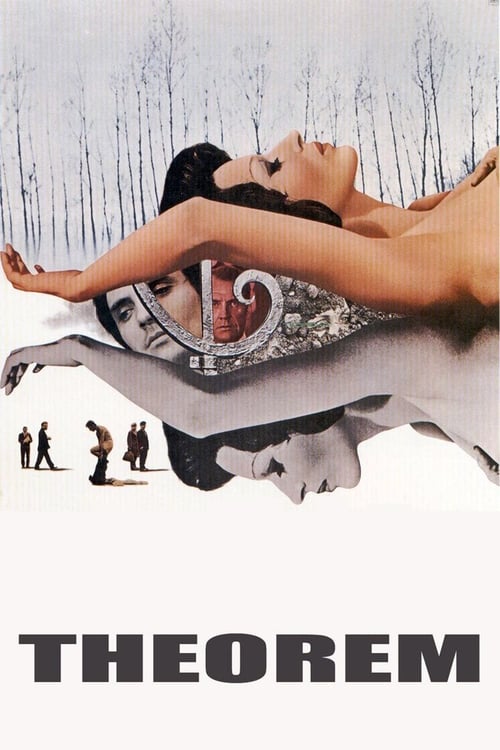
Theorem
1968 · Pier Paolo Pasolini
When you want strange and provocative over comfortable — a short, hypnotic art film to watch closely and argue about after. Bring curiosity and patience; it gives nothing away for free.
What it's about
A beautiful young stranger arrives at the villa of a wealthy Milanese industrialist and, one by one, draws the maid, the son, the daughter, the mother and finally the father into intimacy. Then he leaves as inexplicably as he came — and the household he touched cannot go back to what it was. Who he is and why he came is the question the film pointedly refuses to answer.
The experience
Eerie, spare and dreamlike — closer to a parable than a plot, told with long silences and images that feel charged with something sacred or dangerous. It unsettles more than it entertains, and it stays with you like a riddle you can't put down.
Performances
Terence Stamp barely speaks and is unforgettable anyway — all presence, beauty and unreadable calm — while Silvana Mangano and Laura Betti give the family's undoing its rawest edges.
The craft
Pasolini strips the film down to essentials: minimal dialogue, stark compositions, a bourgeois villa shot like a mausoleum and a volcanic desert that recurs like a vision. The austerity is the style — every image feels deliberate, symbolic and slightly radioactive.
Why it matters
Scandalous on release — denounced, prosecuted and defended in the same breath — it became one of the defining provocations of 1960s European cinema and a template for the mysterious-stranger story ever after.
Snapshot
A handsome, unnamed young man arrives at the villa of a wealthy Milanese industrialist. Over the course of his stay he seduces every member of the household in turn — the maid Emilia, the teenage son Pietro, the daughter Odetta, the mother Lucia, and finally the patriarch Paolo himself — then departs as mysteriously as he came. Each is shattered and remade: Emilia returns to her village and achieves sainthood; Pietro becomes a tortured avant-garde painter; Odetta collapses into catatonia; Lucia prowls the city in sexual desperation; Paolo strips naked in Milan's central station and walks into a volcanic desert. Adapted by Pasolini from his own simultaneously published novel, Teorema is at once a Marxist autopsy of the Italian bourgeoisie, a meditation on the sacred, and an allegory whose deliberate indeterminacy has generated four decades of contested interpretation. It is among the most philosophically loaded films of the European art-cinema tradition and one of the few works of the 1960s to have its Venice prize citation and a Vatican condemnation issued within days of each other.
Industry & production
The film was produced under the banner of Aetos Film, a production vehicle aligned with Pasolini's projects in the late 1960s, in association with Euro International Film. The Italian film industry of 1968 occupied a peculiar position: commercial genre cinema (the poliziesco, the Spaghetti Western) coexisted uneasily with a state-subsidized auteur sector that could sustain formally ambitious work while navigating censorship pressure. Pasolini was no stranger to legal jeopardy — Accattone and The Gospel According to St. Matthew had each attracted scrutiny from both the Church and the Italian judiciary — and Teorema was prosecuted for obscenity shortly after release. The charges were eventually dismissed, but the case underscored the double bind in which Pasolini worked: vilified by the right for his Marxism and his homosexuality, and regarded with suspicion by the orthodox Italian left for his mysticism and his Christian symbolism. The casting of British actor Terence Stamp as the Visitor was a deliberate industrial and aesthetic choice: his foreignness and linguistic remove from the Italian cast physically embodied the Visitor's radical alterity. Laura Betti, who won the Volpi Cup for Best Actress at the Venice Film Festival for her performance as Emilia, was a longtime Pasolini collaborator — actress, singer, and intellectual intimate — whose casting carried the weight of personal trust.
Technology
Teorema was shot in color on 35mm, but Pasolini brackets the main narrative with sequences rendered in black-and-white documentary footage. The opening shots — grainy, newsreel-quality images of workers at a factory, accompanied by a voiceover announcing that the industrialist Paolo is giving his factory to the proletariat — establish a rupture in register that recurs in the film's epilogue. This alternation between color fiction and B&W document is not a formal novelty borrowed from the French New Wave so much as a deliberate epistemological claim: the bourgeois interior world of the family is representable through the codes of color melodrama, while the world of labor and historical fact demands a different, harder-edged ontology. The film's visual grammar otherwise follows the conventions of late-1960s Italian art cinema: standard spherical lenses, naturalistic exposure, no special-effects technologies.
Technique
Cinematography
The film was photographed by Giuseppe Ruzzolini, who worked with Pasolini on Oedipus Rex (1967) and continued to collaborate with him into the 1970s. Ruzzolini's approach to Teorema is characterized by a quality of patient, almost devotional attention to surfaces: the warm plaster walls of the villa, the parched volcanic rock of the concluding desert sequences, the planes of Terence Stamp's face. Long focal-length lenses compress the spatial relationships between figures, lending encounters an airless, slightly surreal proximity. Reaction shots are held beyond the duration that naturalistic editing would require, forcing the spectator to read faces as if deciphering sacred iconography — a strategy consistent with Pasolini's stated ambition to restore the "cinema of poetry" to a pre-psychological, hieratic mode of expression. The desert landscape at the film's close, volcanic and featureless, achieves an almost CinemaScope grandeur within a standard frame, recalling the iconography of the biblical epics Pasolini had reworked in The Gospel According to St. Matthew.
Editing
Nino Baragli, one of Italian cinema's most accomplished editors and a regular Pasolini collaborator, cut the film. Baragli's editing sustains the film's contemplative rhythm through unusually extended takes and a refusal of conventional scene-change acceleration. The seduction sequences unfold with a deliberate slowness that refuses titillation, positioning each encounter as ritual rather than event. The structural repetition — five characters, five versions of the same transformative encounter, five divergent aftermaths — gives the film a serial, almost geometrical organization that echoes its title's mathematical register.
Mise-en-scène / staging
The villa is staged as a space of bourgeois suffocation: luminous, tastefully furnished, emotionally vacant. Pasolini and Ruzzolini frequently position characters as solitary figures in the frame, isolated by space rather than by narrative, anticipating Antonioni's methods while inflecting them with a theological rather than sociological reading. The Visitor's arrivals and departures are staged with minimal psychological preparation — he materializes and vanishes as if subject to different causal laws than the household around him. The volcanic wasteland in the final sequences is among the most iconographically distinct landscapes in Pasolini's filmography: a space utterly stripped of social meaning, where Paolo's naked scream recalls both the prophets of the Hebrew Bible and the howl of Antonioni's alienated bourgeois, now beyond redemption or diagnosis alike.
Sound
Ennio Morricone composed the original score, which is sparse and disquieting — a recurring motif of unsettled tonal ambiguity that refuses the consolations of conventional dramatic scoring. Mozart is also drawn upon, most memorably in sequences that counterpoint the Visitor's presence with the formal perfection of the classical tradition — a strategy that heightens the sacred register of the film without reducing it to explicit religious allegory. Pasolini's use of silence is equally calculated: prolonged absences of non-diegetic sound isolate individual sounds (footsteps, breath, wind across stone) and charge them with an almost unbearable significance.
Performance
Pasolini directs his actors toward what he called a cinema of poetry: performances that present inner states as external, physical signs rather than psychological processes. Terence Stamp is instructed to give almost nothing — his face remains still, his movements economical, his affect unreadable. The effect is to project onto the Visitor whatever each viewer, or each character, requires: grace, desire, threat, salvation. Silvana Mangano as the mother Lucia, Massimo Girotti as the father Paolo, and Anne Wiazemsky as the daughter Odetta each calibrate their post-departure trajectories through a similar discipline of bodily sign rather than Stanislavskian interiority. Laura Betti's Emilia is the most expansive performance in the ensemble, a role that moves from servile invisibility to miraculous levitation through a technique of accumulated physical detail rather than conventional dramatic arc.
Narrative & dramatic mode
The film's title announces its logic: a theorem is a proposition that, once the axioms are accepted, follows necessarily. Pasolini's argument runs: given that a sacred force (however one construes it) enters the structure of bourgeois life, the structure cannot survive unaltered. The narrative architecture is rigorously symmetrical — five seductions, five transformations, five outcomes — but the outcomes are not commensurate. Emilia achieves a sainthood that the film presents without irony; the family members achieve only various degrees of dissolution. This asymmetry is Pasolini's sharpest knife: the maid, the figure who stands outside the bourgeois order by virtue of class, is the only one capable of authentic transformation. The family, constituted by ownership and propriety, can only be undone. The narrative mode oscillates between allegory and case study, resisting the conventions of either.
Genre & cycle
Teorema is generically hybrid in ways that matter. It belongs to the Italian tradition of bourgeois-interior drama (Antonioni, Visconti's late work) while emptying that tradition of its faith in psychological explanation. It participates in the 1960s European art-cinema cycle of erotic transgression (the films of Louis Malle, early Bertolucci, contemporaneous Godard) while refusing the liberationist politics that usually underwrote that cycle: sex here is not freedom but annunciation. Most significantly, the film belongs to the long tradition of sacred-visitor narratives — from Euripides' Bacchae (whose Dionysus enters a city and destroys those who deny his nature) to Dostoevsky's Christ figure in the "Grand Inquisitor" episode of The Brothers Karamazov — a lineage Pasolini acknowledged explicitly. Its surface resemblance to a bourgeois-melodrama thriller is a formal trap: the conventions of suspense and explanation are systematically withheld.
Authorship & method
Pasolini occupies one of the most theoretically self-conscious positions in European cinema. His 1965 essay "The Cinema of Poetry," delivered at the Pesaro Film Festival, laid out a theory of authorial style as the use of indirect free discourse in cinematic terms — the camera itself absorbing and expressing a character's subjective world, producing a style legible as the director's signature rather than a neutral record. Teorema is his most concentrated application of this theory. He also wrote the novel Teorema concurrently with the screenplay, treating fiction and film as parallel but non-identical probes of the same material. The simultaneous publication of novel and film — rare in auteur practice — is one index of the conceptual ambition of the project. Ruzzolini's cinematography, Baragli's editing, and Morricone's score are all instruments of a total authorial vision in the Bazinian-negative sense: the film permits no zone of technical transparency through which an unconscious style might be detected.
Movement / national cinema
Teorema is a central document of Italian art cinema's 1960s zenith and of the broader political-modernist tendency that cut across European filmmaking after 1960. Pasolini's work sits at an angle to the French New Wave — more indebted to Italian Neo-realism, more saturated with classical and sacred reference, more directly political in a Marxist key — but shares the New Wave's anti-classical formal ambition and its investment in the director as intellectual. Within Italian cinema, Pasolini represents the continuation of the Neo-realist impulse (location shooting, socially marginal subjects, the camera as social instrument) transformed by a philosophical project that Neo-realism did not carry. His refusal of the Communist Party's orthodoxy — he was expelled in 1949 — combined with his heterodox Catholicism produced a singular political theology with no real equivalent in Italian or European filmmaking.
Era / period
1968 is the film's biographical coincidence and its structural condition. The year of student revolt, the Prague Spring, the assassination of Robert Kennedy and Martin Luther King, May '68 in France — Teorema was shot and released in a moment when the European left believed, briefly, that the existing social order was genuinely fragile. Pasolini's diagnosis was darker than the optimism of the student movement, which he famously attacked in the poem "Il PCI ai giovani" (1968): the bourgeoisie could not be overthrown from within the terms the bourgeoisie had produced, including the terms of political resistance. Teorema's visitor does not organize; he does not argue. He touches each person, then leaves. The revolution, if that is what it is, is catastrophic and offers no program.
Themes
The film's central thematic tension is between the sacred and the bourgeois, mapped onto a Marxist critique of class structure. The Visitor is variously readable as Christ, Dionysus, the Devil, or a pure catalytic force; Pasolini refused reduction to any single identification and described him simply as "the sacred." Desire — erotic, spiritual, and destructive simultaneously — is the mechanism by which the sacred operates; Pasolini refuses any separation between eros and revelation that would permit either a religious or a libertarian appropriation of the film's argument. Property and grace are structurally incompatible: Paolo's final act is to divest himself of the factory, the ground of his class identity, before entering the void. The maid Emilia's trajectory toward popular sainthood draws on Southern Italian folk religiosity that Pasolini had documented and celebrated throughout his career, positioning the subaltern as the authentic site of spiritual experience from which the bourgeoisie is, by definition, excluded.
Reception, canon & influence
Backward. Teorema's antecedents include Antonioni's bourgeois alienation trilogy (L'Avventura, La Notte, L'Eclisse), which established the Italian art-cinema template for interior space as a figure for psychological emptiness. Rossellini's Viaggio in Italia (1954), in which a marriage is undone and provisionally remade by contact with Neapolitan death-culture, anticipates the logic of the catalytic outsider. Dreyer's use of the human face as the primary field of spiritual legibility — in The Passion of Joan of Arc, in Ordet — is the most immediate visual precedent for Pasolini's extended close-up strategies. The Bacchae and the "Grand Inquisitor" are the literary-dramatic models Pasolini acknowledged.
Critical reception. At the Venice Film Festival, the film won the OCIC (International Catholic Film Office) Prize — an award that the issuing body almost immediately sought to reclaim, under Vatican pressure, citing the film's explicit content. The Vatican's own publication listed it among works condemned for obscenity. Laura Betti won the Volpi Cup. Italian prosecutors charged Pasolini with obscenity; the case was eventually dismissed on appeal. Initial critical reception was divided along predictable ideological lines: the secular left found the mysticism evasive; Catholic commentators found the film blasphemous despite the OCIC prize. Serious critical engagement — reading the film as the rigorous philosophical-cinematic argument Pasolini intended — emerged more gradually, led in part by French critics at Cahiers du Cinéma and Positif, and consolidated in the 1970s and 1980s as the scholarly literature on Italian art cinema expanded.
Forward. The film's influence is diffuse and powerful. Rainer Werner Fassbinder's extended examination of bourgeois self-destruction — particularly in The Bitter Tears of Petra von Kant (1972) and Fox and His Friends (1975) — bears the imprint of Teorema's combination of social critique and homoerotic transgression. Michael Haneke's work, especially Funny Games (1997) and The White Ribbon (2009), echoes the logic of the disruptive visitor who functions as a structural critique rather than a psychological character. Within Pasolini's own career, Teorema is the pivot between the mythological adaptations (Oedipus Rex, Medea) and the Trilogy of Life (The Decameron, The Canterbury Tales, Arabian Nights): it is the film in which his Marxist and sacred registers most completely interpenetrate, before the pessimism of Salò, or the 120 Days of Sodom (1975) made their reconciliation impossible. It remains, alongside The Gospel According to St. Matthew and Salò, one of the essential points of entry into Pasolini's project and into the larger question of what it might mean to make a politically serious, aesthetically radical cinema that refuses the consolations of either secular progress or orthodox faith.
A Deleuzian reading
A face fills the frame and refuses to explain itself.
The full Deleuzian reading of Theorem →
Reception
Teorema detonated on arrival in 1968: a Catholic film office jury gave it a prize at Venice, the Vatican promptly denounced it, and Italian authorities seized it for obscenity before a judge acquitted Pasolini on the grounds that it was art. Today that scandal is part of its aura — it's settled comfortably into the canon as one of Pasolini's essential films.
How Theorem was received, from release to now →
Influences: the films it descends from and the films it influenced
- The Passion of Joan of Arc (1928) — Dreyer establishes the technique of holding a facial close-up on Falconetti far beyond narrative necessity, treating the face as a surface to be contemplated rather than decoded — the direct precedent for Ruzzolini's strategy of sustaining reaction shots on the bourgeois household members until their faces become hieratic icons rather than psychological windows.
- Stromboli (1950) — Rossellini photographs a foreign-body protagonist (Bergman, literally non-Italian) isolated on volcanic terrain that functions as existential terminus rather than landscape — the structural and visual template for Teorema's closing sequences in which Paolo strips and walks into the volcanic desert, the geological as register of spiritual rupture.
- Diary of a Country Priest (1951) — Bresson's 'model' technique — forbidding performers from expression, producing a hieratic blankness that registers the sacred through withholding — is the precise performance method Pasolini absorbs and theorizes as 'cinema of poetry,' applying it directly to Stamp's affectless delivery as the Visitor.
- Nazarín (1959) — Buñuel constructs a serial episodic structure in which a Christ-figure catalyst moves through successive encounters, each shattering the recipient while the sacred figure remains unchanged and uncontaminated — the direct structural template for Teorema's pentagonal architecture of five visits and five divergent devastations.
- L'Avventura (1960) — Antonioni develops the staging of solitary bourgeois figures marooned within volcanic island frames as spatial rather than psychological analysis of class emptiness — establishing the figure-in-geological-void grammar that Pasolini literalizes when Paolo walks into featureless volcanic desert at the film's terminus.
- The Gospel According to St. Matthew (1964) — Pasolini's own development of the B&W documentary ontology for the historically 'real' versus the color indexical present — the epistemological distinction between representational modes that he carries directly into Teorema's black-and-white factory sequences bracketing the color villa narrative.
- Au Hasard Balthazar (1966) — Bresson's serial structure — an impassive sacred entity passes through successive human encounters, each devastating the human contact while the sacred figure remains unreadable and unaffected — is the precise structural model for the Visitor's transit through the household, with Balthazar's affectless endurance the direct precursor to Stamp's minimal presence.
- Persona (1966) — Bergman and Nykvist develop the strategy of compressing two faces under long telephoto lenses and holding the image in sustained takes, treating paired faces as contemplative objects rather than psychological windows — the same strategy Ruzzolini applies when sustaining close-ups on the Visitor and each household member during the seduction sequences.
- Oedipus Rex (1967) — Shot by Ruzzolini immediately prior, the film establishes the specific visual grammar Teorema inherits: telephoto compression of arid Moroccan landscapes and faces, the ontological bracket structure of a contemporary Italian prologue framing an ancient myth, and Morricone scoring of sacred mythological material.
- The Leopard (1963) — Pasolini extends Visconti's method of staging bourgeois psychology through performance restraint and material-authentic interiors: theatrical-tableau compositions in a patrician Milan household, stillness-as-interiority in Terence Stamp's performance, and the material excess of the décor deployed as an index of class extinction.
- Viridiana (1962) — Borrows Viridiana's device of a charged outsider whose arrival exposes and detonates the hypocrisies of a pious bourgeois household, told with the same realist gravity.
- Diary of a Chambermaid (1964) — A bourgeois household upended by an eroticized intruder, rendered in cool deadpan that lets gesture and object expose class and desire.
- Salò, or the 120 Days of Sodom (1975) — Pasolini organizes the film's serial atrocities within a geometrical structure (the four Dantean circles) that directly inherits Teorema's pentagonal theorem-architecture, retaining the same devotional attention to faces and bodies under duress and the same non-psychological performance register as a method of political autopsy.
- Funny Games (1997) — Two young men arrive at a bourgeois lakeside home and apply a geometrically precise, affect-less protocol of destruction — the sacred-visitor theorem transposed into horror register, with the visitors' minimal affect and the family's serial devastation inheriting Teorema's structural logic of an alien causality operating inside a bourgeois household.
- The Killing of a Sacred Deer (2017) — Lanthimos stages a visitor who imposes a symmetrical retributive theorem on a bourgeois family (one member must die for each of his own family destroyed), with the visitor's affectless delivery and the film's geometrically inevitable structure directly inheriting Stamp's minimal-affect performance and Teorema's mathematical architecture of spiritual debt.
- Miroirs No. 3 (2025) — The cinematic statement of the folk archetype Petzold cites — a stranger admitted into a too-perfect household who silently transforms each member's grief and desire.
- Y Tu Mamá También (2001) — Pasolini's structural device of the sexually liberating stranger who enters a bourgeois household, sleeps with each member, and departs having irreversibly collapsed their self-certainty is the scaffolding Cuarón uses for Luisa: she does not develop across the film, she reveals what was already broken.
- The Idiots (1998) — The structural device of an outside disruption shattering a bourgeois household's self-image, recast as the commune that invades respectable Danish spaces to provoke hypocrisy.
- Saltburn (2023) — Provides the structural device of the enigmatic erotic visitor who seduces every member of a bourgeois household in turn and quietly dissolves the family from within.
- To Sleep with Anger (1990) — The ambiguous-stranger allegory as method — an unexplained visitor whose mere presence acts as a catalyst that unravels each family member in turn, deliberately withholding whether he is angel or devil so the household's own repressions supply the menace.
- mother! (2017) — Uses a mysterious visitor entering a household as a rigorously programmatic allegory, staging characters as theological ciphers rather than psychological people — the same parable-first construction mother! deploys.
- The Shout (1978) — The visitor arrives with no biography, no stated motive and no explanation of his power, and the film refuses to supply one — the structural withholding that lets Crossley's claim about Aboriginal magic stay permanently unadjudicated.
- Weekend (1967) — Godard interpolates B&W documentary-register sequences into color fiction as simultaneous Marxist editorial commentary on the bourgeoisie — the same ontological strategy Pasolini deploys in Teorema's factory sequences, with both films released the same year treating the color/B&W distinction as a political epistemology rather than a stylistic choice.
- The Color of Pomegranates (1969) — Paradjanov independently develops the strategy of staging human figures as painted icons in shallow-focus tableaux with no psychological characterization, denying spatial depth in favor of surface contemplation — a parallel arrival at Pasolini's 'cinema of poetry' through Armenian visual tradition rather than Italian neo-realism, treating the filmed body as a hieratic object rather than a legible subject.
- Porcile (1969) — Pasolini's immediate companion piece deploys the same color/B&W ontological split — contemporary bourgeois sequences in color, allegorical medieval sequences in B&W — and the same Morricone-scored serial structure of encounters with an indeterminate transgressive figure whose meaning resists resolution.
- The Swimming Pool (1969) — A sexually magnetic stranger arrives at a bourgeois family's leisure space and destabilizes every relationship through unresolved desire — the same closed-world intrusion geometry as Harry arriving at Jean-Paul and Marianne's villa — though Pasolini extends it to allegory where Deray contains it as erotic thriller.
- Hour of the Wolf (1968) — Pasolini's theatrical frontality — figures positioned perpendicular to the camera plane, staging that refuses naturalistic depth — combined with the predatory visitor who dismantles a bourgeois family by awakening repressed drives, parallels Bergman's aristocratic community as agents of dissolution; both films use formal stagedness to underscore the allegorical, non-naturalistic status of their threatening figures.
- The Servant (1963) — Pasolini sends an enigmatic outsider into a bourgeois household to dismantle it through sexual magnetism — class and homoeroticism deployed as solvent, the same allegorical mechanism Losey uses.
- El Topo (1970) — Pasolini's parable of a sacred stranger who transforms everyone he touches shares El Topo's method of treating cinema as scripture — symbolic figures enacting a theology in stripped, allegorical scenes.
- Simon of the Desert (1965) — Builds a sacred-intrusion parable in the same episodic, anti-psychological register, treating a metaphysical visitor with deadpan formal detachment.
Similar films
- L'Avventura (1960) — influence & lineage · often watched together
- L'Âge d'or (1930) — same viewing thread · often watched together
- Viridiana (1962) — same viewing thread · often watched together
- Nazarín (1959) — influence & lineage · same viewing thread
- The Exterminating Angel (1962) — same viewing thread
- Belle de Jour (1967) — same viewing thread
- The Phantom of Liberty (1974) — same viewing thread
- Au Hasard Balthazar (1966) — influence & lineage · often watched together
All the films related to Theorem →
Watch it with: curated runs of related films
- Buñuel and the Bourgeoisie — A run of surrealist provocations where every dinner, prayer, and marriage bed hides an appetite polite society can't admit — watch them together for the way Buñuel (and Pasolini's Theorem) keep pulling the tablecloth out from under the well-heeled.